March 4, 2026
·
Updated July 28, 2026
·
8 min read
AI SEO Agency Case Studies: 3 Real-World Examples
Three real-world case studies showing how AI-powered SEO agencies actually operate in practice — constraints and workflows, what worked vs. what didn’t, what to measure, and a fit checklist to choose the right partner.

AI in SEO is easy to sell and hard to verify. You can get a flood of “optimized” pages, but still miss the things that move rankings: the right URLs, the right intent, and the right technical foundations.
These three case studies show what AI-assisted SEO looks like when it’s done under real constraints—local lead gen, B2B SaaS growth, and ecommerce catalogs. You’ll see the changes each team made, where the approach broke down, and how to evaluate an agency’s process using clear measures and a practical fit checklist.
What These Prove
These three case studies work like viability tests, not victory laps. They show where AI reliably accelerates production and analysis, and where human judgment still makes the call. Before you copy any tactic, measure the constraints, the decision points, and the leading indicators that moved first.
Who This Fits
This section is for buyers comparing options, not fans of tools. You’re deciding between an AI SEO agency, in-house hires, or a traditional retainer. The right read if you need leverage without losing control of quality.
Case Study Rules
“Real-world” only counts if you can see the constraints and the choices. You need enough detail to judge whether the same play would work for you.
- Clear starting constraints and context
- Explicit decision points and tradeoffs
- Documented implementation steps and cadence
- Observable leading indicators before rankings
- QA ownership and escalation path
If those pieces are missing, it’s a story, not a case study.
How To Evaluate
Judge outcomes like an operator, not a scoreboard watcher. Rankings are fragile; your workflow and pipeline are the durable parts. Look for signals that compound even when algorithms shift.
Common Failure Modes
AI SEO fails in predictable ways when inputs and incentives are sloppy. Most blowups are process problems wearing a tech costume.
- Vague briefs and thin source inputs
- Weak QA and inconsistent editorial standards
- Misaligned incentives around volume over outcomes
- Over-automation of strategy and internal linking
Fix the inputs and ownership first; the model is rarely the bottleneck.
Example 1: Local Services
Imagine a local home-service company with a small team and a strict monthly budget. They hired an AI SEO agency to scale service-area pages, tighten review responses, and target more locations without adding headcount.
Starting Constraints
They had enough demand to stay busy, but not enough predictability to plan staffing. Leads came in waves.
Content was thin and outdated, with only a few core service pages. Nearby towns were mentioned in passing, not served by dedicated pages.
Tracking was also messy. Calls, forms, and direction requests lived in different places.
AI helped, but the real constraint was focus.
AI-Assisted Changes
The agency used AI to reduce blank-page work and standardize execution.
- Drafted location and service pages from a structured template.
- Expanded FAQs from call logs and onsite questions.
- Suggested internal links based on shared intent and proximity.
- Built review-response drafts with guardrails and escalation tags.
- Flagged pages needing photos, pricing notes, or permit details.
Speed is useful, but only when you control the shape of the output.
What Worked
Topical coverage improved because the agency mapped services to real search intents. Each page answered the same few buyer questions, clearly.
Updates got faster. Seasonal notes, policy changes, and new service areas shipped in days.
The best win was clarity. “Emergency repair” and “maintenance” stopped competing with each other.
AI didn’t create strategy. It made a good strategy easier to execute. For more real-world automated SEO examples, see additional case-style breakdowns.
What Didn’t
Scaling pages is easy to overdo when templates feel productive.
- Reused copy across towns too aggressively
- Changed only names and directions
- Published pages without local proof
- Pushed GBP tweaks too frequently
- Over-optimized categories and services
If your pages feel interchangeable, Google treats them that way.
Lessons Learned
Unique local proof beat clever wording. Photos, job notes, and neighborhood-specific constraints carried more weight than adjectives.
Human QA mattered most on anything reputational. Reviews, GBP edits, and claims needed a careful hand.
They also learned to sequence growth. They focused on a few priority locations, then scaled the pattern.
Build one repeatable “good page” first. Then multiply.
Example 2: B2B SaaS
Initial Problem
The SaaS team was producing careful, high-effort articles, but publishing stayed painfully slow. Topic ownership was fuzzy, and sales kept saying leads felt curious, not ready.
Writers chased broad keywords, product marketers guarded messaging, and SMEs were booked weeks out. The result was “good content” with unclear intent signals and no consistent path into a demo conversation. That gap, not rankings, became the real constraint.
New Workflow
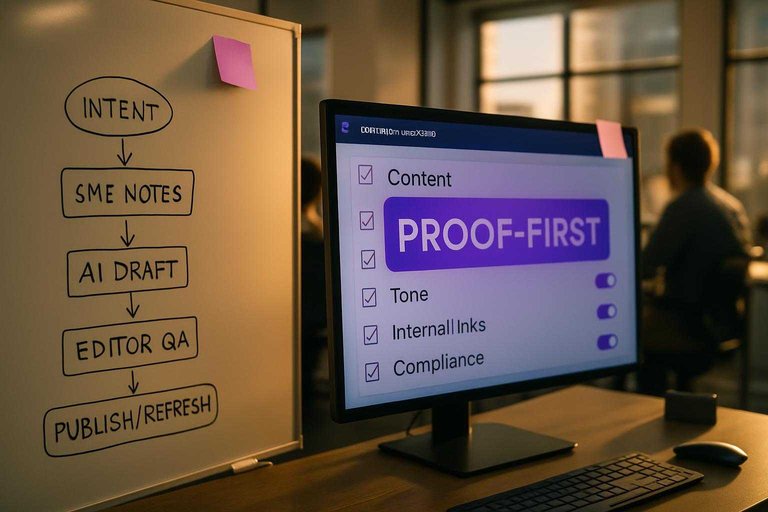
They needed a repeatable system that used AI for speed, without letting it invent facts. The agency built a pipeline that started with intent and ended with enforceable QA.
- Cluster keywords by job-to-be-done and funnel intent.
- Extract SME answers from short interviews into claim-proof notes.
- Draft with AI using the notes, voice guide, and page template.
- Run editor QA for accuracy, tone, and internal-link targets.
- Publish, then refresh on a fixed cadence using query and SERP changes.
Speed came from structure, not from asking the model to “be smart.”
What Changed
They stopped trying to win every generic top-of-funnel term. Instead, they built pages that matched how buyers evaluate tools.
More effort went into solution pages tied to specific pain points, plus comparison and “alternatives” content that addressed real switching questions. Older posts got rewritten into tighter, proof-backed assets, or folded into stronger hubs with clearer internal paths. The site began to sound less like a blog and more like a product-led handbook.
Where It Broke
AI speed can hide quiet failures until sales feels it. These were the recurring breakpoints.
- Hallucinated claims slipped past casual reviews.
- Compliance flagged pages lacking approved wording.
- Keyword-matched drafts ignored buying-stage context.
- Comparisons sounded evasive, not decisive.
- SMEs rejected tone that implied guarantees.
If sales can’t use the page in a live deal, it’s not done.
Lessons Learned
They treated SMEs as the source of truth, not last-mile reviewers. Outlines started with SME-provided claims, examples, and “what we won’t say.”
Writing became proof-first: every assertion needed a link, a product screen, or a verified internal note. Fact checks were mandatory, and “SEO wins” only counted when the page also worked as sales enablement collateral. That’s where AI helps most: accelerating a process you already trust.
Example 3: Ecommerce Brand
An ecommerce brand hired an AI SEO agency to untangle category pages and scale copy without repeating manufacturer descriptions. The goal was simple. Rank for real category intent, and keep product pages readable.
Catalog Reality
Their catalog grew fast, then got weird. Taxonomy drifted, seasonal items churned, and “one-size-fits-all” descriptions spread everywhere.
Category pages were thin, then stuffed. Product copy repeated manufacturer text with tiny edits. Filters created dozens of near-identical URLs.
That’s where SEO friction turns into UX friction, and both start compounding.
AI SEO Tactics
The agency used AI to standardize decisions, not to auto-publish everything.
- Audit faceted navigation, then set index rules per filter type.
- Build category brief templates with intent, entities, and exclusions.
- Rewrite product copy from attributes, fit notes, and differentiators.
- Add internal link modules that rotate by availability and margin.
AI helped scale the boring work, so humans could police the edge cases. Tools like Skribra can support that same approach by generating SEO-structured drafts (with keywords, meta descriptions, and formatting) at scale—while still keeping the “publish” decision behind human review and ecommerce-specific guardrails.
What Worked
Clarity beat cleverness. Categories got a single job, and the page layout matched it.
On-page elements stopped contradicting each other. Titles, H1s, and intro copy pointed at the same intent. Merchandising could swap priorities without rewriting everything.
Speed became the advantage, because iteration was finally safe—especially when publishing workflows were streamlined and consistent, rather than dependent on ad hoc manual updates.
What Didn’t
AI scaled problems, too, when guardrails were loose.
- Index bloat from uncontrolled filter URLs
- Near-duplicate copy across sibling categories
- Over-optimized templates that read robotic
If users wince, Google usually does later.
Lessons Learned
Canonicals and crawl rules are not “technical cleanup.” They’re the foundation for scaled content.
Template systems needed variation rules. Different intents required different openings, modules, and phrasing. SEO changes had to respect inventory, or pages decayed the moment stock shifted.
Align your architecture to how you actually sell, not how you wish you did—and make sure any automation (including WordPress publishing integrations) is constrained by the same taxonomy, indexation, and quality rules as the rest of the site.
What To Measure
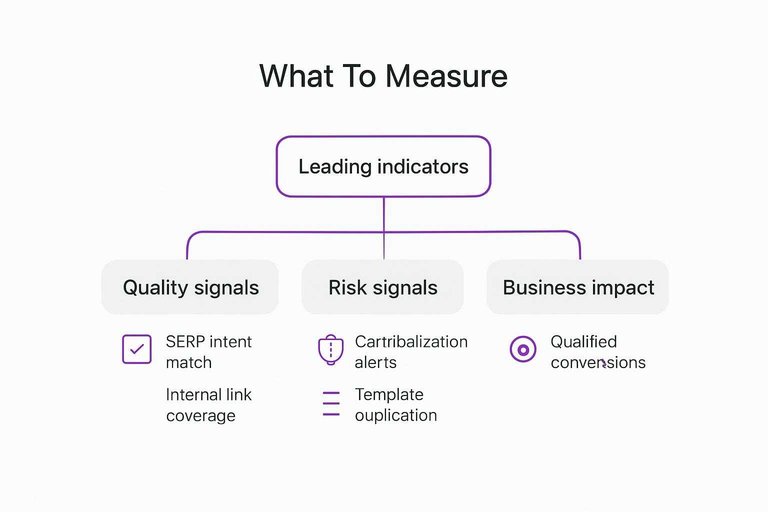
Track leading indicators while AI output is still ramping. You want three lenses: quality, risk, and business impact.
| Signal type | Leading indicator | How to check | Why it matters |
|---|---|---|---|
| Quality | SERP intent match | Manual SERP review | Avoids wrong pages |
| Quality | Internal link coverage | Crawl, link map | Speeds discovery |
| Risk | Cannibalization alerts | Query-to-URL report | Prevents self-competition |
| Risk | Template duplication | Crawl, similarity scan | Limits thin patterns |
| Business impact | Qualified conversions | Analytics events | Proves real value |
If you only track rankings, you’ll miss risk until it ships.
Agency Fit Checklist
You’re not buying “AI.” You’re buying a workflow you can trust under pressure.
- Define required inputs: access, SME time, brand rules
- Show QA gates: reviews, tests, rollback plan
- List tooling: crawl, logs, SERP, content, evals
- Prove reporting clarity: decisions, deltas, next actions
- Commit accountability: owners, SLAs, outcome ownership
If they can’t name inputs and owners, you’ll own the mess. Use this checklist for streamlining SEO content to verify their process holds up end to end.
Use These Cases to Vet Your Next AI SEO Partner
- Match the case that looks most like your situation (local, SaaS, or ecommerce) and note the shared constraints—resources, technical debt, and content velocity.
- Ask agencies to walk you through their workflow end-to-end: research → briefs → production → QA → publishing → measurement, including where humans override AI.
- Validate the measurement plan before you sign—page-level outcomes, lead/pipe or revenue proxies, and leading indicators like indexation, CTR, and internal link impact.
- Use the checklist to confirm fit on strategy, execution, governance, and failure-mode handling (cannibalization, thin content, brand risk), then start with a tightly scoped pilot tied to one outcome.
Turn Case Studies Into Output
These AI SEO agency examples show what works across local, SaaS, and ecommerce—but results still come down to publishing consistently and measuring the right signals.
Skribra produces daily SEO-optimized articles with WordPress publishing, automated images, and built-in backlink exchanges—so you can execute the playbook faster with a 3-Day Free Trial.
Written by
Skribra
This article was crafted with AI-powered content generation. Skribra creates SEO-optimized articles that rank.
Share: