March 13, 2026
·
8 min read
Indexing & Crawlability Case Study: 3 Fixes That Improved Clicks
A practical indexing and crawlability case study that shows how three targeted fixes improved search clicks—sitemap hygiene, robots/parameter trap containment, internal linking priority mapping, and a validation workflow to tie technical changes to click movement.


Your pages can be “published” and still be invisible—because Google can’t crawl them efficiently, can’t trust the signals, or keeps discovering the wrong URLs.
This case study walks you through a real-world cleanup where we narrowed the problem down, set success criteria, and shipped three fixes in sequence: sitemap hygiene, robots/parameter controls, and internal linking. You’ll see what broke, what we changed, what surprised us, and how we validated that indexing and crawl behavior—not guesswork—explained the click lift.
Case setup
The site looked “fine” at a glance, but search visibility behaved like a system under stress. Indexing and crawlability became the prime suspect because pages were being created, yet not reliably found, processed, or kept indexed.
Starting symptoms
Pages that should have ranked were missing, even when you searched for exact titles. Impressions spiked, dropped, then returned, which hinted at unstable indexing decisions.
New and updated URLs took too long to show up, even after internal links were added. Canonical signals also looked inconsistent, with similar pages competing or swapping in results.
When discovery is slow and canonicals wobble, content quality is rarely the bottleneck.
Initial diagnostics
You want sources that show both what Google saw and what your server delivered.
- Google Search Console: Indexing and Performance reports
- Server logs: Googlebot hits and status codes
- Crawl tool export: canonicals, redirects, orphan URLs
- XML sitemap status: submitted, fetched, and errors
- CMS templates: canonical, robots, pagination, internal links
If two sources disagree, trust the server and debug the gap.
Success criteria
The goal wasn’t “more pages indexed” in the abstract. It was a cleaner pipeline from submission to crawl to stable indexing, focused on URLs that can actually earn clicks.
We tracked indexed versus submitted, whether crawl activity concentrated on priority sections, and how quickly new URLs were discovered. We also watched query coverage and click quality, because more impressions can still mean worse traffic.
A win is when Google spends time on the pages you want to defend.
Constraints
Changes had to fit real-world engineering limits. The CMS was legacy, templates were shared across many sections, and releases shipped on a fixed cadence.
Anything touching URLs, canonicals, or page templates carried risk. One wrong rule can de-index a whole folder.
So the plan favored reversible fixes with tight blast radiuses.
Fix 1: Sitemap hygiene
Your sitemap is a crawl budget map, not a content dump. Clean rules reduce wasted crawling and make your indexation signals hard to misread—especially when you’re publishing frequently and need new URLs discovered predictably. Platforms like Skribra can help here by consistently generating SEO-formatted posts with clean metadata and predictable URL patterns (and publishing via WordPress integration), which makes it easier to keep sitemap rules aligned with what should be indexed.
What was wrong
The sitemap had become a catch-all export, so it kept advertising pages you didn’t want indexed. That creates noisy discovery signals and trains crawlers to distrust the file.
Stale URLs lingered long after template changes.
Mixed canonicals showed up, including URLs that canonicalized elsewhere.
Parameter URLs slipped in, especially from sorting and tracking.
3xx chains were submitted, sometimes redirecting more than once.
Non-200 pages made the list, including 404s and soft-404s.
When your sitemap contains contradictions, Google spends time verifying instead of indexing.
What changed
Sitemap cleanup works when it’s rules-first, not a one-off manual prune.
- Rebuild sitemap rules from your canonical URL logic.
- Split sitemaps by type, like products, categories, and posts.
- Add accurate lastmod based on meaningful content changes.
- Exclude non-canonicals, parameters, and any non-200 URLs.
- Validate in Google Search Console, then resubmit and monitor.
This matters even more if you’re scaling content output: when new articles go live daily (whether created manually or via an automated workflow), sitemap rules and canonical logic have to be reliable so publishing velocity doesn’t turn into indexation noise. Treat the sitemap generator like code, because it is.
For Google’s guidance on specifics like lastmod accuracy and including only indexable URLs, see sitemap best practices.
What worked
The clearest wins show up as reduced friction in Search Console, not a single dramatic spike. You’re looking for signs that Google believes your URLs again.
Watch for fewer “Submitted URL not indexed” entries on key templates.
Watch for faster discovery of new or refreshed canonical pages.
Watch for more stable coverage, with fewer random drops and reprocessing.
If you’re publishing at a steady cadence, faster discovery is often the practical payoff: clean sitemaps plus consistent on-page signals (titles, meta descriptions, formatting) help new pages enter the crawl-and-index loop without extra debugging. Once coverage stops wobbling, ranking work stops getting undone.
What didn’t
A perfect sitemap still can’t make weak pages earn a place in the index.
- Thin pages that fail quality thresholds
- Internal link gaps that hide important URLs
- Faceted navigation that creates duplicative variants
Fix discovery first, then fix value.
Fix 2: Robots and parameters
Crawl traps waste budget, inflate duplicates, and blur what should rank. The goal was containment, not a scorched-earth block that hides valuable pages.
The line that gets crossed is simple. When “more URLs” stops meaning “more content.”
Crawl traps found
The trap showed up as patterns, not single bad URLs. Each pattern generated near-infinite variations that looked unique to crawlers.
Infinite calendars produced endless next-month URLs. On-site search pages spawned combinations of queries, pagination, and sorting.
Faceted filters and sort orders multiplied category pages into thin duplicates. Tracking parameters added yet more versions of the same page.
Once you spot five versions of “the same” listing, assume there are fifty more behind it.
Containment plan
We contained traps with layered controls, so indexing stayed safe. Each lever targeted a different failure mode.
- Add robots.txt rules for pure crawl traps
- Apply noindex to low-value parameter sets
- Set canonicals to the primary version
- Constrain internal links to clean URLs
Use robots for “don’t fetch,” and canonicals for “not this version.” If you need a broader framework, see this technical SEO guide for prioritizing crawl and index controls.
Deployment sequence
We rolled changes out in a controlled order to avoid accidental blackouts.
- Stage the rules on a limited set of patterns.
- Test key URLs with URL inspection tools.
- Monitor log samples for bot behavior shifts.
- Expand rules to full parameter families.
Ship the smallest safe change first. Then widen the net.

Tradeoffs
Robots rules can over-block and cut off discovery paths. If bots cannot fetch, they also cannot see canonicals.
Noindex can still consume crawl resources, because crawling often continues. Internal linking changes can also hide legitimate long-tail pages.
Containment is a scalpel. Treat it like one.
Fix 3: Internal linking
Internal links are your crawl budget and relevance signals, in plain HTML. We adjusted architecture and templates so crawlers and users reached priority pages the same way, every time.
Priority mapping
You can’t “improve internal linking” until you decide what deserves consistent crawling. We mapped priority to pages that create value, stand out, and won’t change URLs every week.
We used three filters:
- Revenue or value pages you want discovered fast
- Unique content that can’t be replaced by a category page
- Stable URL patterns that won’t generate duplicates
Once those pages were explicit, every link decision had a clear target.
Link changes
We changed a few structural links, then enforced them in templates. Small edits. Big consistency.
- Add hub pages that link to the full priority set.
- Fix orphan pages by linking them from one relevant parent.
- Standardize breadcrumb paths so every page has one “home.”
- Ensure nav links are crawlable HTML, not JS-only handlers.
If a crawler can’t reach it in a predictable path, you’re relying on luck.
Google’s own guidance on crawlable HTML links is a useful reference when auditing nav, breadcrumbs, and template-driven links.
What surprised us
Some pages “fixed themselves” after the link graph became cleaner. Not magic. Just signals aligning.
Canonicals started matching the pages Google actually preferred. Topic clusters tightened, because hubs and breadcrumbs agreed. Weaker pages faded as internal links stopped propping them up.
When links get clearer, rankings often stop being noisy.
Common mistakes
Internal linking fails in predictable ways, usually from templates. You can spot them in a quick crawl.
- Using JavaScript-only links for core navigation
- Stuffing footers with hundreds of links
- Swapping anchors randomly across templates
- Linking to non-canonical URL variants
Fix the template, not the symptom. That’s where the scale is.
How we validated
We validated with the same checks we use to diagnose crawl bottlenems. We compared signals before and after shipping fixes, using identical scopes.
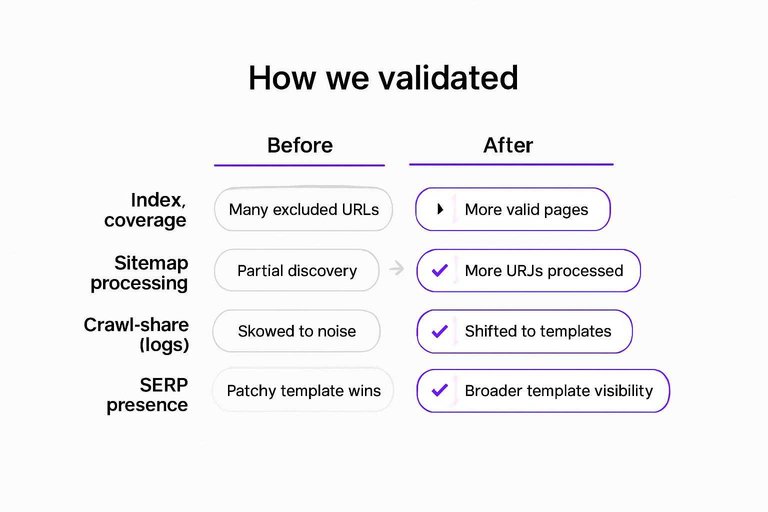
We looked at four areas: coverage, sitemap processing, log-based crawl share, and SERP presence for key templates—aligned with our checklist for streamlining SEO content.
| Check | Before | After | Where we checked |
|---|---|---|---|
| Index coverage | Many excluded URLs | More valid pages | Search Console |
| Sitemap processing | Partial discovery | More URLs processed | Search Console |
| Crawl share (logs) | Skewed to noise | Shifted to templates | Server logs |
| SERP presence | Patchy template wins | Broader template visibility | Manual SERPs |
If the logs and SERPs move together, you fixed the right thing.
Clicks: why they moved
Clicks moved because more of your pages became eligible to show, then matched the right queries more often. Indexing isn’t traffic, but it’s the gate you have to pass.
First mechanism: better indexation expanded the pool of pages search could actually rank. Imagine a category page that was crawlable but not indexed; once it’s indexed, it can finally compete.
Second mechanism: relevance matching improved because search could see the intended version. Canonicals, internal links, and cleaner templates reduce ambiguity.
Third mechanism: fewer duplicates stopped splitting signals and impressions. When three near-identical URLs compete, none of them wins cleanly.
Apply the Same 3-Fix Playbook on Your Site
- Stabilize discovery: Audit sitemaps for only indexable, canonical URLs; remove dead/redirecting/parameterized entries and resubmit.
- Stop crawl waste: Identify parameter-driven crawl traps, then implement a containment plan (robots rules, parameter handling, and consistent canonicals) in a controlled deployment sequence.
- Reassign importance: Map business-priority pages to internal link hubs, add contextual links from high-traffic/high-authority pages, and fix orphaned or competing URLs.
- Prove cause and effect: Validate with crawling tests, index coverage checks, log patterns, and page-level click trends—then iterate on the next biggest constraint.
Turn Fixes Into Growth
Sitemap cleanup, robots rules, and smarter internal links boost Google searchability—but keeping those gains requires consistent, optimized publishing and clean site integration.
Skribra generates SEO-optimized articles with meta, formatting, and WordPress publishing built in, so your content stays crawlable and compounding—start with the 3-Day Free Trial.
Written by
Skribra
This article was crafted with AI-powered content generation. Skribra creates SEO-optimized articles that rank.
Share: