May 5, 2026
·
10 min read
Topical Authority SEO: 3 Case Study Examples
Three topical authority SEO case studies that show what actually changes when you shift from scattered keywords to structured coverage—a case-study walkthrough covering viability checks, case study setup and measurement, topic maps and clusters, internal linking models, and a step-by-step implementation playbook.

If you’ve published “all the right keywords” but the site still can’t break through, the problem often isn’t effort—it’s coverage. Search engines reward pages that sit inside a credible network of related answers, not isolated posts that happen to target a phrase.
In this case study, you’ll see three real-world-style examples (SaaS, local service, and e-commerce) and how each built topical authority through topic maps, cluster planning, and internal linking. You’ll also get a practical playbook for deciding when it’s worth doing—and how to execute without overbuilding.
Why topical authority
Topical authority is a business bet: build a category you can win, not a page you can spike. It beats page-by-page SEO when rankings depend on trust signals across many related queries, not one perfect URL. Viability looks like repeatable coverage, tight internal linking, and patience for compounding returns.
Decision context
Topical authority is your site behaving like a reliable specialist, not a one-off answer. You earn it by covering a topic with complete subtopics, linking them in a logical path, and consistently satisfying search intent across the cluster. Imagine a “home solar” site where guides, calculators, and FAQs reinforce each other instead of living as isolated posts.
When it matters
It becomes decisive when Google needs stronger signals than on-page polish. These are the common triggers.
- YMYL topics where trust is evaluated across the site
- Crowded SERPs where “good” pages still lose
- Weak brands without built-in credibility
- Long consideration journeys with many follow-up queries
If you see multi-step journeys, you’re optimizing a system, not a page.
Viability checklist
You can judge fit fast with a few hard questions. Move in order, and stop when you hit a “no.”
- Map the topic to subtopics you can cover better than competitors.
- Confirm resources for ongoing updates, not just initial publishing.
- Set an editorial cadence you can sustain for months.
- Secure SME access for review, accuracy, and real-world nuance.
- Align stakeholders on delayed payback and compounding gains.
If you can’t sustain the cadence, pick fewer clusters and go deeper.
Common misconceptions
Topical authority isn’t a word-count contest or a publishing treadmill. It’s also not “build a hub like the top result” and hope Google confuses you for them. Authority comes from coverage that resolves intent end-to-end, with internal links that make the cluster navigable and coherent.
Case study setup
All three examples use the same before/after snapshot: a site with real constraints, uneven content, and no clear topical structure. The “after” is not more content at any cost, but a different architecture and publishing logic. The change is moving from chasing isolated keywords to building a navigable topic system Google can understand and users can finish. In practice, teams usually need both the map and a way to publish consistently against it—platforms like Skribra can help maintain the cadence and formatting discipline once the architecture is defined (see the Skribra SEO guide).
Starting conditions
These setups are common because content usually grows by request, not by map.
- Scattered blog posts with overlapping angles
- Thin category pages with vague purpose
- Inconsistent intent across similar queries
- Weak internal links between related pages
- Orphan pages with no pathway
If you see three or more, you’re looking at a topical authority problem—and often a production workflow problem too, where publishing is too ad hoc to ever fill coverage gaps systematically.
Strategy shift
The shift starts when you stop treating keywords as targets and start treating them as evidence. You build a topic map, assign roles like pillar and support, then segment queries by intent so each page has one job. That’s when your site stops being a pile of posts and becomes a system. Once that system is clear, using a tool that reliably generates SEO-structured drafts (keywords, meta descriptions, consistent formatting) can make it easier to execute without drifting back into one-off posts.
Execution cadence
Rollouts fail when they’re “publish and pray,” so you need a repeatable loop.
- Audit existing URLs, intent, and duplication.
- Map topics into clusters with a clear pillar page.
- Prioritize clusters by business value and ranking proximity.
- Publish or refresh pages, then add deliberate internal links.
- Iterate using SERP shifts, cannibalization, and coverage feedback.
Treat the SERP like a spec, not a scoreboard. And treat publishing like an operations problem: if you can push SEO-ready content directly into WordPress on a schedule (and keep internal linking intentional), you’re far more likely to complete clusters instead of stalling halfway through.
What to measure
You need signals that reflect topical coverage and page relationships, not just a single “money keyword.”
- Coverage gaps closed across subtopics
- Rankings distribution across the cluster
- Internal link flow into pillars
- Conversions by topic cluster
- Crawl and index behavior changes
Measure the cluster, not the hero page, or you’ll optimize the wrong thing. This also helps you judge whether your publishing engine is actually improving coverage and indexation—not just adding more URLs. You can validate internal link flow using the Links report in Search Console.
Example 1: SaaS niche
A B2B SaaS site picked one problem space and built a real topic cluster around it. Then they cleaned up the mess they had already published.
Initial pain
They had tons of BOFU pages and almost no TOFU education. Several pages chased the same query, and none won consistently.
Sales kept answering the same “how does this work?” questions on calls. The site wasn’t doing its share of the job.
Topic map built
They mapped one cluster that could educate, qualify, and convert. Every piece had a job.
- Pillar guide for the core problem
- Integration explainers for key tools
- Comparison pages for alternatives
- Troubleshooting posts for common errors
- Templates and glossary entries for quick wins
When your cluster answers pre-sales questions, your demos get shorter.
What changed
They fixed the content system first, not the word count.
- Merge overlapping pages into one canonical URL.
- Standardize intent per page: educate, evaluate, or convert.
- Add SME review for claims, steps, and edge cases.
- Create internal links that match real user journeys.
If links follow decisions, not “related posts,” conversions feel inevitable.
What worked
Intent got tighter, so Google stopped guessing which URL to rank. With fewer competing pages, the site built one strong answer instead of five weak ones.
Coverage improved because each page targeted a distinct sub-question. Users also reached product pages through natural next steps, not random CTAs.

What didn’t
They made a few mistakes that slowed momentum. All of them were avoidable.
- Overproducing posts with near-identical angles
- Ignoring existing high-intent pages during planning
- Delaying technical fixes that blocked crawling
Topical authority fails quietly when search engines cannot reach your best work.
Lessons learned
Set hard boundaries for the cluster, then defend them. If a new idea cannot connect to the pillar and a journey, it’s probably a distraction.
Write consolidation rules before you publish more. Decide when to merge, when to redirect, and when to delete.
Stop expanding when new pages repeat intent or reuse the same evidence. Depth beats sprawl.
Example 2: Local service
A multi-location service business wanted more calls from search, not more pageviews. The fix was topical authority built around local intent, without doorway-page spam.
Initial pain
They had dozens of near-duplicate city pages with swapped place names and little else. E-E-A-T signals were thin, so visitors bounced and the blog rarely produced calls or bookings.
Cluster approach
They needed content that answered local questions at each step of the buying path.
- City pages that prove coverage and response areas
- Service pages that define scope and exclusions
- Permitting and price explainers for local constraints
- FAQs pulled from real customer conversations
- Project checklists and “what to expect” guides
Each piece earned its slot, or it didn’t get published.
On-page adjustments
One clean template beats a hundred messy variations.
- Rebuild templates around one intent per page.
- Add proof elements: photos, licenses, reviews, policies.
- Tighten headings to match local questions and tasks.
- Connect pages with contextual links, not footer spam.
Internal links became the map, and Google followed it.
What worked
Local relevance improved because pages stopped pretending every city was identical. Service coverage became clearer, and proof elements made the decision feel lower risk.
Pogo-sticking dropped, and leads got more qualified.
What didn’t
Scale makes problems louder when the system is weak.
- Scaling new cities before finishing one full cluster
- Ignoring GBP and NAP consistency across citations
- Publishing FAQs that never come up on calls
If ops can’t support it, content can’t save it.
Lessons learned
Depth per city beats breadth across cities, especially for services with real-world constraints. Reuse content like a template, not a copy-paste, and keep the “local” parts genuinely local.
When the phones are missed or schedules slip, fix operations first and publish second.
Example 3: E-commerce
An e-commerce brand wanted topical clusters to lift category pages and lean less on ads. The goal was simple. Turn informational demand into revenue-page sessions.
Initial pain
Category pages stalled because they had little unique context beyond filters. PDP copy stayed thin, so long-tail questions bounced back to search.
Content lived in a blog silo, rarely linking into categories or PDPs. Seasonal spikes made the gap worse, because paid filled demand while organic lagged.
Buying-intent map
You need clusters that match how shoppers decide. Each type should answer a distinct pre-purchase question.
- “Best for” roundups by use case
- Buyer’s guides by feature tradeoffs
- Sizing and care guides by product type
- Alternatives and comparisons by constraint
- Problem-solution posts by pain point
When each cluster has a job, your category pages stop being the only entry point.
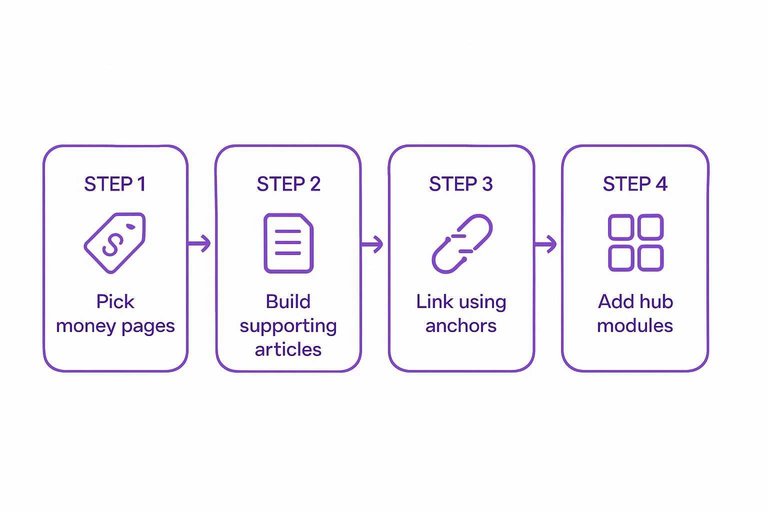
Internal linking model
A cluster only works when links move intent forward.
- Pick the money pages per category and margin.
- Build supporting articles per intent and seasonality.
- Link using anchors that match intent, not keywords.
- Add breadcrumbs and hub modules on categories.
If links don’t route shoppers, you’re publishing for traffic, not sales.
What worked
Pre-purchase education got stronger, so shoppers arrived warmer and more specific. Category pages became more relevant because clusters reinforced the same set of attributes and use cases.
Non-brand discovery improved because the site had credible answers before the click to a PDP. That made the path from question to product feel natural.
What didn’t
Commerce content breaks when it ignores how the store actually sells.
- Publishing without merchandising alignment
- Referencing inventory that later disappears
- Ignoring faceted navigation controls
If your filters create crawl chaos, your new content won’t save you.
Lessons learned
Content had to match inventory realities, or it created dead ends. Guides stayed evergreen by avoiding brittle SKU references and focusing on durable criteria.
Category pages acted as the cluster’s center of gravity, not the blog. Build the cluster to push authority into those pages.
Implementation playbook
Pick a scope you can actually finish, then earn depth before you chase breadth.
- Choose one tight topic boundary and list the 20–50 questions you can answer best.
- Build one hub page and 6–12 supporting pages that link in a clean, obvious pattern.
- Ship “good enough” drafts, then upgrade the top pages with clearer intent matching and examples—use an ultimate checklist for streamlining SEO content to keep production consistent.
- Watch signals like impressions, queries, internal-click paths, and which pages cannibalize each other.
- Expand only where you see pull, then prune or merge pages that stay redundant.
Treat this like product iteration, not publishing—your next batch should be decided by demand, not hope.
Build Your Topic Engine and Keep It Honest
- Pick one revenue-critical topic and run the viability checklist (demand, competition, internal resources, and a realistic time horizon).
- Build a topic map: define the pillar, the supporting subtopics, and the intent stages (learn → compare → buy → use).
- Publish in a cadence you can sustain, then wire it together with deliberate internal links (hub-to-spoke, spoke-to-hub, and adjacent spokes).
- Measure what matters: coverage gaps closed, impressions and query breadth, rankings at the page level, internal link flow, and conversions tied to the cluster—then prune, merge, or expand based on what the data proves.
Build Topical Authority Faster
These case studies show the playbook works, but executing it across dozens of supporting articles takes consistent bandwidth and a reliable publishing cadence.
Skribra generates and publishes SEO-optimized content clusters daily, complete with keywords, metadata, images, and WordPress integration—plus a backlink exchange network to compound authority; start with the 3-Day Free Trial.
Written by
Skribra
This article was crafted with AI-powered content generation. Skribra creates SEO-optimized articles that rank.
Share: