March 9, 2026
·
11 min read
6 Content SEO Strategy Trade-offs When Scaling Output
A practical collection of six content-SEO scaling trade-offs—set realistic scale goals, balance quality/speed/depth, use templates and automation without losing trust, and align SEO with brand using a simple decision matrix.

If you’re trying to publish more content, you’ve probably felt the squeeze: quality slips, facts get messy, and the “SEO wins” start sounding less like your brand. Scaling output isn’t just a hiring or AI problem—it’s a series of trade-offs that compound fast.
This collection walks you through six common scaling tensions and the guardrails that keep them from turning into traffic, trust, and conversion losses. You’ll get decision rules for when to prioritize speed, depth, originality, automation, or brand—and a matrix to make those calls consistently.
Scaling Reality Check
Scaling content forces trade-offs because your bottleneck moves faster than your plan. “Output” is volume, velocity, and formats, and each one stresses a different part of your system. Usually, the first thing to break is review quality, then internal alignment, then trust in the metrics.
Scale goals defined
Volume is how many pieces you publish, velocity is how fast they ship, and coverage is how many intents you satisfy. Each maps to a different SEO win, and a different failure mode.
Volume tends to buy you more long-tail surface area, until thin pages trigger “why does this exist?” reactions. Velocity tends to buy you freshness and iteration speed, until your QA slips and rankings churn. Coverage tends to buy you topical authority, until you sprawl into off-brand queries you can’t credibly answer.
Pick one primary scale goal per quarter, or you’ll fund three risks at once.
Hidden constraints
Scaling looks like a writing problem, but it’s usually a systems problem. These constraints show up late, then hurt all at once.
- Limited SME time for reviews
- Editing throughput and standards drift
- Dev bandwidth for templates and fixes
- Brand risk from wrong claims
- Link acquisition capacity and relationships
- Data access for proof and examples
If one constraint is hard-capped, your “scale plan” is just backlog inflation.
Viability test
Run these quick tests before you promise a publishing cadence. They’ll tell you if your scale is real, or fragile.
- Publish one week at target pace, with full reviews and fixes.
- Random-audit five drafts for citations, claims, and originality.
- Check Search Console for cannibalization on similar intents.
- Track time-to-update for one post after new info appears.
- Ask, “Who signs their name on this?” for every template.
If any step fails, slow down and fix the constraint before you add more output.
Trade-off 1: Quality vs Quantity
Publishing more pages usually lowers your average usefulness. You start shipping “good enough” drafts that read like everyone else.
Google can forgive a few thin posts, but patterns show. Once many URLs look interchangeable, your E-E-A-T signals blur—especially when you ignore the key differences between AI and humans in how content earns trust and originality.
Where it breaks
Scale breaks when your process rewards throughput over thinking. You’ll see the same misses repeat across dozens of URLs.
- Publish thin pages with padded sections
- Rewrite top results with swapped phrasing
- Avoid a strong point of view
- Target duplicated intent across multiple URLs
- Use vague examples without numbers
If three bullets describe most new pages, you’ve crossed the tipping point.
Guardrails that work
You need hard standards that block mediocre drafts from shipping. Make them measurable, or they won’t survive deadlines.
- Require one unique insight per page, stated in one sentence.
- Add one primary source, like data, logs, or a real interview.
- Include one real screenshot, chart, or annotated example.
- Run SME review for any claim that changes a decision.
- Fail the draft if it can’t cite a lived experience.
Guardrails feel slow until you compare them to cleaning up a polluted index.
Acceptable compromises
Lighter content is fine when the user just needs a quick definition, a checklist, or a fresh date. A glossary page, a minor feature update, or “what does X mean” can be short.
It’s fatal when stakes are high. YMYL topics, pricing guidance, medical claims, or “which tool should I buy” need depth, proof, and a real perspective.
Trade-off 2: Speed vs Accuracy
Faster publishing cycles feel like a win until the errors compound. One wrong claim can turn “quick to ship” into “slow to clean up.”
Speed increases factual drift, outdated advice, and mismatched intent because you skip verification steps. Then you pay twice: once to publish, again to correct.
Error multipliers
Rushed drafts fail in the same predictable places, because shortcuts cluster. You’re not making one mistake. You’re creating a chain.
- Assume last quarter’s SERP still holds
- Define terms from memory, not sources
- Copy tool steps that no longer match UI
- Invent stats when numbers are missing
- Cite sources secondhand, not primary
If you see three or more, you’re looking at a correction backlog.
Fast-but-safe workflow
You can move fast without guessing, if you standardize the checks. Make accuracy a pipeline step, not a heroic effort.
- Capture a SERP snapshot and note dominant intent patterns.
- Run a source checklist for every definition, stat, and claim.
- Do a five-minute SME spot-check on the highest-risk sections.
- Add a changelog entry with date, SERP notes, and sources.
- Automate link checks and claim validation where possible.
Speed comes from repeatable guardrails, not from skipping reality.

When speed wins
Timeliness beats perfection when the user’s goal is “what changed today?” Think newsy updates, feature launches, and reactive comparisons like “X vs Y after the update.”
Ship fast, but label uncertainty and schedule a revision window, or you’ll leak trust when the dust settles. For more on how rankings can skew toward recently updated pages, see this data-driven look at content refresh cadence.
Trade-off 3: Topical Depth vs Breadth
Scaling content forces a choice: own one cluster, or touch many categories. Depth compounds authority through internal links and shared entities, while breadth spreads signals thin.
If your site feels like a “department store” instead of a “specialty shop,” rankings usually follow that drift.
Depth indicators
Depth is visible in the page set, not a single article. You feel it when every new post makes older posts rank better.
Real depth signals include:
- Entity coverage that stays consistent across pages
- Sub-intents handled separately, then linked back
- Unique examples you can only write from experience
- Internal links that repeat, not random one-offs
- Returning users who navigate the cluster
When users and crawlers keep moving inside the same cluster, you’re building a moat.
Breadth failure modes
Breadth breaks down in predictable ways once you ship fast. You can spot it in Search Console before traffic drops.
- Publish orphan pages with no internal links
- Trigger cannibalization on near-identical queries
- Switch terminology across categories and authors
- Build thin hubs with weak parent pages
- Earn scattered backlinks that don’t reinforce one topic
If links and anchors don’t converge, authority never stacks.
Decision rule
You need a repeatable rule, not a debate in Slack. Use market size and ranking difficulty, then sanity-check revenue distance.
- Estimate TAM for the cluster and your realistic share.
- Score competition by SERP strength and content saturation.
- Check linkability: can you earn links without begging.
- Measure conversion proximity: how close to revenue is the intent.
- Choose depth when 3 and 4 are strong; choose breadth when 1 is huge.
Pick the path where one win makes the next win cheaper.
Trade-off 4: Templates vs Originality
Templates make briefs faster and production predictable. They also push you toward “same page, different keyword,” which erases differentiation.
A good template is scaffolding, not the finished building. Treat it like a checklist that forces uniqueness, not a mold that copies itself.
Template sweet spots
Templates shine when users expect a consistent format and you need coverage at scale. You still need fields that force a fresh angle every time.
- Product pages: unique value proof, use case, comparison target
- Location pages: local proof, service constraints, regulatory notes
- Glossary pages: original examples, edge cases, “wrong usage” section
- Checklists: role context, tool stack, time estimate, failure modes
If your template doesn’t require uniqueness fields, it’s a duplication machine.
Originality injectors
You can keep the template and still ship new information. Add novelty on purpose, not by hoping the writer “gets creative.”
- Add proprietary data, even one chart or benchmark.
- Interview one operator, then quote the messy specifics.
- Include a workflow with decisions, not just tips.
- Take a contrarian stance and defend it with evidence.
- Compare tools using the same task and real results.
Novelty is an asset you can schedule, not a vibe you wait for.
Duplicate-risk warning
“Same outline, new keyword” fails because the underlying intent often overlaps. When two pages answer the same job-to-be-done, Google picks one and ignores the rest.
That creates index bloat, splits links, and leaves you with a pile of near-duplicates that never rank. Fix it by consolidating into one strong page, then differentiate with real intent shifts—aligned with Google’s guidance on helpful, reliable, people-first content.
Trade-off 5: Automation vs Trust
Automation helps you scale without hiring a small army. But trust is the asset you’re actually compounding, and AI can burn it fast.
Use AI for speed and coverage, then earn trust with disclosure, compliance checks, and real editorial depth. That’s the line that gets crossed—especially when you’re fixing content bottlenecks with smart AI.
Automation best uses
Automation works best when it suggests, formats, or organizes. Use it where errors are cheap and reversible.
- Generate outlines and section briefs
- Draft FAQs from query patterns
- Suggest titles, metas, and slugs
- Produce schema and internal clusters
- Flag refresh opportunities and translation drafts
Automate structure. Keep judgment human.
Trust breakers
Trust breaks when your content feels like it was written by “nobody” for “everyone.” One bad page can poison the rest.
Unverifiable claims, fake authorship, generic advice, thin experience signals, and a wobbling voice trigger that reaction fast. If you can’t back it up, readers assume you’re making it up.
Human-in-loop design
You need a system that scales review, not hero editors who catch everything. Design the loop like you’re building a QA pipeline.
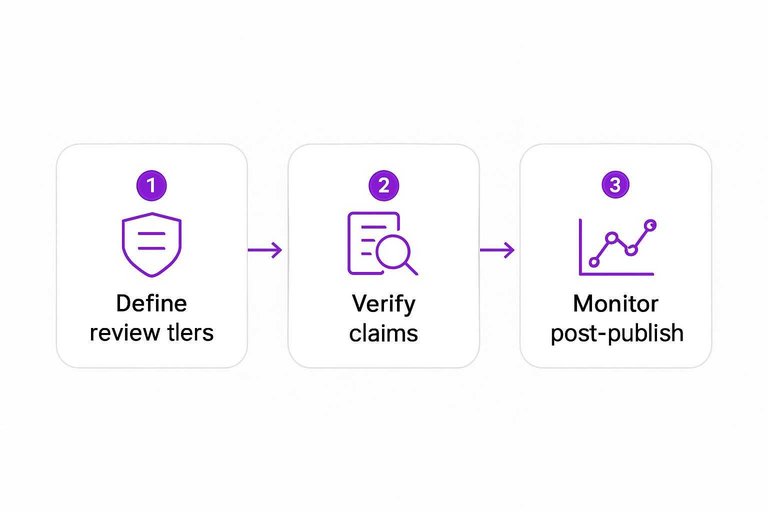
- Define review tiers by risk, like YMYL, legal, or brand claims.
- Verify claims with sources, screenshots, logs, or first-hand notes.
- Set sampling rates for low-risk pages, and increase on drift.
- Create escalation rules for sensitive topics and inconsistent outputs.
- Monitor post-publish signals, like corrections, complaints, and rank volatility.
Make review predictable. That’s how you scale without gambling your brand.
Trade-off 6: SEO vs Brand
Rankings reward pattern-matching, but your brand wins with distinct choices. Push too hard on “SEO best practices,” and your writing starts to sound like everyone else’s. You’ll see it in lines like “ultimate guide” everywhere, while conversions quietly soften over time.
SEO-first pitfalls
SEO-first scaling feels safe because it produces predictable pages. It also creates predictable copy, and your audience notices.
- Stuff keywords until sentences crack
- Match competitor outlines, lose distinctiveness
- Write clickbait titles, earn low-intent clicks
- Force internal links, break reading flow
- Dilute your POV, avoid friction
If you can swap logos and nothing changes, you’re not building a brand asset.
Brand-forward SEO
You can keep SEO discipline without giving up voice. Treat brand constraints like guardrails, not decoration.
- Define 3–5 message pillars, then map keywords to them.
- Write a tone guide with “say this, not that” examples.
- Add POV blocks that state a stance, then defend it.
- Use narrative examples that only your team can tell.
- Set one CTA strategy per intent stage, then repeat it.
Do this, and SEO becomes a distribution channel for positioning, not a replacement for it.
When to choose brand
Choose brand over SEO when you sell premium pricing, because trust beats traffic. Choose brand when the category is trust-sensitive, like finance, health, or security, where one vague sentence can kill conversions. Also choose brand in saturated SERPs, where “better” content loses to “different” content, and when you already capture demand with a known name.
In those cases, the compounding effect is real: every on-brand page makes the next page convert faster.
Practical Trade-off Matrix
Scaling content forces trade-offs, and you need a visible “stop line” for each one.
Use this matrix to spot symptoms early, choose a mitigation, and decide what loss is acceptable.
| Trade-off | Symptoms (lagging) | Leading indicators (early) | Mitigation + acceptable loss |
|---|---|---|---|
| Speed vs depth | Thin pages, low conversions | Briefs skipped, SME time drops | Templates + SME office hours; accept 10–15% fewer posts |
| Coverage vs focus | Cannibalization, rankings stall | Similar keywords, overlapping outlines | Topic map + pruning; accept 5–10% overlap |
| Consistency vs novelty | Flat CTR, fewer shares | Same angles, repeated intros | Angle library + experiments; accept 1 in 5 “weird” |
| Automation vs accuracy | Corrections, trust loss | Fewer citations, no fact checks | Source requirements + QA; accept 0 critical errors |
| Topical authority vs diversification | No cluster lift | Orphan pages, weak internal links | Pillar-first cadence; accept 1 off-topic per 10 |
Make Your Next 30 Pieces a Controlled Experiment
- Pick one primary constraint for the next sprint (time, expertise, budget, approvals) and set a realistic output target around it.
- For each planned piece, choose the “winning side” of each trade-off up front (quality, accuracy, depth, originality, trust, brand) and write the guardrail that prevents the losing side from breaking.
- Run the Practical Trade-off Matrix in one review pass before drafting and one pass before publishing to catch duplication, thin coverage, and trust breakers.
- After publishing, score outcomes page-by-page (rank movement, engagement, conversions, corrections needed) and adjust the next sprint’s defaults—not your expectations.
Scale SEO Content Confidently
Balancing quality, speed, and brand while increasing output is where most content SEO strategies break down without the right systems.
Skribra helps you scale daily, SEO-optimized articles with built-in formatting, WordPress publishing, and automation you can trust—start with the 3-Day Free Trial.
Written by
Skribra
This article was crafted with AI-powered content generation. Skribra creates SEO-optimized articles that rank.
Share: