February 26, 2026
·
Updated September 5, 2026
·
13 min read
7 Content SEO Strategy Models: When to Use Each
A practical collection of seven content SEO strategy models—and when to use each—covering goal-and-stage selection, resourcing and risk runway, execution best practices, and pitfalls to avoid so you can pick a model that actually fits your team and targets.


If your content calendar is full but results are thin, you probably don’t have a content problem—you have a strategy-model mismatch. The same “publish more” plan can be perfect for one site and a waste of quarters for another.
This collection breaks down seven proven Content SEO strategy models and shows you when each one wins. You’ll learn how to choose based on funnel stage, resources, and time-to-impact, plus what to watch out for so the model you pick doesn’t create technical debt, thin pages, or missed conversions.
How to Choose
Pick a model based on what you need first: pipeline, proof, or compounding traffic. “We need leads this quarter” forces different choices than “we need a moat.”
Use four filters: goal by funnel stage, time-to-impact, resources, and risk tolerance. Then match your scenario to one of seven models: Programmatic Pages, Topic Clusters, Product-Led SEO, Refresh & Consolidate, Linkable Assets, Bottom-of-Funnel Pages, or Community-Led SEO.
Goals by stage
Different stages reward different content shapes and different KPIs. If you can’t name the KPI, you’re picking by vibes.
| Funnel stage | Best-fit models | Typical KPIs |
|---|---|---|
| Awareness | Topic Clusters, Linkable Assets | impressions, new users |
| Consideration | Refresh & Consolidate, Topic Clusters | rankings, engaged sessions |
| Conversion | Bottom-of-Funnel, Product-Led SEO | signups, SQLs |
| Retention | Product-Led SEO, Community-Led SEO | activation, expansions |
Choose the stage you’re actually judged on, not the one you wish you owned.
Resource reality check
Your constraints pick the model for you. A two-person team with no dev time can’t run like a marketplace with templates.
If SMEs are scarce, lean on Refresh & Consolidate and Bottom-of-Funnel pages with tight scopes. If dev bandwidth is real, Programmatic Pages and Product-Led SEO become options. If budget buys design and outreach, Linkable Assets can work fast. If you publish weekly without fail, Topic Clusters compound.
Don’t pick the “best” model. Pick the one you can actually execute for 90 days.
Risk and runway
Risk is mostly about dependency. Dependency on links, dev work, or a new information architecture changes your runway.
- Low risk: Refresh & Consolidate, Bottom-of-Funnel pages
- Medium risk: Topic Clusters, Product-Led SEO
- High risk: Programmatic Pages, Linkable Assets, Community-Led SEO
Expect 30 days for low-risk wins, 90 for most compounding models, and 180+ for high-dependency bets. The faster you need proof, the less you should rely on “eventual” signals like links or community momentum.
Topic Cluster Model
Use the Topic Cluster Model when you need topical authority fast, not scattered wins. You build one pillar page that owns the theme, then cluster pages that answer specific intents like “pricing,” “templates,” or “examples.” The goal is simple: internal links that look intentional, plus a cadence that keeps the cluster fresh.
Use when
You use this model when your content feels like a junk drawer and rankings stall. It works because search engines reward coverage, not random posts.
- Entering a new category fast
- Consolidating fragmented legacy content
- Competing on broad, high-volume themes
- Scaling internal links without chaos
- Reducing topic overlap across teams
If you can’t explain your site map in one breath, you need a cluster.
Best practices
Do this when you want clusters that rank and stay maintainable.
- Write a pillar outline with one primary intent and 6–12 sub-intents.
- Map clusters to one query each, plus a clear “job to be done.”
- Set linking rules: clusters link up; pillar links down; peers link only when useful.
- Run cannibalization checks before publishing, then after 2–4 weeks.
- Refresh quarterly: update stats, add missing subtopics, prune weak pages.
Treat internal links like product navigation, not decoration. You can also validate internal links to ensure your pillar/cluster connections are implemented correctly.
Watch outs
This model breaks when intents overlap, so two pages fight for the same query. You also lose momentum with thin clusters, orphan pages, or “everyone links to everything” dilution.
Guardrails: write an intent sentence per URL, require a minimum depth bar, and block publication without at least one in-link and one out-link. If a cluster can’t justify its own SERP intent, fold it into the pillar instead.
Programmatic SEO
Programmatic SEO works when your content is a repeatable pattern, not a one-off essay. You bring structured data, generate many pages, then earn traffic by matching long-tail queries like “plumber in Mesa” or “Slack + HubSpot integration.” If you want inspiration for what this looks like in practice, review these real-world automated SEO examples. Done right, templates scale relevance; done wrong, they scale thin pages and index bloat.
Use when
You use programmatic SEO when the query space is a matrix you can enumerate. The goal is coverage without writing 10,000 bespoke pages.
- Expand a large product or SKU catalog
- Build location × service landing pages
- Publish comparison and alternative pages
- Create directories of providers or listings
- Generate integration and connector pages
If you can’t describe the page set as a spreadsheet, you don’t have pSEO yet.
Minimum viable quality
Set quality gates before you ship templates, or you’ll mass-produce “almost helpful” pages. Your baseline should define what makes one page worth indexing.
| Quality block | What it adds | How to measure | Red flag |
|---|---|---|---|
| Unique value block | Specific local facts | 150+ unique words | Same across pages |
| Entity enrichment | Attributes, specs, hours | 5+ filled fields | Mostly nulls |
| FAQs | Objection handling | 3 Q&As | Generic questions |
| Schema | Rich results eligibility | Valid JSON-LD | Errors in GSC |
| Internal links | Crawl + discovery | 5 contextual links | Orphaned pages |
Your template is the product, so treat every missing field like a broken feature.
Execution workflow
Programmatic SEO wins on process, not inspiration. You need a pipeline that catches thin content before Google does.
- Define the data model with required and optional fields.
- Build a template that renders value, not just placeholders.
- Create a QA rubric and fail pages below thresholds.
- Launch in stages with controlled indexation and sitemaps.
- Monitor logs and GSC, then enrich pages that get impressions.
Indexation is earned, not assumed, so ship in batches you can defend.
When it’s a bad fit (and the guardrails you need)
Programmatic SEO is a bad fit when you’re using templates to compensate for missing differentiation. If the “data” is basically the same across rows (or you can’t fill key fields reliably), pSEO will scale sameness—and you’ll end up with duplicate intent, thin pages, and a crawl/index mess.
Avoid programmatic SEO (or pause the rollout) when:
- Your page set collapses into a handful of intents (e.g., every page answers the same question with swapped nouns).
- You can’t guarantee a meaningful unique value block per page (not just “About {city}”).
- Most entity fields are empty or inconsistent across the dataset (nulls, outdated attributes, mismatched naming).
- You can’t create distinct internal link paths and navigation that help users move laterally (not just “related pages”).
- You don’t have a plan to control indexation (shipping 1,000 pages at once and hoping Google sorts it out).
Minimum data + quality controls before you scale beyond a pilot:
- Required fields: define a “must-have” set (and fail pages that don’t meet it) so templates never render placeholder content.
- Duplicate detection: block pages that are materially identical after token swaps (near-duplicate titles, intros, FAQs).
- Intent clustering: group keywords first; only generate a page when the intent is truly distinct.
- Indexation controls: start noindex (or limited sitemaps) until pages prove they earn impressions and engagement.
- Ongoing enrichment: treat content gaps as data bugs—fix the source and re-render, rather than manually patching one-off pages.
If you can’t enforce these controls, you don’t have programmatic SEO—you have automated publishing, and the risks compound with every new page.
Product-Led SEO
Product-led SEO works when your product creates pages people search for. Think “public project page,” “template gallery,” or “user profile” that solves a real query.
The win is compounding: usage creates inventory, inventory creates rankings, rankings bring new users. Done wrong, you ship an indexable spam farm.
Use when
Use product-led SEO when your product can publish useful, stable pages by default. You’re not writing articles. You’re shipping pages that happen to rank.
- Publish templates, calculators, or tools
- Expose user profiles and portfolios
- Index community Q&A or discussions
- Create share links for public pages
- Generate pages from API outputs
If users can create it and Google can understand it, you have a channel.
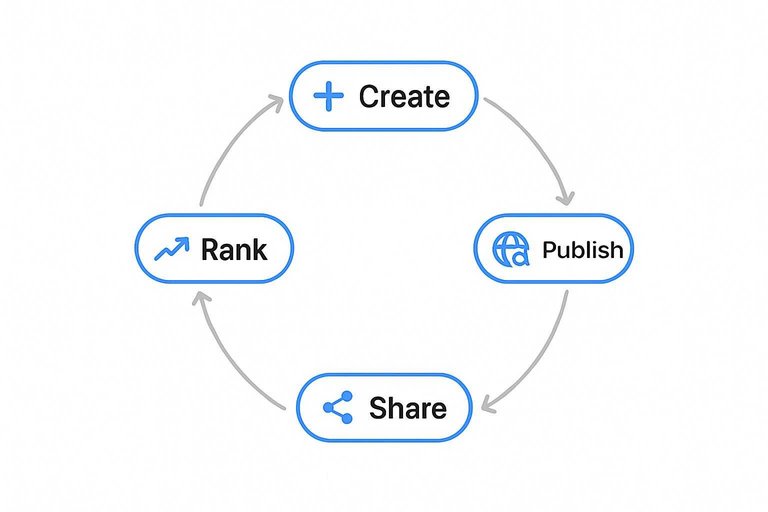
Growth loop design
Design the loop so value appears before SEO, not after. Your loop should feel like “I made something,” not “I filled a form.”
Create → publish → rank → share → acquire.
Permissioning matters. Default private, with a clear “Make public” switch, avoids accidental indexing.
Moderation keeps quality high. Rate limits, trust levels, and report flows beat manual reviews.
Canonicals keep signals clean. Pick one URL per artifact, then redirect or canonicalize the rest.
Make the loop SEO-safe, and it turns usage into distribution.
Safety checklist
You need guardrails before you scale indexed pages. Fix the system first.
- Set index rules per page type using meta robots and robots.txt.
- Block spam with throttles, CAPTCHA, and reputation-based publishing.
- Handle duplicates with canonicals, redirects, and parameter controls.
- Implement pagination correctly with crawlable category pages and sane limits.
- Protect performance with caching, lightweight templates, and Core Web Vitals budgets.
If you can’t defend quality at 10x pages, don’t let it grow to 10x.
Linkable Asset Model
You use the Linkable Asset Model when rankings stall because you lack authority. Instead of writing another “ultimate guide,” you publish something others must cite, like an original dataset or calculator. Think: “2026 salary benchmark report” or a free ROI tool that makes writers look smart.
Use when
You reach for linkable assets when content alone can’t break through. You need a reason for other sites to mention you.
- Competing SERPs demand authority signals
- Your domain strength is low in the niche
- Rankings have plateaued despite updates
- You have PR-ready stories or data
- Competitors keep winning on links
If you can’t earn mentions, you’ll keep rewriting pages that never move.
Asset types
Pick the asset that creates a “citation reflex” for your audience. The best choice depends on who links in your space.
| Asset type | Best for | Why it earns links | When it wins |
|---|---|---|---|
| Original study | Industry pages | New numbers to cite | No fresh benchmarks |
| Calculator | Product-led niches | Shareable utility | ROI debates are common |
| Template pack | Operators, teams | Instant implementation | Processes feel messy |
| Interactive tool | High attention topics | Demo beats description | SERP needs differentiation |
| Stats hub | Journalists, bloggers | One source of truth | Quotes need sourcing |
Your job is simple: build the thing people reference when they want credibility.
Promotion plan
Great assets die quietly without distribution. Treat promotion like a launch, not a tweet.
- Build a prospect list from SERP linkers and “resources” pages.
- Create three angles: news, utility, and contrarian insight.
- Run a two-touch outreach sequence with a clear citation ask.
- Pitch journalists using a tight list and embargoed highlights.
- Repurpose into posts, charts, and partner swaps for second-wave links.
If you can’t name your first 50 prospects, you’re not ready to publish.
Refresh and Consolidate
Refresh and Consolidate is your model for aging content that still has equity. You prune what’s dead, merge what’s redundant, and re-optimize what can win again.
Think “one strong guide,” not “six thin posts,” plus cleaner internal links that stop pages competing with each other.
Use when
You use this model when your site has history, but performance is drifting. The goal is fewer, stronger URLs that match today’s SERP.
- Seeing steady traffic decline
- Fighting keyword cannibalization
- Managing bloated archives
- Publishing many near-duplicates
- Missing new SERP features
If two pages answer the same intent, Google will pick one. Help it choose.
Prioritization rubric
Score each page so you don’t “refresh” whatever someone complains about loudest.
| Factor | Score 0–3 | What to look for | Notes |
|---|---|---|---|
| Traffic | Low to high | Sessions trend | 90-day view |
| Ranking potential | Weak to strong | Positions 4–20 | Near wins |
| Conversion value | None to high | Leads, trials | Assisted OK |
| Freshness | Current to stale | Dates, stats | SERP changed |
| Effort | Hard to easy | Rewrite needs | Include dev |
Pick batches where potential beats effort, then ship those first.
Update playbook
Run a consistent sequence so refreshes don’t turn into random edits.
- Confirm the query and intent from the current SERP.
- Fill content gaps and remove sections that don’t serve the intent.
- Improve UX: structure, scannability, speed, and above-the-fold clarity.
- Add or update schema that matches the page type and SERP features.
- Fix internal links and anchors, then consolidate duplicates with redirects.
Request reindexing, then monitor rankings and conversions for two weeks. That’s where you catch the real regressions. For a step-by-step approach, see Ahrefs’ guide to republishing content for SEO.
Bottom-Funnel Capture
Use this model when revenue leads, not awareness. You build BOFU pages that answer “should I buy?” with proof, not poetry.
Use when
You need pipeline this quarter, and your ICP already knows the category. Your product-market fit is real, and you can say “we win because X” without squirming.
Bottom-funnel capture fits sales-assisted motions where content tees up demos, trials, or quotes. Think “Book a demo” pages that rank, then convert.
Page patterns
Pick a page type based on intent, not vibes.
- Write alternatives pages for “what else is like X?”
- Write comparisons for “X vs Y” decisions
- Write pricing explainers for “how much does it cost?”
- Write use-case pages for “will it work for my job?”
- Write integration pages for “does it connect to Z?”
If the query smells like a buying meeting, it’s your page to win.
Conversion signals
Your BOFU pages should remove risk fast.
- Lead with proof blocks near the top.
- Place a primary CTA above the first scroll.
- Answer top objections in a visible FAQ.
- Route internal links to pricing and demo pages.
- Add review schema where it’s honest.
If the page ranks but doesn’t convert, your “trust stack” is too thin.
Use-Case Recommendation Table
You need a fast way to choose the right Content SEO model for your constraints. This table compares time-to-impact, effort, cost, risk, and best-fit, with clear winner picks.
| Model | Time-to-impact | Effort | Cost | Risk | Best-fit scenarios | Winner picks |
|---|---|---|---|---|---|---|
| Topic Cluster Hub | 3–6 months | High | Med–High | Medium | New category authority | Authority building |
| Programmatic SEO | 1–3 months | High | Med–High | High | Many similar pages | Fast scale |
| Refresh & Republish | 2–8 weeks | Low–Med | Low | Low | Existing traffic, decay | Quick wins |
| Linkable Asset + Outreach | 2–4 months | Med–High | Med | Medium | Competitive SERPs | Link velocity |
| BOFU Landing Pages | 2–8 weeks | Medium | Med | Medium | High-intent keywords | Revenue capture |
| Internal Linking System | 2–6 weeks | Low | Low | Low | Crawl issues, orphan pages | Lowest risk |
| EEAT SME Content | 3–6 months | Medium | Med | Medium | YMYL, trust gaps | Trust & conversion |
Pick the model that wins on your tightest constraint, then run it for one quarter before switching.

Final Pick Framework
Pick one primary model that drives your roadmap. Then add one supporting model that fixes your biggest constraint.
- Choose your primary model by goal: revenue pages, demand creation, or authority building.
- Identify your constraint: speed, links, expertise, distribution, or budget.
- Match the constraint to a supporting model: programmatic for speed, digital PR for links, SMEs for expertise.
- Define the handoff: “Primary sets topics, supporting sets amplification and QA.”
- Lock a 30-day test with one KPI and one kill rule (use this as part of your SEO guide for planning).
Your pair is only “right” if it survives a month of real publishing.
Common Pitfalls
You can pick the right model and still lose on execution. These mistakes show up across every content SEO strategy, from hubs to programmatic pages.
- Targeting keywords with mismatched intent
- Publishing thin pages that add nothing new
- Building weak internal links and orphan pages
- Skipping a measurement plan and baselines
- Overproducing content without QA
Fix your system first, then scale output.
Pick One Model, Then Commit to the Constraints
Use the recommendation table to shortlist 1–2 models, then run them through the Final Pick Framework to choose a single primary play for the next 8–12 weeks. Once you commit, enforce the model’s constraints—quality minimums for programmatic pages, consolidation rules for refresh work, safety checks for product-led loops, and conversion signals for bottom-funnel capture. Finally, review outcomes against your original stage goal (awareness, consideration, or revenue) and adjust the model—not just the topics—before you scale.
Frequently Asked Questions
- Is a content SEO strategy the same as a content marketing strategy?
- No. A content SEO strategy is built to win organic search demand (keywords, intent, SERP features, internal links), while a content marketing strategy also targets channels like email, social, and brand storytelling that may not be search-driven.
- Do I need backlinks for a content SEO strategy to work in 2026?
- Often, yes—especially in competitive SERPs where authority is the main differentiator. You can still grow without heavy link building in low-competition niches, but most sites see faster, more reliable lifts when some link acquisition is part of the plan.
- How do I measure whether my content SEO strategy is working?
- Track leading and lagging signals: Google Search Console (impressions, clicks, query coverage, CTR), rank tracking for priority terms, and GA4 conversions or assisted conversions from organic. Review weekly for indexing/coverage and monthly for traffic, rankings, and revenue impact.
- How long does a content SEO strategy take to show results?
- Expect early movement in 4–8 weeks (indexing, impressions, long-tail rankings) and meaningful growth in 3–6 months for most sites. New domains or highly competitive topics often need 6–12 months to compound.
- What if I don’t have the resources to publish a lot—can a content SEO strategy still work?
- Yes—most teams get better ROI by publishing fewer, higher-quality pages with clear intent targeting and strong internal linking. A practical baseline is 2–4 well-researched pieces per month plus ongoing optimization of existing pages.
Operationalize Your SEO Model
Choosing the right content SEO strategy model is only half the battle—executing it consistently across clusters, refresh cycles, and bottom-funnel pages takes real bandwidth.
Skribra turns your chosen model into a daily publishing engine with SEO-optimized articles, WordPress publishing, and built-in backlink support—start with the 3-Day Free Trial.
Written by
Skribra
This article was crafted with AI-powered content generation. Skribra creates SEO-optimized articles that rank.
Share: