May 6, 2026
·
11 min read
9 Free Google Ranking Methods: Limits in Competitive Niches
A reality-based collection of nine free ways to improve Google rankings—even in tough SERPs—covering what “free” really means, intent/SERP mapping, topic clusters, internal linking, on-page entities, technical basics, content refresh, and SERP feature targeting so you know what works, what breaks, and when to stop.

“Just do SEO for free” sounds great until you’re in a competitive niche and every top result has years of links, brand demand, and content depth behind it. That’s when “free methods” can feel like spinning your wheels.
This collection gives you nine no-budget ranking moves that actually matter, plus a reality check to decide if they’re viable for your site. You’ll learn how to match intent faster, structure clusters and internal links, tighten on-page and technical basics, refresh decaying pages, and use SERP features—without pretending it replaces authority.
Reality Check First
Free ranking tactics cost time, attention, and patience. They can work fast in weak SERPs, and painfully slow under strong incumbents.
What “free” means
“Free” means you skip paid links, paid tools, and paid ads. You still pay with hours, focus, and the content you don’t ship elsewhere.
Costs still exist:
- Labor to research, write, and update
- Basic tools, even if lightweight
- Content velocity to stay visible
- Opportunity cost of chasing hard SERPs
If you can’t sustain the time burn, it’s not free. It’s just unfunded.
Competitive niche signals
You can spot a “free won’t move this” SERP in minutes. Look for patterns that scream defended territory.
- SERP stacked with household brands
- Top pages loaded with backlinks
- High-DR domains owning every slot
- Mixed intents on one keyword
- Heavy ad density above fold
If you see three or more, you’re not “optimizing.” You’re competing in public.
Where it breaks
Free tactics stall when your site’s authority can’t cash the check your content writes. You can publish great pages and still bounce off the top ten.
The usual failure modes are predictable:
- Authority gaps you can’t out-write
- Link velocity you can’t match organically
- Content saturation with identical angles
- Slow feedback loops that hide mistakes
At that point, the constraint isn’t creativity. It’s distribution.
Viability decision rule
Decide with a short, brutal test. You’re looking for traction, not hope.
- Scan the top 10 for brands, DR, links, and ad load.
- Choose a wedge set: 10–20 tight, low-overlap keywords.
- Publish and internally link aggressively for 30 days.
- Track impressions, rankings, and clicks weekly.
- Continue only if you see clear upward movement.
No movement after 30 days means change the wedge or change the budget.
Method 1: Intent Matching
Intent matching is the fastest free ranking lever because it aligns with what Google already rewards. If your page fights the dominant intent, you’ll feel stuck at positions 11–30.
Example: if the SERP screams “best X” and you publish a “what is X” guide, you’re off-brief.
Do SERP mapping
Map the SERP before you write, so you copy the winning pattern on purpose. You’re looking for repeatable structure, not inspiration.
- Classify intent: informational, commercial, transactional, local.
- Note winning formats: list, comparison, tool, product, video.
- Capture common headings across top results.
- Identify must-have entities: brands, specs, standards, locations.
- Spot missing angles you can own without changing intent.
If you can’t describe the SERP in five bullets, you’re guessing.
Match format fast
Once you know the SERP’s preferred shape, match it immediately. Don’t “educate” the algorithm with a new format.
- Listicle: “best,” “top,” “alternatives”
- Comparison: X vs Y tables
- How-to: steps, tools, time
- Calculator: inputs, outputs, assumptions
- Local page: areas, hours, directions
- Product page: price, specs, FAQs
- Video-first: timestamps, transcript, schema
Format match buys you eligibility; everything else buys you advantage.
Limits in niches
Intent matching fails when the SERP is locked by trust, not relevance. You’ll see it in “best” queries dominated by big review sites, or affiliate pages with brutal link profiles.
Example: “best VPN” or “best mattress” often rewards brands with years of authority signals. Your perfectly matched list won’t outrank a site with thousands of referring domains.
When trust is the moat, match intent for entry, then build authority elsewhere. If you need a shorthand way to quantify this, see how tools define keyword difficulty as a proxy for link-driven competition.
Method 2: Topic Clusters
Topic clusters build internal authority by turning one “hub” page into the reference point for many supporting pages. You’re signaling, “We cover this whole problem,” not just one keyword. Without external links, expect meaningful movement in 8–16 weeks, then slower gains as you exhaust easy long-tails.
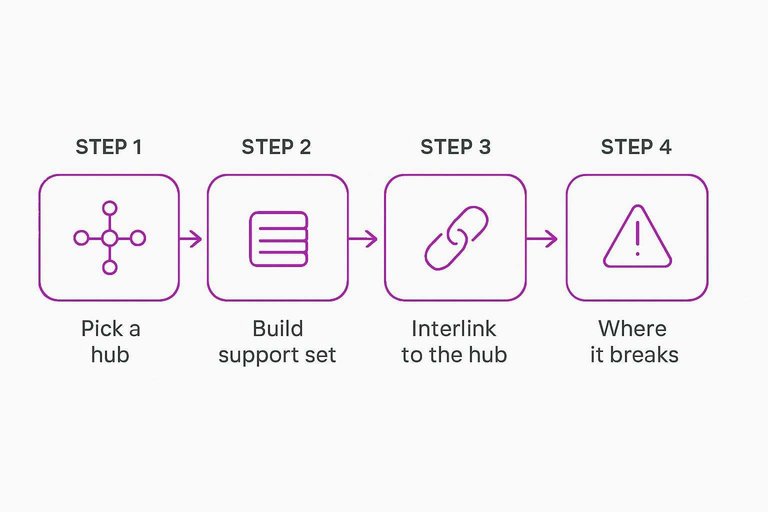
Pick a hub
You’re choosing the page that will carry the cluster’s meaning and internal links. Pick wrong, and your support pages won’t stack authority.
- Target broad intent, not one question
- Leave room for expandable subtopics
- Sit next to commercial-adjacent terms
- Offer a clear conversion path
Your hub is your internal homepage for that topic, so treat it like a product page.
Build support set
Build the cluster like a production system, not a brainstorming exercise.
- Choose 10–20 long-tail queries with clear intent.
- Create brief templates with headers, FAQs, and examples.
- Publish on a steady cadence your team can sustain.
- Interlink to the hub using consistent, descriptive anchors.
Consistency is the multiplier here; scattered anchors create scattered signals.
Where it breaks
Clusters hit a ceiling when the remaining keywords are true head terms, like “project management software.” In competitive niches, higher-authority sites often own those terms through backlinks, brand searches, and age.
You’ll still win long-tails and comparison angles, but the top spot on the head term usually won’t budge without external authority.
Method 3: Internal Linking
Internal links move PageRank around your site and tell Google what matters most. Done right, they also prevent “good pages” from dying in the crawl shadows.
On small sites, internal linking is still worth doing. You just hit a ceiling fast when there isn’t much authority to redistribute.
Fix hierarchy leaks
Internal linking fails when your structure leaks value into dead ends. Plug the leaks first, then push equity toward your money pages.
- Find orphan pages with zero internal links.
- Reduce click depth for priority pages to three clicks.
- Add navigation links to key categories and hubs.
- Strengthen hub-to-spoke links from guides to supporting articles.
If a page can’t be reached fast, it won’t rank fast.
Anchor text rules
Anchor text is a label, not a keyword dump. Write it for humans, then check it for patterns.
- Use descriptive anchors that preview the destination.
- Avoid exact-match repetition across many pages.
- Prefer partial matches for commercial terms.
- Vary anchors by page context and intent.
When your anchors read naturally, your internal linking scales without tripping filters.
Competitive limits
Internal links can’t manufacture authority you don’t have. They only reallocate your existing trust, so the biggest wins are usually reshuffling which pages rank, not breaking into a stronger SERP.
In competitive niches, you’ll feel it as a “glass ceiling” where better structure improves impressions but stalls on page two. That’s your cue to earn external links or build brand signals, not tweak another menu item.
Method 4: On-Page SEO
On-page SEO is the fastest “free” lever you control, because you can change it today. It works until your competitors run the same checklist, then the gains get thin.
Title and H1 wins
Your title tag and H1 decide clicks and comprehension before anything else. Small edits can beat “better content” when intent is close.
- Add specific qualifier, not vague superlatives
- Match primary intent with one clear verb
- Lead with a benefit hook, not your brand
- Use year or price modifiers when relevant
- Keep under truncation limits, front-load keywords
When everyone is “optimized,” the real win is earning the click, not just the crawl.
Entity coverage pass
You’re trying to look complete to both users and Google’s entity model. Treat it like a focused gap scan, not a rewrite.
- Extract repeated entities from top SERP pages and snippets.
- Add FAQs that target missing sub-questions and modifiers.
- Include comparisons for common alternatives and edge cases.
- Add examples, numbers, or scenarios that prove the claim.
- Improve definitions where readers would say “wait, what?”
If you can’t find new entities, you’re not behind on-page anymore.
Where it breaks
In competitive SERPs, the top ten results already share the same entity set, headings, and “People also ask” angles. At that point, tweaking coverage is like rearranging furniture in a full house.
Your next lift usually comes from stronger links, better UX, or a differentiated angle worth citing—if you need a refresher, this practical SEO guide pairs well with Google’s own SEO Starter Guide as a baseline for what on-page can (and can’t) do by itself.
Method 5: Technical Basics
Technical SEO is where you remove the quiet blockers that keep good pages from showing up. Think “Google can’t crawl it” or “users bounce because it’s slow.” It’s the work behind the line, like fixing a page that says “noindex” by accident.
Crawl/index fixes
Crawling problems usually come from a few repeat offenders. Fix them first because content can’t rank if it’s invisible.
- Check robots.txt and meta robots for accidental blocks or “noindex.”
- Audit canonicals so they point to the preferred URL, not a random variant.
- Clean your sitemap: only 200-status, indexable, canonical URLs.
- Find parameter traps and infinite URL paths, then constrain them.
- Identify duplicate content clusters and consolidate or differentiate them.
Once these are clean, Google stops wasting crawl budget on junk URLs.
Speed and CWV
Speed work pays off when it targets the biggest files and the slowest paths. Focus on changes that move real metrics, not “optimization theater.”
- Compress and resize images before upload.
- Lazy-load below-the-fold media.
- Reduce and defer non-critical JavaScript.
- Add server caching and CDN where possible.
- Use a simple font strategy with preloads.
When you fix the heavy stuff, Core Web Vitals usually follows—and it helps to pair these wins with an ultimate checklist for streamlining SEO content so technical improvements translate into cleaner, more index-friendly pages.
Competitive limits
In competitive SERPs, technical parity is table stakes, not a cheat code. If your page loads fast and indexes cleanly, you’ve mostly prevented loss, not created advantage. “Perfect tech” rarely beats a rival with stronger authority and better link signals.
Method 6: Content Refresh
Content refresh is the fastest way to reclaim rankings you already earned. You fix drift, not fundamentals, like updating a “2023” checklist that now reads stale.
Find decay targets
Decay hides in plain sight, so you need signals you can spot quickly. Look for pages that used to pull their weight.
- Impressions trending down in GSC
- CTR dropping on steady positions
- Stats, dates, or tools now outdated
- New competitors rewriting the query
- SERP features shifting the click map
If you see three or more, you’re looking at a real refresh candidate.
Refresh playbook
Treat a refresh like a controlled rewrite, not a full reset.
- Update drifting sections with current facts, examples, and dates.
- Add missing intent blocks, like comparisons, pricing, or “best for” picks.
- Improve media with new screenshots, charts, or a short explainer graphic.
- Tighten the intro so the answer appears in the first lines.
- Resubmit for indexing and request recrawl in Search Console.
Do the smallest change that fixes intent, then ship the update fast.
Where it breaks
Refresh works best when the page already won once and is just fading. In competitive niches, some pages stall because your site lacks authority, not because a paragraph needs polish.
A new domain with no traction often needs links, reputation, and topical depth before edits move the needle.
Method 7: SERP Features
SERP features can rank you without a #1 blue link. They also change the click math fast.
You can win featured snippets, FAQs, and People Also Ask by writing answer-first blocks. In competitive niches, those same features often steal clicks by satisfying the query on Google.
Target feature types
Pick features that match your intent and your content shape. “How to” pages don’t win the local pack.
- Featured snippets
- People Also Ask (PAA)
- Image pack
- Video results
- Local pack
If you see three or more, you’re looking at a feature-first SERP.
Snippet formatting
Format for extraction, not vibes. Make Google’s job boring.
- Add a 1–2 sentence definition block near the top.
- Use numbered steps for processes, with 5–8 words each.
- Add a tiny comparison table when choices exist.
- Apply valid schema only, like FAQ or HowTo.
- Test wording, then re-check the snippet monthly.
Treat it like on-page A/B testing, except Google runs the experiment.
Limits and risks
SERP features are volatile because Google rewrites them constantly. You can “win” a snippet on Monday, then lose it to a forum on Friday.
Features can also cannibalize clicks. If the snippet answers the query fully, users stop before your page loads.
In crowded markets, the upside shifts from traffic to trust. Optimize for assisted conversions, not raw sessions.
Pick Your Battles, Then Execute the Few That Move the Needle
- Run the reality check: if the SERP is dominated by brands, heavy link profiles, and ultra-deep pages, treat “free” tactics as optimization—not a full competitive strategy.
- Start with the highest-leverage basics: intent matching, internal linking, and on-page entity coverage, then fix crawl/index issues that block growth.
- Refresh what’s already close: prioritize decaying pages and near-page-one queries before publishing more.
- Use SERP features as your wedge: format for snippets/PAAs where you can win visibility now, and document what still requires authority (links, brand, budget).
Turn Free Tactics Into Output
In competitive niches, the “free Google ranking” methods work best when you can execute them consistently—refreshing content, tightening intent match, and shipping on-page improvements fast.
Skribra helps you publish SEO-optimized articles daily with built-in formatting, images, and WordPress publishing, so your clusters and internal links compound over time—plus a 3-Day Free Trial to start.
Written by
Skribra
This article was crafted with AI-powered content generation. Skribra creates SEO-optimized articles that rank.
Share: