May 10, 2026
·
15 min read
Advanced Link Building SEO: Signals, Risk, and Scale
An advanced pillar guide to link building that actually moves rankings without blowing up your site—modern link signals, relevance engineering, footprint-aware risk models, scalable digital PR, and measurement frameworks that prove impact.


If your link building plan still revolves around DA screenshots and “safe” guest posts, you’re optimizing for the wrong game. Google evaluates links as a network: context, intent, corroboration, and behavior over time matter more than a single metric.
This pillar breaks down what’s working now—and what’s quietly getting devalued. You’ll learn how to engineer relevance, scale acquisition channels and PR, reduce footprints with a risk budget, and measure link impact with attribution that holds up in stakeholder meetings.
Modern Link Signals
Modern link evaluation looks less like “count the links” and more like “read the graph.” Relevance, intent matching, and corroboration across independent sources decide whether a link behaves like a real recommendation or a manufactured vote. Think: your page earns belief when the web’s neighborhoods agree on what you are.
Graph trust flow
Trust moves through link neighborhoods, not across the whole web evenly. Seeded hubs in a topic cluster pass more usable trust than distant, generic authority.
A practical mental model:
- Start with trusted seed sets in your niche
- Follow short paths to topical hubs
- Discount isolated or cross-topic jumps
- Reward dense, consistent neighborhoods
Close to trusted hubs beats “high DR” every time.
Context beats metrics
Google can read the paragraph around your link, then compare it to the page’s purpose. If the context screams “sponsored roundup” while the query needs expertise, DA and DR won’t save you.
What tends to matter more than metrics:
- Surrounding terms and modifiers
- Page intent and format match
- Entity alignment with the topic
- Outbound link pattern sanity
Metrics are a filter. Context is the verdict.
Link intent alignment
Links look “natural” when they match the query’s job-to-be-done. Intent classes attract different anchors, sources, and placement patterns.
- Navigational: brand anchors, homepages, sitelinks
- Commercial: comparisons, “best” lists, category pages
- Informational: citations, guides, definitions, research
- Local: directories, maps, community mentions
- Mixed intent: varied anchors, varied landing pages
If your link profile fights intent, rankings wobble.
Corroboration signals
Competitive terms rarely move from one “hero link” alone. Google looks for multiple, independent confirmations that converge on the same entity and claim.
- Co-citation: two sites cited together
- Co-occurrence: brand near key entities
- Multi-source mentions: different owners, same story
- Repeated topical framing: consistent descriptors
- Cross-format proof: articles, forums, data
One strong link is a spark. Corroboration is the fire.
Temporal behavior
Time is a signal, not a footnote. Link velocity, churn, and aging patterns help separate steady demand from short-lived promotion.
Typical patterns that read “real”:
- Gradual growth tied to publishing cadence
- Low churn on editorial mentions
- Fresh links plus older anchors still active
- Small spikes after news, then taper
Campaign spikes can work, but they raise the bar for everything else.
Relevance Engineering
Relevance is the part you can engineer before you ever send an outreach email. If you skip it, you’ll chase “good links” that reinforce the wrong story.
Think of it like tightening bolts before a road test. One loose joint, and the whole rig rattles.
Entity-first mapping
You need an entity map so every new link reinforces a consistent set of facts. Otherwise, Google sees scattered associations and you get noisy results.
- List your core entities: brand, products, founders, locations.
- Add topic entities: categories, use cases, problems you solve.
- Add adjacent entities: tools, standards, competitors, complementary products.
- Build an entity grid: entity × page, then mark “reinforce via links.”
- Assign each outreach target to one entity and one page.
If you can’t name the entity a link should strengthen, don’t build it.
For a broader framework on aligning pages, entities, and intent, see this SEO guide for building relevance.
Topical neighborhood design
Topical fit lives in neighborhoods, not single keywords. You want sites that share audience intent, even when language differs.
A cybersecurity vendor can win links from IT ops blogs, compliance newsletters, and SaaS procurement guides. Same buyer. Different vocabulary.
When the audience overlaps, relevance follows without forcing anchors.
Anchor distribution strategy
Anchors are labels, so control them like UI text. Your goal is meaning and intent, not an exact-match trophy.
- Favor partial-match anchors tied to use cases.
- Use implied anchors through brand mentions near key terms.
- Keep URL anchors for citations and “source” contexts.
- Mix in branded anchors for entity reinforcement.
- Reserve exact match for rare, natural fits.
Over-precision is a footprint, and footprints travel faster than rankings.
Internal-link handshake
External links create pressure, but internal links route it. Without routing, you get random lifts and weak commercial impact.
If a guide earns the link, point it to the money page with a clean, relevant internal path. Two hops max.
Authority that lands on the wrong node is just expensive heat.
SERP-led validation
SERPs expose what Google thinks the topic contains. Use them to catch silent splits before you scale links into the wrong bucket.
- Collect the top 10 ranking URLs for your primary query.
- Tag each page by intent: buy, compare, learn, fix, define.
- Note repeated entities: brands, tools, standards, subtopics.
- Check backlink patterns: anchor themes and referring site types.
- Adjust your entity grid when patterns disagree with your plan.
If the SERP clusters into two intents, you’re building two strategies, not one.
Risk and Footprints
Link building is adversarial because detection is the default outcome. Your job is to earn signals without leaving patterns that scale into liabilities.
Footprint taxonomy
Most footprints come from repetition, not the link itself. The fastest way to get caught is to “standardize” what should look organic.
- Reuse templated outreach subject lines
- Cluster sites on shared hosts or themes
- Place links via the same editors repeatedly
- Publish identical blurbs across domains
- Mix pages with unnatural topic spreads
If you can describe your pattern in one sentence, so can an evaluator.
Penalty vs devaluation
Devaluation is silent and common. Manual actions are loud and rare, and they usually follow obvious intent.
Devaluation looks like this:
- New links index, rankings don’t move.
- Some pages lift, money pages don’t.
- Gains fade within weeks.
Manual actions look like this:
- Messages in Search Console.
- Sitewide or section-wide drops.
- Recovery requires cleanup and time.
If you’re “stuck,” assume discounting first and fix the pattern, not the page.

Link toxicity myths
Most “toxic” metrics are proxy guesses built from surface features. Google does not need your tool’s score when it can model intent.
What correlates with suppression more reliably:
- Network signals: shared owners, templates, link graphs.
- Irrelevance: off-topic placements with no audience logic.
- Manipulation intent: anchors, velocity, and obvious quid pro quo.
Ignore scary labels and hunt for intent signals in the graph.
Risk budgeting model
You need a portfolio, not a vibe. Budget risk like you budget spend, with caps and isolation.
- Define tiers: low, medium, high detectability.
- Cap tier exposure per money page, before you build.
- Allocate tests to one topical cluster at a time.
- Measure lift, fade, and indexation over 30–60 days.
- Scale only what survives, then rotate patterns.
Your edge is not bravado; it’s controlled blast radius.
Disavow decisioning
Disavow is a scalpel, not a broom. Use it when you have evidence, not anxiety.
- Confirmed network ties you can document
- Paid schemes with traceable footprints
- Hacked pages or injected link blocks
- Negative SEO that clusters at scale
- Manual action cleanup requirements
If the link is just “ugly” but disconnected, leaving it alone is often safer. See Google’s guidance on disavowing links to your site before you act.
Acquisition Channels Matrix
You need multiple link channels because each one trades scale for risk and signal strength. This matrix helps you build a portfolio instead of betting on one tactic.
| Channel | Scalability | Risk | Signal strength |
|---|---|---|---|
| Digital PR (news) | Medium | Low | Very high |
| Resource pages | Medium | Low | High |
| Expert quotes (HARO) | Medium | Low | High |
| Partnerships (real) | Low | Low | Very high |
| Guest posts (editorial) | High | Medium | Medium |
Use this to diversify on purpose: anchor your profile with low-risk, high-signal links, then add scalable volume carefully.
Digital PR That Scales
One-off “big stories” are fragile. You need repeatable assets and a distribution loop that keeps earning editorial links.
Think less “annual industry report,” more “fresh angle every month” from the same engine.
Newsworthiness engineering
You can manufacture newsworthiness without manufacturing facts. The goal is to turn real product or data into angles editors can justify.
- Add novelty with a surprising delta
- Add stakes with clear impact
- Add locality with city-by-city cuts
- Add conflict with trade-offs
- Add proof with transparent methods
If it reads like a generic report, you’re competing with everyone and winning with no one.
Data asset pipelines
Evergreen PR assets win when they refresh themselves. Build a pipeline that ships updates on schedule, not on inspiration.
- Instrument collection from product, APIs, or scrapes.
- Run QA checks for outliers, gaps, and schema drift.
- Publish to a stable, canonical URL with version notes.
- Refresh on a cadence and alert on meaningful changes.
- Re-pitch deltas, not the whole dataset.
Your best pitch is often “what changed since last time.”
Journalist-fit targeting
Most pitches fail because they’re formatted wrong for the recipient. Cluster reporters by beat and by the content template they reuse.
A “daily chart” writer wants one clean graphic. A “case study” writer wants a named example and a quote.
Match their format and you’ll stop sounding like spam.
Link inclusion tactics
Editors link when it’s effortless and safe. Your job is to make attribution the lowest-friction choice.
- Provide embed-ready charts with alt text
- Use one canonical URL per asset
- Include copy-paste citations and dates
- Add a “How to reference” block
- Offer source files or methodology links
Reduce effort and increase trust, and links show up without being “asked for.”
Syndication pitfalls
Syndication can inflate mentions while shrinking value. Republish networks often duplicate content, strip links, or create obvious footprints.
If ten partner pages share the same template, Google can treat them like one signal. Sometimes like a negative one.
Set partner rules before you scale distribution.
High-Leverage Content Hooks
Design content to earn links on purpose, not by accident. You want formats people cite, while your site stays clean and non-duplicative.
Linker intent modeling
Links are rarely “about SEO.” They are social proof, a citation, or a shortcut for the author.
Map intents to formats:
- Citation intent → original stat, benchmark, dataset
- Tool intent → calculator, generator, checker
- Example intent → swipe file, teardown, “good vs bad” gallery
- Controversy intent → contrarian take with evidence
- Community intent → directory, resource hub, standards list
Build the page like the linker writes. Give them a quotable line and a clean URL.
Programmatic linkables
Programmatic pages can earn links when each page adds a real unit of value. Templates fail when they ship the same paragraph 500 times.
- Use unique inputs per page, not swapped keywords
- Add a “why it matters” snippet, tied to that entity
- Include a source block with dates and methodology
- Show comparisons, not isolated facts
- Enforce a no-index threshold for weak pages
The guardrail is simple: if a human wouldn’t bookmark it, don’t index it.
Tooling and widgets
Micro-tools win links because they reduce effort for the writer. A “UTM builder” or “ROI calculator” gets embedded when it saves minutes.
Treat embeds like brand assets, not link schemes.
Use one canonical attribution link, vary nothing else, and keep the embed code short.
If your embed footprint looks identical across the web, you’re advertising manipulation.
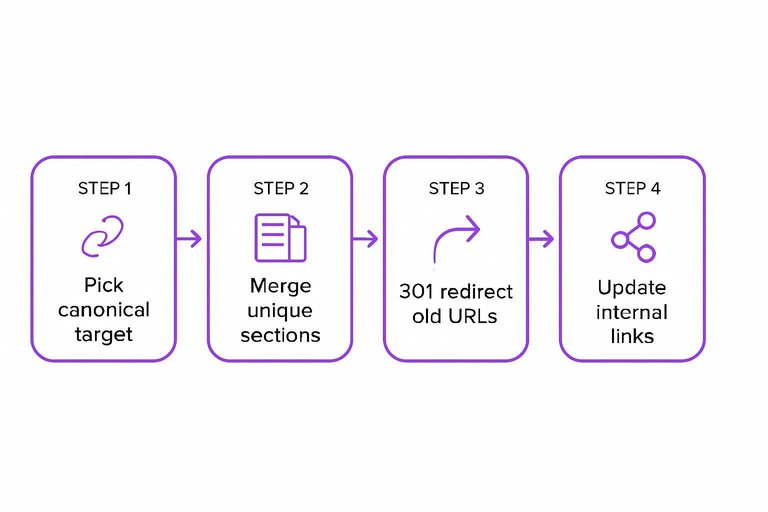
Content consolidation
Consolidation turns scattered relevance into one link magnet. You do it when two or more pages chase the same query family.
- Pick the strongest URL as the canonical target.
- Merge unique sections from the others, then delete duplicates.
- 301 redirect old URLs to the canonical, one hop only.
- Update internal links to point directly to the canonical.
- Re-submit the canonical in your sitemap and indexing tools.
Your goal is one page that deserves every future link.
Refresh and relaunch
A relaunch gives writers a reason to cite you again. “Updated for 2026” is a pitch, not a vanity badge.
- Rewrite the thesis to match today’s search intent.
- Add new entities: competitors, standards, tools, and terms.
- Update proof: dates, screenshots, benchmarks, and references.
- Re-pitch prior linkers with a specific new angle.
- Reclaim lost links by fixing 404s and outdated URLs.
Old link prospects convert fast when you hand them a new reason.
Authority Sculpting
Authority sculpting is how you decide where earned equity accumulates and where it gets diluted. You’re not “pushing juice” to everything. You’re choosing the few pages that should compound, like a hub that feeds ten spokes instead of ten competing targets.
Money-page insulation
Transactional pages attract the most scrutiny because they map to revenue. You can still benefit from links without making your checkout-adjacent URLs the first point of contact.
Use a hub-and-spoke layer:
- Earn links to a hub that’s defensible and useful, like “Complete buyer’s guide.”
- Link from the hub to money pages with varied, plain anchors.
- Add intermediates when needed, like category explainers or comparison pages.
That’s how you keep rankings tied to commercial intent, not to a fragile link footprint.
Link landing optimization
People remove links when the page feels thin, dated, or self-serving. Make the landing page the thing they meant to cite.
- Add a citeable definition block
- Include original stats or tests
- Publish a “method” section
- Provide downloadable assets
- Show last-updated dates
If editors can defend the link in one sentence, it tends to survive updates.
Crawl and index gating
Link equity leaks when crawlers waste time on duplicates and dead ends. Consolidate what Google can index, and you consolidate what links can amplify.
- Kill index bloat from filters, tags, and internal search.
- Normalize parameters with canonicals and consistent internal URLs.
- Fix soft-404s and thin pages that return 200s.
- Enforce one preferred version with redirects and hreflang rules.
- Re-audit sitemaps so only index-worthy URLs remain.
If Google keeps choosing the wrong URL, your links keep paying the wrong bill.
Cross-page reinforcement
Topical authority compounds when related pages reinforce each other. Do it with structure, not with repeated “exact match” anchors that look manufactured.
Build clusters that mirror real intent:
- Breadcrumbs that reflect category logic.
- Internal anchors that vary naturally, like “pricing,” “cost,” “rates.”
- Context links from explanations to transactions, not the reverse.
When your internal graph matches user journeys, optimization stops looking like a pattern. Google’s SEO link best practices are a good baseline for crawlable links and anchor usage.
International and local quirks
International SEO can accidentally fork your authority into near-duplicates. Local SEO can do the same with citation sprawl.
- Use hreflang with self-referential tags
- Avoid duplicating copy across regions
- Choose ccTLD vs subfolder deliberately
- Consolidate local citations by NAP
- Canonicalize regional near-duplicates
If you split the same intent across five URLs, you also split the links that should win it.
Measurement and Attribution
Link building fails when it becomes “busy work” with no outcome trail. Your job is change control. Every link is a hypothesis with a timestamp.
Leading indicators
You need signals that move before revenue does. They keep you from waiting six weeks to learn you shipped junk.
- Improve indexation rate on linked pages
- Increase referring page quality scores
- Expand topic coverage across clusters
- Stabilize ranking volatility on targets
If your leading indicators stay flat, your links are cosmetic.
Causal inference basics
Rankings move for reasons that have nothing to do with you. Treat links like an experiment, or you will “prove” anything.
Use holdout pages that get no new links while similar pages do. Roll links out in staggered waves so timing becomes a clue. Add SERP controls like a stable keyword set and a competitor baseline, then check seasonality.
If you can’t explain what would have happened without the links, you don’t have attribution.
Link impact audits
You want to connect specific changes to specific outcomes. That requires a clean timeline, not vibes.
- Build a change log for links, content, and internal linking.
- Mark first-crawl and indexation dates for new referring pages.
- Compare pre-post rank shifts with a holdout keyword set.
- Flag outliers where many links produced little movement.
- Note plateaus to spot diminishing returns by URL type.
When returns flatten, stop buying “more” and start fixing relevance.
Competitor delta analysis
Competitors tell you what Google already accepts as corroboration. Your goal is not parity. It’s targeted overmatch.
- Segment pages by type: hub, product, guide, tool.
- Map each page to a topic cluster and intent.
- Compare referring domains and linking page types per segment.
- Score gaps by quality, not just count.
- Queue outreach where competitors show repeated corroboration.
If three competitors share the same pattern, that’s the line you should cross.
Reporting that persuades
Stakeholders confuse activity with progress because most reports invite it. Your dashboard should separate “we did stuff” from “it worked.”
Show three tracks: activity metrics, leading indicators, and outcome metrics like rankings and assisted conversions. Add risk markers like anchor skew, source concentration, and link rot, plus durability signals like sustained indexation. Call out compounding effects, like one strong link lifting an entire cluster. If you need a repeatable cadence for improving signals between reporting cycles, see daily SEO gains with AI.
The point is confidence, not applause.
Build a Link System You Can Defend and Scale
- Start with signal truth: map target pages to entities, topical neighborhoods, and the corroboration signals you need to look “earned,” not manufactured.
- Engineer relevance end-to-end: plan anchor and internal-link handshakes, validate in the SERP, and optimize link landings so authority flows where rankings are won.
- Scale responsibly: use a channel matrix to balance PR, assets, and outreach while tracking footprints with a risk budget and a clear disavow decision rule.
- Prove impact: monitor leading indicators, run link impact audits, and report competitor deltas so link building becomes a measurable growth lever—not a monthly activity report.
Frequently Asked Questions
- Does link building SEO still matter in 2026 if Google is using AI and entity-based ranking?
- Yes—links still act as trust and corroboration signals, especially for competitive queries and newer brands. They usually work best when paired with clear entity signals (About pages, schema, consistent mentions) and strong topical relevance.
- How long does link building SEO take to show results in rankings and traffic?
- Most sites see early movement in 4–8 weeks (crawl/indexation, improved query coverage) and clearer ranking/traffic impact in 3–6 months. For highly competitive SERPs, compounding gains often take 6–12 months.
- How do I measure link building SEO impact without confusing it with content updates or seasonality?
- Use change-control: log link velocity and target URLs, then compare against a holdout set of similar pages that didn’t receive links. Validate with Google Search Console (query/page trends) plus third-party link crawlers like Ahrefs or Majestic to confirm timing and coverage.
- Can I do link building SEO without guest posts or paid placements?
- Yes—digital PR, data assets, tools, original research, and partner/co-marketing campaigns can earn editorial links at scale. Most teams combine 2–3 “earned-first” channels to keep velocity consistent without relying on placements.
- What’s the safest anchor text strategy for link building SEO in competitive niches?
- Most healthy profiles skew heavily toward branded, URL, and partial-match anchors, with exact-match used sparingly and spread across many referring domains. A practical rule is to keep exact-match anchors in the low single digits (%) unless your brand naturally earns them.
Scale Link Building Safely
Building links at scale today means balancing relevance, risk, and measurable impact—while still feeding your site with content worth citing and sharing.
Skribra helps you publish SEO-ready content daily and tap into a backlink exchange network to grow authority with fewer footprints—start with the 3-Day Free Trial.
Written by
Skribra
This article was crafted with AI-powered content generation. Skribra creates SEO-optimized articles that rank.
Share: