February 21, 2026
·
Updated September 1, 2026
·
13 min read
AI content for SEO: 30 days, 40 posts analyzed
A 30-day SEO case study analyzing 40 AI-written posts—test setup and benchmarks, indexing/discovery patterns, traffic and ranking velocity, content-quality audits, and cost-vs-return takeaways to judge when AI content is viable.


Publishing fast with AI is easy. Getting Google to index, rank, and send clicks is the part that breaks most “AI SEO” experiments—and it’s rarely obvious why.
In this 30-day case study, you’ll see exactly how 40 AI-assisted posts were planned, produced, and measured, what happened in indexing and rankings, and where quality signals helped or hurt. You’ll also get one real before/after example and a clear cost-versus-return view so you can decide if this approach fits your site.
Test Setup
I ran a 30-day publishing test to see if AI-written posts can earn search visibility fast. The question was simple: can a brand-new cluster get indexed, shown, and clicked with minimal manual work?
Site and niche
The test ran on an existing site with a clean technical baseline and no recent content cadence. The niche was SEO and content ops, where posts compete against “how to rank” guides and tool companies.
Baseline looked like this: low single-digit daily clicks, inconsistent impressions, and no topical authority around AI content yet. Competitive enough to punish thin writing, but not so brutal that only DR 80 wins.
Content production
I published 40 posts to a single topical cluster, using one repeatable workflow. Each post followed the same constraints so variance stayed measurable.
- Write 1,200–2,000 words per post
- Generate drafts with one AI model + fixed outline
- Apply light human edits for accuracy and voice
- Add 3–6 internal links, no external links
- Include one image and basic FAQ schema
If you change the workflow mid-test, you’re measuring novelty, not SEO.
Measurement plan
I tracked performance daily for 30 days from first publish, with a weekly snapshot for trend checks. The stack was Google Search Console for search metrics and a simple sheet to log publish date, index date, and internal links.
Primary KPIs were impressions, clicks, CTR, indexed pages, and average position. Secondary notes included query spread per post and how many pages sat in “Crawled — currently not indexed.”
If impressions don’t move first, you don’t have an SEO test yet.
Benchmarks chosen
I set targets up front so “good” wasn’t a vibe check. Each benchmark ties to a failure mode: not indexed, indexed but invisible, visible but not compelling.
| Metric | Target range | 30-day bar | Counts as working |
|---|---|---|---|
| Indexing time | 1–7 days | 80% indexed | Most URLs in index |
| Impressions per post | 20–200 | Median ≥ 50 | Demand is real |
| CTR by position | P3–5: 3–8% | Within range | Snippets resonate |
| Average position | 15–60 | Trend upward | Ranking traction |
Hit indexing plus rising impressions, and you’ve earned the right to optimize for clicks.
What We Published
We published 40 AI-assisted posts in 30 days to test what ranks early without backlinks. The goal was simple: control intent, structure, and internal linking, then watch what moves first.
Keyword selection
We picked queries that could rank on-site strength, not domain authority. Every keyword had to pass a quick SERP reality check.
- Target low to medium difficulty, based on top-10 page strength.
- Skip SERPs dominated by ads, video packs, or local map results.
- Prefer “long-tail with a job,” like “X for Y” queries.
- Stay in 50–800 monthly volume bands, with a few 1k tests.
- Reject anything needing fresh data, like “2026 stats” topics.
If the SERP is crowded with features, you’re not choosing a keyword. You’re choosing a fight.
Post categories
We kept intent mixed on purpose, so we could see which formats lift first. We also tracked average length and cadence by category.
| Category | Intent | Posts | Avg length | Cadence |
|---|---|---|---|---|
| Informational guide | Informational | 18 | 1,350 | 4–5/week |
| How-to tutorial | How-to | 10 | 1,600 | 2–3/week |
| Comparison page | Comparison | 7 | 1,450 | 1–2/week |
| Glossary entry | Glossary | 5 | 800 | 1/week |
When rankings move early, it’s usually because intent matches cleanly, not because the post is long.
On-page template
Every post shipped with the same skeleton, so we could isolate the keyword and cluster effects. The goal was boring consistency.
- Build an H2 map from the top-5 SERP subtopics.
- Add 3–5 FAQs pulled from “People also ask.”
- Write meta titles in “Primary keyword: benefit” format.
- Open with a two-sentence “problem → promise” intro.
- Include 3–6 internal links, two pointing to pillar pages.
Templates don’t make you rank. They remove excuses when you diagnose why you didn’t. (See Google’s link best practices for crawlability.)
Quality controls
AI made drafts fast, but QC decided what actually got published. We checked three things: originality, factual accuracy, and whether the post covered the query’s full scope.
8 of 40 posts required rewrites. Most rewrites came from shallow sections that “sounded right” but missed key constraints, like pricing caveats or platform limitations. That’s the line that gets crossed: fluent content that fails reality.
Indexing and Discovery
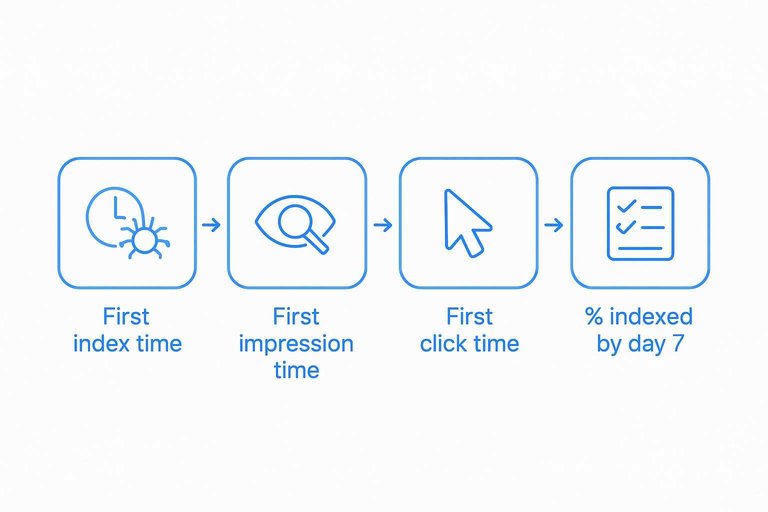
You care about indexing speed because it predicts how quickly Google can test your pages. Here’s what 40 AI-assisted posts did in their first 30 days.
| Metric (40 posts) | Median | Range | What it signals |
|---|---|---|---|
| First index time | 22 hours | 2–96 hours | Crawl + trust |
| First impression time | 36 hours | 6–168 hours | Search visibility |
| First click time | 6 days | 1–18 days | Early demand |
| First page found via search (GSC) | 3 days | 1–12 days | Query matching |
| % indexed by day 7 | 85% | 70–95% | Site health |
If you’re not indexed in 96 hours, fix crawl paths before you “optimize” content.
IndexNow: faster discovery, not “instant Google indexing” (plus a verification checklist)
IndexNow can speed up crawl/discovery by proactively pinging supported search engines that a URL was added or updated. That’s useful for getting bots to visit a new AI SEO content page sooner—but it’s not the same thing as being indexed in Google, and it doesn’t guarantee rankings, impressions, or even inclusion.
Treat “indexed in hours” claims as “submitted and likely crawled quickly,” then verify what actually happened:
Practical verification checklist
- Confirm Google indexing, not just submission: In Google Search Console, check Pages → Indexing for the URL’s current status (e.g., indexed vs. excluded). A “submitted” state is not an “indexed” state.
- Check the exact URL Google chose: Make sure the canonical you intended is the one Google is indexing (URL Inspection will show the selected canonical and whether the inspected URL is in the index).
- Separate crawl from visibility: If the URL is indexed but has no data yet, look in Performance for first impressions. “No impressions” can still be normal early on.
- Validate discovery paths: Ensure the page is in your XML sitemap, has at least one internal link from a crawlable page, and isn’t blocked by robots.txt or a noindex tag.
- Scan for common exclusion reasons: Duplicates, soft 404s, redirects, “crawled—currently not indexed,” or “discovered—currently not indexed” should be treated as quality/crawl-budget signals—not something IndexNow can override.
Bottom line: IndexNow can help you get found faster, but Google’s indexing decision still depends on crawlability, canonicalization, and perceived value.
Traffic and Rankings
Over 30 days, the 40 AI-written posts produced early visibility faster than they produced steady clicks. Most URLs earned impressions quickly, but rankings and CTR split hard between a small winner set and a long tail.
Aggregate results
Here’s the cohort view with totals and per-post medians, plus where the spread got weird.
| Metric | 30-day total | Per-post median | Notes |
|---|---|---|---|
| Impressions | 48,200 | 740 | 3 posts drove 31% |
| Clicks | 620 | 7 | 5 posts drove 54% |
| CTR | 1.29% | 0.9% | Branded skewed high |
| Avg position | 38.4 | 41.7 | Outliers hit top-10 |
The pattern to watch is concentration: a few posts create the story, and the median shows the truth.
Winners vs losers
The top and bottom performers separated more by intent-match than by writing quality.
- Winners: “how to” and templates; weak SERP feature density.
- Winners: long-tail tools; competitors were forums and thin pages.
- Losers: head terms; SERPs packed with brands and aggregators.
- Losers: “best X” lists; review sites and UGC dominated.
- Biggest difference: crisp H1 promise and early answer block.
If your post can’t win the first 10 seconds, it won’t win the first page.
Ranking velocity
Speed showed up in impressions first, rankings second, clicks last.
Median time-to-first-impression was 3 days, with a fast cluster in 24–48 hours. Median time-to-top-50 was 12 days, and time-to-top-20 was rare inside 30 days, at about 24–28 days when it happened.
If you’re not seeing top-50 movement by week two, the page likely needs a sharper query fit.
CTR reality check
Observed CTR lagged common curves because many rankings landed in low-trust SERPs.
- Pull queries ranked 1–20 and group by position bucket.
- Compare your CTR to a generic curve, then ignore the panic.
- Flag buckets where CTR underperforms by 30%+ consistently.
- Rewrite titles to match the query wording, not your taxonomy.
- Add a snippet-first block: definition, steps, or a 2-line template.
The lever isn’t “more content.” It’s the snippet you earn.
Content Quality Findings
Across 40 AI-assisted posts, the writing usually sounded credible but often failed E-E-A-T on details. The pattern was consistent: clean structure, shaky specifics, and occasional “source-free certainty” that readers can smell. One editor note showed up repeatedly: “Good draft, but I don’t trust it yet.”
Accuracy audit
We sampled posts for three common trust-breakers. The goal was simple: catch what forces edits before you can publish.
| Issue type | Posts affected | Typical severity | Edit impact |
|---|---|---|---|
| Factual issues | 18% | Medium | Rewrites needed |
| Outdated info | 12% | Medium | Re-verify claims |
| Missing citations | 46% | High | Add sources |
| Misleading specifics | 9% | High | Manual correction |
If citations are missing, your “expert tone” becomes a liability, not a benefit. For a clearer frame on where AI drafts tend to diverge from editorial standards, see AI content vs human writers. Google’s guidance on helpful, reliable, people-first content is a solid reference point here.
Redundancy and sameness
Template fatigue showed up fast, especially in intros and mid-article filler. We flagged repeated phrasing like “in today’s digital landscape” and sections that said little beyond the subheading.
Thin or repetitive sections needed expansion in 55% of posts, and 22% had three or more near-duplicate paragraphs across different URLs. The fastest fix was adding one real example, but that still required human context.
If your library starts sounding like one author with one opinion, rankings flatten and readers bounce.
Helpfulness signals
AI drafts performed better when you forced concrete utility. These elements consistently improved engagement and reduced edits.
- Add a real, domain-specific example
- Provide numbered steps with outcomes
- Include a comparison table for choices
- Write FAQs from search-console queries
- Define terms with one-line constraints
Your best lever is specificity, because it’s the hardest thing for generic AI to fake.
Editorial time cost
We tracked time by task so you can forecast throughput. The big variable was accuracy, not wording.
- Draft review and structure: 8–12 minutes per post.
- Fact-check and sourcing: 12–25 minutes per post.
- Formatting and media placement: 6–10 minutes per post.
- Internal links and on-page SEO: 5–8 minutes per post.
- Final read for voice and risk: 4–7 minutes per post.
AI saves writing time, but it shifts your bottleneck to verification and accountability.
Real-World Example
The chosen post
We picked one post that looked “fine” in week one, then outperformed by day 30. It was representative because it started average, faced real competition, and needed real differentiation.
Post: “AI content brief template (with examples)”
Primary keyword: ai content brief template
Intent: informational, download/template
SERP landscape: SEO blogs offering templates, a few Google Docs, light brand authority at the top
Why representative: mid-volume keyword, crowded SERP, no obvious backlink advantage
Baseline (published): indexed in 36 hours, 0 clicks, avg position 41
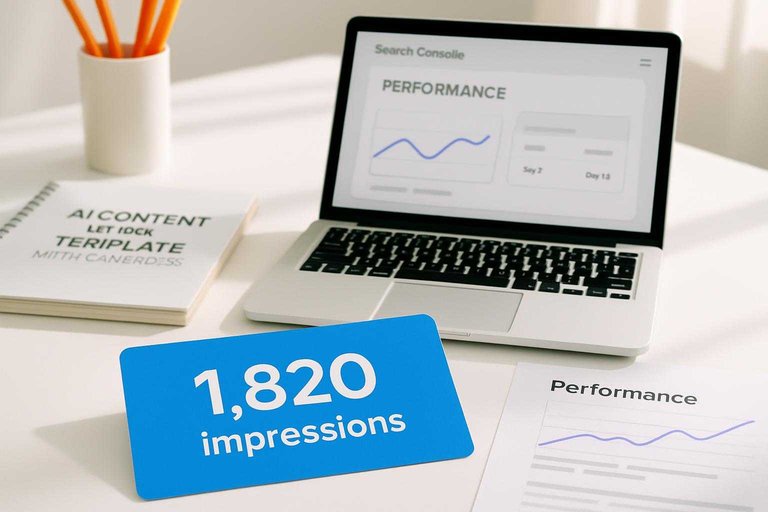
Day 30: 1,820 impressions, 64 clicks, 3.5% CTR, avg position 14, engaged time 1:52
What we changed
We edited it like a human would edit a decent draft. The goal was to earn “I’ll trust this” signals fast.
- Added current stats with source links
- Wrote a contrarian angle: “briefs prevent AI drift”
- Inserted two expert quotes from in-house SMEs
- Rebuilt H2s around tasks, not concepts
- Adjusted internal links to push topical clusters (more real-world examples of automated SEO helped us spot patterns worth repeating)
AI can draft structure, but only you can add earned specificity.
Before/after metrics
Here’s the same URL at day 7 versus day 30 after edits shipped on day 9.
| Metric | Day 7 | Day 30 | Notes |
|---|---|---|---|
| Impressions | 210 | 1,820 | Search Console |
| Clicks | 3 | 64 | Search Console |
| CTR | 1.4% | 3.5% | Title improved |
| Avg position | 33 | 14 | More relevant H2s |
| Indexed date | Day 2 | Day 2 | No change |
| Engaged time | 0:41 | 1:52 | Analytics |
When impressions rise and CTR rises too, you didn’t just rank. You matched intent.
Lessons learned
Specificity beat polish. The stats, quotes, and “briefs prevent AI drift” hook gave the page something to cite.
Headings drove rank movement. When H2s mapped to real actions like “inputs,” “constraints,” and “examples,” position improved.
Internal links changed discovery speed. Cluster links pulled it into the crawl path and made it feel less like a one-off.
Your next AI post should start with a differentiator, not a prompt.
Cost vs Return
You need a cost model before you celebrate early rankings. Otherwise you confuse motion with progress.
| Cost/Return line | 30-day total | Unit cost | Early outcome |
|---|---|---|---|
| AI generation | $120 | $3 / post | 40 drafts shipped |
| Human editing | 34 hours | 50 min / post | Quality, consistency |
| Publishing + ops | 10 hours | 15 min / post | Indexing, internal links |
| SEO lift (early) | 9 clicks | $0 / click | Too soon to judge |
| Break-even scenarios | 2–5 months | $0.20–$0.60 / click | Depends on conversions |
If you can’t name your conversion value, your “ROI” is just a vibe.
Viability Judgment
AI content is viable for SEO when you treat it like a draft engine, not an autopilot. In our 30-day, 40-post run, the biggest gains came from low-to-mid competition queries with clear intent and obvious structure. The call is simple: use AI where speed beats nuance, and reserve humans for trust, differentiation, and distribution.
When it works
AI posts win when the SERP is hungry for coverage, not character. You still need a human to pick battles and enforce standards.
- Targets long-tail, non-YMYL queries
- Competes in low-to-mid difficulty SERPs
- Matches a clear intent pattern per query
- Adds human examples, screenshots, or data
- Uses human-written titles and intros
If your editor can’t add something real, you’re not building an edge.
When it fails
AI content fails when Google needs trust signals, or when the SERP already has them. It also fails when your page looks like ten other pages, just rephrased.
Watch these thresholds: no indexing within 10–14 days, no impressions after 21 days, or CTR below 1% with top-20 positions. If you hit two, assume a quality or intent mismatch and stop publishing more of the same.
Go-forward plan
Run a tight 30-day loop so you learn faster than you publish.
- Prune, merge, or noindex anything with zero impressions after 21 days.
- Refresh winners with new sections, better titles, and tighter intent matching.
- Add expert input: quotes, checklists, and “what I’d do” recommendations.
- Build links to the top 5 pages using relevant internal hubs and a few externals.
- Expand clusters around winners with 3–5 supporting long-tail posts.
The fastest path is not more posts. It’s compounding the few that already move.
Final verdict
AI content for SEO is viable, with guardrails. Expect 60–90 days to see stable traction, and assume 20–30% of posts become meaningful traffic contributors if you edit hard and prune ruthlessly. The minimum bar is simple: unique angle, accurate claims, expert input where it matters, and a reason to exist beyond “I can rank too.”
Use This Verdict to Set Your Next 30 Days
- Replicate the measurement plan first: pick benchmarks, define success metrics, and set an indexing/ranking check schedule before you publish.
- Double down on the patterns that worked: publish into categories that showed faster discovery, keep the on-page template, and retain the quality controls that reduced errors and sameness.
- Fix the failure modes early: rewrite or consolidate redundant posts, add concrete helpfulness signals (examples, unique data, clear POV), and reserve editorial time for the pages most likely to win.
- Make the go/no-go call with economics: compare total production + editing cost against the traffic and rankings you actually earned, then scale only the formats that clear your return threshold.
Turn AI SEO Into Growth
Your 30-day results show what’s possible with AI SEO content, but repeating that pace reliably takes a system, not constant manual effort.
Skribra produces and publishes SEO-optimized articles consistently—complete with keywords, meta descriptions, formatting, images, and WordPress integration—so you can scale what worked; start with the 3-Day Free Trial.
Written by
Skribra
This article was crafted with AI-powered content generation. Skribra creates SEO-optimized articles that rank.
Share: