January 28, 2026
·
12 min read
Rankings Drop Triage
Rank drops feel personal, but they’re usually diagnosable. Treat this like incident response: confirm the signal, then narrow the blast radius. If you need a quick refresher on fundamentals while you triage, keep this SEO guide for troubleshooting handy.
Verify the drop
Compare sources first, because each tool lies differently on bad days.
- Align dates across GSC, GA4, and your rank tracker.
- Segment GSC by query, page, device, and country.
- Check GA4 landing pages for organic-only traffic shifts.
- Review annotation logs for tracking, CMS, or template changes.
- Compare year-over-year to rule out seasonality and demand swings.
If the drop only exists in one tool, you’re debugging measurement, not Google.
Find common traits
You’re looking for repeats, not one-offs, because Google usually punishes patterns.
- Shared template or layout component.
- Heavy AI footprint with thin human edits.
- Same intent type, like “how-to” or “best X”.
- Similar internal linking and anchor patterns.
- Recent refresh date or content pipeline change.
When three or more pages share a trait, you’ve found the lever to pull.
Rule out technicals
Content fixes won’t stick if Google can’t crawl, index, or trust the URL signals. One bad canonical can sink a whole template.
Check indexing status, canonicals, robots rules, sitemap coverage, redirect chains, and server error spikes.
Fix the plumbing first, or you’ll keep rewriting pages Google can’t evaluate.
Map to update windows
Line up the decline against known update windows to separate “we changed something” from “Google changed something.”
| Date range | Known update? | First pages hit | Likely driver |
|---|---|---|---|
| Early March | Core update | Informational | Helpfulness signals |
| Late April | Reviews update | Commercial | Review quality |
| Mid June | Spam update | Programmatic | Scaled content |
| Early September | Core update | Mixed | Re-ranking shift |
If the timing matches an update, test smaller edits first, then escalate to rewrites.
Keyword Soup Copy
AI generators love to “cover the keywords,” then leave you with robotic paragraphs that feel written for crawlers. Users bounce, and systems read low usefulness in the patterns.
A classic tell is a sentence like: “Our AI content generator for SEO content generation improves SEO rankings for SEO.”
Spot the signals
Keyword soup hides in plain sight, because each line looks “optimized” in isolation. Scan the full page for repeated patterns and forced phrasing.
- Repeated exact-match phrases in every paragraph
- Awkward synonyms that no human uses
- Bloated headings stuffed with modifiers
- Forced entity stuffing across unrelated sections
- Sentences that say nothing but keywords
If you can highlight the same phrase five times, you’re not optimizing; you’re signaling spam.
Rewrite for intent
Your job is to answer the query fast, then earn depth. Keep one primary term per section and let the rest breathe.
- Write a one-sentence answer in plain language.
- Add 2–3 subtopics that match the real intent.
- Replace exact-match repeats with pronouns or shorter nouns.
- Move secondary entities into examples, not headings.
- Read it aloud and cut anything that sounds “SEO-ish.”
If it sounds natural out loud, it usually reads useful to systems too.
Add real specificity
Specificity breaks the template feel and raises trust fast. Add constraints like “for ecommerce category pages,” numbers like “3 examples,” and caveats like “only if your query is informational.”
Swap filler for context: instead of “This guide covers everything,” write “Start with one primary keyword, then support it with 3 related questions from Search Console.”
When you add limits and real conditions, you stop sounding like a generator and start sounding like experience.
Thin Programmatic Pages
Programmatic pages fail when they look different to you, but identical to Google. If every URL reads like “{city} + {service}” with the same answers, indexing systems devalue them fast.
Detect duplication
Run a quick template audit before you write another page. You’re hunting for sameness that search systems can pattern-match.
- Open 10 URLs and view them side-by-side.
- Highlight intros, headings, FAQs, and conclusions that repeat.
- Swap the city or product name and reread for meaning change.
- Compare internal links, schema, and CTAs for identical structure.
- Check SERPs to see if multiple pages target one query.
If only the noun changes, you don’t have a page set. You have a template footprint.
Consolidate or noindex
When pages overlap, you’re splitting relevance and wasting crawl budget. Combine them into one stronger hub, or step aside with noindex.
Merge pages that answer the same job-to-be-done into a single hub with clear sections. Noindex pages that can’t win, then keep only URLs with distinct intent and provable demand. The line is simple: if you can’t explain the unique query, kill the page.
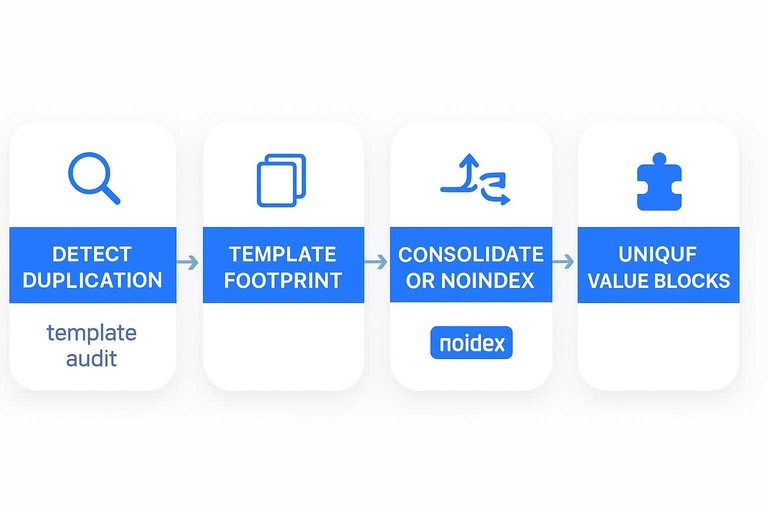
Unique value blocks
Your fix isn’t “rewrite the intro.” It’s adding blocks that can’t be copied across 200 URLs.
- Add local pricing ranges with assumptions.
- Show availability windows and lead times.
- Include real examples, screenshots, or mini case notes.
- List local constraints, laws, or service limitations.
- Provide decision criteria and comparison points.
If a block can’t survive a find-and-replace, it’s not unique value. It’s filler.
Stale AI Facts
AI content generators love confident specifics. When those specifics are outdated or made up, readers bounce and Google notices.
A page saying “2023 tax rates” in 2026 or citing a dead study link is a trust leak. Fixing it is usually faster than rewriting the whole piece.
High-risk claims
Some claims are ranking landmines because they invite complaints, corrections, and fast exits.
- Statistics without a source
- Legal or medical instructions
- Dates, prices, or thresholds
- Product specs and compatibility
- Citations you can’t open
Treat these like production bugs, not “nice-to-fix” edits.
Fact-check workflow
You need a repeatable loop, not heroic research every time.
- Extract each factual claim into a checklist.
- Verify against primary sources, then save the URLs.
- Replace weak sources with stronger, newer ones.
- Delete any claim you cannot verify.
- Add “Last updated” only after review.
If you can’t prove it fast, cut it faster.
Handle uncertainty
Some topics change by region, vendor, or time, and certainty is the fastest way to be wrong.
Use ranges like “30–45 days,” state assumptions like “for US-based employers,” and name what varies.
Write “can” and “often,” not “will” and “always,” when evidence is thin.
Precise uncertainty beats fake precision every time.
Generic Topical Coverage
AI generators love writing the “complete guide” that feels safe. Google sees it as thin because it dodges the specific job your reader hired it for.
A page can rank for impressions while still failing intent. That’s the line that gets crossed.
Intent mismatch clues
Your page can look busy in Search Console and still lose the click. You’re hunting signals that readers didn’t get a usable answer.
Watch for patterns like “I bounced back to Google in ten seconds.”
High impressions with low clicks.
Short dwell time after the click.
Pogo-sticking to other results.
Comments like “but what about X?”
Follow-up searches in PAA.
Treat those clues as a missing-question list, not a traffic mystery.
Depth through angles
Depth is rarely “more words.” It’s more decision-support per paragraph.
- Compare options with clear tradeoffs
- Cover edge cases and exceptions
- Add troubleshooting paths and diagnostics
- State constraints, thresholds, and limits
- Give a decision framework with rules
Cut the generic “what is” section if it repeats every other page. The angles are where your original insight lives.
Rewrite the outline
Your outline should match the reader’s sequence of questions. Put the payoff where their cursor is.
- Write the one-paragraph direct answer first.
- Add the decision criteria and “when to choose what.”
- Insert edge cases and common failure modes next.
- Move definitions, history, and broad context to the bottom.
- End with next steps, tools, or templates.
If the first scroll doesn’t solve something, the rest won’t get read.
Use Google’s own checklist for helpful, people-first content to pressure-test whether your reordered outline actually answers the reader’s “Why/How/Who” questions.
E-E-A-T Signals Missing
AI-only pages often read anonymous, untested, and unaccountable. In competitive or sensitive niches, that’s a ranking handicap. Add clear authorship cues and verifiable evidence, or expect Google to trust someone else.
Add accountable authorship
Own the page like a professional, not a prompt. You want a real person responsible for accuracy, updates, and corrections.
- Add a named author box with role, credentials, and relevant experience.
- Link to a full bio page with portfolio, publications, and a contact path.
- Publish an editorial policy page with sourcing and update rules.
- Add a review process page showing who checks facts and when.
- Include “last reviewed by” for YMYL or high-stakes topics.
If nobody can be held accountable, Google assumes nobody is accountable.
Demonstrate first-hand proof
AI can describe anything, which is exactly why proof matters. Show receipts that you actually did the work.
Use photos, screenshots, test results, sample outputs, or a simple “what we tried” log. Name the tooling and environment, like “Chrome 121 on macOS” or “Ahrefs + Search Console,” and state constraints like budget, timeframe, and dataset size.
When readers can reproduce your result, Google can trust your claims.
Citations that matter
Citations should verify the exact claim, not decorate the paragraph. Swap generic blog references for sources that carry weight.
- Link to primary research, not rewrites.
- Prefer standards bodies and official documentation.
- Cite statutes, guidelines, or policies for compliance claims.
- Add inline links on the sentence that needs proof.
- Quote exact numbers with a source and date.
If your citations don’t anchor the claim, they don’t buy you trust. For a practical, end-to-end checklist to tighten these trust signals, use this AI content checklist for marketers.
Internal Cannibalization
AI content generators love to produce “another version” of the same page. Google reads that as confusion, then splits your relevance signals across URLs.
You want one clear answer per intent, not five pages fighting over the same query.
Find competing URLs
You can’t fix cannibalization until you can see it. Use Google’s own outputs to spot where multiple pages trade places for one query.
- In GSC, open Performance → Search results → Queries.
- Click a query, then switch to the Pages tab.
- Flag queries where 2–5 URLs share impressions or clicks.
- Confirm with a
site:yourdomain.com "query"search. - Repeat for your top 20 non-brand queries.
If two URLs keep rotating, Google is asking you to pick one.
Choose one winner
You need one URL that owns the intent. Everything else should feed it, not compete with it.
Pick the page with the best intent match and backlink profile, then merge useful sections from the others. 301 the old URLs, align title and H1 to the winner’s query, and update internal links to point there.
When you consolidate, rankings often jump without writing anything new.
For implementation options, follow Google’s guidance to consolidate duplicate URLs (redirects vs canonicals vs sitemaps) so the signals actually roll up to the winner.
Set intent boundaries
AI drafts blur page purposes because the prompts blur them. Give each page a single job, then make the headings obey.
- Assign “beginner” vs “advanced” per topic
- Split “comparison” vs “how-to” into separate URLs
- Reserve “templates” for one dedicated page
- Rewrite H2s to match the chosen angle
- Replace FAQs that drift across intents
If you can’t describe the difference in one sentence, Google can’t rank both.

Boilerplate Intros Everywhere
You lose rankings when every page opens with the same AI throat-clearing. It wastes above-the-fold space and makes your content feel templated.
- Delete the “In today’s world…” opener
- Cut the “We’ll cover…” roadmap paragraph
- Replace with one specific claim or number
- Start with a real example from your niche
- Remove the mirrored “In conclusion…” ending
Google doesn’t need your warm-up. Lead with the thing only your page can say.
SERP Snippet Underperforms
Your rankings can hold while clicks drop because your title and meta description read like everyone else’s AI output. Fix the snippet first, because it’s the only part most searchers ever see.
Use this quick swap table to rewrite “AI-generic” snippets into specific, clickable ones.
| AI-generic pattern | Why it underperforms | Better rewrite formula | Example rewrite |
|---|---|---|---|
| “Ultimate Guide to X” | Says nothing unique | Outcome + audience + timeframe | “Cut payroll errors in 30 days (for teams under 50)” |
| “Top 10 X for 2026” | Feels mass-produced | Criteria + context + constraint | “Best CRM for consultants: fast setup, low admin” |
| “X: Everything You Need to Know” | Vague, no promise | Problem + fix + proof point | “Fix GA4 spikes: 3 checks that catch bot traffic” |
| “Discover the Benefits of X” | Sounds like marketing | Task + speed + result | “Generate invoice reminders in 5 minutes, not 50” |
| “X Made Simple” | Too generic | Specific difficulty + who it’s for | “Email deliverability, simplified for Shopify stores” |
If your snippet could fit any competitor, Google won’t punish you—but searchers will.
Written by
Skribra
This article was crafted with AI-powered content generation. Skribra creates SEO-optimized articles that rank.
Share: