February 3, 2026
·
Updated June 2, 2026
·
10 min read
AI Content Generator vs Copywriter for SaaS Launches
A clear comparison for choosing an AI content generator vs a copywriter for SaaS launches—decision snapshot, launch asset mapping, cost/ROI tradeoffs, quality-and-risk checks, and scenario-based recommendations with a final decision matrix.

Shipping a SaaS launch is hard enough—then you hit the content question: do you let an AI tool draft everything, hire a copywriter, or juggle both while the deadline keeps moving?
This comparison helps you pick the right approach per asset and stage. You’ll get a launch asset map, a side-by-side table of strengths and risks, budget and ROI benchmarks, and practical quality checks—so your pages, emails, and ads ship fast without sacrificing positioning or credibility.
Decision Snapshot
Choosing AI, a copywriter, or both comes down to risk and differentiation. If the page can be wrong and you can fix it tomorrow, move fast. If the page sets positioning or pricing, treat it like product work.
Use AI when
Use AI when speed and volume matter more than perfect nuance. It shines when you need many shots on goal.
- Shipping under a tight deadline
- Creating many ad and email variants
- Testing early-stage messaging hypotheses
- Supporting internal or low-visibility launches
- Iterating on low-regret pages
Move fast here, but instrument everything so wins aren’t vibes.
Use copywriter when
Use a copywriter when the work is about differentiation and trust. You’re paying for judgment, not word count.
- Defining positioning and category language
- Writing high-stakes landing and pricing pages
- Explaining complex, multi-stakeholder products
- Navigating regulated or provable claims
- Crafting founder-led narrative and voice
If it can’t be easily walked back, don’t outsource it to a prompt.
Use hybrid when
Use hybrid when you want strategy-grade messaging with production-grade throughput. The writer sets positioning, voice rules, and the “non-negotiables,” like proof points and claim boundaries.
AI then scales drafts, variants, SEO expansions, and localization, using the writer’s guardrails. That division of labor keeps your voice consistent while you move at campaign speed.
Launch Asset Map
SaaS launches fail in boring places. Not product. Positioning drift, vague promises, and mismatched assets.
Use this map to decide where AI drafts fast and where a copywriter owns the message. Stakes and complexity decide, not your tool preference.
Core launch pages
These pages carry your first impression and your conversion rate. One fuzzy claim on pricing can cost months of pipeline.
Homepage and core landing pages need sharp positioning, a clear “who it’s for,” and proof that reads like truth. Pricing and comparison pages need decision-copy: objections, edge cases, and honest tradeoffs.
If a page answers “why you,” make it writer-led and treat AI as an assistant.
Email sequences
Email is where narrative compounds. You need consistency across days, not just clever subject lines.
- Announcement: writer sets promise and urgency
- Nurture: AI drafts variations per persona
- Onboarding: writer defines milestones and tone
- Re-engagement: AI tests angles and offers
- Sales assist: writer handles objections
Use AI for volume, but keep the arc human-owned.
Ads and socials
Paid and social win on iteration speed. The goal is more shots on goal, faster.
- Paid search: AI expands keyword-to-benefit variants
- Paid social: AI generates hook and thumbstopper options
- Organic posts: AI repurposes wins into formats
- Retargeting: writer defines the sequence logic
- Founder voice: writer captures the real tone
Your best ad is usually draft #37, not draft #1.
Sales enablement
Sales assets fail when they’re “mostly true.” One wrong claim in a deck becomes a churn problem later.
Pitch decks and one-pagers need crisp positioning, quantified outcomes, and proof you can defend live. Battlecards need accuracy, restraint, and input from product, sales, and legal.
If an asset will be quoted in a call, make it writer-led and stakeholder-approved.
Comparison Table
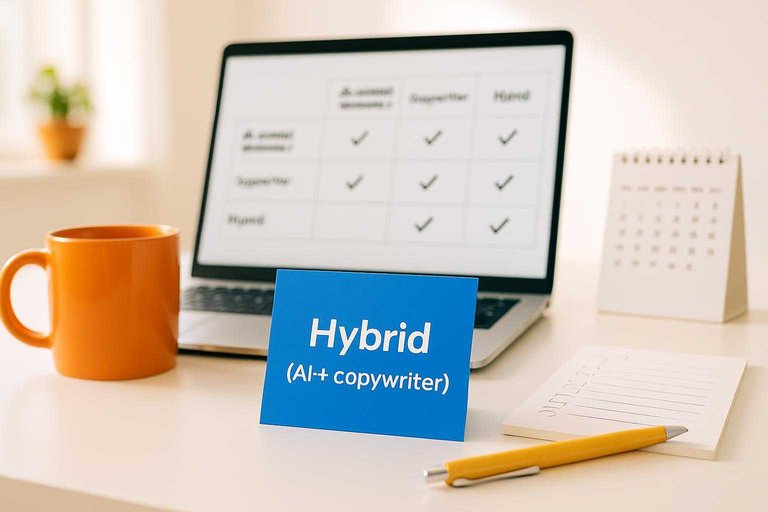
You’re choosing between speed, nuance, and risk tolerance. Use this table to pick what fits your launch constraints—and for a deeper breakdown of tradeoffs, see AI content vs human writers.
| Factor | AI content generator | Copywriter | Hybrid (AI + copywriter) |
|---|---|---|---|
| Speed | Minutes | Days to weeks | Hours to days |
| Cost | Low subscription | Higher per project | Mid, flexible |
| Differentiation | Generic without inputs | Strong positioning | Strong with guardrails |
| Accuracy | Needs verification | Higher, still check | Higher, best checks |
| Compliance risk | Higher, easy mistakes | Lower with experience | Lower with process |
| Collaboration | Async, prompt-based | Workshops, interviews | Both, streamlined |
| Scalability | Very high volume | Limited bandwidth | High, controlled |
| Learning curve | Prompting and review | Briefing and feedback | Process and roles |
Pick hybrid when stakes are high and deadlines are real.
Use AI Content Generator
You use an AI content generator when output volume is the constraint, not taste. Think “good enough, fast” for launch assets like emails, ads, and landing-page sections.
High-volume iterations
AI wins when you need many shots on goal and you can measure the winner. For a SaaS launch, that’s dozens of A/B variants, persona rewrites, headline banks, and feature-to-benefit expansions like “SAML support” → “get IT approval faster.”
Velocity beats originality here. Your edge comes from testing, not prose.
Lean team workflows
Use AI as your first-draft engine, then run a tight human gate. The goal is fewer blank pages and faster learning.
- Prompt with ICP, offer, and one real example.
- Draft the asset in one format.
- Fact-check every claim against sources.
- Apply brand voice and legal constraints.
- QA links, screenshots, and numbers, then ship.
Treat AI like a junior writer with infinite stamina. You still own the accuracy. (See OpenAI’s guidance on accuracy & limitations.)
Localized campaigns
AI helps when you need fast localization across regions without rebuilding the campaign. Give it a terminology glossary, region-specific proof points, and “do-not-translate” rules like product names.
Add a native-speaker review gate for nuance, compliance, and cultural fit. That’s how you scale language without scaling mistakes.
Use a Copywriter
When your launch needs strategy, not just sentences, hire a copywriter. They reduce risk by making hard calls on positioning, proof, and what not to claim.
Positioning discovery
You need positioning before you need paragraphs. A copywriter turns messy inputs into a message you can defend in a sales call.
They’ll pull from:
- Customer interviews and call snippets
- Win/loss notes from sales
- Competitor teardowns and teardown screenshots
They’ll ship:
- Messaging hierarchy: primary, secondary, supporting
- Narrative: “from pain to payoff” story
- Proof plan: stats, quotes, case studies
If the inputs are human, the strategy should be too.
High-stakes pages
Some pages carry your entire funnel. They deserve precision because small changes swing conversion.
- Pricing page: anchors value, reduces sticker shock
- Homepage hero: makes the “why you” click fast
- Enterprise landing: handles risk, procurement, objections
- Demo request page: removes friction, sets expectations
- Comparison page: wins the “shortlist” moment
Treat these like product surfaces, not content tasks.
Regulated claims
If your product touches finance, health, privacy, or security, wording becomes liability. A copywriter knows when “we prevent” should become “we help reduce.”
They run controls like:
- Claim substantiation tied to real evidence
- Legal review paths and approval logs
- Security language that matches your actual posture
- Testimonials that avoid implied guarantees
- Guarantees and refunds that match policy
Nuance is where lawsuits live, and humans hear nuance.
Stakeholder alignment
Alignment is a process, not a meeting. A copywriter gives you a workflow that protects timelines and sanity.
- Run a kickoff with goals, ICP, and non-negotiables.
- Lock a voice guide with do’s, don’ts, and examples.
- Get outline approval before anyone touches copy.
- Do structured draft reviews with one decision owner.
- Finish with final QA for claims, links, and consistency.
This is how you stop “one more tweak” from eating the launch.
Budget and ROI
You can ship a SaaS launch with an AI tool, a copywriter, or both. The right choice depends on your stakes, your timeline, and how expensive “wrong” is.
Typical cost ranges
“AI is cheap” is only true if you ignore everything around it. The subscription is rarely the real cost driver—review time is.
Budget for three buckets:
- Tooling: AI subscription(s), SEO tooling, design/copy systems, and any compliance tooling you already run.
- Human time: prompting, editing, fact-checking, stakeholder review, and project management.
- Rework risk: the time you spend unshipping bad claims, fixing mismatched pricing, or rewriting after sales says “this doesn’t land.”
A copywriter costs more upfront, but often reduces total cycles. You’re buying fewer drafts, fewer meetings, and fewer “we need to rethink this” moments.
Hybrid budgets best when you separate strategy work (writer-led) from production work (AI-led with review). Without that split, you pay twice: once for the writer, then again in messy revisions.
ROI drivers
Your ROI comes from a few levers that compound across the funnel.
- Time-to-launch: If you’re late, you lose learning cycles. AI can buy speed, but only if you have a clean approval path.
- Conversion clarity: Better positioning shows up as fewer bounces, better demo requests, and higher intent from the right ICP.
- Sales efficiency: Great copy reduces explanation debt. Reps spend less time translating your product and more time qualifying.
- Risk reduction: Avoiding one unprovable claim, one inaccurate security statement, or one misleading pricing line can save weeks of cleanup.
- Asset reuse: A strong messaging core (voice, proof, objection answers) becomes a template library you can reuse across launches.
If you can’t measure results yet, use proxy signals: fewer objections in calls, tighter stakeholder alignment, and faster iteration without brand drift.
When to upgrade
Stay on AI while the cost of being “pretty good” is low. Move to a writer when the business starts paying for nuance.
Upgrade from AI-only to copywriter-led (or hybrid) when:
- Your homepage, pricing, or comparison page becomes a primary acquisition surface.
- Sales says, “Prospects keep misunderstanding what we do” (positioning problem, not a copy problem).
- You’re entering enterprise or regulated conversations and need claim boundaries you can defend.
- Stakeholder reviews keep ballooning because nobody owns the narrative.
- Your ads generate clicks but your landing pages don’t convert (message mismatch).
A practical rule: use an AI content generator to produce volume, but don’t let it define your strategy. When a page sets expectations you’ll live with for months, pay for judgment.
Quality and Risk Checks
Speed is useless if your launch copy drifts off-spec. That’s how you ship hallucinated features, generic promises, or a brand voice that sounds rented.
Accuracy checklist
Before you publish, lock facts to sources you can point to—use an essential AI content checklist to catch missing citations early. Treat every claim like it will be screenshotted by a competitor.
- Confirm product facts against current docs
- Verify integrations in live environments
- Match pricing to the checkout page
- Substantiate security claims with reports
- Authenticate quotes, benchmarks, disclaimers
If a claim lacks a source, it’s not copy yet. It’s a liability.
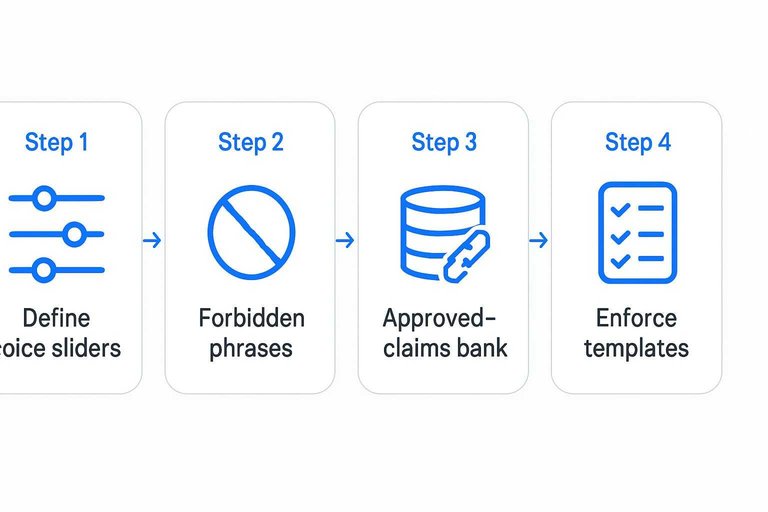
Brand voice controls
You can’t “review your way” into a consistent voice. You need constraints that your AI or writer can’t ignore.
- Define voice sliders, like “bold vs careful,” with examples.
- List forbidden phrases, plus preferred rewrites.
- Create an approved-claims bank with links to evidence.
- Enforce templates, then run a human voice review.
You’re building a writing system, not hoping for good taste.
Originality and differentiation
Sameness happens when you start from features and end in adjectives like “seamless” and “powerful.” Start from a point of view, use customer language verbatim, and write proof-first.
Use competitive contrasts carefully. Name the tradeoff you choose, like “fewer features, faster setup,” and back it with specifics.
Common Launch Scenarios
MVP launch
You need speed, not polish. Use AI first, then do a light human edit for clarity.
Ship a simple homepage, one email, and a short “what it does” deck. Keep one positioning line consistent, like “automated refunds for Stripe,” then iterate weekly.
The goal is learning, so optimize for feedback loops, not perfect voice.
Series A growth
You need consistency and scale. Go hybrid: a writer sets the message, then AI multiplies it.
Have the copywriter lock your core story, ICP language, and proof points. Then use AI to generate variants for ads, landing pages, nurture emails, and segment-specific angles.
If your message is stable, AI turns it into experiments fast.
Enterprise push
You’re selling trust, not features. Lead with a copywriter who can build credibility.
Your narrative must cover security, compliance, and risk reduction in plain language. Prioritize case studies, ROI stories, procurement-ready pages, and sales enablement that matches how reps sell.
In enterprise, one weak claim can stall a deal for months—especially if you don’t follow the FTC’s advertising substantiation guidance.
New category bet
You’re not just launching a product. You’re teaching the market what to believe.
Start copywriter-led on strategy: the category name, the “enemy,” the before-and-after story, and the objection map. Then use AI to distribute that thinking across blogs, emails, social threads, and webinar promos.
If you don’t write the narrative, competitors will write it for you.
Final Recommendation Matrix
Use this when you need a fast, defensible call for your SaaS launch stage and risk level.
| Stakes / stage | AI | Copywriter | Hybrid |
|---|---|---|---|
| Low stakes, early MVP | Default | Optional | Nice-to-have |
| Medium stakes, beta launch | Draft + iterate | Review key pages | Recommended |
| High stakes, paid launch | Risky alone | Strong choice | Default |
| Regulated, enterprise | No | Default | With legal review |
| Brand reposition, new category | Weak | Default | Strong choice |
Make AI your baseline only when mistakes are cheap; otherwise, pair speed with judgment.
Choose your default, then lock in safeguards
- Pick a default based on stakes: AI for volume and iteration, a copywriter for positioning and high-stakes pages, or hybrid when you need speed plus narrative coherence.
- Map that choice to your asset list (pages, emails, ads, sales enablement) and assign owners—who drafts, who edits, who approves claims.
- Run the quality and risk checks before anything ships: factual accuracy, compliant wording, consistent voice, and clear differentiation from competitors.
- Revisit the recommendation matrix after the first launch results (CTR, demo rate, sales cycle feedback) and upgrade the workflow where returns justify it.
Frequently Asked Questions
- Does an AI content generator replace a SaaS copywriter for a product launch?
- Usually not for the full launch. An AI content generator is strongest for drafting and scaling variations, while a copywriter is better for positioning, proof-backed claims, and high-stakes pages like the homepage and pricing.
- How do I evaluate AI-generated launch copy before publishing it for my SaaS?
- Run a checklist: verify every claim against sources (docs, analytics, customer quotes), scan for compliance issues (security/privacy, regulated claims), and test clarity with 3–5 target users. Tools like Grammarly, Originality.ai, and a brand-style linting prompt can catch obvious issues, but human review should approve final messaging.
- What results should I expect from using an AI content generator for SaaS launch assets?
- Expect faster production and more testable variants (often 2–5x more headlines/ads/emails) rather than guaranteed conversion lifts. Performance gains typically come from better experimentation velocity and tighter iteration using data from tools like GA4, Mixpanel, or Amplitude.
- Is AI-generated copy safe for SaaS compliance, security, and privacy messaging?
- It’s often risky to publish without review because AI can invent certifications, overpromise capabilities, or misuse legal language. Treat AI output as a draft and require approval from product/security/legal for SOC 2, HIPAA, GDPR, pricing, and data-handling statements.
- How often should I refresh AI-generated landing pages and emails during a SaaS launch?
- Refresh weekly during the first 2–4 weeks of launch based on conversion data and sales-call objections, then move to a monthly cadence. Update sooner if you change pricing, positioning, onboarding, or add proof like case studies and benchmarks.
Launch Faster With AI Content
If your launch plan calls for lots of assets, the real constraint is producing on-message pages and posts quickly without sacrificing quality checks.
Skribra generates SEO-optimized launch content consistently—with WordPress publishing, formatting, and images handled—so your team can focus on positioning; start with the 3-Day Free Trial.
Written by
Skribra
This article was crafted with AI-powered content generation. Skribra creates SEO-optimized articles that rank.
Share: