May 8, 2026
·
10 min read
AI ranking vs classic SEO: which to prioritize
A clear comparison of AI ranking vs classic SEO to help you prioritize your roadmap—understand how AI systems retrieve and cite content, where traditional ranking signals still dominate, how to choose by business model, and which metrics and playbooks drive results in 90 days.

You can publish the “perfect” SEO article and still watch AI answers skip right past you. Or you can chase AI visibility and wonder why organic traffic, links, and conversions didn’t move.
This comparison helps you decide what to prioritize based on how AI systems select sources, how classic SEO still wins the SERP, and where the overlap creates compounding gains. You’ll leave with a decision matrix, model-specific guidance, and measurable 90-day targets—plus practical sprints you can run immediately.
Decision Context
You’re choosing where to spend your next hour and your next dollar: classic SEO work, or work aimed at AI-driven discovery. “Prioritize” means shifting budget, calendar slots, and KPIs toward what moves outcomes, not what feels modern. Think, “Do we chase rankings and clicks, or citations and answers?”
What “AI ranking” is
AI ranking is how your content gets selected, summarized, or cited inside AI experiences, not just listed as a blue link. That includes AI Overviews, LLM chat answers, recommendation feeds, and retrieval systems that lift passages like “According to X…” from your pages.
The key unit is often the snippet, not the page.
If your best paragraph can’t stand alone, you’ll struggle to show up.
What “classic SEO” covers
Classic SEO is the set of systems that help search engines crawl, index, and rank your pages for queries. It’s on-page relevance, internal linking, backlinks, technical performance, and SERP features like rich results and sitelinks.
It’s the world of “we moved from position 8 to 3.”
If Google can’t reliably fetch and understand your pages, nothing else compounds.
Where they overlap
Both paths reward the same basics, because machines still need clarity and proof. You’re building content that reads well and extracts cleanly.
- Write helpful, specific content
- Use clear headings and structure
- Keep pages fresh and maintained
- Show authority cues and provenance
- Serve fast, accessible pages
Do those well, and you’re not choosing sides yet—you’re buying optionality.
What prioritizing changes
Prioritizing changes your production and measurement, not your beliefs. You’ll adjust content formats, architecture, link and PR effort, schema usage, and what you count as a win.
Classic SEO priority leans into scalable pages, internal link hubs, and rank-to-click conversion. AI ranking priority leans into quotable passages, entity clarity, citations, and distribution that earns mentions.
Pick the KPI first, or you’ll ship the wrong work really efficiently.
How AI Ranks Content
AI systems don’t “rank pages” the way classic search does. They assemble answers from chunks they can retrieve, trust, and reuse.
You can’t control the model. You can control how easily your content becomes the chosen source and the chosen quote—especially as AI transforms SEO content creation.
Retrieval and selection
AI answer systems start by building a candidate set, because they can’t read the whole web per question. If your best passage isn’t retrievable, you won’t be considered.
Candidate sourcing often looks like this:
- Query rewriting to expand intent and synonyms
- Vector embeddings to find similar meaning
- Keyword indexes for exact terms
- Passage-level retrieval over whole pages
Passage-level relevance is the big shift. A single strong paragraph can beat a “better” page with a buried answer.
Answer composition
Once candidates exist, the system chooses what it can safely quote or paraphrase. Your job is to write passages that survive compression.
- Write quotable lines with clean definitions
- Add specificity: numbers, ranges, thresholds
- Align with consensus when possible
- Reduce ambiguity with tight nouns and verbs
- State one claim per sentence
If your paragraph can’t be lifted cleanly, it won’t make the cut.
Trust and attribution
Models and RAG layers lean on credibility signals because wrong answers are expensive. They prefer sources that look stable, attributable, and consistent over time.
You influence that with entity clarity and repeatable authorship signals: the same organization name, the same experts, the same bios, and citations that point to primary sources. When your page reads like “someone said this somewhere,” attribution usually goes elsewhere.
Failure modes
Most AI visibility problems are basic publishing problems with new penalties. The system can’t quote what it can’t find or trust.
- Publish thin pages with no unique claims
- Bury answers under long intros
- Split entities across inconsistent names
- Block bots or key resources
- Make claims without needed context
Fix retrieval and clarity first. “Better writing” comes after the content is selectable.
How Classic SEO Wins
Classic SEO still wins when you want predictable, repeatable traffic. It turns rankings into an engineering problem: access, relevance, and authority. If Google can’t crawl it, can’t understand it, or can’t trust it, nothing else matters.
Technical access
Crawlability and indexability are the admission ticket, not a growth hack. You’re removing friction so Google can fetch, render, and store the right URLs.
Clean internal linking distributes discovery and priority, especially for deeper pages. Canonicals prevent “which URL wins?” chaos, while sitemaps confirm what should exist.
Performance closes the loop: fast pages get crawled more, and users stick. Fix access first, then argue about content.
Relevance signals
Relevance is you proving you deserve the query. You do it with on-page choices that mirror what the SERP already rewards.
- Match keyword intent to page purpose
- Use headings that reflect subtopics
- Cover the topic, not just terms
- Add depth with examples and data
- Use SERP-native formats, like lists
If your page looks unlike the winners, you’re betting against the market.
Authority signals
Authority is the compounding part of classic SEO. Links pass equity, but they also act as independent “votes” you don’t control.
Digital PR earns those votes through coverage, citations, and legit mentions, not directory spam. Brand demand helps too, because navigational searches and repeat clicks send durable trust signals.
When authority is real, small on-page changes move rankings faster. That’s the difference between a spike and a baseline.
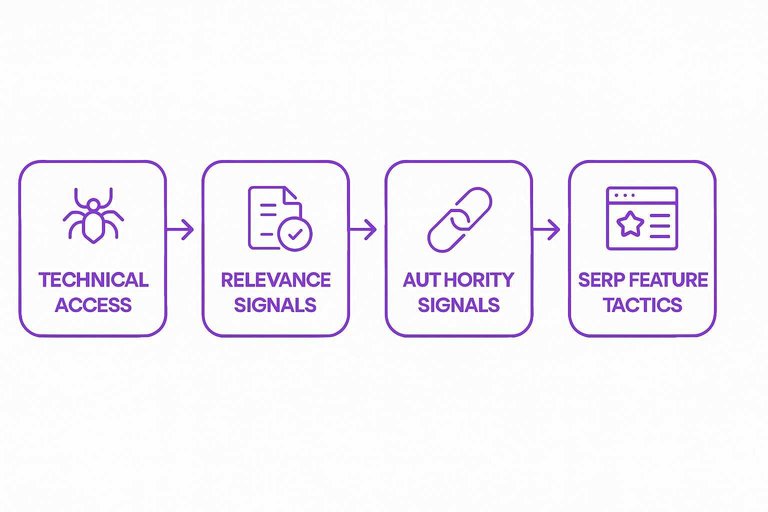
SERP feature tactics
SERP features are extra surfaces, not bonuses. You’re optimizing for how Google chooses to present answers.
- Win snippets with direct, scoped answers
- Add FAQs with clean Q-and-A markup
- Use descriptive filenames and alt text
- Publish video with tight intros
- Optimize local with category and reviews
Features can steal clicks from your blue link. Take the slot before someone else does. For a deeper walkthrough, see this classic SEO guide.
Option Comparison Matrix
You’re choosing where to spend your next 30 days: AI ranking signals or classic SEO fundamentals. Compare them on effort, speed, risk, measurability, and durability before you pick a lane.
| Focus | Effort | Speed | Risk | Measurability | Durability |
|---|---|---|---|---|---|
| AI ranking focus | Medium | Fast | Medium-High | Low-Medium | Medium |
| Classic SEO focus | Medium-High | Medium | Low-Medium | High | High |
| Hybrid (SEO-first) | High | Medium | Medium | Medium-High | High |
| Hybrid (AI-first) | High | Fast | High | Medium | Medium |
If you can’t measure it weekly, you can’t manage it monthly.
Choose by Business Model
Different revenue motions reward different ranking surfaces. Pick the mix that matches how buyers discover, compare, and convert.
Ecommerce and retail
Classic SEO and feed hygiene usually pay first because shopping discovery is still query-and-grid. If your Merchant Center titles are messy, you’ll never win “running shoes size 11” clicks.
Your priority stack:
- Nail category pages: facets, internal links, indexation rules
- Fix product feeds: titles, GTINs, availability, images, shipping
- Build comparison assets: “best X for Y” and “X vs Y” pages
- Add AI-friendly spec blocks: dimensions, materials, compatibility, warranties
AI ranking shows up most in comparison and recommendation queries, so publish the pages shoppers use to decide, not just to browse.
B2B SaaS
B2B SaaS wins when you capture demand and then shape it. You need pages that answer “what is” and “does it integrate with” fast.
Local services
Classic SEO dominates because the local pack, reviews, and proximity still decide the call. People search “emergency plumber near me” and trust the star count.
Do both, but sequence it:
- Win local: GBP, reviews, NAP, service pages, location pages
- Clarify service areas: neighborhoods, zip codes, travel fees
- Publish pricing clarity: ranges, minimums, common add-ons
- Add “what happens next” pages: process, timelines, prep checklists
AI-friendly clarity reduces tire-kickers and primes leads before they hit the phone.

Publishers and media
You’re competing on speed, authority, and reusability. If your reporting isn’t easy to cite, AI systems will cite someone else.
Metrics That Decide
If you don’t define success, you’ll optimize vibes. In 90 days, you need metrics that move, attribute cleanly, and trigger decisions like “double down” or “stop.”
Classic SEO metrics
Measure classic SEO because Google still rewards consistency, and you can diagnose cause and effect faster.
- Track impressions by query and page
- Track clicks and CTR trends
- Track rankings for priority terms
- Track crawl stats and index coverage
- Track CWV, backlinks, and landing conversion rate
Use these to find constraints, not trophies.
AI visibility metrics
Measure AI visibility because “being recommended” is different from “being ranked.” You’re tracking whether models surface you, cite you, and send engaged traffic.
- Track brand mentions in AI outputs
- Track citations and linked sources
- Track referral sources from AI tools
- Track prompt testing coverage by intent
- Track engagement on cited pages
If citations rise but engagement drops, your pages are getting used as filler.
Attribution reality check
AI referrals are noisy because the click often happens later, elsewhere, or not at all. A user might read an answer, search your brand, then convert from “Direct.”
Use experiments, cohorts, and assisted conversions to stay honest. Run holdouts on a subset of pages, track branded-search lift by region, and credit “assist” when AI traffic appears in the path.
If you only count last-click, you’ll kill the channel that’s seeding demand.
90-day targets
Set targets that force trade-offs monthly, not after a quarter.
- Baseline weeks 1–2 with current traffic, rankings, mentions, and conversions.
- Pick 2–3 leading indicators per channel, like CWV pass rate or citations.
- Set thresholds, like “+15% non-brand clicks” or “+30% citation rate.”
- Review monthly and reallocate effort based on threshold hits.
- Lock one constraint to fix next month, like crawl waste or thin citations.
Your goal is a repeatable decision loop, not a perfect dashboard.
Implementation Playbooks
You don’t need a religious war between classic SEO and AI rankings. You need a plan that compounds, survives churn, and still ships this week.
Run one sprint per path to learn fast. Then settle into a blended cadence you can repeat without heroics.
Classic SEO sprint
Do this when your crawl, indexation, or core pages are underperforming. It’s the fastest way to unlock “already-earned” demand.
- Fix indexation: sitemaps, canonicals, robots, and thin-duplicate clusters.
- Optimize top pages: titles, H1s, intent match, and above-the-fold answers.
- Refresh decaying content: update facts, examples, and screenshots.
- Build internal link hubs: one hub per theme, with tight contextual anchors.
- Launch a link/PR plan: pitch data, tools, and founder POV.
If your best pages aren’t indexed and linked, AI visibility won’t save you.
AI ranking sprint
Do this when you rank but don’t get cited. You’re optimizing for extraction, quoting, and answer assembly.
- Create quotable sections: crisp claims, numbers, and “what to do” blocks.
- Add entity clarity: consistent names, attributes, and definitions across pages.
- Cite sources: link primary references and date-stamp key assertions.
- Build comparison pages: X vs Y, alternatives, and “best for” scenarios.
- Improve passage discoverability: descriptive subheads and self-contained paragraphs.
If a model can’t lift a clean passage, you won’t win the mention.
Blended weekly cadence
Split your week by business priority, not by channel ideology. Aim for steady technical hygiene, a few high-leverage content upgrades, and ongoing authority building.
A workable cadence is: one technical block to prevent silent losses, two content blocks tied to revenue pages, one PR/outreach block for new citations, and a short monitoring block for rankings, mentions, and conversions. Tie every task to a funnel stage, like “pricing page clarity” or “comparison page for late-stage buyers.”
You’re building a system that wins twice: in search results and in answers.
Content formats to favor
These formats map cleanly to search intent and AI extraction. They also force you to be specific.
- Definitions and “what is” explainers
- Comparisons and alternatives pages
- Checklists and templates
- Troubleshooting and error guides
- Pricing, plans, and packaging pages
If you can’t express it in one of these formats, you probably can’t rank it.
Pick a priority, then run a 90-day proof plan
- Choose your primary constraint: if you’re not consistently indexed, ranking, and converting, prioritize classic SEO; if you already win core queries but aren’t being selected/cited in AI answers, prioritize AI ranking.
- Set paired targets for 90 days: one classic (e.g., +X pages in top 10 or +Y% non-brand traffic) and one AI visibility target (e.g., citations/mentions for Z topics, inclusion rate in key answer surfaces).
- Run one sprint, then blend: ship the highest-leverage technical/relevance fixes or AI-citable content upgrades first, measure weekly, and keep what moves both visibility and revenue.
Frequently Asked Questions
- Does AI ranking replace classic SEO in 2026?
- No—AI ranking usually rewards the same fundamentals (clear intent match, trustworthy sources, strong technical accessibility) while adding more emphasis on citation-worthiness and entity clarity. Classic SEO still drives the most reliable, trackable demand capture for many queries.
- How do I tell if my traffic drop is from AI ranking changes or a classic Google algorithm update?
- Check Google Search Console for query/page-level impressions and CTR shifts, then compare in GA4 whether sessions fell without a matching ranking drop (often a sign of AI answers reducing clicks). Use SERP tracking (Semrush/Ahrefs) to see if AI Overviews or answer modules appeared for your top queries around the same dates.
- What should I optimize first for AI ranking: content structure, schema markup, or backlinks?
- Start with content structure and source quality—tight answers, clear headings, and verifiable claims make you easier to quote and summarize. Add schema (Organization, Article, FAQ, Product/Review where relevant) next, then build topical authority and links to reinforce trust signals.
- Can small sites win AI ranking without a big backlink profile?
- Often yes, if you publish original, specific information (data, examples, firsthand experience) and cover a narrow topic deeply with consistent internal linking. You’ll still need baseline credibility signals (author pages, references, mentions) to compete on sensitive or high-stakes topics.
- How long does it take to see results from AI ranking optimization compared to classic SEO?
- AI ranking improvements can show in 2–6 weeks once content is crawled and surfaces in AI-driven results, but volatility is higher. Classic SEO typically shows early movement in 4–8 weeks and more stable gains in 3–6 months.
Operationalize AI Ranking Strategy
After weighing AI ranking signals against classic SEO fundamentals, the hard part is executing both consistently across every new page you publish.
Skribra helps you produce SEO-optimized articles at scale—complete with keywords, formatting, and WordPress publishing—so you can pursue AI ranking and classic SEO together with a 3-Day Free Trial.
Written by
Skribra
This article was crafted with AI-powered content generation. Skribra creates SEO-optimized articles that rank.
Share: