April 17, 2026
·
Updated July 28, 2026
·
10 min read
AI SEO agency vs in-house team for SaaS
A comparison to choose between an AI SEO agency and an in-house SEO team for SaaS—use decision snapshots, criteria and cost/ROI tables, time-to-impact benchmarks, quality/expertise checks, alignment/control factors, and data-security risk controls to pick the right operating model.

Hiring for SEO in SaaS isn’t just a budget call—it’s a speed, control, and risk decision that can quietly shape your pipeline for a year. Move too fast with the wrong model and you’ll ship content that doesn’t convert, or worse, create technical debt.
This comparison helps you decide whether an AI SEO agency or an in-house team fits your stage and constraints. You’ll get a clear decision snapshot, side-by-side scoreboards, cost and ROI expectations, timelines to impact, quality criteria, alignment tradeoffs, and the security realities of AI-assisted production.
Decision Snapshot
Choosing between an AI SEO agency and an in-house team is a trade between speed and control. If your CEO says “pipeline this quarter,” the agency model usually wins. If your product needs careful language and tight technical accuracy, in-house tends to win.
Best For Fast Growth
You choose an AI SEO agency when output speed matters more than internal precision. This fits SaaS teams with thin headcount and aggressive targets.
An agency wins when you need:
- High content velocity without hiring delays
- Broader SEO coverage across many topics
- Faster testing of pages, briefs, and updates
- A plug-in team for audits and fixes
If you can’t staff it in 30 days, you’re already in “agency” territory.
Best For Deep Control
You choose in-house when the cost of being wrong is high. This fits SaaS with technical depth, regulated claims, or brand-sensitive positioning.
In-house wins when you need:
- Product-accurate writing on complex features
- Tight review loops with legal or security
- Consistent voice across docs and marketing
- Close alignment with roadmap and releases
If approvals are the bottleneck, outsourcing won’t fix the system.
Key Assumptions
These comparisons assume a fairly normal SaaS setup. Change these inputs and the “winner” flips.
- Series A–C growth stage
- $8k–$30k monthly SEO budget
- Clear ICP and buying triggers
- Mix of BOFU and MOFU content
- Some engineering access each sprint
- Weekly reporting, monthly planning
If your ICP is fuzzy, both models will publish noise faster.
What You’ll Decide
Make the choice like a product experiment, not a branding debate.
- Score speed, control, cost, quality, and risk from 1–5.
- Map constraints: approvals, SMEs, engineering time, and tools.
- Pick the model that removes your biggest bottleneck.
- Validate with a 90-day plan and a kill switch.
Treat it like a trial you can exit, and you’ll choose faster.
Criteria Scoreboard
You’re choosing between speed and control, not “good” versus “bad.” Use this scoreboard to decide what you need right now, not what sounds impressive.
| Criterion | AI SEO agency | In-house team | Winner (why) |
|---|---|---|---|
| Time-to-impact | Fast launch | Slower ramp | Agency: ready process |
| SaaS domain depth | Broad patterns | Product nuance | In-house: closer context |
| Content throughput | High volume | Medium volume | Agency: more capacity |
| Technical SEO fixes | Advises teams | Executes daily | In-house: ships changes |
| Tooling + automation | Included stack | Build and maintain | Agency: less overhead |
If execution lives in your product squad, an agency’s “recommendations” can die in Jira.
Cost And ROI
You’re not choosing “cheaper.” You’re choosing when you want ROI to show up, and what risk you can tolerate.
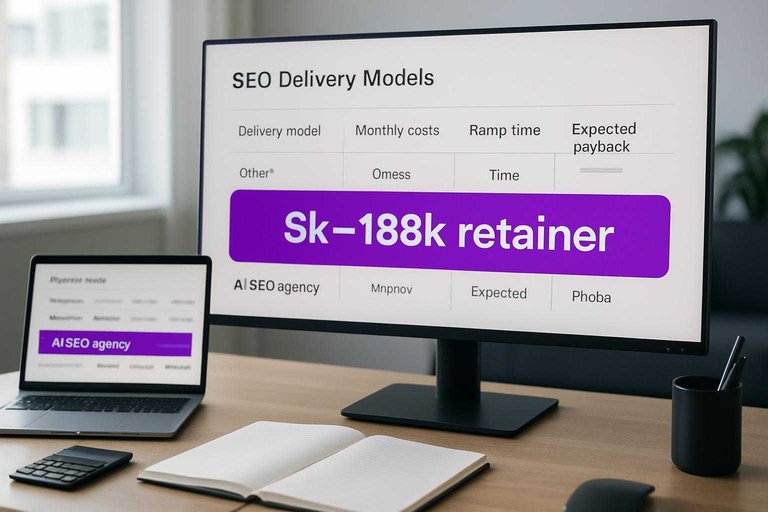
| Model | Monthly costs | Hidden costs | Ramp time | Expected payback |
|---|---|---|---|---|
| AI SEO agency | $6k–$18k retainer | Rework, approvals | 2–6 weeks | 3–6 months |
| In-house (1 hire) | $9k–$16k fully loaded | Recruiting, tools | 8–16 weeks | 6–12 months |
| In-house (2 hires) | $18k–$32k fully loaded | Management overhead | 12–24 weeks | 9–18 months |
| Hybrid (agency + owner) | $4k–$12k retainer | Context switching | 2–4 weeks | 2–5 months |
If your runway is tight, payback timing matters more than the sticker price.
Time To Impact
Speed is the whole game in SaaS SEO. You’re paying for the gap between kickoff and the first graph that moves.
An AI SEO agency usually wins early speed through ready-made systems and tooling. In-house usually wins later speed once your org stops being the constraint.
Ramp-Up Timeline
The first 90 days decides whether SEO feels like momentum or mystery. Here’s what typically happens, by model.
- Days 1–30: Agency gets access faster; in-house fights permissions and tool setup.
- Days 1–30: Agency runs audits immediately; in-house aligns on scope and baseline.
- Days 31–60: Agency ships briefs in batches; in-house perfects one template.
- Days 61–90: Agency publishes weekly cadence; in-house ramps with fewer blockers.
- Days 61–90: Agency learns fast on patterns; in-house learns deep on product nuance.
If day 30 has no publishing plan, you don’t have an SEO program yet.
Content Velocity
Content velocity is mostly a throughput problem, not an “ideas” problem. Agencies ship more pages per month early because they bring production capacity, AI workflows, and an editorial line already working.
In-house can match or beat that later, but only after you’ve built repeatable briefs, review loops, and a writer bench. Until then, your bottleneck is usually editorial bandwidth, not strategy.
If you can’t publish consistently, rankings won’t “eventually” happen.
Iteration Speed
Iteration speed is the time from signal to change. Agencies move quickly when they own the loop: CTR tests, internal link passes, refresh batches, and pruning decisions happen on a set cadence.
In-house is faster when updates need cross-team context, like product-led pages or complex messaging. It’s slower when every change requires approvals, engineering tickets, or a quarterly roadmap slot.
The model that controls the knobs ships the learning.
Bottleneck Watchlist
Delays cluster in the same places every time. Spot them early, or they’ll set your pace.
- Agency: slow stakeholder reviews and “drive-by” feedback.
- Agency: limited SME time for accuracy checks.
- In-house: engineering queue for templates and fixes.
- In-house: legal and compliance approvals.
- Both: missing analytics and GSC access.
Fix the bottleneck, not the calendar.
Quality And Expertise
Quality is where the model choice stops being philosophical and becomes operational. You either ship clean SEO work weekly, or you ship backlog.
In SaaS, constraints are predictable: limited engineering time, fast releases, and messy attribution from content to revenue.
Technical SEO Depth
Technical SEO quality is mostly about how well you integrate with engineering. Audits are easy; getting fixes merged before the next deploy is the job.
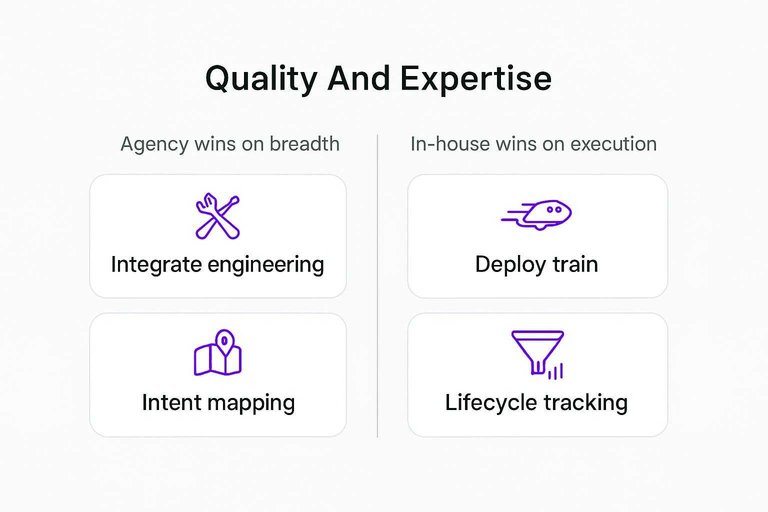
An agency usually wins on breadth: sharper audits, faster crawl diagnostics, better schema patterns, and calmer migrations. In-house often wins on execution under SaaS constraints: knowing your deploy train, your feature flags, and which PM owns the template that’s breaking canonicals.
If your bottleneck is “we don’t know what’s wrong,” hire depth. If it’s “we can’t get it shipped,” hire proximity.
Content Strategy Fit
SaaS content strategy fails when it optimizes for traffic instead of pipeline. The right strategy maps intent to a next step like “start trial” or “book demo.”
In-house usually wins on funnel fit because they know the ICP, objections, and sales narrative. An agency can win when it brings disciplined intent mapping, competitor gap mining, and a repeatable system for turning product edges into pages—especially once you understand the key differences between AI and humans.
Pick the team that can answer, “What should a visitor do next?” without guessing.
Subject-Matter Accuracy
AI-heavy SEO breaks trust when it invents details about your product. You need a system that forces reality into the draft.
- Run SME interviews before outlines
- Use mandatory review loops per feature
- Require citations for claims
- Add QA checks for “made-up” pricing
- Maintain a product-source doc
If accuracy depends on heroics, you’ll ship confident nonsense.
Measurement Rigor
Measurement is where “good content” turns into budget protection. You need attribution, dashboards, and experiments that survive scrutiny.
In-house tends to own the messy parts better: lifecycle tracking from visit to trial, activation, CAC, and LTV. Agencies can outperform when they bring a hardened experimentation cadence, clean reporting templates, and the discipline to call a test a loss.
The winner is whoever can prove SEO’s impact after the sales cycle, not after the click.
Control And Alignment
Control is where SEO either compounds or stalls. If approvals drag or voice drifts, your “one more page” becomes six weeks.
Brand And Voice
Brand voice is a system, not a vibe. The winner is whoever can ship updates without turning your site into a patchwork quilt.
In-house usually wins when positioning changes often, or when legal and exec review is tight. Agencies win when you give them a clear style guide, a message house, and a single approver who can say “yes” fast.
If your tagline changes quarterly, keep voice ownership inside.
Cross-Team Access
SEO needs real inputs: churn reasons, feature nuance, ticket language, and roadmap timing. The winner is whoever can reach those sources without begging for screenshots.
In-house wins when you need direct access to PMs, engineers, and support dashboards. Agencies win only when you assign an internal liaison with authority and recurring access to product and sales, plus a clean implementation path.
If your agency can’t talk to the people building the product, they’re guessing.
Governance Model
You prevent chaos by deciding who owns what, before the first brief. Pick the model, then lock the decision rights.
- Name one SEO DRI and one brand approver per team.
- Set SLAs for briefs, reviews, and deployments by channel.
- Create a weekly review cycle and a monthly planning cycle.
- Document standards: voice, internal links, templates, and QA.
- Define decision rights: who can publish, pause, or redirect work.
Without decision rights, you don’t have governance. You have group chat.
Stakeholder Load
Both models cost internal time. The difference is where that time shows up.
- In-house: recurring reviews, fewer context meetings.
- In-house: more enablement, less vendor management.
- Agency: heavier approvals, more feedback loops.
- Agency: more coordination, less hands-on writing.
- Agency: more change management, fewer ad-hoc asks.
If you can’t fund attention, you can’t fund outcomes.
Data Security Risk
In SaaS SEO, security risk usually comes from access sprawl and undocumented handling of customer-adjacent data. Your real question is who can operate fast while keeping least-privilege, audit trails, and clean exits.
Access And Permissions
Winner: In-house team for least-privilege, because you can align access to your existing IAM and offboarding flow.
Agencies often need broad access to GSC, GA4, your CMS, and sometimes repos for templates or schema. That’s manageable, but only if you enforce role-based access, time-bound permissions, and a written offboarding checklist that removes users, tokens, shared drives, and CMS keys.
If you can’t revoke access in one place, you don’t have least-privilege. You have hope.
Make sure third-party access and data handling align with your privacy policy and data practices.
AI Content Risk
AI multiplies output, so small mistakes become systemic.
- Duplicate phrasing across pages; use uniqueness checks and human rewrites.
- Factual inaccuracies and stale claims; require citations and product-owner review.
- Policy violations in regulated spaces; enforce redlines and approved language banks.
- Over-automation of internal links and titles; cap changes and sample-audit weekly.
Treat AI like a junior writer with a megaphone. Gate it accordingly.
Compliance Readiness
Winner: In-house team for SOC2/GDPR readiness, because your workflows already map to your controls.
Agencies can be compliant, but you’ll still need vendor questionnaires, DPAs, subprocessors lists, retention rules, and evidence of access reviews. You also need documentation for prompts, training data boundaries, and where drafts live, because “it’s in a tool” is not an audit answer.
If you can’t document it, you can’t defend it.
Reputation Exposure
SEO failures don’t stay technical for long.
- Spammy, templated pages; run quality thresholds and manual spot checks.
- Link penalties from bad outreach; whitelist tactics and log every placement.
- Misclaims about security or features; require legal-approved copy blocks.
- Inconsistent messaging across pages; enforce a single source of truth.
Your brand is a compliance surface now. Treat it like one.
Choose Your Model, Then Lock In the Guardrails
- Pick your primary constraint for the next 6–12 months (speed, control, or risk) and let that decide “agency-led” vs “in-house-led.”
- If you choose an AI SEO agency, require a written governance plan: access permissions, approval workflow, measurement definitions, and an AI-content policy.
- If you choose in-house, budget for ramp time and coverage gaps (technical + content + analytics) and set a weekly shipping cadence with clear ownership.
- Re-score your choice after 90 days using the criteria and ROI tables—keep what’s working, and adjust the mix before bad habits become process.
Frequently Asked Questions
- What should a SaaS company ask before hiring an AI SEO agency?
- Ask for SaaS case studies with metrics (pipeline, trials, demos), a sample technical + content roadmap, and a clear list of tools/processes (GA4, GSC, Ahrefs/Semrush, CMS workflow). Also confirm who owns the data, content, and prompts, and how reporting ties to revenue outcomes.
- How do you measure whether an AI SEO agency is actually working for SaaS?
- Track leading indicators weekly (indexation, impressions, ranking distribution, crawl errors) and business KPIs monthly (organic sign-ups, demo requests, conversion rate, CAC by channel) using GA4 + Search Console plus your CRM. Most strong programs show measurable lift in qualified organic conversions within 8–16 weeks.
- Can an AI SEO agency replace a content writer or SEO manager in-house?
- Usually no—an AI SEO agency can produce strategy and execution, but you still need an internal owner for positioning, product accuracy, approvals, and stakeholder alignment. Most SaaS teams keep at least one internal marketing lead to manage priorities and QA.
- What’s the best way to run a pilot with an AI SEO agency before committing long-term?
- Start with a 6–8 week pilot focused on one product area: a technical audit fix list, 10–20 content briefs, and a measurable baseline-to-target plan in GSC/GA4. Require a weekly changelog and a clear “go/no-go” success threshold (e.g., +X% impressions, +Y qualified sign-ups, or Z technical fixes shipped).
- What are common red flags when choosing an AI SEO agency for SaaS?
- Red flags include vague reporting, no access to Search Console/GA4, generic AI content without SME review, and reluctance to share workflows or change logs. Also avoid agencies that promise guaranteed rankings or won’t define attribution to trials/demos in your analytics stack.
Scale AI SEO Output
Whether you choose an AI SEO agency or build in-house, the real challenge is delivering consistent, secure, ROI-positive content without slowing your team down.
Skribra turns strategy into daily SEO-optimized articles you can publish straight to WordPress, plus built-in backlinks—so you can move faster without sacrificing control. Start with the 3-Day Free Trial.
Written by
Skribra
This article was crafted with AI-powered content generation. Skribra creates SEO-optimized articles that rank.
Share: