February 12, 2026
·
Updated July 1, 2026
·
12 min read
AI Tools for SEO: Choose for B2B vs E-commerce
A side-by-side comparison to choose the right AI tools for SEO in B2B vs e-commerce—clarify decision context, apply evaluation criteria (data quality, workflow fit, automation safety, total cost), map tools to job-to-be-done picks, and use matrices/rubrics to avoid common pitfalls and build a hybrid-ready stack.

Picking “the best” AI SEO tool is the fastest way to waste budget—because B2B and e-commerce win with different inputs, outputs, and risk tolerance. What helps a sales-led funnel can quietly break a catalog, and what scales product pages can dilute a B2B narrative.
This comparison gives you a practical way to choose: priority checklists, evaluation criteria, B2B vs e-commerce tool picks by use case, and a head-to-head matrix. You’ll leave with implementation steps and a final rubric to defend your decision.
Decision Context
B2B and e-commerce both want search traffic, but they monetize it differently. One sells trust over months; the other sells products in minutes.
B2B Priorities
B2B SEO is judged by pipeline impact: demos booked, MQL quality, and “we’ve heard of you” credibility. You usually have fewer pages, but each page carries higher deal value and stricter approvals.
You’ll bias toward topics that match pain, role, and stage: problem framing, comparisons, security, and implementation. Think “SOC 2 checklist” or “ERP migration timeline,” not endless SKU variations.
Pick tools that protect accuracy, citations, and brand voice, because one wrong claim can slow legal and sales.
E-commerce Priorities
E-commerce SEO is judged by revenue and product discovery: sessions to PDPs, add-to-carts, and category page performance. You have many pages, frequent changes, and a constant risk of thin, duplicated, or out-of-stock content.
You’ll bias toward scalable coverage: category expansion, faceted navigation control, and templated content that stays unique. Think “women’s trail running shoes” plus filters, availability, and shipping promises.
Pick tools that handle scale, feeds, and freshness, because stale data silently kills rankings and conversion.
Tool Categories
AI SEO tools cluster by where they touch your funnel and site complexity.
- Keyword research and intent clustering
- Content generation and brief creation
- On-page optimization and SERP testing
- Technical crawling and change detection
- Internal linking and programmatic suggestions
The right stack follows your bottleneck: persuasion for B2B, scale and hygiene for e-commerce.
Fast Self-Check
Use four signals to label your SEO motion before you shop tools.
- Count indexable pages and SKUs; note monthly change rate.
- Map the conversion path: demo form, cart, or both.
- Measure content velocity: net-new pages per week.
- List required approvals: legal, brand, security, pricing.
If you can’t answer these fast, tool choice won’t save you; instrumentation comes first.
Evaluation Criteria
You can’t pick AI SEO tools by feature lists alone. Score them by impact, risk, and fit with your team and CMS. A “perfect” tool that breaks your workflow is dead on arrival.
Data Quality
Verify the data before you trust the recommendations. Bad inputs create confident nonsense.
- Demand source transparency for keywords and links
- Check SERP freshness for your core queries
- Confirm GSC/GA4 integration and permissions
- Validate competitor set selection and relevance
- Spot-check accuracy on 10 priority pages
If the tool can’t explain its data, it can’t defend its decisions.
Workflow Fit
Judge the tool by the handoffs it supports, not the dashboards it ships. Your SEO work touches writers, merchandisers, and engineers.
Look for role-based views, approval flows, and reusable briefs like “category page template v3.” Also check whether outputs travel cleanly into your CMS, tickets, or docs. The tool should reduce coordination, not add another place to argue.
Automation Safety
Assess automation like you’d assess deploy scripts. Small mistakes scale fast.
- Require guardrails like URL caps and noindex defaults.
- Define human review points for titles, internal links, and claims.
- Ensure rollback for templates, feeds, and bulk edits.
- Verify logging for prompts, changes, and publish events.
- Block mass page generation without unique inventory or intent.
If you can’t undo it cleanly, don’t automate it.
Total Cost
Total cost is licensing plus friction. The “cheap” tool often costs more in people-hours.
B2B usually pays for fewer seats, deeper research, and better integrations with CRM analytics. E-commerce often pays for more seats, higher API usage, and heavier maintenance across feeds, templates, and faceted pages. If you’re comparing options, reference best AI tools to boost organic traffic to benchmark capabilities against your real workflow. Price the tool like infrastructure, because that’s how it behaves once adopted.
B2B Tool Picks
B2B SEO isn’t “more content.” It’s content that earns trust, captures the right lead, and arms sales.
Pick AI tools by job-to-be-done: build topic authority, improve lead capture, and align with sales enablement.
Topic Strategy
You need tools that model your market like Google does, then turn that model into an editorial plan.
Do it before you write another “ultimate guide.”
- Entity/topic clustering: InLinks, Clearscope, MarketMuse
- Gap analysis: Ahrefs, Semrush, Similarweb
- SME interview support: Otter, Fireflies, Descript
- Editorial planning: Notion, Airtable, Trello
If your clusters don’t match sales narratives, you’re building authority for someone else.
Content Production
You want speed, but you can’t ship unverified claims or off-brand language.
So you build a guardrailed pipeline where AI drafts and humans approve.
Use this stack by workflow step:
- Briefs and outlines: MarketMuse or Clearscope + your template in Notion
- Draft assists: ChatGPT or Claude with locked tone examples
- Brand voice: Writer or Jasper style guides and snippets
- Citations: Perplexity for sources, then verify manually
- Compliance checks: Grammarly Business + internal legal checklist
Your advantage isn’t “AI content.” It’s repeatable publishing that risk teams can tolerate.
For the baseline principles, align your process with Google’s guidance on helpful, reliable, people-first content.
Conversion SEO
B2B conversion SEO is intent matching, not button color.
Keep trust intact while you move people toward demos and pipeline.
- Map each page to an intent and a single primary CTA.
- Rebuild demo and ebook pages around objections and proof.
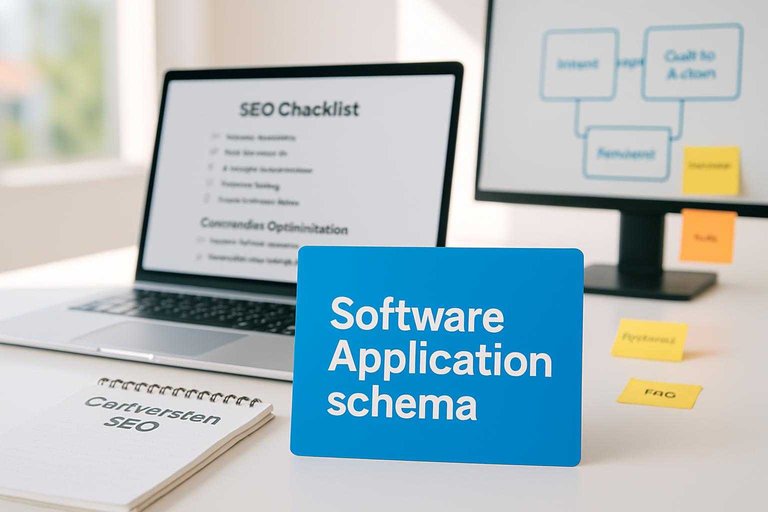
- Add schema for SoftwareApplication, Organization, FAQ, and Reviews.
- Run experiments with guardrails: no bait, no mismatched promises.
- Audit forms and routing to prevent “junk lead” incentives.
If experimentation changes the promise, you’re optimizing conversion and losing the sale.
Reporting to Revenue
Traffic reports don’t survive a pipeline meeting.
You need attribution views that sales trusts and marketing can influence.
Connect the chain:
- Attribution: GA4 + CRM multi-touch views, not last-click alone
- Lead quality: firmographics, stage velocity, meeting rate, win rate
- Sales feedback: call tags, objection themes, “what did you read” fields
- Content alignment: map keywords to opportunities, not sessions
When sales starts quoting your pages on calls, you’ve closed the loop.
E-commerce Tool Picks
E-commerce SEO breaks tools fast because your catalog is big, your templates repeat, and your changes ship weekly. Pick AI that survives scale, helps merchandising, and stays boringly reliable when URLs hit six figures.
Catalog Keywording
You need tools that speak in attributes, not just “keywords,” because filters create most of your long tail. Think “waterproof trail running shoes size 12” and not just “trail running shoes.”
Choose tools that can:
- Cluster queries by facet values, not intent labels.
- Expand categories from on-site search and filter usage.
- Mine long-tail from attributes like size, material, and compatibility.
- Validate demand with seasonality and inventory signals.
If the tool can’t model facets, it will overpush generic categories you already rank for.
Product Content
You need AI that generates at scale without creating “same-but-different” PDPs that trigger duplication. Your bar is brand-safe, compliant, and variant-aware.
Use this evaluation template:
- Generate unique value props per PDP, grounded in attributes.
- Handle variants without cloning paragraphs across colors and sizes.
- Summarize reviews into claims, then link to proof.
- Enforce tone, claims, and banned phrases per brand rules.
- Detect duplication across the full catalog automatically.
If it can’t police itself, you’ll ship thousands of near-duplicates in a weekend.
Internal Linking
You want scalable linking that follows your merchandising logic, not random “related items.” Constrain the model so it can’t create crawl traps.
- Define hubs by intent and margin, like “running shoes” to “trail running shoes.”
- Set crawl depth targets per template, like PDPs within four clicks.
- Generate related-product links with rules, like same brand or compatible parts.
- Block links to parameter URLs and out-of-stock dead ends.
- QA suggestions against crawl simulations before rollout.
Unconstrained linking looks smart in a spreadsheet, then melts your crawl budget.
Technical Scaling
Technical reliability is where e-commerce tools earn trust, because templates change and problems replicate instantly. One bad canonical rule can deindex half a category overnight.
Prioritize tools that support:
- Crawl budget controls and priority URL sets.
- Log analysis tied to template groups and status codes.
- Canonical and parameter rules you can test before deploy.
- Schema generation at scale with validation, not just output.
- Monitoring for template diffs, like title or internal link shifts.
Your best tool is the one that catches “we changed the filter template” before Google does.
Head-to-Head Matrix
Use this matrix to pick AI SEO tool categories based on your motion: B2B pipeline vs e-commerce revenue. The “owner” column shows who should run it day to day.
| Tool category | Best for B2B | Best for e-commerce | Key features | Risks | Team owner |
|---|---|---|---|---|---|
| Topic & keyword discovery | Pain-point clusters | Category demand gaps | SERP clustering | Wrong intent | SEO lead |
| Content briefs & outlines | SME interview prompts | Scaled product copy | Brief templates | Hallucinations | SEO + Editor |
| On-page optimization | Solution pages | PDP/PLP tuning | Entity + internal links | Over-optimization | SEO lead |
| Technical SEO automation | JS + crawl fixes | Facets + canonicals | Log insights | Broken indexing | Tech SEO |
| Programmatic SEO generation | Use-case libraries | Long-tail categories | Template variables | Thin pages | SEO + Eng |
| Link prospecting & PR | List building | Digital PR targets | Prospect scoring | Spam outreach | PR/Outreach |
| Reporting & forecasting | Pipeline attribution | Revenue impact | Anomaly alerts | False confidence | Analytics/RevOps |
Pick one category to pilot, then define a single success metric before you automate anything. If you’re evaluating content tooling specifically, see this breakdown of top AI content platforms compared.
Common Pitfalls
AI SEO tools fail fast when you feed them vague prompts or messy data. One bad assumption becomes 50 bad pages, like shipping “best CRM” content without defining your ICP.
- Using thin inputs and vague briefs
- Over-automating without human review
- Accepting hallucinated stats and quotes
- Optimizing for the wrong KPIs
- Scaling content before proving rankings
Treat AI output like a draft, not a source of truth, and your system stops leaking trust.
Hybrid Scenarios
Hybrid SEO is where B2B and e-commerce requirements collide in one site. Think “SaaS with a pricing page and a catalog,” or a marketplace selling to businesses and consumers.
Your goal is one stack that shares data and tech, but keeps intent-specific execution clean.
When You’re Hybrid
You’re hybrid when the same domain has different jobs to do. One URL sells. Another URL teaches.
- Target both “buy now” and “how to” intents
- Run product-led and content-led acquisition
- Share templates across different conversion goals
- Measure success with mixed KPIs per section
- Serve different buyers on one domain
Treat it like two funnels sharing one foundation, not one funnel with extra pages.
Stack Architecture
Hybrid stacks fail when each team builds its own keyword universe. You want one taxonomy, one crawl truth, and two execution lanes.
Use this split:
- One source of truth (keywords and entities): a shared keyword map, intent tags, and page-type rules.
- Shared technical tooling: crawler, log analysis, indexation monitoring, schema testing, and release tracking.
- Separate workflows where intent differs:
- Content lane: briefs, outlines, internal linking, expert review.
- Merch lane: titles, facets, PDP copy, feed rules, and category logic.
Centralize the data. Decentralize the decisions that change revenue mechanics.
Implementation Steps
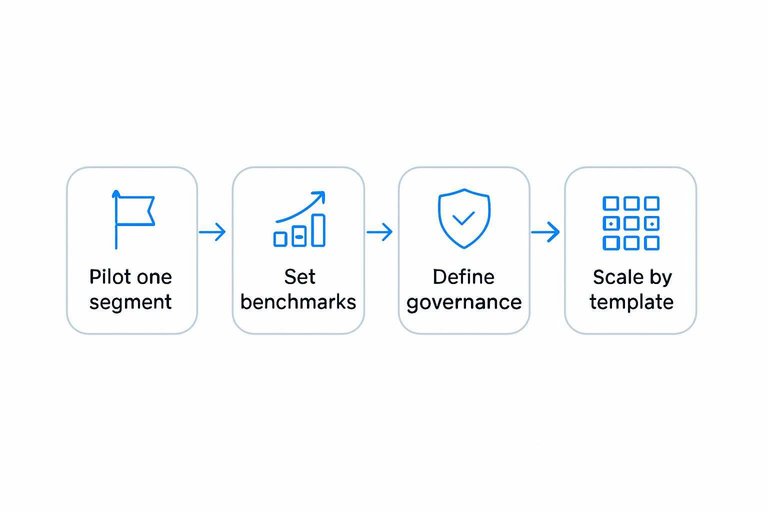
Roll out tools in one slice of the site first. You’re testing the workflow, not the AI.
- Pilot one segment, like “Resources” or one category cluster.
- Set benchmarks: rankings, crawl stats, CVR, and production time.
- Define governance: owners, approval paths, and rollback rules.
- Train by role: writers, merchandisers, SEOs, and engineers.
- Scale by template, not by enthusiasm.
If you can’t scale via templates and rules, you don’t have a stack yet.
Governance Rules
Automation without policy becomes silent SEO debt. Write rules that make changes predictable, auditable, and reversible.
Set policies for:
- QA checklists: duplication checks, schema validation, cannibalization scans, and link integrity.
- E-E-A-T standards: author identity, expert review thresholds, and citation requirements for claims.
- Disclosure rules: where “AI-assisted” notes appear, and when they’re required.
- Approval boundaries: who can publish, who can bulk-edit, and who can auto-deploy.
Decide who can touch templates, because templates move more traffic than any single page.
AI Risk, Compliance, and Content Policy (What to Decide Before You Scale)
AI tools for SEO don’t just change output volume; they change your legal, brand, and platform risk profile. Before you scale any automation, decide the rules your tools must obey.
The non-negotiables (both models)
- No invented facts: ban “statistics,” certifications, awards, and testimonials unless they’re pulled from an approved source or database.
- Claims must be provable: if the content says “reduces errors,” “fastest,” or “compliant,” you need internal proof or you rewrite it as a softer, accurate statement.
- Sources and traceability: require stored prompts, model versions (when available), and a record of who approved changes.
- Human ownership: every page needs a named owner accountable for the final copy, not “the model.”
B2B risk profile: trust, compliance, and sales friction
B2B content gets scrutinized by buyers, procurement, and internal reviewers.
Set rules like:
- Regulated topics require SME sign-off: security, legal, financial, and technical claims route to the right reviewer.
- Comparison pages need evidence: if you publish “X vs Y,” define acceptable sources (docs, public pricing pages, verified product behavior) and block unsupported feature claims.
- Case studies and logos are restricted: disallow AI-generated customer names, quotes, or implied partnerships.
If your AI workflow can’t support approvals and evidence, it will create sales friction even when rankings improve.
E-commerce risk profile: accuracy, pricing, and catalog integrity
E-commerce content fails when it disagrees with the product database, inventory reality, or shipping/returns policies.
Set rules like:
- Feed is the source of truth: attributes, compatibility, materials, sizing, and availability must be pulled from structured data—not guessed.
- Pricing and promos are protected fields: AI can format copy around them, but it shouldn’t invent “discounts,” delivery windows, or guarantees.
- Out-of-stock behavior is explicit: define what happens to PDPs and PLPs when inventory changes (copy updates, internal links, indexability rules).
If the model can write faster than your catalog updates, it will publish confident inaccuracies.
Copyright and originality: avoid “rewrite the SERP” automation
Tools that “optimize by rewriting competitors” can push you into unsafe territory.
Guardrails:
- Prohibit direct rewriting of a single source.
- Prefer first-party inputs: product attributes, internal docs, support tickets, call notes, and review themes.
- Require novelty checks: “What’s new here?” as a mandatory field in every brief.
Align with Google’s expectations: quality systems, not AI systems
Google doesn’t reward or punish content based on whether AI helped; it evaluates results. Build a system that produces content users trust.
Operationally, that means:
- Intent match tests: each template/page type has a defined intent, primary query class, and success metric.
- Quality gates before indexing: prevent auto-publishing new URLs without uniqueness, inventory/intent validation, and internal-link placement.
- Ongoing audits: sample pages monthly for accuracy, duplication, and “thinness” by page type (PDP, PLP, solution page, comparison, glossary).
If your policies are clear, tool choice becomes easier: you’ll automatically disqualify anything that can’t enforce the rules.
Recommendation
Pick your stack by business model and how often you publish. A 20-page B2B site needs control, while a 20,000-SKU store needs automation.
- Choose your track: B2B for demand capture, e-commerce for catalog scale, hybrid for both.
- Start minimal: GA4 + GSC, Screaming Frog, Ahrefs or Semrush, and one AI writer.
- Add advanced: programmatic SEO tool, internal linking automation, and log-file or crawl scheduling.
- Set guardrails: human SME review, unique sources, and brand voice prompts.
- Measure by model: B2B uses pipeline keywords, e-commerce uses revenue per landing page.
If your tools don’t change weekly decisions, you bought a dashboard, not a stack.
To automate reporting cleanly, consider using the Google Analytics Data API for GA4.
Final Rubric Checklist
Use this to score each AI SEO tool fast, and avoid “cool demo” decisions.
| Criterion | Weight | Pass/Fail test | Notes |
|---|---|---|---|
| Data sources + freshness | 20% | Uses your GSC/GA + weekly updates | No stale keyword dumps |
| B2B intent handling | 15% | Separates problem vs vendor queries | ICP matters more than volume |
| E-commerce SKU coverage | 15% | Scales across templates + variants | Facets can break tools |
| Content quality controls | 15% | Detects hallucinations + cites sources | “Trust, but verify” |
| Workflow + integrations | 10% | Exports to CMS + tickets | Adoption beats features |
| Total cost to value | 10% | Clear ROI model in 60 days | Don’t buy hope |
| Security + compliance | 10% | SSO + data retention controls | Legal will ask |
| Support + roadmap | 5% | Response SLA + shipped changelog | Dead tools look “stable” |
Decision threshold: pick only tools scoring 80+ overall and passing Security + Data freshness.
If a tool fails the two gates, stop scoring and move on.
Pick your lane, then lock the rules
- Confirm your motion: B2B = pipeline and narrative depth; e-commerce = catalog coverage and margin-driven scale.
- Shortlist 2–3 tools per category using the matrix, then score them with the rubric (data quality, workflow fit, automation safety, total cost).
- Run a 14–30 day pilot with pre-defined success metrics (SQLs/opp influence for B2B; revenue, indexation, and conversion rate for e-commerce).
- Ship with governance: human review gates for AI outputs, logging for automations, and clear ownership for prompts, templates, and rollbacks.
Frequently Asked Questions
- Are AI tools for SEO safe to use with Google’s spam policies in 2026?
- Yes, usually—Google focuses on content quality and intent, not whether AI helped create it. Keep human review, cite sources for claims, and avoid auto-generated pages at scale without added value.
- How do I measure ROI from AI tools for SEO for B2B vs e-commerce?
- Track B2B ROI with pipeline-linked metrics (organic-sourced leads, MQL→SQL rate, influenced revenue) and e-commerce ROI with revenue metrics (organic revenue, PDP conversions, indexation coverage). Use GA4 + Search Console plus a rank/visibility tool to tie changes to specific pages and releases.
- Can I use ChatGPT (or another LLM) as my only AI tool for SEO?
- Not usually—LLMs are best for drafting and analysis, but you still need SEO data sources like Google Search Console, keyword/crawl tools, and a content workflow for publishing and QA. Pair an LLM with a crawler (e.g., Screaming Frog) and a rank/keyword platform for reliable decisions.
- How long does it take to see results after внедрing AI tools for SEO?
- Expect workflow speed gains immediately (days to weeks) and search impact in 4–12 weeks for updates on existing pages, while new pages often take 2–6 months to show meaningful growth. Technical fixes (indexation, internal linking) can move fastest when crawlable changes ship quickly.
- Do AI tools for SEO replace an SEO specialist or content team?
- No—AI tools usually replace repetitive tasks (drafting variants, clustering keywords, generating briefs, basic audits), not strategy and QA. Most teams get the best results with an SEO owner setting priorities and humans validating facts, intent match, and brand voice.
Turn Tool Choice Into Output
Once you’ve matched AI tools for SEO to B2B or e-commerce needs, the real challenge is producing optimized content consistently without sacrificing quality or time.
Skribra generates daily SEO-ready articles with keywords, metadata, images, and WordPress publishing built in—plus a backlink exchange network to support authority. Start with the 3-Day Free Trial.
Written by
Skribra
This article was crafted with AI-powered content generation. Skribra creates SEO-optimized articles that rank.
Share: