February 25, 2026
·
Updated September 4, 2026
·
10 min read
Build a Content SEO Strategy: 12-Point B2B Checklist
A 12-point B2B checklist for building a content SEO strategy that actually ships and performs — define outcomes and scope, lock prerequisites (positioning/offers/tracking/governance), and execute market research, intent mapping, keyword standards, competitor teardowns, architecture, templates, and briefs with repeatable rules.

If your “content SEO strategy” lives in a deck but your rankings don’t move, the problem usually isn’t effort—it’s missing decisions. Without clear scope, tracked outcomes, and standards for keywords, intent, and internal linking, every new piece becomes a one-off.
This checklist turns strategy into a build plan. You’ll set what success means, validate prerequisites like positioning and offers, then work through market research, intent maps, keyword rules, competitor teardowns, architecture, templates, and a brief system your team can reuse.
Outcome and scope
A “working result” is a content SEO system your team can run every month, not a one-off traffic spike. You’ll finish with 12 checkpoints completed, each with an owner, evidence, and a pass/fail call. Picture the output as a shared doc where someone can point and say, “This page drove three demos,” or “This cluster ranks for pricing terms.”
Target audience fit
This checklist assumes you sell B2B with a defined ICP and a real buying committee. Think roles like end user, manager, finance, security, and the executive sponsor, each with different search intent.
It also assumes longer sales cycles and higher consideration content needs.
- Sales cycle: 30–180+ days
- Deal size: mid-four figures to six figures+
- Motion: inbound-assisted, sales-led, or hybrid
If you’re in a fast, self-serve, low-ACV model, your priorities shift toward volume and signup UX.
Success metrics set
Pick metrics that connect search to revenue, not just visibility. You’ll track these as leading and lagging indicators.
- Qualified organic pipeline created
- Organic conversions by intent
- Assisted revenue influence
- Rankings by intent groups
- Content velocity versus targets
If your KPIs don’t survive a CFO question, they’re not KPIs.
Checklist rules
Use this like an operating checklist, not a brainstorm prompt.
- Assign one owner per checkpoint.
- Define required evidence before starting.
- Mark pass/fail with a single sentence rationale.
- Complete all 12 within 30 days.
- Log blockers and decisions in one place.
Execution beats agreement; owners and evidence turn “we should” into “we did.”
Strategy prerequisites
Publishing without prerequisites creates “busy” SEO that never converts. Lock inputs first: positioning, offers, and measurement that make intent pay off. If you need a baseline, start with this practical SEO guide before scaling output. If you’re deciding between resourcing models, read enterprise SEO agency vs in-house team to determine what scales faster. If you’re building an affiliate program, use this affiliate SEO checklist and gameplan to set the right prerequisites.
Positioning locked
You need one clear category claim, one sharp differentiator, and repeatable proof. Think: “SOC 2 compliance platform” plus “fastest audit-ready path” plus “used by 200+ fintech teams.” Every SEO page should carry the same three proof points: outcomes, credibility, and constraints. If your positioning shifts page to page, rankings can rise while revenue stays flat.
Offers mapped
Map offers to intent so each page has a believable next step. Match “learn” pages to low-friction assets, and “buy” pages to high-commitment actions.
- Top-of-funnel: webinar, template, checklist
- Mid-funnel: comparison page, case study, calculator
- Bottom-of-funnel: pricing page, demo, trial
- Expansion: playbook, admin guide, roadmap webinar
- Proof: security page, SLA, reference call
When the offer fits the question, conversion feels like progress, not pressure.
Tracking ready
Instrument tracking before you publish, or you’ll argue from vibes. Tie every page type to a measurable action and a downstream stage.
- Configure GA4 events for form, demo, trial, and outbound clicks.
- Connect CRM attribution to source, page, and campaign parameters.
- Define lead stages and required fields for lifecycle reporting.
- Verify GSC coverage, queries, and indexation for each template.
- Document KPIs by page type: blog, landing, comparison, pricing.
If you can’t name the event, you can’t improve the page.
Governance model
Decide who owns what, or approvals will quietly kill output. Use a simple RACI: SEO owns keyword targets, content owns drafts, product marketing owns claims, and sales owns objection accuracy. Add two gates that never move: editorial review for clarity and legal/compliance review for regulated promises. Governance turns “can we publish?” into a predictable checklist, not a recurring debate.
Point 1: Market research
Market research gives you the exact words buyers use, plus the shifts happening in your category. Get that wrong and your “SEO topics” sound like internal jargon.
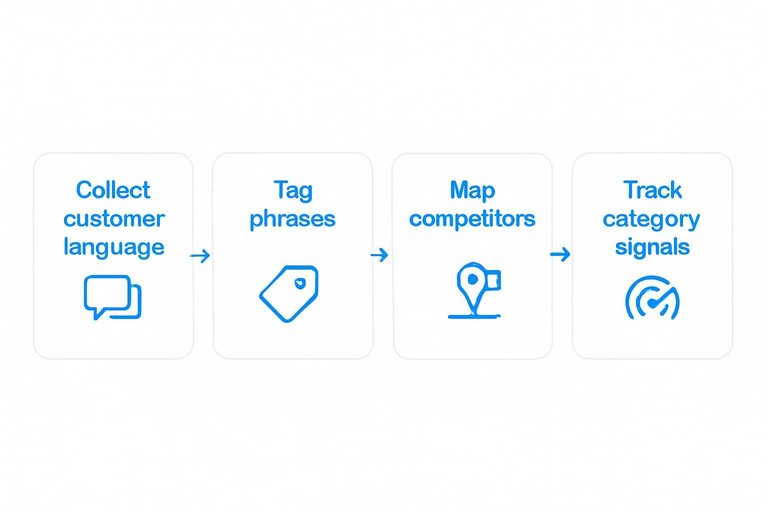
- Collect customer language from calls, demos, tickets, and reviews.
- Tag phrases by job, pain, trigger, and desired outcome.
- Map competitors by positioning, proof points, and repeated claims.
- Track category signals: new terms, new regulations, new budgets.
- Turn findings into topic angles that mirror buying conversations.
Write with the buyer’s vocabulary, then you’ll rank for intent, not trivia.
Point 2: Intent map
Your keyword list is useless until you map intent to a page type and a next action. In B2B, that next action is often “talk to sales,” but only after you’ve earned it.
Here’s a simple intent map you can reuse across products and personas.
| Keyword intent | What they want | Best page type | CTA that fits |
|---|---|---|---|
| Informational | Understand problem | Blog guide | Subscribe for updates |
| Commercial research | Compare options | Comparison page | Download buyer’s guide |
| Solution-aware | Validate approach | Use case page | Book a demo |
| Transactional | Choose a vendor | Product page | Start trial |
| Navigational | Find your brand | Landing page | Contact sales |
If your CTA feels pushy, your intent map is wrong, not your copy.
Point 3: Keyword standards
Keyword standards keep your content team from chasing shiny terms that never sell. Think of them as your “no volume-only bets” policy, written down and enforced.
Selection criteria
You need hard filters so every keyword earns its spot on your roadmap. Otherwise, you’ll ship pages that rank and still don’t pipeline.
- Match real buying intent
- Fit your ICP and use-case
- Show useful SERP features
- Pass realistic difficulty checks
- Suggest clear conversion paths
If a keyword fails two filters, cut it fast and move on.
Clustering method
Clusters stop cannibalization and make internal linking obvious. You’re building a topic map, not a pile of disconnected pages.
- Pick one primary keyword per page, based on intent.
- Group close variants as secondary keywords, same meaning and outcome.
- Add subtopic pages for distinct angles, like “pricing” or “security.”
- Assign supporting queries to sections, FAQs, or comparisons within a page.
- Define internal links: subtopics point to the primary, not sideways.
If two pages answer the same question, merge them before Google chooses for you.
Common traps
Volume-only keywords fail because they attract tourists, not buyers. Brand-only keywords fail because you’re paying for traffic you already earned, like “{YourCompany} pricing.” Tool-only keywords fail because they map to execution, not outcomes, like “Jira workflow automation” when you sell governance.
Adjust by rewriting targets around pains, jobs, and constraints. Aim for phrases a buyer would say in a meeting: “reduce onboarding time” or “SOC 2 evidence collection.” That’s where B2B intent hides.
Point 4: Competitor teardown
Reverse-engineer the pages already ranking, because Google is telling you what it trusts today. Your goal is to spot patterns, then publish something more useful with stronger proof.
Steps
- Pick 3–5 competitor URLs ranking for your target query.
- Map each page’s intent, angle, and “job to be done.”
- Extract their content structure: H2s, sections, and missing questions.
- Inventory proof: stats, screenshots, templates, pricing, and case studies.
- Write your gap plan: what you’ll add, cut, or simplify to win.
If you can’t name the gap in one line, you don’t have a strategy yet.
Point 5: Content architecture
Content architecture is the scaffolding that keeps growth from turning into a maze. In B2B, it’s the difference between “Where do I start?” and “Here’s the path to a demo.”
Pillar structure
A pillar structure is hub-and-spoke: one strong hub page, supported by focused spokes. It works because buyers research in clusters, like “CRM for manufacturing” plus “integration checklist” plus “pricing questions.”
Build hubs around three demand centers:
- Solution areas (what you help teams do)
- Industries (where you win and why)
- Product themes (the capabilities that matter)
Each hub sets the narrative, defines the terms, and routes readers to the right depth. Your spokes do the ranking work, then pass authority back up.
That’s how you scale pages without scaling confusion.

Internal link rules
Internal links are your traffic routing layer, not an afterthought. Write rules once, then enforce them in every publish cycle.
- Link every spoke back to its hub
- Use contextual anchors, not “click here”
- Keep breadcrumbs on all indexable pages
- Add related modules to high-intent pages
- Include one “next step” conversion link
If your links don’t create a path, you don’t have architecture. You have pages.
URL and taxonomy
Consistency prevents duplicates and keeps equity consolidating. Set the rules early, before 300 posts lock you in.
- Choose one slug style and never deviate.
- Use folders for pillars, not for arbitrary dates.
- Limit categories, then tag for nuance.
- Set canonical rules for near-duplicates.
- Redirect old URLs to the single winner.
Do this now, and every new page lands in the right place automatically.
Point 6: Page templates
Standardize page templates so every new page hits intent, includes proof, and offers a clear next step. Your writer should never ask, “What goes on this page type?”
| Page type | Search intent | Required sections | Conversion CTA |
|---|---|---|---|
| Solution page | Evaluate options | Problem, approach, proof, FAQs | Request demo |
| Industry page | Fit for niche | Use cases, compliance, proof | Talk to sales |
| Use case page | How it works | Workflow, integrations, results | See it live |
| Comparison page | Choose vendor | Criteria, table, objections, FAQs | Switch to us |
| Pricing page | Budget clarity | Tiers, inclusions, FAQs, ROI | Get a quote |
If a page can’t be mapped to a template, your strategy is still a list of ideas.
Point 7: Content brief system
A brief is your contract between SEO, editorial, and the SME. It prevents the classic “can you just tweak this” loop by making decisions upfront. Example: you lock “primary query” and “acceptance criteria” before anyone writes a word.
Brief must-haves
Your brief should be fill-in-the-blanks, not a blank page. Require these fields every time so writers and SMEs stop guessing.
- Search intent and audience stage
- Primary query and secondary terms
- SME inputs and quotable points
- Proof: data, sources, screenshots
- Outline with section promises
- Internal links and anchor text (use an essential AI content checklist to standardize reviews)
- CTA and next action
- Acceptance criteria and “done” checks
If a field is missing, the draft is unreviewable.
SME interview flow
You have 30 minutes, so you need a script. Use a repeatable flow that forces specifics fast.
- Confirm the reader, job, and “why now” trigger.
- Ask for one recent story with numbers and constraints.
- Pull three objections you hear and your rebuttals.
- Identify two differentiators and what competitors get wrong.
- Capture a safe limitation: where this advice breaks.
You’re not collecting opinions. You’re collecting decision-grade details.
Quality bar
B2B E-E-A-T is earned through traceable expertise, not confident tone. You show it with a real author, tight citations, original examples, and clear limits.
Use named authors with relevant roles, like “Solutions Architect, 8 years in SOC teams.” Cite primary sources, not recycled blogs, and link to vendor docs or standards when possible. Add at least one original artifact per piece: a teardown, a mini case, a workflow, or a screenshot. Then state what you didn’t test or what varies, like “Works for PLG funnels; enterprise procurement differs.”
That transparency is what makes your content believable, shareable, and hard to outrank.
Point 8: Post-publish measurement and maintenance loop
A content SEO strategy isn’t finished when the brief is approved—it’s finished when you’ve created a repeatable loop that measures performance, makes targeted changes, and prevents your own library from competing with itself. Build this into your checklist so every URL has a clear “next action” after it’s live.
At a minimum, treat Google Search Console as your source of truth for what to update first. It tells you what queries you’re already showing for, where you’re close to breaking through, and which pages are declining. That’s the difference between random refreshes and an optimization system. For a deeper breakdown of how the crawl-to-rank process connects to a create-to-refresh workflow, see how SEO content marketing works.
Your operating rhythm (simple and sustainable):
- Weekly: Triage new content and obvious issues (indexing coverage, sudden drops, pages with impressions but weak CTR).
- Monthly: Run a structured refresh pass (query-led updates, internal link tune-ups, cannibalization checks).
- Quarterly: Re-validate intent and architecture (are clusters still aligned, do you need consolidation, are templates still serving the SERP?).
Document these steps the same way you document your brief system: inputs, checks, decisions, and outputs.
Search Console-driven updates (query-first, not opinion-first)
Use Search Console to choose what to update and how to update it.
What to pull for each priority URL:
- Top queries and pages (which terms you already rank for, even if the page wasn’t written for them)
- Impressions vs. clicks (CTR clues)
- Average position by query (where you’re “almost there”)
A practical update checklist:
- Title and meta alignment: If impressions are high but CTR is lagging, rewrite the title/meta to match the dominant intent you’re already earning impressions for.
- On-page intent match: If you’re ranking for adjacent subtopics, add/reshape sections to satisfy those sub-intents (definitions, comparisons, steps, pitfalls, implementation notes—whatever the SERP is rewarding).
- Snippet eligibility hygiene: Tighten headings, add concise answer blocks where appropriate, and ensure key definitions/steps are easy to extract.
- Content freshness with restraint: Update claims that could become outdated (tool steps, screenshots, process details). Don’t “freshen” by adding filler.
Rule: If Search Console shows the page earning impressions for a different angle than your original brief, treat that as feedback from the market and adjust the page—not the other way around.
Internal linking refreshes (keep clusters working as the site grows)
Internal linking isn’t a one-time architecture task. As you publish more, older pages need new pathways and newer pages need authority routed to them.
Run a monthly internal linking sweep:
- Add links from winners to climbers: From pages with stable traffic/visibility to pages that are close to ranking (based on Search Console positions and impressions).
- Re-audit hub pages: Ensure each pillar or hub actually links to every supporting piece—and that supporting pieces link back.
- Fix “orphan” and “near-orphan” URLs: Every strategic page should be reachable within a few clicks from relevant hubs.
- Anchor text standards (light-touch): Use descriptive anchors that reflect the destination’s intent; avoid repeating the exact same anchor everywhere.
Output to track: a simple log of links added/updated, and which target pages they were meant to lift. This makes future diagnostics far easier when rankings shift.
Cannibalization checks (prevent self-competition and consolidate when needed)
As your library expands, multiple pages will start targeting the same or very similar intent. That can split signals, dilute internal links, and create ranking volatility.
How to spot cannibalization using Search Console:
- Pick a query that matters.
- Check which pages are getting impressions/clicks for that same query.
- If two (or more) pages trade positions or both sit mid-pack, you likely have overlap.
Decide the fix based on intent:
- Same intent, same stage: Consolidate into one primary page; merge the best sections; redirect or canonicalize the secondary page (based on your CMS/tech constraints).
- Different intent (or different funnel stage): Differentiate. Rewrite introductions and headings to clarify the angle, adjust the keyword focus, and rework internal links so each page has a clear role.
- Template collisions (common in B2B): If you have “alternatives,” “vs,” and “reviews” pages overlapping, define strict rules for what each template covers so future content doesn’t recreate the conflict.
Definition of done: For every important query, you can point to one primary URL and explain why it’s the best match for the searcher.
Turn the checklist into your next 30 days of execution
- Pick one primary outcome and metric (pipeline, sign-ups, demos, or influenced revenue) and write the scope boundaries for this quarter.
- Confirm prerequisites: positioning and offers are documented, tracking is live, and one owner approves standards and publishing.
- Build the foundation in order: market research → intent map → keyword standards → competitor teardown.
- Then operationalize: define content architecture, lock page templates, and roll out a brief system so every new page follows the same rules.
Operationalize Your Content SEO
This checklist works best when market research, intent mapping, and briefs turn into a consistent publishing rhythm—without slipping on standards or templates.
Skribra helps you turn your content SEO strategy into daily, SEO-optimized articles with WordPress publishing baked in—start with the 3-Day Free Trial.
Written by
Skribra
This article was crafted with AI-powered content generation. Skribra creates SEO-optimized articles that rank.
Share: