April 8, 2026
·
10 min read
Build an SEO strategy in 45 minutes
A time-boxed guide to building an SEO strategy in 45 minutes — set the right inputs, choose measurable outcomes, create a tight 25-keyword set, map pages and gaps, run a fast technical triage, and leave with a shippable content plan.

If your SEO planning turns into hours of tabs, tools, and “we’ll decide later,” you don’t have a strategy—you have a backlog. The real risk isn’t missing a keyword; it’s shipping content and fixes that don’t ladder up to a goal.
This 45-minute workflow forces clarity fast. You’ll pick one primary outcome, build a focused keyword set, map it to pages, catch gaps and cannibalization, sanity-check technical foundations, and finish with a small content plan you can actually publish.
Prep and inputs
You’re collecting only what you need to make a usable SEO plan fast. Think “one sitting, one page,” like a flight checklist.
If you can’t use an input in the next 45 minutes, skip it. Momentum beats perfection.
Set a 45-minute timer
Block 45 minutes and name the output before you start. Your deliverable is a one-page strategy covering goals, target keywords, target pages, tasks, and tracking.
Assign one owner who ships the page today, even if it’s “v1.”
Speed forces clarity, and clarity beats a beautiful doc nobody runs.
Gather quick data
Pull only the numbers that tell you what’s already working. Use three tabs: Search Console, Analytics, and one rank or keyword tool.
- Top 5 pages by clicks
- Top 10 queries by impressions
- Highest-converting landing pages
- Biggest drop pages, last 28 days
- Branded vs non-branded split
You’re hunting for leverage, not trivia, so stop when patterns show up.
Pick one primary goal
Choose one primary goal you can measure weekly, like “demo requests” or “trial starts.” Add one secondary goal you won’t optimize for, like “newsletter signups.”
Write the baseline and the target, like “12 leads/week → 20 leads/week in 90 days.”
One goal prevents the classic SEO failure mode: ranking improvements that don’t pay rent.
Define audience promise
Write a one-sentence ICP and the problem you solve, tied to search intent. Example: “IT managers at 200–2,000 employee firms who need to reduce endpoint downtime.”
Add the promise in plain language, like “Fix it in hours, not days.”
If you can’t say it in one sentence, your keyword list will drift into noise.
Choose target outcomes
You need a few outcomes that force tradeoffs and stop endless “while we’re at it” requests.
Use one primary KPI, one supporting KPI, and one guardrail KPI (if you need a refresher on how to choose and define them, see this SEO guide for setting KPIs).
Here’s a fast KPI set you can lock in before anyone adds scope.
| Outcome type | KPI | How you measure | 45-minute target |
|---|---|---|---|
| Primary | Organic conversions | GA4 key events | +10–20% QoQ |
| Supporting | Non-brand organic sessions | GSC + GA4 | +15% QoQ |
| Supporting | Top 10 keyword count | Google Search Console | +25 keywords |
| Guardrail | Conversion rate | GA4 | Not down >5% |
| Guardrail | Index coverage | GSC report | Errors not rising |
If you can’t explain a task’s impact on these numbers, it’s not in scope.
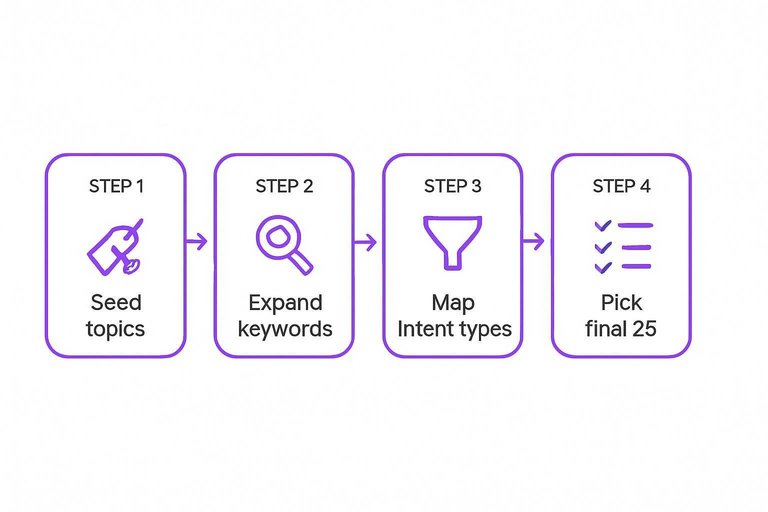
Keyword set in 10
You need a small keyword set you can ship against today, not a spreadsheet you admire later. Think “pages we sell” and “problems they Google,” like “SOC 2 compliance cost” instead of “what is security.”
Start with seed topics
Pick topics that connect to revenue pages and real pain, because intent beats volume. If a topic can’t lead to a product page or a demo, cut it.
- Pricing and costs
- Alternatives and comparisons
- Implementation and setup
- Troubleshooting and fixes
- Compliance and requirements
If you can’t picture the landing page, you don’t have a topic.
Expand to keywords
Pull queries you already earn impressions for, then widen with a tool to find adjacent intent.
- Export GSC queries for relevant pages and filters.
- Group queries under each seed topic.
- Add 10–20 queries per topic from a keyword tool.
- Keep queries with clear next-step intent.
- Delete vague “definition-only” queries.
Your list should feel like a buyer’s journey, not a Wikipedia outline.
Map intent types
Label intent fast so you stop mixing blog keywords with product-page expectations.
| Keyword example | Intent | Best page type | Keep? |
|---|---|---|---|
| what is SOC 2 | Informational | Explainer post | Maybe |
| SOC 2 compliance software | Commercial | Category page | Yes |
| buy SOC 2 tool | Transactional | Pricing page | Yes |
| Acme Security login | Navigational | Login/help page | No |
If the intent doesn’t match your page, rankings won’t pay you.
Pick a final 25
Choose keywords you can win and monetize, not just ones that look impressive in a tool.
- Keep keywords with the right intent for your site.
- Prefer lower difficulty when business value is equal.
- Choose terms that map to existing or planned pages.
- Cut duplicates that target the same page.
- Tag 5 as “priority now” for this sprint.
You’re building a work queue, not a wish list.
Define success signals
Decide what “working” means before you publish, or you’ll move goalposts later. For each keyword, set a target like “top 10 in 60 days,” plus a minimum traffic threshold and a conversion action like “demo click” or “checkout start.” Tie success to the page’s job, not just the rank.
Page map and gaps
Keywords don’t ship results. Pages do.
Your job here is to turn “we should rank for X” into a page plan you can execute this week.
Build a one-page map
You need one sheet that shows how keywords map to URLs. It prevents “five pages, one query” chaos.
- Export your priority keywords with intent and estimated value.
- Assign each keyword to exactly one existing URL.
- If no URL fits, mark it “NEW” and note page type.
- Enforce one primary keyword per page; log secondary variants.
- Add the owner and next action: optimize, create, consolidate.
If a keyword can’t claim a single URL, you don’t have a strategy yet.
Find cannibalization
Cannibalization happens when two pages answer the same query. Google picks one, and it’s often not the one you want.
- Filter GSC by query; list all ranking URLs.
- Flag queries with two-plus relevant pages.
- Label each page: keep, merge, or retire.
- Choose a canonical “winner” URL per query.
- Write 301s and internal link updates in your task list.
If two pages fight for one term, neither page gets the full signal.
Spot missing pages
Some keywords won’t have any URL that truly matches intent. That’s not an optimization problem. It’s a content gap.
Look for priority keywords where your best-ranking page is “close, but wrong.” Common signs include high impressions, low clicks, or bouncing traffic. Then decide the net-new page type (landing page, comparison, guide, integration, glossary) and assign an owner with a due date.
If there’s no right page, your “SEO issue” is actually a publishing issue.
Internal link targets
Internal links are your fastest lever for moving authority and clarifying relevance. Pick targets on purpose, not by habit.
- Select 5 hub pages that represent core topics.
- Select 10 spoke pages that support each hub.
- Define anchor themes: “pricing,” “alternatives,” “how it works.”
- Identify link sources: nav, templates, top blogs, resource pages.
- Add a rule: every new post links to one hub.
When links follow a map, rankings follow the links.
Minimum page requirements
Your pages need a baseline spec or quality drifts. Think “definition of done,” not “nice to have.”
At minimum, every money page should match intent in the first screen, show proof (results, reviews, logos), answer objections with FAQs, and drive one clear CTA. Add the right schema where it fits, plus deliberate internal links to hubs, spokes, and next-step pages.
Boring is good. Boring ships. Boring ranks.
Fast technical triage
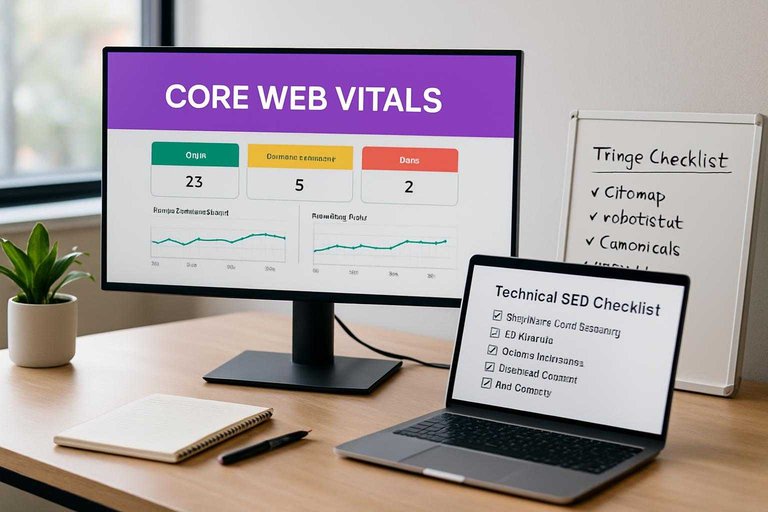
You only need a few technical checks to unblock crawling, indexing, and speed wins. Treat this as a “can Google reach it, trust it, and load it fast?” pass on your priority pages.
Indexing checkpoints
Run these checks on your top templates and top landing pages.
- Open the sitemap and confirm priority URLs are included.
- Check robots.txt and verify those paths aren’t disallowed.
- Inspect canonicals and confirm they point to the preferred URL.
- Confirm noindex isn’t set on pages meant to rank.
- Log blockers with the exact URL and rule causing them.
If one of these fails, content work won’t matter yet.
Core Web Vitals quick wins
Pick fixes you can ship this week, not someday.
- Compress and resize hero images.
- Defer or remove unused scripts.
- Add full-page caching for HTML.
- Preload critical fonts and use swap.
Speed gains compound, but only after you stop shipping slow defaults.
Structured data basics
Structured data is a template decision, not a page-by-page hobby. Choose one schema type per template, then apply it everywhere that template renders.
For example: Organization on global pages, Product on PDPs, Article on blog posts, and FAQ only where FAQs are visible. Pick the simplest valid markup first, then expand once it’s stable.
Tracking sanity check
Validate tracking on the same priority URLs you’re trying to rank.
- Confirm the correct GA4 property fires on each priority page.
- Verify key events trigger, like “generate_lead” or “purchase”.
- Confirm conversions are marked and reporting in GA4.
- Check GSC has the right property type and domain coverage.
- Note any missing tags, duplicate properties, or broken events.
If tracking is wrong, you’ll optimize based on noise.
Content plan you ship
You don’t need a 60-row calendar to get SEO results. You need a small pipeline you can finish, then refresh, like “publish three, update five, repeat.”
Think in shipping units, not campaigns. A simple plan beats a perfect plan that never leaves drafts.
Choose 3 new pages
Pick three pages you can publish fast because they unlock rankings or revenue. Tie each page to a priority keyword and a funnel outcome, then timebox the work.
- List your top 10 keywords by business impact.
- Mark each as TOFU, MOFU, or BOFU.
- Choose one page per stage that you can ship in 7–10 days.
- Assign an owner and a publish date for each.
- Add one internal-link target page per new page.
Deadlines create momentum, and momentum beats “someday” SEO.
If you want a repeatable process, use this checklist for streamlining SEO content to keep planning and publishing tight without adding overhead to the team’s workflow.
Deadlines create momentum, and momentum beats “someday” SEO.
Choose 5 updates
Refreshing existing pages is the fastest win because Google already knows them. Pick five pages with traffic, impressions, or conversion potential, then specify the exact edits.
- Add missing sections that match intent
- Replace weak examples with real numbers
- Rewrite CTAs for one clear action
- Add 3–5 FAQs from Search Console
- Fix internal links to key pages
If you can’t name the edit, you won’t ship the update.
Write a brief template
A short brief keeps writers aligned and prevents “generic SEO article” syndrome. Use this 7-part template for every new page and every major refresh.
| Brief part | What to decide | Example | Where it shows |
|---|---|---|---|
| Intent | Job to be done | “compare options” | Intro, headings |
| Outline | Sections + order | H2/H3 map | Page structure |
| Differentiator | Unique angle | “benchmarks + screenshots” | Examples, visuals |
| Sources | Proof and cites | docs, studies | Links, quotes |
| On-page SEO | Basics to include | title, H1, entities | Metadata, copy |
| CTA | Single next step | “book a demo” | End, inline |
| Internal links | Pages to connect | 3 targets | Body, nav |
When every page has a point of view, “helpful content” stops being luck.
Define review gates
You need QA, not bureaucracy. Set two quick review gates so quality stays high without slowing shipping.
Use this checklist before publish and after publish: intent match, metadata, headings, internal links, external links, schema, and one conversion element. If a page fails intent or has no next step, it’s not ready, even if it’s “optimized.”
Turn the 45 Minutes Into a 45-Day Sprint
- Save your one-page strategy (goal, audience promise, outcomes table, 25-keyword set, page map) and assign an owner for each action.
- Schedule a 30-minute weekly check-in: ship the 3 new pages and 5 updates, then verify indexing, internal links, and tracking.
- Measure only the success signals you defined (rankings to the mapped URL, organic landings, conversions), and fix cannibalization before publishing anything new.
- At day 45, repeat the same timer exercise to refresh the keyword set, update the page map, and select the next batch to ship.
Frequently Asked Questions
- Is a 45-minute strategy of SEO enough to rank, or is it just a starting point?
- It’s enough to create a focused, shippable plan, but rankings usually require 4 to 12 weeks of execution before you see clear movement. Think of 45 minutes as the decision-making sprint that prevents months of unfocused SEO work.
- What tools do I need to build a strategy of SEO quickly (and can I do it without paid tools)?
- You can do it with free tools like Google Search Console, Google Analytics, and PageSpeed Insights, plus a simple spreadsheet for tracking. Paid tools like Ahrefs or Semrush speed up competitor and keyword validation but aren’t required for a usable plan.
- How do I measure if my strategy of SEO is working in the first 30 days?
- Track leading indicators: pages indexed, impressions and average position in Search Console, crawl errors, and improvements in Core Web Vitals. Most sites also see early wins in click-through rate and long-tail queries before big traffic lifts.
- Do I need backlinks for this strategy of SEO to work, or can on-page SEO alone move the needle?
- Most sites can gain traction with on-page improvements and better content-to-intent matching, especially on low-to-mid competition queries. Backlinks become more important when you’re competing against strong domains or targeting high-value, competitive keywords.
- How often should I update an SEO strategy after the 45-minute plan is done?
- Review performance weekly for quick fixes and update the strategy monthly based on Search Console query data and rankings. Do a deeper refresh every quarter to reprioritize pages, consolidate content, and expand into new keyword clusters.
Turn Strategy Into Rankings
A 45-minute SEO strategy is a strong start, but keeping keywords, page gaps, and shipping content on schedule is where most plans stall.
Skribra turns your SEO plan into consistent, optimized publishing with AI-written articles, WordPress delivery, and built-in backlinks—start with the 3-Day Free Trial.
Written by
Skribra
This article was crafted with AI-powered content generation. Skribra creates SEO-optimized articles that rank.
Share: