February 14, 2026
·
Updated August 1, 2026
·
11 min read
Contextual Backlinks Case Study: 30 Links Built
A hands-on case study of building 30 contextual backlinks—how the campaign was set up, how prospects were qualified and placed, and how results were measured using outcomes, attribution windows, and link-quality/risk signals.


Building “contextual backlinks” sounds straightforward until you try to define what counts, track what actually changes, and separate link impact from everything else happening on your site.
This case study walks you through a 30-link build from start to finish: the baseline and success criteria, the exact prospecting and outreach mechanics, and a measurement framework that treats lag, attribution, and link quality as first-class inputs. You’ll also see what placements mattered most—and the costs and tradeoffs you can expect.
Case setup
This case tests whether 30 contextual backlinks are a viable lever for an existing site in a defined niche. The goal is decision-grade clarity: do these links create measurable, attributable movement without introducing obvious risk.
“Success” here means the approach looks repeatable under real constraints. Not magic. Just a signal you can trust.
Site baseline
You need a clean starting snapshot so later changes have a credible source. Otherwise, every win or loss can be explained away.
At baseline, record what you can verify:
- Indexation coverage and obvious gaps in Google Search Console
- Existing link profile shape, including branded vs non-branded anchors
- Content inventory by intent: informational, commercial, and supporting pages
- Technical health flags: crawl errors, canonicals, redirects, and internal linking
- Current acquisition channels: organic, referral, email, social, and direct
If your baseline is fuzzy, your conclusions will be, too.
Link definition
You need a strict definition so you don’t “count” links that can’t carry weight. It also keeps the builder honest.
A link counted as contextual only if it was:
- Placed in-body, inside the main article content
- Surrounded by relevant text, not a random resource dump
- On a page with clear topical alignment to the target page
- Editorially included, not user-generated or self-serve
- Excluded if in footer, sidebar, author bio, or comment area
If it isn’t part of the narrative, treat it like a different tactic.
Success criteria
You’re evaluating viability, not chasing a single vanity metric. So you watch several indicators that should move together if links are doing real work.
Success is indicated by patterns like:
- Ranking movement for tracked queries tied to linked pages
- More qualified organic traffic to the target page cluster
- Conversion proxies improving, like signups, leads, or key clicks
- Cleaner crawl and index behavior on pages receiving link equity
- No obvious risk signals, like spammy neighbor links or sudden anchor skew
If rankings rise but quality drops, you didn’t win. You shifted the problem.
Tracking plan
Decide tracking before link building starts, or you’ll backfill stories later.
- Maintain a link log with URL, target, anchor, placement, date, and notes.
- Track SERPs for a fixed keyword set mapped to specific pages.
- Segment analytics to isolate organic landing pages tied to the test.
- Monitor GSC queries and pages for impressions, clicks, and indexing changes.
- Add annotations for every link placement and every on-site change.
Clean logs turn “I think” into “I know.”
Build methodology
We treated the 30 contextual links like an assembly line with guardrails. Each link moved through the same stages: source, qualify, pitch, produce, place. Repeatability came from controlling inputs you can actually control: prospect type, relevance rules, outreach angle, and placement format.
Prospecting approach
We pulled prospects from a few repeatable channels, then filtered hard before outreach.
- Competitor link gaps from direct SERP rivals
- Topical SERPs for “best,” “guide,” and “tools” pages
- Resource pages and curated link hubs
- Newsletters that cite external resources
- Partnerships and industry communities with real members
If a source can’t produce qualified prospects weekly, it’s not a channel.
Qualification checklist
Use the same checklist every time, so quality doesn’t depend on mood.
- Confirm topical alignment with the target page and surrounding content.
- Check editorial standards: bylines, citations, and coherent formatting.
- Look for real traffic signs: ranking pages, fresh posts, active navigation.
- Review outbound link patterns for spam, irrelevance, or affiliate clutter.
- Verify ownership transparency: clear company, author, or accountable editor.
If you can’t explain “why this site” in one sentence, don’t pitch it.
Outreach mechanics
We used a small set of email angles to keep outreach consistent, then customized only the parts that matter. Common angles were “quick fix” (broken or outdated reference), “add missing resource” (your page fills a gap), and “contribution” (a short section, quote, or example they can publish). Value exchanges stayed clean: content help, subject-matter input, or promotion to your audience, not pay-to-place arrangements.
Cadence was simple: one initial email, one short follow-up, then one final nudge spaced out to avoid pestering. Personalization stayed efficient by referencing one specific page element and one concrete improvement, then stopping there.
You’re not trying to win attention. You’re making it easy to say yes.
Content placement types
Each placement type fits a different level of relationship and editorial friction.
| Placement type | Best for | Typical pitch | Risk level |
|---|---|---|---|
| Guest contribution | Deep relevance pages | “I’ll draft a section” | Medium |
| Expert quote | Fast authority adds | “One quote + bio” | Low |
| Link insert | Updating existing content | “Add missing resource” | Medium |
| Partner page | Known relationships | “Mutual resources page” | Low |
| PR mention | Newsworthy angles | “Story + source” | Variable |
Match the format to the publisher’s workflow, not your wishlist.
Anchor strategy
We treated anchors like a portfolio, not a single bet. Most anchors were brand, naked URLs, or topical phrases that fit naturally in the sentence—like referencing a comprehensive SEO guide when it genuinely supports the point—with partial-match anchors used sparingly and only when the surrounding text earned it. The goal was to let the publisher’s language drive the anchor, then steer gently when needed.
Over-optimization shows up as repetition, not perfection. Watch for the same money phrase appearing across multiple domains, or anchors that feel “selected” instead of written.
If the anchor looks engineered, the link will age poorly.
Measurement framework
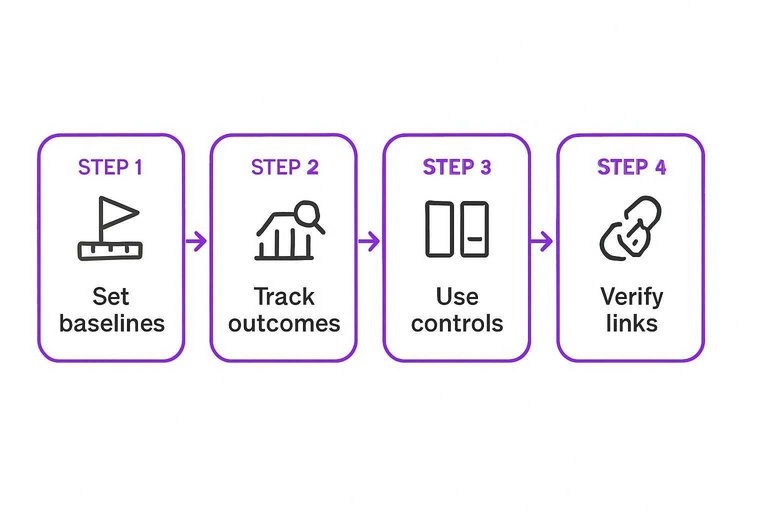
You can’t learn anything from 30 contextual links without a measurement plan. Track outcomes at the query and page level, then separate link effects from content changes and seasonal demand.
Primary outcomes
Measure what moves the business, not what flatters the report. Set baselines before any placements, then watch the same slices throughout the build.
Query-level rankings tell you where relevance and authority shift. Landing-page impressions and clicks show whether Google is rewarding that page. Non-brand visibility reduces the “brand hid the problem” effect. Conversion-aligned actions confirm the traffic is actually useful.
If rankings rise but non-brand clicks don’t, you probably bought position, not demand.
Supporting indicators
Use secondary metrics to explain the “why” behind outcome swings. They also help you spot technical bottlenecks early.
- Crawl frequency on linked-to URLs
- Indexation changes for target pages
- Internal link flow into targets
- Branded demand shifts in Search
- Referral traffic quality and intent
When outcomes stall, these indicators tell you where the chain broke.
Lag and attribution
Links rarely show impact instantly, and the lag varies by site strength and crawl behavior. Treat the first days as validation, not victory.
Use annotations for every placement date, major content update, and internal linking push. Then compare against control pages or control queries that did not receive links. Pick controls with similar intent, similar historical trend, and no simultaneous on-page changes.
If your controls move the same way, you’re looking at seasonality, not link impact.
For clarity on how query/page metrics are calculated and filtered, use the Search Console Performance report and unlocking daily SEO gains with AI.
Link quality signals
Don’t assume a placed link is a live asset. Verify it after publishing, then re-check it later.
- Confirm the linking page is indexed in Google.
- Verify the link placement stays in-content and dofollow.
- Review the outbound neighborhood for spammy, unrelated links.
- Check clicks and on-site behavior from referral traffic.
- Re-audit stability after crawls and page updates.
A link that never gets crawled or clicked is just a line of HTML.
Risk monitoring
Monitor patterns that look manipulative or unstable. Catching them early is cheaper than cleaning them later.
- Sudden anchor text concentration
- Toxic or irrelevant link neighborhood
- Link removals or “nofollow” flips
- Manual action or security warnings
- Repeating footprints across placements
If the pattern is obvious to you, it’s probably obvious to Google.
Results analysis
You want to know what moved, where it moved, and what stayed flat after building 30 contextual links. The safest way to read it is page-by-page and query-by-query, not as one blended site metric.
Here’s the view we used to interpret changes without pretending there’s a universal benchmark.
| View | What you compare | What “good” looks like | How to interpret |
|---|---|---|---|
| Linked page | Pre vs post trend | Smoother upward curve | Link impact is plausible |
| Similar unlinked page | Same period | No matching lift | Reduces seasonality bias |
| Query group (topical) | Keyword set trends | More queries rising | Relevance improved |
| Query type | Brand vs non-brand | Non-brand improves | Discovery expanded |
| SERP position bands | 1–3, 4–10, 11–20 | More in 4–10 | Near-wins increased |
If the linked pages rise while similar unlinked pages don’t, you’re seeing signal, not vibes.
What moved the needle
A few patterns lined up with the periods where rankings and visibility improved. They look like correlation, not proof, but they’re consistent enough to guide your next build — especially if you’re pairing link work with a steady cadence of well-structured, intent-matched content (the kind of workflow platforms like Skribra are built to support).
Best-performing contexts
Links placed inside tightly matched content tended to behave better. Think: a paragraph already explaining the same concept your target page covers, then your link as the next logical reference.
High-intent pages also seemed to help more. Product comparisons, “best X” lists, and problem-solution guides carried clearer intent, especially when the surrounding page covered the topic thoroughly — which is easier to scale when your publishing process consistently bakes in on-page structure, keywords, and meta basics.
Chase context first, not domain metrics. Relevance compounds.

Anchor and placement
Stable link patterns showed up when anchor text and placements looked boring and natural.
- Use brand or URL anchors often
- Keep anchors in natural sentences
- Prefer partial-match over exact-match
- Place links mid-article, not footer
- Add links near supporting context
When a link reads like an edit, it tends to age better.
Google’s guidance on writing descriptive anchor text aligns with this approach.
Page-level readiness
Some target pages responded faster because they were already “ready to rank.” The pages had real topical depth, answered the query cleanly, and didn’t force users to hunt for the payoff.
Internal links mattered too. Pages with supportive internal links gave crawlers and users a clear path, which makes external links feel like fuel instead of a jump-start.
This is also where content ops can quietly decide outcomes: if you can keep publishing SEO-structured pages with consistent formatting and metadata (and get them live without friction, for example via WordPress publishing workflows like Skribra’s), more of your targets will actually be worth building links to.
Build links to pages that deserve them. Fix the page first.
Diminishing returns
You need a simple way to spot when more links stop helping.
- Watch rankings for flattening across multiple related queries.
- Check impressions for stalled growth, even after new links land.
- Compare new link velocity to traffic movement on the target page.
- Monitor whether marginal links get indexed or ever earn clicks.
- Pause building and improve the page when signals stay flat.
When links stop moving anything, you’re not under-linked. You’re under-improved.
Costs and tradeoffs
You can build 30 contextual links with money, time, or both. The real cost is the friction you absorb to keep quality consistent.
| Cost area | Typical drivers | Hidden friction | When it hurts most |
|---|---|---|---|
| Cash spend | Content creation | Revisions, rewrites | Tight budgets |
| Staff time | Prospecting, follow-ups | Inbox churn | Small teams |
| Opportunity cost | Delayed core work | Context switching | Product crunch |
| Quality risk | Weak relevance | Unstable placements | Aggressive pace |
| Compliance risk | Disclosure, policies | Vendor opacity | Regulated niches |
If the coordination overhead feels heavier than the link value, your process is the bottleneck.
Replicate the Playbook, Then Pressure-Test the Results
- Lock the definition first: document what “contextual” means in your campaign (placement, editorial control, topic alignment) and exclude anything that doesn’t meet it.
- Build with repeatable constraints: use a qualification checklist, vary placement types intentionally, and keep anchor choices mapped to the target page’s intent—not just the keyword.
- Measure like an experiment: track page-level baselines, annotate link go-lives, watch for lag, and judge outcomes alongside quality and risk signals.
- Scale only what holds up: double down on the contexts and pages that were “ready” to benefit, and pause when marginal links stop moving primary outcomes.
Turn Links Into Rankings
This case study shows contextual backlinks work—but repeating the process with consistent content, tracking, and outreach discipline is where most teams hit a time wall.
Skribra helps you publish SEO-ready articles daily and tap into a backlink exchange network to earn more contextual links—plus you can start with a 3-Day Free Trial.
Written by
Skribra
This article was crafted with AI-powered content generation. Skribra creates SEO-optimized articles that rank.
Share: