February 27, 2026
·
Updated October 1, 2026
·
11 min read
Contextual backlinks vs guest posts for SaaS SEO
A side-by-side comparison of contextual backlinks vs guest posts for SaaS SEO—use a decision snapshot, quality signals, control/risk tradeoffs, cost and scalability realities, and KPI tracking to pick the tactic that compounds authority and pipeline.

If your SaaS link building feels like a choice between “fast links” and “safe links,” you’re not alone—and that tradeoff is usually oversimplified. Contextual backlinks and guest posts can both work, but they behave very differently once you factor in editorial control, stability, and how equity actually flows to product and feature pages.
This comparison helps you choose based on your goal (rank lifts vs brand demand), your constraints (budget, speed, team bandwidth), and your risk tolerance. You’ll get clear quality checks, realistic cost/time expectations, and playbooks to execute without buying volatility.
Decision Snapshot
Contextual backlinks are earned links placed naturally inside someone else’s relevant article, like a “see this pricing benchmark” citation. Guest posts are contributed articles you write for another site, with one or more links you control.
For SaaS, both can work, but they win in different conditions. Pick based on how fast you need authority, how much content your team can ship, and how tightly you need message control.
SaaS link goals
Links are not the goal. Revenue motion is.
Contextual backlinks usually support bottom-funnel pages like “/pricing,” “/compare,” and “/integrations.” Guest posts usually support category pages, thought leadership, and “how-to” content that seeds demand.
A clean success target looks like this: higher rankings on revenue keywords, more demo starts, and better pipeline-assisted attribution from organic.
If your links don’t map to trials or pipeline, you’re collecting trophies, not leverage.
Tactics defined
Two tactics. Two tradeoffs.
- Place links inside existing articles
- Publish new articles on external sites
- Control anchor and messaging differently
- Invest outreach time versus writing time
- Target niche blogs versus media sites
Your constraint decides the tactic: editorial access or content capacity.
Fast chooser
Use a few rules, then commit.
- Pick contextual backlinks when you need speed and minimal writing.
- Pick guest posts when you need message control and topic ownership.
- Prioritize contextual backlinks for “money pages” and comparisons.
- Prioritize guest posts for category education and narrative building.
- Mix both only if you can track rankings to pipeline.
If you can’t measure impact, start with the tactic that ships fastest.
Quality Signals
You don’t buy “a backlink.” You buy a bundle of signals Google and humans can trust. Here’s how contextual backlinks and guest posts stack up on the signals that move SaaS SEO.
Quality signals: contextual backlinks vs guest posts
Use this as a quick scorecard when you’re judging a specific opportunity, not a channel.
| Signal | Contextual backlinks | Guest posts | Winner |
|---|---|---|---|
| Relevance | In-article mention | Topic aligned article | Contextual backlinks |
| Anchor text | Natural, varied | Often keyword-led | Contextual backlinks |
| Placement | Surrounded by proof | Bio or author box | Contextual backlinks |
| Traffic | Real readers click | Often low, new | Contextual backlinks |
| Editorial context | Cited as source | Published as contributor | Contextual backlinks |
If your link sits in the “evidence” part of a paragraph, you’re playing the strongest game.
Control vs Risk
You can buy control with guest posts, or borrow trust with contextual backlinks. The trade-off shows up fast when you choose anchors like “best payroll SaaS” instead of your brand.
Anchor control
Anchor text is where SEO intent meets the spam filter. Pick the winner by anchor type, then keep ratios boring.
| Scenario | Guest posts | Contextual backlinks | Safe ratio hint |
|---|---|---|---|
| Branded anchors | Strong | Strong | 60–80% branded |
| Partial-match anchors | Strong | Medium | 10–30% partial |
| Exact-match anchors | Risky | Weak | 0–5% exact |
| Naked URL anchors | Medium | Strong | 5–20% URLs |
If you “need” exact-match control, your risk is already too high.
Editorial independence
Contextual backlinks read like a third-party citation, which is the trust signal you can’t fake. Guest posts read like authored content, even when you disclose “contributor,” and reviewers can sense the agenda.
For E-E-A-T perception, contextual backlinks win because independence beats polish.
Link stability
Links live or die by publisher incentives, not your outreach spreadsheet. Treat stability as a risk register.
- Edit removes link after a “refresh”
- Nofollow flips during policy change
- Site sale triggers sweeping cleanup
- Content pruning deletes “thin” pages
- CMS migration breaks URL paths
Contextual backlinks are usually more durable, because they’re woven into existing pages with real traffic.
Cost and Time
Total cost is more than a publish fee. You pay in outreach hours, writing cycles, and calendar delay.
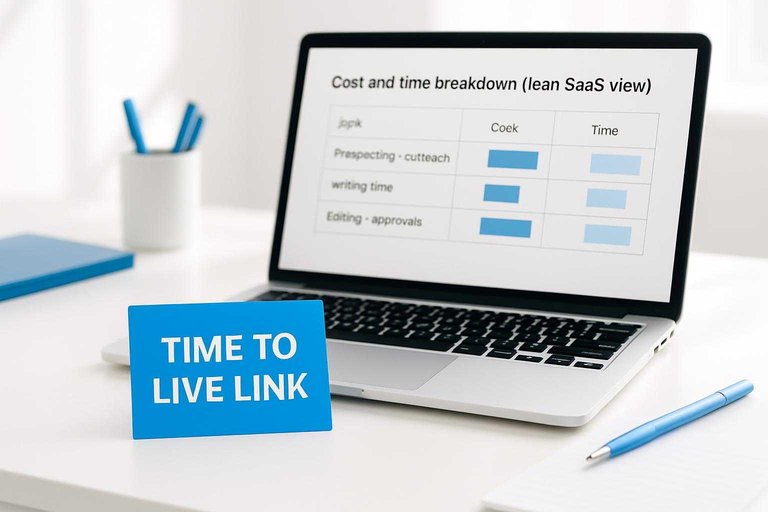
Cost and time breakdown (lean SaaS view)
| Cost / time item | Contextual backlinks | Guest posts | Lean-team verdict |
|---|---|---|---|
| Prospecting + outreach | Low to medium | Medium to high | Contextual wins |
| Writing time | None to light | Heavy | Contextual wins |
| Editing + approvals | Light | Heavy | Contextual wins |
| Placement fees | Sometimes | Often | Tie, niche-dependent |
| Time to live link | Days to weeks | Weeks to months | Contextual wins |
Lean SaaS teams usually win with contextual backlinks, because they buy speed and focus.
Scalability
Contextual backlinks and guest posts both “work,” but they scale differently when you add pages, geos, and product lines. One scales like operations. The other scales like a newsroom.
Outreach throughput
Scaling outreach is mostly a systems problem, not a writing problem.
- Build segmented prospect lists by geo, product line, and intent.
- Write one core pitch per segment, then personalize only the first line.
- Standardize follow-ups in your CRM with strict timing rules.
- Add QA checks for relevance, anchors, and page indexability.
- Track replies, placements, and time-to-link per tactic weekly.
Contextual backlink outreach scales cleaner because you don’t ship a new article each time.
Content production load
Guest posts demand steady new drafts, edits, and SME review, even when the link target changes. Contextual backlinks usually need a “quote,” a short insight, or a small contribution, like “we saw a 22% drop.”
Small teams run out of SME bandwidth before they run out of prospects. Choose contextual backlinks when your calendar can’t support publishing like a media company.
Inventory constraints
Both tactics hit ceilings, but they hit different walls.
- Wait for publisher acceptance and inbox cycles
- Match topic fit to your target page
- Respect link quotas per site
- Work around editorial calendar gaps
- Avoid duplicate angles across geos
Guest posts hit limits first because editorial calendars and draft capacity don’t expand on your timeline.
SEO Impact Paths
Both contextual backlinks and guest posts can move SaaS rankings, but they do it through different routes. One concentrates authority where you publish; the other borrows authority where you’re cited.
Topical authority
Topical authority is about repeated proof that you own a category, not a single lucky link. For SaaS, you’re usually fighting on tight niches like “SOC 2 automation” or “product analytics for B2B.”
A sustained guest post series wins for category expertise:
- Guest posts let you publish a sequence: glossary → comparisons → implementation playbooks.
- You control anchors, examples, and the “we’ve done this” tone.
- You can interlink posts to a hub, then funnel to your product pages.
Contextual citations help, but they’re scattered proof from others, not a coherent body of work. If your niche needs education before purchase, the series is the flywheel. For a broader framework on building this kind of compounding authority, see our SaaS SEO guide.
Link equity flow
Different targets need different link paths, and control matters more than raw DR.
| Tactic | Money pages | Supporting pages | Hub pages |
|---|---|---|---|
| Guest post | Medium control | High control | High control |
| Contextual backlink | Low control | Medium control | Medium control |
| Winner | Guest post | Guest post | Guest post |
If you need to push a specific page, guest posts give you steering, not hope.
Referral demand
Referral traffic is where SEO stops being “rankings” and starts being pipeline. SaaS deals often need two or three touches, so assisted conversions count.
Guest posts usually drive higher referral and assists:
- Newsletter-style placements with a clear “read more” CTA.
- Operator blogs with “how we did it” case studies.
- Partner ecosystems pages with an integration angle.
- Comparison posts that rank and keep sending clicks.
Contextual backlinks can spike referrals when the citing page already ranks, like “best X tools” roundups. If you want reliable assisted conversions, you want the page you wrote.
Use-Case Matchups
Pick the tactic that matches your constraints, not your ego. Use the table to call a winner fast.
| SaaS situation | Winner | Why it wins | Do this next |
|---|---|---|---|
| New category, low awareness | Guest posts | Borrowed audience trust | Pitch 10 niche blogs |
| Strong content, weak links | Contextual backlinks | Upgrade existing winners | Build 50-link prospect list |
| Regulated space, trust gaps | Guest posts | Control narrative, citations | Publish compliance-ready byline |
| High DR site, slow rankings | Contextual backlinks | Direct relevance signals | Target pages ranking 6–20 |
| Small team, limited bandwidth | Contextual backlinks | Less content overhead | Run monthly link inserts |
If you can’t name a winner per page, you’re doing “marketing,” not SEO prioritization.
Execution Playbooks
You don’t need more “link building ideas.” You need repeatable ops that survive a bad week. Use these playbooks to ship clean links, avoid sloppy footprints, and keep attribution tight.
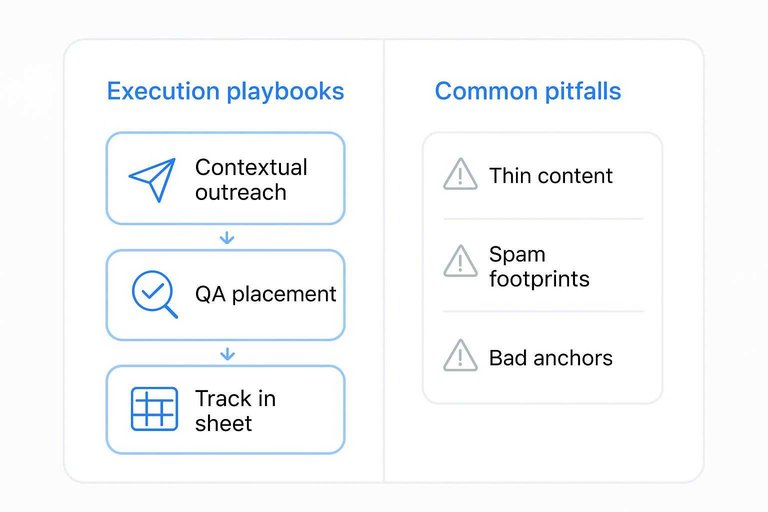
Contextual backlink steps
Run this like a PR workflow, not a bulk-email campaign.
- Inventory linkable assets: stats page, benchmark report, templates, calculators.
- Map pitch angles per persona: “new data,” “contrarian take,” “missing step,” “updated guide.”
- Produce cite-worthy nuggets: one chart, one table, one quotable metric.
- Do targeted outreach to relevant pages, then propose exact insertion copy.
- QA placement: dofollow, correct URL, nearby topical context, natural anchor.
- Track in a sheet: target page, URL, anchor, date, DA, traffic, notes.
If you can’t point to the sentence that earns the link, you’re renting attention.
For tighter execution and fewer dropped balls, use an ultimate SEO content checklist before you pitch or publish anything that needs to earn citations.
Guest post steps
Guest posts are editorial projects with deadlines, stakeholders, and revisions.
- Pick a topic the host already ranks for, then add one new angle.
- Get outline approval with proposed headings and one link target.
- Pull SME quotes: “We saw X% change,” “Here’s the failure case,” “Here’s the fix.”
- Draft with tight examples, screenshots, and one primary source citation.
- Place links naturally in-body, then keep the author bio minimal.
- QA before publish: formatting, rel tags, canonicals, images, author page.
If your draft can’t earn engagement without the link, it’s a liability.
Common pitfalls
Most failures are unforced errors: you chase the link and forget the reader. Thin content is the big one, like a “10 tips” post with no numbers.
Mismatched sites kill both tactics, but guest posts suffer more because your byline makes the association public. Spam footprints pile up fast, like identical bios, repeated templates, and the same “best software” anchors.
Bad anchors are the quiet leak, especially when every link is exact-match or brand-only. Weak internal linking wastes the win, because your new link points at a page with no clear next click.
Guest posts are usually riskier operationally, because they create more visible patterns and more negotiation points.
Measurement and KPIs
You can’t compare contextual backlinks and guest posts without shared scorekeeping. Use one KPI table so your SEO and growth numbers don’t argue.
Track the same KPIs for both tactics, then declare a winner per KPI using one measurement method.
| KPI | How to measure | Contextual backlinks | Guest posts |
|---|---|---|---|
| Rankings | GSC query groups | Winner: contextual | Strong: guest posts |
| Assisted conversions | GA4 path, UTMs | Strong: contextual | Winner: guest posts |
| Referral quality | Engaged sessions, ICP | Strong: contextual | Winner: guest posts |
| Link retention | Monthly link audit | Winner: contextual | Risk: edits/remove |
| Link velocity | New RDs per month | Winner: contextual | Slower: approvals |
If you don’t pick winners per KPI, you’ll keep funding the tactic with the loudest anecdote.
Final Recommendation
If you need compounding SEO with low brand risk, pick contextual backlinks as your default. Think “links in existing, relevant pages,” not “one-off guest post spikes.”
Use this by stage and constraints:
- Pre-seed to seed, tiny team: prioritize contextual links to 3–5 money pages, then ship product pages.
- Series A, content engine running: keep contextual links primary, add guest posts only for narrative and partnerships.
- Enterprise motion, high scrutiny: contextual links from vetted sites, and publish guest posts only on tier-1 outlets.
Primary pick: contextual backlinks for most SaaS teams, most months. Secondary mix: run 70/30 contextual-to-guest when you need both rankings and a louder point of view.
What “Contextual Backlinks” Means in Practice (and Where It Gets Risky)
“Contextual backlinks” isn’t one tactic—it’s a spectrum of ways your link can appear inside the body content of a relevant page (as opposed to a footer, sidebar, author bio, or a generic directory listing). When people compare contextual backlinks vs guest posts, they’re usually comparing how that in-content link gets there.
Below are the most common practical forms, what typically makes them acceptable vs risky, and how to vet placements so you don’t buy a footprint you’ll regret later.
The contextual backlink spectrum (common formats)
1) Earned editorial link (best case)
A site references your product/content because it genuinely improves their article. You don’t control the page, anchor text, or exact placement.
2) Guest post in-content link (controlled editorial)
You (or a writer you hire) publishes a new article on a third-party site and includes one or more in-content links back to your SaaS (or to supporting content). This is still “contextual,” but it’s publisher-mediated content you supplied.
3) Editorial link insertion / niche edit (existing article update)
A link is added to an existing page—ideally because it improves accuracy, adds a source, or fills a missing resource. Some vendors call these “editorial insertions,” “link insertions,” or “niche edits.” The risk profile depends on why the link is being added and how consistently the site does this for money.
4) Unlinked mention conversion (often the cleanest ‘outreach’ version)
Your brand/product is already mentioned without a link, and you ask the publisher to make it clickable. This is typically easier to justify editorially because the reference already exists.
5) Paid placements disguised as editorial (highest-risk end of the spectrum)
This is where “contextual backlink” becomes shorthand for buying links at scale: templated outreach, predictable anchor patterns, and sites that publish/modify content primarily to sell placements.
Acceptable vs risky: practical guardrails
There’s no single rule that makes a contextual backlink “safe,” but there are patterns that consistently reduce risk.
Generally acceptable (lower risk) signals
- The link addition has a clear reader benefit: definition, comparison, supporting evidence, or a genuinely useful tool/resource.
- The page already links out to other credible sources in a natural way (your link doesn’t look like the only commercial outbound link).
- The anchor text reads like an editor wrote it (brand name, product name, or descriptive-but-not-keyword-stuffed phrasing).
- The linking site has a real audience and real editorial choices (unique authors, consistent topical focus, normal publishing cadence).
Generally risky (higher risk) signals
- The placement is sold as a commodity (“DA X+ contextual link”) with no discussion of fit, page context, or editorial rationale.
- Anchors are overly commercial or repeated across multiple sites/pages (obvious patterning).
- The site’s outbound links skew heavily toward money pages, affiliate-heavy lists, or unrelated industries.
- The link appears in a paragraph that reads like it was retrofitted to accommodate it (awkward sentence structure, sudden topic shift).
- The site looks like it exists primarily to host guest posts or link insertions (thin categories, generic topics, lots of “write for us,” inconsistent authorship).
If you’re building links for a SaaS, the safest north star is: could the publisher defend this link as an editorial improvement if a reader asked why it’s there?
How to vet placements and avoid footprints (a quick checklist)
When you’re evaluating a contextual backlink opportunity—whether it’s a guest post, an insertion, or an unlinked mention conversion—vet it like you’re trying to prove it’s real editorial.
Page-level checks (placement quality)
- Topical alignment: Does the page’s primary intent match what you’re linking to (feature page vs blog guide vs glossary)?
- Context fit: Would your link still make sense if it were removed—i.e., is the surrounding paragraph coherent and genuinely related?
- Link neighborhood: What other sites does the page link to? Are they legitimate references, or a cluster of commercial placements?
- Placement location: In-body is necessary, but not sufficient. A link buried in a “Resources” dump or a tacked-on paragraph can still be a footprint.
Site-level checks (editorial reality)
- Consistency of topic coverage: A tight niche is usually a better sign than a site that publishes on everything.
- Authorship and accountability: Named authors, bios, and a believable editorial structure beat anonymous content farms.
- Outbound link behavior: A natural mix of citations, internal links, and a limited number of relevant external links looks healthier than pages that exist to point outward.
Deal-structure checks (where footprints are created)
- Anchor constraints: Avoid requirements like exact-match anchors across multiple placements.
- Template content: Be wary of identical intros, identical “as seen in” blocks, or the same CTA language repeated across domains.
- Timing and velocity: Large batches of similar links acquired in a short window can create obvious patterns—especially if they share anchor style and target the same money page.
What to ask for before you say yes
- The exact URL where the link will live (not just the domain).
- The proposed sentence/paragraph including the anchor text.
- Whether the publisher will add the link because it improves the content, and what change they’re making around it (if any).
This level of scrutiny helps you compare guest posts vs contextual insertions on equal terms: not “which is cheaper,” but which produces the fewest detectable patterns while still improving relevance and referral value.
Choose your primary lane, then operationalize it
- Pick your primary objective for the next 60–90 days: faster ranking movement on a cluster (favor contextual backlinks) or durable brand + top-of-funnel authority (favor guest posts).
- Set hard quality gates before outreach: relevance to your ICP, real editorial standards, indexed pages with organic traffic, and a natural in-body placement that supports the surrounding content.
- Run one focused pilot per tactic (10–20 placements), track lift at the page/cluster level (rank, clicks, assisted sign-ups), then scale the winner with a repeatable workflow and quarterly link audits to protect stability.
Frequently Asked Questions
- Are contextual backlinks safer than guest posts for SaaS SEO in 2026?
- Usually yes, because they’re placed inside existing editorial content and can look more natural than a new article built around a link. Safety still hinges on relevance, real traffic, and avoiding keyword-stuffed anchors.
- How many contextual backlinks do I need to rank a SaaS page?
- Most SaaS pages see movement after 5–20 strong contextual backlinks from relevant sites, but competitive keywords often take 30+ plus solid internal linking. Prioritize unique referring domains and topical relevance over hitting a specific number.
- How do I find contextual backlink opportunities for a SaaS product page?
- Use Ahrefs/SEMrush to identify pages already ranking for your target topic, then prospect “mention” and “resource” pages where your product is a legitimate add. Combine Google operators ("best" + keyword, "alternatives", "vs") with competitor backlink gap reports to build a qualified list fast.
- What anchor text should I use for contextual backlinks to avoid over-optimization?
- Use mostly branded, URL, and partial-match anchors, and keep exact-match anchors to a small minority (often under 10%). Match the anchor to the sentence naturally and rotate landing pages so one URL doesn’t get an unnatural anchor pattern.
- How long do contextual backlinks take to impact SaaS rankings and pipeline?
- Expect early signals in 2–6 weeks (indexation, impressions, position shifts) and more reliable ranking lifts in 6–12 weeks once the linking page is crawled and re-scored. Pipeline impact typically trails by another 4–8 weeks as organic traffic grows and converts.
Turn Context Into Rankings
Choosing between contextual backlinks and guest posts is only half the work—building a steady stream of link-worthy pages and earning placements consistently is the real bottleneck.
Skribra helps you publish SEO-ready content daily and participate in a quality backlink exchange network to grow authority faster—start with a 3-Day Free Trial.
Written by
Skribra
This article was crafted with AI-powered content generation. Skribra creates SEO-optimized articles that rank.
Share: