February 15, 2026
·
Updated August 2, 2026
·
19 min read
What AI SEO tools do for content teams
A pillar guide to everything AI SEO tools do for content teams—map the tool landscape, turn intent and SERP data into prioritized plans, generate briefs/drafts/optimizations faster, and measure outcomes with governance-ready reporting.

If your content team is “using AI for SEO,” but results still hinge on spreadsheets, guesswork, and last-minute optimizations, the problem isn’t effort—it’s a fuzzy workflow. Most teams can’t explain what AI should do at each stage, so tools overlap, gaps hide, and quality slips.
This pillar breaks the stack into clear jobs: discovery, prioritization, briefing, drafting, on-page and technical support, and measurement. You’ll see where humans stay in control, what outputs to expect, the risks to govern, and how to choose a toolset that actually ships better content.
AI SEO tool map
AI SEO tools for content teams blend SEO data, LLMs, and workflow controls to move from “keyword” to “shippable page.” Traditional SEO suites measure and monitor, but rarely write or structure content. Generic AI writing tools write fast, but they do not know your SERP, your site, or your constraints.
What they are
AI SEO tools are systems that turn search demand plus site context into content decisions and assets. They differ from classic SEO platforms by generating briefs, outlines, and on-page actions, not just dashboards. They differ from generic AI writers because they ground output in SERP patterns, intent, and your existing pages.
Where they fit
They sit across the full content lifecycle, not just “optimization.”
- Research: mine topics, intents, SERP patterns
- Planning: build clusters, prioritize, assign owners
- Drafting: generate briefs, outlines, first drafts
- Optimizing: suggest edits, links, schema, gaps
- Publishing: check readiness, metadata, templates
- Updating: detect decay, refresh targets, re-optimize
- Reporting: track rankings, traffic, conversions
If your tool stops at “write 1,500 words,” it’s not an SEO system.
Core outputs
Expect outputs that look like production artifacts, not inspiration. The common set includes topic clusters, content briefs, outlines, draft sections, and on-page recommendations tied to specific queries. Many also propose internal links, schema markup, and performance reports that close the loop.
Human vs machine
Use the tool for speed and coverage, and keep humans on accountability and taste.
| Work area | Machine owns | Human owns | Failure risk |
|---|---|---|---|
| Strategy | options, forecasts | priorities, bets | wrong target |
| Accuracy | citations, checks | verification | bad facts |
| Originality | recombination | unique POV | sameness |
| Compliance | policy flags | legal sign-off | violations |
| Approvals | routing, logs | final decision | drift |
| Editorial voice | style hints | voice, tone | brand blur |
The tool can propose; you still have to sign your name to it.
Strategy and discovery
Before you write a word, AI SEO tools map the demand and the constraints. Think of it as a pre-flight check that prevents “great content” from targeting the wrong job.
Audience and intent
AI SEO tools classify intent so you stop guessing what the searcher wants. You also get persona signals pulled from SERPs, forums, and your own support tickets.
They’ll label queries as “learn,” “compare,” or “buy,” then surface patterns like “IT admin,” “freelancer,” or “new manager.” They mine recurring pains from Reddit threads, PAA questions, and ticket phrases like “keeps timing out.”
Write for the job, not the keyword, and your outline almost writes itself.
Keyword discovery
AI tools expand your keyword universe fast, then organize it into something you can plan.
- Expand long-tail variants from seed topics
- Cluster keywords by shared intent
- Estimate difficulty from ranking signals
- Flag seasonality and trend spikes
- Detect cannibalization across your pages
If two pages want the same query, you don’t have a content problem. You have an architecture problem.
SERP intelligence
AI SEO tools read the SERP like a spec sheet for what will rank. You see what Google keeps rewarding, and what it keeps ignoring.
They extract patterns like listicles vs guides, common H2s, repeated entities, and PAA themes. They also infer depth expectations, like “needs pricing examples” or “must include a checklist.”
When the SERP demands a format, fighting it is just paying a tax.
Competitive gap
Run a gap pass before you draft, so your brief has teeth.
- Compare competitor topic coverage to your existing URLs.
- Flag weak pages with low depth or mismatched intent.
- Identify link gaps by domain and page-level authority.
- Extract differentiators from reviews, forums, and product docs.
- Convert gaps into brief sections and “proof” requirements.
The win rarely comes from saying more. It comes from saying what everyone else dodged—use a solid SEO guide for planning to pressure-test what your brief includes and what it leaves out.
Planning and prioritization
AI SEO tools turn a messy opportunity list into a roadmap your team can actually ship. They connect keywords, pages, effort, and owners, so you stop debating opinions and start moving tickets. Think: “We’re building a hub on payroll compliance,” not “We should blog more.”
Topic clustering
AI tools cluster related queries so you can design hubs and spokes before anyone writes a word. You use them to pick pillar pages, assign each query to a page, and prevent two writers from covering the same intent.
A practical workflow:
- Define one pillar per cluster, based on broad intent.
- Assign spokes to a single supporting page each.
- Map every query to one URL, even if it’s “TBD”.
- Flag overlap when two pages target the same SERP.
The win is structural: your site reads like a library, not a pile of posts.
Effort scoring
Effort scoring makes prioritization less political by forcing tradeoffs onto a visible grid. Your tool can estimate lift and cost using signals like authority, freshness, and dependency chains.
| Factor | Score (1-5) | What you check | Signal |
|---|---|---|---|
| Impact | 5 | Revenue pages | High intent |
| Feasibility | 3 | SME access | Limited time |
| Authority | 2 | Link gap | Weak domain |
| Freshness | 4 | Stale SERP | Recent updates |
| Dependencies | 1 | Platform work | Blocked |
When “easy wins” score low on impact, you’ll stop shipping busywork.
Editorial calendar
Once priorities are set, tools convert them into a calendar with owners and gates. You get timelines that reflect real capacity, not vibes.
- Assign each item an owner, due date, and target URL.
- Set stages like brief, draft, SME, SEO, and publish.
- Add SLA-style gates for reviews, with time boxes.
- Auto-shift dates when upstream stages slip.
- Track status in one board tied to the keyword map.
If reviews are a bottleneck, the calendar will prove it in a week.
Stakeholder alignment
Tools help you package each content bet into a shareable rationale stakeholders can’t easily ignore. You attach the target query, the business goal, the metric, and the risks to the same card.
A good brief reads like: “Target ‘SOC 2 vs ISO 27001,’ drive demo assists, measure by assisted conversions, risk is legal review.” That’s the line between “content idea” and “execution plan.”
Tools like AI content planning software can help standardize this rationale across topics and teams.
Briefs and outlines
AI SEO tools turn scattered guidance into one repeatable brief, so your writers stop guessing. One doc can carry the “what to rank for” and the “how to say it,” before drafting starts.
Brief essentials
You need a brief that answers every predictable question up front, so drafts move fast. Keep it strict, and writers will still have room to think.
- Target intent and job-to-be-done
- Primary and secondary keywords
- Entities and related topics
- Angle and audience definition
- Success criteria and SERP benchmarks
When success is measurable, revisions stop being opinion fights.
Outline generation
A good outline mirrors the reader’s intent path, not your org chart. AI tools can draft the hierarchy in minutes, then you edit for truth and taste.
- Map intent to sections, from basics to edge cases.
- Suggest H2/H3 headings that match SERP patterns.
- Add FAQs pulled from related queries and PAA.
- Insert examples, templates, and comparisons where needed.
- Flag differentiators your competitors don’t cover.
If your outline can’t explain the angle, your draft won’t either.
Source guidance
Writers stall when they can’t tell what needs proof and what’s common knowledge. AI SEO tools can pre-load the brief with “cite this” prompts, like “add a 2024 benchmark” or “quote an SME on risk.”
They can also list recommended sources, specific data points to find, expert input you’ll need, and claims that require verification. You ship faster when research gaps are visible on day one.
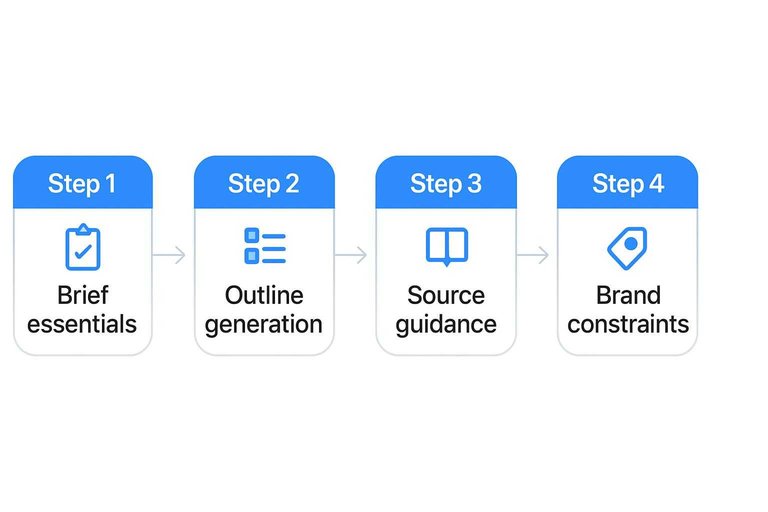
Brand constraints
Consistency dies in the margins, like whether you say “customers” or “users.” AI tools can lock in brand rules inside the brief, so every writer plays on the same field.
That includes tone, approved terminology, do/don’t lists, and legal or compliance constraints, like “no medical claims” or “avoid guarantees.” When constraints are explicit, creativity becomes safer and editing gets boring.
Drafting assistance
AI SEO drafting tools cut the blank-page time while keeping your team accountable for facts and originality. Think “give me a clean first pass from this brief,” then you decide what’s true, what’s yours, and what ships.
Writer copilots
Writer copilots turn your brief into usable text fast, so you spend time editing instead of typing. You can ask for “a tighter intro” or “a smoother transition,” without breaking the outline.
They generate first drafts from headings, rewrite clunky paragraphs, insert bridges between sections, and produce short summaries for meta or newsletters. You keep the structure, then verify claims, add firsthand detail, and remove anything that sounds generic.
Speed is nice, but control is the feature that keeps your content credible.
Reuse and refresh
Your best drafts often already exist, just trapped in other formats. These tools turn that backlog into publishable assets.
- Convert webinar transcripts into structured posts
- Turn internal docs into public guides
- Extract PDF sections into articles
- Expand thin pages with missing subtopics
- Update outdated stats and examples
If you can’t refresh it, you’ll keep rewriting it.
Voice consistency
Drafting speed can wreck tone if you don’t constrain it. Voice controls keep your content sounding like one team, not ten freelancers.
You set style rules, reading level, and approved terminology, then the tool flags off-brand phrasing and POV drift. It’s how you prevent “we” turning into “they,” or “customers” becoming “users” mid-article.
Consistency is what makes your content feel intentional, even at scale.
Collaboration workflow
Drafting help matters more when it fits your existing review process. Workflow features keep edits, decisions, and accountability in one place.
| Feature | Where it lives | Who uses it | Why it helps |
|---|---|---|---|
| Comments | Docs, CMS | Editors | Faster clarifications |
| Versioning | Workspace | Writers | Safe rewrites |
| Approvals | CMS | Leads | Controlled publishing |
| Role-based edits | CMS | Specialists | Protected sections |
When drafting is integrated, reviews get stricter and turnaround still drops.
On-page optimization
AI SEO tools change the page itself, not just your plan. They rewrite key elements to match intent, reduce confusion, and earn the click.
Think: swapping “Complete Guide” for “Pricing, Features, and Limits” when the query screams comparison.
Title and meta
You need titles and descriptions that match intent and win clicks without lying. Tools generate variants, test them against SERPs, and flag “clickbait drift.”
- Pull the dominant SERP intent and common modifiers.
- Draft 5–10 title and meta variants per intent.
- Score each variant for clarity, uniqueness, and truncation risk.
- Check for mismatch triggers like “free” or “template” claims.
- Ship the best pair and monitor CTR by query.
CTR gains usually come from specificity, not cleverness.
Semantic coverage
Relevance now depends on what you cover, not how often you repeat a keyword. Tools map entities and subtopics from top pages, then tell you what’s missing.
They’ll add concrete examples, definitions, and edge cases while cutting filler like “in today’s digital world.” That improves perceived expertise and reduces pogo-sticking.
Your goal is to sound like someone who has done the work, not someone describing it.
Internal linking
Internal links move authority and help Google understand page relationships. Tools spot gaps fast because they can crawl your site like a search engine.
- Suggest descriptive anchors tied to intent
- Recommend target pages for each mention
- Build hub-and-spoke link clusters
- Find orphan pages with no inbound links
- Detect broken links and redirect chains
If you see repeated orphaning, your publishing process is the bug.
Schema and media
Rich results and accessibility start with structured markup and usable media. Tools recommend schema types based on page intent, then draft the JSON-LD.
They also improve images and video by proposing alt text, captions, and chapters that match how people skim. Cleaner media metadata can lift both relevance and CTR.
When your page is machine-readable, it becomes easier to rank and easier to trust.
Technical SEO support
AI SEO tools earn their keep when something blocks Google from seeing your work. They scan templates and URL patterns fast, then point to the exact rule or tag causing the outage. Think “why isn’t this page in the index?” with receipts.
Crawl and index
AI tools flag the stuff that silently kills visibility, before you blame the content team.
- Spot accidental noindex tags
- Detect canonical pointing elsewhere
- Trace redirect chains and loops
- Cluster duplicates by URL patterns
- Compare sitemap and robots conflicts
If two systems disagree, Google usually listens to the stricter one.
Content quality flags
AI can scan thousands of pages for quality signals humans miss in templates and repeats. It’s how you find the “looks fine” pages that still get ignored.
It typically flags thin pages with low unique text, doorway-like variations across locations, and boilerplate blocks repeated sitewide. It also groups near-duplicate clusters, so you can fix the source template instead of editing 200 URLs.
When duplicates share the same skeleton, rewrite the skeleton first.
Structured audits
Turn detections into tickets your engineers can reproduce.
- Export affected URLs with issue labels and frequency.
- Add one example URL per pattern for quick validation.
- Write exact reproduction steps, including template or rule location.
- Assign impact and priority using estimated traffic at risk.
- Track fixes with recrawls and indexing checks.
If a ticket can’t be reproduced, it won’t get fixed.
CMS integration
The best setups catch SEO breakage at publish time, not after rankings drop. Plugins and APIs can auto-check pages for noindex, canonical rules, schema validity, internal links, and performance budgets.
You publish, the system runs gates, and failures get blocked or routed to review. That prevents regressions like a new template rolling out with “noindex” left on.
Make SEO a build step, not a weekly fire drill.
Measurement and reporting
AI SEO tools turn content work into numbers you can defend. You see what moved, why it moved, and what to do next. Think, “This refresh drove 18% more demos.”
KPI framework
You need one scoreboard that matches your business goals, not vanity metrics. AI tools map each content motion to a KPI set, then keep it consistent across teams and time.
A practical mapping looks like: brand pages track impressions and CTR, demand pages track conversions and leads, and customer content tracks retention. You can finally argue about tradeoffs with shared definitions, not opinions.
When your KPIs ladder up cleanly, every brief becomes a measurable bet.
Attribution views
Content rarely “wins” on the last click, so you need multiple lenses. AI SEO tools group pages and journeys so you can see assist value and compounding effects.
| View | What it credits | Best for | Typical question |
|---|---|---|---|
| Last-click | Final touchpoint | Demand pages | “What closed?” |
| Assist | Earlier touchpoints | TOFU content | “What influenced?” |
| Page groups | Template or section | Site strategy | “What section works?” |
| Topic clusters | Cluster and hub | Editorial planning | “What topic compounds?” |
| Journey paths | Sequence of pages | UX and IA | “Where do users go?” |
If assist value rises while last-click stays flat, your pipeline is warming, not failing.
Alerting and insights
You can’t watch every URL, keyword, and SERP change all day. Tools monitor patterns, then tell you what broke, what surged, and what changed upstream.
- Detect anomalies in clicks, CTR, rankings, and conversions.
- Classify cause signals like SERP features, cannibalization, or indexation shifts.
- Flag “winners” worth cloning across similar pages.
- Recommend actions like rewrite titles, consolidate pages, or unlock daily SEO gains with AI.
- Track recovery and annotate updates, including algorithm volatility.
Fast alerts turn a two-week mystery into a same-day fix.
Experimentation
Without tests, reporting becomes storytelling. AI SEO tools help you run controlled changes on titles, intros, templates, and internal links, then store what worked.
You can run A/B tests where traffic allows, or sequential tests when it doesn’t. For example: roll a new intro formula across 20 pages, hold out 20, and compare CTR and scroll depth.
Captured learnings become reusable rules, not one-off wins.
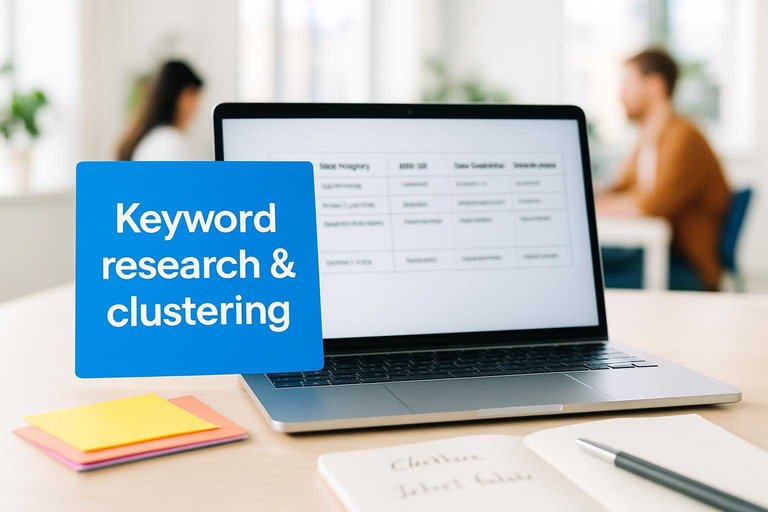
Tool categories cheat-sheet
You’re not choosing “an AI SEO tool.” You’re choosing a job-to-be-done for your content team.
| Tool category | Best for | Typical outputs | Watch-outs |
|---|---|---|---|
| Keyword research & clustering | Topic selection | Clusters, intent labels | Thin keyword chasing |
| Content optimization editors | On-page improvements | Briefs, term guidance | Over-optimization risk |
| SERP & competitor analyzers | Strategic gaps | Page outlines, gaps | Copycat content |
| Technical SEO auditors | Site health checks | Crawl issues, fixes | No content insight |
| Rank tracking & alerts | Measuring impact | Positions, volatility | Vanity KPI fixation |
Pick the category that removes today’s bottleneck, then stack the next one.
Use cases by role
Content teams buy AI SEO tools for outcomes, not features. Assign ownership by role, or the work becomes “someone should” work.
- Head of Content: roadmap, prioritization, OKRs
- SEO Lead: keyword maps, technical checks, guardrails
- Content Strategist: briefs, intent alignment, internal linking plans
- Writer/Editor: outlines, optimization passes, refresh drafts
- Analyst: dashboards, experiments, performance narratives
Make one person accountable per deliverable, or your tool becomes a suggestion box.
Risks and governance
Accuracy and sourcing
AI will state guesses like facts, especially on niche topics and fast-moving news. That creates brand risk when a claim can’t be traced to a primary source.
Hallucinations show up as invented statistics, misquoted studies, or “according to experts” with no expert. Outdated info slips in when models reuse old guidance, like deprecated Google documentation. Unverifiable claims appear when the tool can’t produce a link, dataset, or named SME behind the statement.
Treat every strong claim as a liability until you can cite it and get an SME to sign off.
Originality and ethics
AI makes it easy to publish something that looks new but isn’t. Your guardrails should protect IP and push real differentiation.
- Run plagiarism checks on final drafts
- Avoid copying competitor structures and phrasing
- Attribute quotes, data, and frameworks clearly
- Add firsthand examples, screenshots, or results
- Confirm you have rights for any assets
If you can’t point to what you uniquely observed, you’re just remixing.
Search policy alignment
AI can scale content faster than your judgment scales, and that’s where policy violations sneak in. If your workflow rewards volume, you’ll drift into “made for search” pages that don’t help anyone.
Align outputs with spam policies, helpful content principles, and strict YMYL standards where relevant. Use clear disclosures when automation materially shapes the page, especially in regulated categories or when readers expect authorship transparency.
Google has explicitly called out risks like scaled content abuse when content is produced at scale primarily to boost rankings.
The safest SEO play is simple: write for the user, then prove it in the SERP.
Operational guardrails
Governance has to live in your workflow, not in a slide deck. Build lightweight controls that make the right thing the default.
- Define a content checklist for facts, links, tone, and legal risks.
- Add approval gates for YMYL, claims, and brand-sensitive pages.
- Maintain a prompt library with approved patterns and banned moves.
- Store audit trails: prompts, sources, edits, and reviewer names.
- Schedule sampling audits to catch drift and retrain the system.
Fix the process once, and you stop paying for the same mistakes every week.
Choosing the right stack
Buying AI SEO tools is less about features and more about fit. Your stack should match your workflows, your data, and your risk tolerance, not a demo script.
Requirements checklist
Start with non-negotiables, because “we’ll figure it out later” becomes months of duct tape.
- Connects to your CMS and GSC
- Uses your keyword and SERP data
- Supports comments, approvals, and versioning
- Ships reusable templates and briefs
- Handles languages, locales, and tone
- Offers SSO, roles, and audit logs
If a tool fails two of these, it will fail you at scale.
Evaluation process
Run a pilot that mimics real work, not best-case marketing examples.
- Capture baselines for traffic, rankings, and production time.
- Pick a test set: 20 pages across 3 content types.
- Map workflows: briefing, drafting, optimizing, updating, publishing.
- Define success criteria: lift targets and time saved thresholds.
- Timebox it to 2–4 weeks with one accountable owner.
If you can’t measure the win, you’ll keep paying for vibes.
Data and privacy
Treat your AI SEO stack like a data processor, not a writing app. One pasted customer email is enough to create a real incident.
Ask about PII handling, model-training defaults, and retention windows. Require SOC 2 or ISO 27001, and read the DPA for subprocessors and breach terms.
If a vendor can’t answer in plain language, your legal team will answer for you.
Total cost reality
Price tags lie when you ignore seats, usage caps, and adoption time.
| Cost driver | What to check | Hidden gotcha | Who feels it |
|---|---|---|---|
| Licenses | Annual vs monthly | Auto-renew lock-in | Finance |
| Seats | Writers, editors, SEO | “Admin” costs extra | Content leads |
| Usage limits | Credits, queries, tokens | Overage pricing spikes | Ops |
| Implementation | Setup, training, change | Two-month stall | Managers |
| Opportunity | Time spent switching | Lost publishing cadence | Everyone |
The cheapest tool is the one your team actually uses every week.
AI SEO Tools and Google’s Evolving Search Ecosystem
Google’s results pages are changing quickly: AI-generated answers (including AI Overviews/SGE), richer entity-driven panels, and more aggressive rewrites of titles/snippets can alter where—and whether—your content gets visibility.
For content teams, this shifts the goal from “rank a page” to “earn presence across the SERP,” including being referenced, summarized, or surfaced as a trusted source. Modern ai seo tools can help you adapt by focusing on three practical areas: (1) aligning content with E-E-A-T signals, (2) optimizing for inclusion in AI-driven answers and SERP features, and (3) tracking citations and share-of-visibility beyond classic blue links.
Operationalizing E-E-A-T with workflows, not slogans
E-E-A-T isn’t a single ranking factor you can toggle—it’s a set of credibility cues that show up in content structure, author information, sourcing, and consistency across your site. AI SEO tools can make this actionable by turning quality expectations into repeatable checks:
- Experience and expertise cues: Prompting writers to include first-hand steps, screenshots, original examples, or clear “how we did this” sections where appropriate—and flagging when drafts are overly generic.
- Author and reviewer support: Suggesting author bio elements, credential formatting, reviewer fields, and consistent byline/review patterns across templates.
- Sourcing discipline: Identifying claims that need citations, recommending where to add external references, and tracking whether key statements have support (without inventing sources).
- Content integrity audits: Scanning for conflicting advice across your own pages, outdated statements, and thin sections that undermine trust.
The win is consistency: editorial teams can enforce the same credibility standards across dozens of contributors without turning every edit into a subjective debate.
Optimizing for AI Overviews/SGE and feature-heavy SERPs
AI-driven answers can reduce clicks for some queries while increasing visibility for sources that are clearly structured and easy to cite. AI SEO tools can help content teams design pages that are more “summarizable” and more competitive for SERP features:
- Intent-to-format matching: Recommending when content should lead with a direct answer, a short definition, steps, comparisons, FAQs, or troubleshooting flows.
- Chunking and clarity: Detecting walls of text and proposing scannable sections, consistent terminology, and tighter headings that mirror user questions.
- Entity and topic coverage: Surfacing missing subtopics, key terms, and related questions that help Google understand the page’s scope.
- Structured data guidance: Suggesting schema opportunities (where relevant) and validating that on-page content supports the markup.
- Snippet resilience: Highlighting titles/descriptions likely to be rewritten and recommending clearer on-page “answer passages” so the displayed summary still reflects your intended message.
In practice, this is less about “writing for the machine” and more about making expertise easy to extract, cite, and trust.
Citation and visibility tracking beyond rankings
As AI Overviews/SGE and other answer surfaces expand, classic rank tracking alone can miss what leadership cares about: whether your brand is being referenced, whether competitors are being cited instead, and which topics are losing visibility.
AI SEO tools increasingly support:
- SERP presence tracking: Monitoring inclusion in AI Overviews/answer modules, featured snippets, People Also Ask, and other prominent surfaces—even when a page isn’t the top organic result.
- Brand and URL citation monitoring: Detecting when your domain or brand is referenced in AI-driven answers, and when competitors receive those mentions.
- Topic-level share of voice: Rolling up visibility by theme (not just by keyword), so teams can see where authority is strengthening or slipping.
- Change detection and alerting: Flagging meaningful shifts when Google updates result layouts, when an overview starts appearing for a query set, or when citations change.
- Attribution-friendly reporting: Connecting these visibility signals to content actions (new pages, refreshes, consolidation) so performance conversations don’t stall at “the SERP changed.”
To make this useful, define a small set of “visibility KPIs” for each content area (e.g., overview inclusion, citation rate, feature coverage) and review them alongside traffic and conversions—because the path from impression to click is no longer consistent across query types.
Turn the stack into a repeatable publishing system
- Map your workflow end-to-end (discovery → planning → briefs → drafting → optimization → measurement) and assign a single “source of truth” tool/output for each stage.
- Set human decision points: final intent call, claim/source verification, brand voice approval, and internal linking targets—then automate everything else.
- Pilot with 2–3 content pieces and track leading indicators (brief quality, production time, revision cycles) plus lagging outcomes (rank/CTR, assisted conversions).
- Lock governance in writing: sourcing rules, originality checks, policy alignment, access/privacy, and an escalation path when the tool and SERPs disagree.
Frequently Asked Questions
- Are AI SEO tools the same as ChatGPT or other AI writing tools?
- No. AI SEO tools combine AI with SEO data (keywords, SERPs, Search Console, crawls) to recommend, optimize, and measure content, while general AI chat tools mostly generate text without SEO-specific context or performance feedback loops.
- Do AI SEO tools replace SEO specialists, editors, or writers on content teams?
- Usually not. They automate research, drafting support, and QA checks, but humans still own strategy, factual accuracy, brand voice, and final decisions—especially for high-stakes or regulated topics.
- How do I measure whether AI SEO tools are actually improving content performance?
- Track a baseline vs. after adoption using Google Search Console (clicks, impressions, CTR, average position), GA4 (engaged sessions, conversions), and time-to-publish metrics like revision cycles and production velocity over 8–12 weeks.
- Can I get results with AI SEO tools if my site has low domain authority or limited backlinks?
- Yes. AI SEO tools often help most by improving topical coverage, internal linking, and content refreshes that win long-tail queries, even before authority-building efforts catch up.
- How long does it take to see SEO impact after using AI SEO tools for new or updated content?
- Expect early movement in indexation and rankings within 2–6 weeks, and more reliable traffic gains in 8–16 weeks, depending on crawl frequency, competition, and how much you changed on-page content.
Automate Your AI SEO Stack
Once you understand what AI SEO tools can do—from briefs and drafting to optimization and reporting—the real challenge is executing consistently without adding workload or tool sprawl.
Skribra turns that tool map into a daily, SEO-optimized publishing engine with WordPress integration, images, and backlinks—start with the 3-Day Free Trial.
Written by
Skribra
This article was crafted with AI-powered content generation. Skribra creates SEO-optimized articles that rank.
Share: