May 16, 2026
·
Updated July 28, 2026
·
13 min read
Everything to Know to Find Competitors’ Keywords
A pillar guide to finding competitors’ keywords and turning them into an actionable content plan — define true rivals, map intent to pages, discover and reverse-engineer ranking terms, score gaps and validate quality, and convert insights into briefs, clusters, and measurable wins.


If you’ve ever copied a competitor’s keywords and still failed to rank, the issue usually isn’t the tool—it’s the process. “Competitor” is often misdefined, intent gets flattened, and keywords get divorced from the pages that actually win.
This guide shows you how to pick the right rivals from the SERP, uncover keywords fast using multiple signal sources, and reverse-engineer the pages that earn clicks. You’ll also learn how to score gaps, validate keyword quality, and translate findings into a content roadmap you can execute.
Competitive Keyword Map
You’re not mapping “keywords.” You’re mapping competitors’ pages to the queries they win, and the intent those queries signal.
Do that well, and keyword gaps stop being trivia. They become a backlog tied to real SERP demand and revenue paths.
What counts as competitor
A competitor is anyone taking clicks you could have earned for the same intent, even if they don’t sell what you sell.
Direct competitors target the same buyer with similar offers, like “time tracking software” brands fighting on pricing pages. Indirect competitors solve the same job differently, like “Excel timesheet template” ranking for “track hours.” SERP competitors are whoever sits above you for a query, like YouTube or Reddit for “how to invoice clients.” Content competitors publish the best answer, like an accounting blog winning “invoice template” traffic.
If they show up for your intent, they’re your competitor.
Keywords vs topics
A keyword is a query string, like “best CRM for startups.” A topic is the broader problem space, like “choosing a CRM.”
Topic clusters group related queries across pages, while entities are the “things” Google connects, like “HubSpot,” “pipeline,” and “lead scoring.” Competitor analysis starts with pages because pages rank, not word lists, and one page usually covers several intent-adjacent queries.
Start from their ranking pages, then reverse-engineer the cluster behind them.
Intent layers
Intent is why the search happens, and the SERP tells you what Google believes that is.
Intent layers
Intent is why the search happens, and the SERP tells you what Google believes that is.
- Informational: guides, definitions, videos, featured snippets
- Commercial: comparisons, lists, reviews, “best” pages, PAA boxes
- Transactional: product pages, category pages, sitelinks, Shopping ads
- Navigational: brand pages, homepages, knowledge panels, sitelinks
When the SERP format changes, your content type must change too.
The page-query relationship
One strong page can rank for hundreds of queries because Google matches meaning, not exact phrases.
Head terms are broad demand signals, like “project management software.” Long-tail queries carry constraints, like “project management software for architects.” Modifiers like “for,” “near me,” “cheap,” “template,” and years signal segments, urgency, and buying stage.
Those modifiers are your roadmap to pages that print qualified traffic.
Pick the Right Rivals
You want competitors who steal clicks from you in Google, not brands your sales team worries about. The fastest check is simple: if they rank for your problems, they’re your rival.
Assume nothing. Start from queries and let the SERP tell you who matters.
Seed query set
Build a seed set so your competitor list comes from actual searches people type. You need enough breadth to sample the SERPs without drowning in keywords.
- List your core offers in plain language.
- List customer pain points using their phrasing, like “can’t reconcile invoices.”
- Add modifiers like “software,” “template,” “pricing,” “near me,” and “for SMB.”
- Combine into 20–50 seed searches, one intent per query.
- Spot-check SERPs and rewrite any query that pulls the wrong intent.
If your seed set mixes intents, your competitor list will be noise.
SERP-based selection
Pick competitors based on who keeps showing up for your seeds. Repetition beats reputation.
- Show up across many seed SERPs
- Match the same search intent
- Publish comparable content depth
- Fit your geographic scope
- Exclude aggregators when irrelevant
If a domain wins repeatedly, it’s competing for attention, even if you’ve never heard of it.
Segment by intent
Separate competitors by funnel intent so your keyword gaps stay actionable. A “what is X” blog rival and a “pricing” landing page rival are different enemies.
Create three buckets: TOFU for education, MOFU for comparison, and BOFU for conversion. Then assign each competitor based on where they consistently rank.
When you mix funnels, you’ll fix the wrong pages and wonder why rankings don’t move.
Competitor shortlist
Capture your shortlist in a simple table so you can score and revisit it. Keep it tight enough to update weekly.
| Domain | Category | Intents covered | Strengths | Weaknesses | Priority score |
|---|---|---|---|---|---|
| example.com | Direct | TOFU, MOFU | Topical authority | Thin BOFU | 8 |
| rival.io | Direct | MOFU, BOFU | Strong pages | Weak blog | 9 |
| directory.net | Aggregator | MOFU | High domain | Wrong intent | 3 |
| niche.co | Niche | TOFU | Great guides | Low links | 6 |
Your priority score decides who you steal from first.
Fast Keyword Discovery
You want competitor keywords fast because speed changes what you test this week. Use a few reliable sources, then merge the outputs into one working list.
Example: pull the same domain from Ahrefs and Semrush, then flag overlaps as “likely real.”
Use SEO platforms
SEO platforms give you bulk keywords with metrics you can prioritize immediately. The goal is a clean export that includes the keyword, the ranking URL, and the SERP context.
Run the same competitor through two tools, then compare exports side by side:
- Rankings: keyword + position
- URL: exact ranking page
- Volume: monthly demand estimate
- Difficulty: ranking friction proxy
- SERP features: snippets, PAA, local, shopping
When two databases agree on a keyword and URL, you can treat it as a high-confidence target.

Google-native signals
Google surfaces competitor-adjacent queries for free, and they’re often closer to real intent. Use them to expand the keyword set beyond whatever a tool crawled last month.
- Type the head term and capture Autocomplete variants.
- Open top results and extract People Also Ask questions.
- Scroll down and copy Related Searches patterns.
- Run site:competitor.com “keyword” to find matching pages.
- Swap in modifiers like “price”, “best”, “vs”, and “near me”.
These signals are the fastest way to spot demand shifts before tools update—especially when paired with AI tools to boost organic traffic that can cluster and prioritize those queries quickly.
From their pages
Competitor pages leak the modifiers that actually convert. You’re looking for repeated phrasing that shows how they segment intent.
Pull keywords and modifiers from:
- Title tags and H1 phrasing
- H2/H3 section labels
- Internal anchor text patterns
- Breadcrumb categories and subcategories
- Schema fields like “brand” and “category”
If a modifier shows up in navigation and headings, it’s usually a revenue slice.
Chrome + SERP tools
SERP overlays make the results page readable in seconds. You can see which URLs win, what features appear, and where intent shifts mid-page.
Use extensions that show titles, canonical URLs, and on-page metrics right in the SERP. Then scan for feature ownership, like “Featured Snippet” or “Top Stories,” and note which competitor holds it.
The moment you see different page types ranking, you’re looking at an intent fork worth separating in your keyword list.
Reverse-Engineer Winning Pages
Competitor keyword lists are noisy until you tie them to pages that actually win. Your job is to spot repeatable page patterns without copying their wording or structure line-by-line.
Identify ranking pages
Start with the URLs driving results, not the keywords sitting in a spreadsheet.
- Pull their top organic pages from your SEO tool.
- Filter to pages with meaningful traffic or conversion value.
- Group URLs by intent: informational, commercial, or transactional.
- Tag each URL by content type: guide, category, comparison, or tool.
- Note the primary keyword each page ranks for most often.
Once you can label pages consistently, you can build a map worth replicating.
Content pattern scan
Patterns beat guesses because they show what Google already rewards.
- Lead angle: “best for X” framing
- Format: list, guide, or landing
- Word count: short, medium, long
- Media: images, video, or charts
- Trust signals: reviews, citations, badges
When two or three winners share the same pattern, treat it like a SERP requirement.
SERP feature strategy
SERP features change what “winning” looks like because they steal clicks from classic blue links. If the query triggers a featured snippet, People Also Ask, local pack, shopping, or video, your target keywords should match the feature you can realistically earn.
A snippet-heavy SERP pushes you toward definition blocks, tight headings, and direct answers. A shopping or local pack SERP pushes you toward product feeds, local pages, and review depth.
Internal link clues
Internal links show what they consider important, even when the content looks similar on the surface. Hub-and-spoke structures reveal the “hub” pages they protect with links, and anchor text shows the exact phrases they want Google to associate.
Track which pages receive the most internal links from nav, footer, and top-performing posts. Those are usually the money pages, and the anchors tell you the topic cluster they’re building.
Keyword Gap Analysis
Keyword gap analysis is how you stop guessing and start stealing demand from the right places. You’re building a shared keyword map, then tagging gaps that are fixable, not just interesting.
Build the dataset
You need one clean table before you can trust any gap calls. Garbage inputs create fake “opportunities” and wasted content.
- Merge exports into one sheet, keeping a source and domain column.
- Dedupe by query, using a consistent keyword casing and trimmed spaces.
- Keep the best URL per domain, based on highest rank and stable intent.
- Normalize volume and position fields, so “1,200” and “1200” match.
- Standardize dates and locations, then filter to your target market.
If your dataset isn’t comparable across domains, your conclusions won’t be either. For a broader framework, see this SEO guide for keyword research.
Gap categories
A gap is only useful if it tells you what to do next. Tag each keyword once, then attach a default action.
- Missing — create or expand the right page.
- Underperforming — refresh content and tighten on-page targeting.
- Declining — diagnose cause, then recover with updates and links.
- Cannibalized — consolidate pages or rewrite to separate intent.
- Irrelevant — ignore, or block with clearer positioning.
The category is your decision rule, not a label for reporting.
Opportunity scoring
You need a simple score that beats gut feel and stays explainable. Use five inputs, each on a 1–5 scale, then weight them.
Score = (Intent fit × 3) + (Rank distance × 2) + (Volume × 2) + (Business value × 3) − (Content effort × 2).
When two keywords look similar, effort is usually the tiebreaker that gets you shipped.
Prioritize quick wins
Use a quick-win table to force clear tradeoffs and assign work. Keep it visible, because hidden backlogs never ship.
| keyword | intent | your URL | competitor URL | current rank | target rank | effort | impact | recommended task |
|---|---|---|---|---|---|---|---|---|
| pricing automation tool | commercial | /pricing | competitor.com/pricing | 11 | 5 | Medium | High | Add comparisons section |
| invoice OCR API | transactional | /ocr-api | competitor.com/ocr-api | 18 | 8 | Low | High | Improve intro + FAQs |
| expense policy template | informational | /blog/policy-template | competitor.com/template | 7 | 3 | Low | Medium | Expand examples + schema |
| AP automation software | commercial | /ap-automation | competitor.com/ap | 23 | 10 | High | High | Rework page structure |
If a row can’t name a task, it’s not a priority yet.
Validate Keyword Quality
Competitors’ keywords are easy to copy and easy to misread. You’re validating one thing: will this query produce the kind of traffic that buys, books, or upgrades.
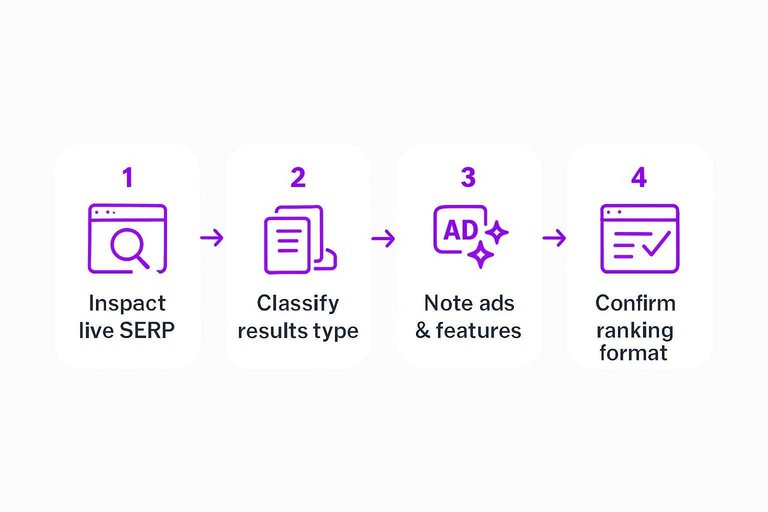
Intent verification
Intent decides whether a keyword prints revenue or prints bounce rates.
- Inspect the live SERP and note what Google rewards.
- Classify page-one results by type: product, category, guide, tool, forum.
- Note the ads and features: Shopping, PAA, local pack, videos.
- Confirm the ranking format matches your conversion path and landing pages.
If your best page can’t match the SERP shape, pick a different keyword.
Demand realism
Search volume is a model, not a measurement. Treat it like the phrase “about 1,000 searches” and assume it drifts.
Use trend lines to spot growth or decay, then layer seasonality on top. Watch SERP volatility too, because constant reshuffles often mean unstable demand or unclear intent.
Stable demand feels boring. That’s the kind you can build forecasts on.
Difficulty sanity checks
Difficulty scores hide what actually blocks you: the sites already winning.
- Compare backlink strength across top results.
- Check referring-domain diversity, not raw link counts.
- Scan content freshness and update cadence.
- Look for deep topical coverage signals on-page.
If page one looks like a closed club, you’ll need a different angle or a longer runway.
Commercial value signals
Commercial intent shows up in how aggressively others monetize the query. When you see “Best X for Y” everywhere, someone is getting paid.
Higher CPC usually means advertisers can track conversions. Affiliate-heavy results, product carousels, and comparison-first SERPs are also strong tells.
Follow the money, then decide whether you can capture it ethically and profitably.
Turn Insights Into Plan
Competitor keywords are only useful when they change what you ship next. Your job is to turn a messy export into page decisions, briefs, and a tracking loop.
Treat every keyword as a routing problem. Where does it belong, and what must change to win?
Create vs optimize
Use simple decision rules so every keyword lands on one action. Otherwise you get “one more blog post” forever.
| Situation | Trigger | Action | Notes |
|---|---|---|---|
| No relevant page | New intent appears | Create new page | Match SERP format |
| Underperforming match | Ranks 6–20 | Refresh existing page | Upgrade depth, entities |
| Two pages compete | Cannibalization | Consolidate pages | One canonical target |
| Wrong intent page | Intent mismatch | Redirect or rebuild | Don’t force-fit |
The fastest wins come from fixing collisions and intent, not writing net-new.
Content brief recipe
A keyword becomes shippable when it has constraints. A brief is those constraints, written down.
- Define the primary query and the exact SERP intent.
- Select a secondary keyword set that fits the same intent.
- Choose an angle that beats competitors’ default framing.
- Draft an outline that mirrors the winning SERP structure.
- List required entities, examples, and “must-answer” questions.
- Specify internal links, anchors, and the target money page.
- Set success metrics: rank band, CTR, and conversion action.
If you can’t write the success metric, you don’t have a brief yet.
Cluster architecture
Competitor keywords often arrive as clusters, not single opportunities. Use those clusters to build hubs that own a topic, then route value to the pages that pay.
Start by naming the hub page as the “why” query, like “best project management software.” Then map supporting articles to sub-intents, like “software for nonprofits” or “Gantt vs Kanban,” and link them back with intentional anchors. Keep anchors specific, not “click here.”
If your internal links don’t tell Google what to rank, your content will.
Measurement loop
You need KPIs that match the funnel, not vanity averages. Track the leading indicators early, and the money metrics later.
- Track impressions by page and query group.
- Track rankings by intent, not just position.
- Track CTR changes after title updates.
- Track conversions per landing page.
- Track assisted revenue in attribution reports.
Add time-to-rank benchmarks per intent, and you’ll spot “bad bets” fast.
Common Pitfalls
You’re trying to copy what works for competitors, but the data lies in predictable ways. Catch these mistakes early, or you’ll optimize for noise.
- Assuming “traffic” equals buyer intent
- Mixing brand and non-brand keywords together
- Trusting one tool’s keyword database
- Ignoring SERP features and layouts
- Copying keywords without matching the page type
Fix the measurement first, then pick the keywords; otherwise you’re just cloning someone else’s luck.
Build Your Competitor-Keyword System—and Ship the First Wins
- Start with a SERP-picked competitor shortlist, segmented by intent (not brand category).
- Build a page-first dataset: each competitor URL + its ranking queries, intent layer, and SERP features.
- Run gap categories and opportunity scoring, then pick 5–10 quick wins (optimize first, create second).
- Turn each win into a brief and a cluster plan, and close the loop with a measurement cadence to refresh, consolidate, or expand.
Frequently Asked Questions
- Can I find keywords of competitors without paid SEO tools?
- Yes—use Google Search (site: searches and “related:” queries), Google Keyword Planner, Google Trends, and free tiers from tools like Ahrefs Webmaster Tools or Semrush to uncover many competitor ranking keywords and page themes.
- How do I find keywords of competitors for Google Ads (not just organic SEO)?
- Use Google Ads Auction Insights plus Google Ads Transparency Center and tools like Semrush Advertising Research to see competitor ad keywords, copy patterns, and landing pages you can test.
- How often should I refresh competitor keyword research in 2026?
- Most sites should refresh monthly for fast-moving SERPs and quarterly for stable niches; re-check immediately after core updates, major launches, or noticeable ranking drops.
- How do I measure whether competitor keywords are actually driving revenue for me?
- Map target keywords to conversion-focused pages and track them in Google Search Console + GA4 (or Shopify/CRM) using conversions, assisted conversions, and revenue per landing page as the primary success metrics.
- Can I use competitor brand keywords, and is it worth it?
- You can usually target competitor brand keywords in organic content and in paid search (without using their trademark in ad copy), but they often convert lower—treat them as comparison/alternative pages and measure CPA or lead quality closely.
Turn Competitor Keywords Into Content
Competitor keyword research only pays off when you consistently publish pages that match the gaps you’ve uncovered and the intent you’ve validated.
Skribra turns your competitor keyword map into SEO-optimized articles with titles, metas, formatting, images, and WordPress publishing—so you can execute faster with a 3-Day Free Trial.
Written by
Skribra
This article was crafted with AI-powered content generation. Skribra creates SEO-optimized articles that rank.
Share: