January 21, 2026
·
8 min read
Step 1: Pinpoint High-Impact Topics With Repeatable Research
If your team picks topics on the fly, you won’t get far with SEO. Chasing trends or just taking whatever a keyword tool spits out wastes effort.
Most budget loss comes from picking the wrong topics, not from bad writing. You need a system that lets you confidently decide what gets resources, every month. Without that, you burn out fast.
Zero in on Commercial Intent, Not Just Search Volume
If you go after search volume alone, most of what you rank for won’t turn into leads. I’ve seen programs drive up sessions but get nothing in the pipeline because they missed commercial intent.
- Filters for modifiers like “review,” “vs,” or “alternative” help
- But set your filters too wide and you start targeting irrelevant keywords or attracting visitors who’ll never buy.
Establish a Process for Discovering Opportunity Clusters
Slapping up unrelated blog posts and expecting to build authority never works. Mapping out topic clusters using mind-mapping tools and keyword grouping does, up to a point—about 50–100 articles per cluster.
Beyond that, cross-linking is too hard to manage manually. Supporting articles should feed the main pillar. Skip quarterly reviews and your cluster goes stale, losing link value. Prune and reconnect clusters regularly to keep rankings and uncover new angles as old ones max out.
Build a Master List With Evaluation Criteria
Keep one central Airtable or Google Sheet with columns for search volume, KD, CPC, and alignment with business goals. If you let score updates slide for even a quarter, your info goes stale—trends shift, competitors catch up, and priorities drift.
If updates are split and nobody owns the process, quality drops fast. Automate where you can, but always assign one person to maintain the list. Otherwise you’re making content for goals that don’t matter anymore.
Step 2: Systemize Brief Creation to Accelerate Production
Inconsistent briefs stall content production. Writers lose time chasing clarification, or worse, turn in drafts that need a full rewrite.
Once you settle on a solid, detailed brief and use it every time, turnaround improves. The risk: as you ramp up content volume, brief quality tends to slide. That’s when mistakes multiply.
Design a Plug-and-Play Brief Template
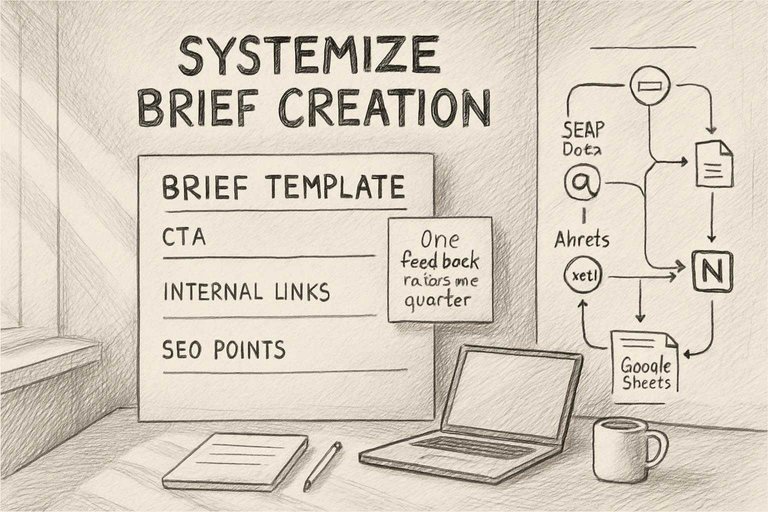
Templates have to be obvious and make it impossible to skip fields. If a brief leaves out the CTA or internal links, you end up waiting for rewrites.
Keep the master template in Notion or Google Drive, with required, clearly marked sections. Most guides suggest distributing static templates via email or downloads, but using a live document platform ensures version control and prevents outdated formats from circulating. If people use old versions or save them all over the place, things break down.
Automate Data Pulls for Competitive Context
Manually copying SERP data eats time—content ops lose days every month doing this. Piping data from Ahrefs or SEMrush APIs into Google Sheets—word counts, backlinks, competitor titles—saves a lot of prep. But someone has to keep an eye on API changes, or the data ends up outdated or missing without warning. Learning how to do keyword clustering can help streamline your research and brief creation further—here’s a guide on how to do keyword clustering and why it helps SEO.
Calibrate Briefs for Writer Specialization
A generic brief for every writer creates problems. In-house writers familiar with the brand just need bullets and the key SEO points. Freelancers or agencies need more detail—tone, example pieces, glossary.
Too much detail bogs them down, too little leaves gaps. One feedback round per quarter is enough to keep templates effective.
Step 3: Build a Modular Workflow for Draft Delivery
A modular workflow is about being able to predict what’s going to happen—not just having things written down. Done right, turnaround times shrink, and draft revisions drop by about a third.
But if the steps are too strict, things jam up the second a writer goes off-script or plans change late in the game. Adjust as you add people; a process for five writers won’t hold at fifteen.
Implement Process-Driven Writer Onboarding
Skip mandatory test assignments and you lose days, sometimes weeks, to writers missing basics. Every new writer here has to submit a sample using our template, after reading the SOPs. Most don’t make the cut because they get the formatting wrong or misuse keywords. If you don’t filter hard at this stage, you spend twice as long editing later just fixing structural mistakes.
Assign and Track Work Using Workflow Tools
Don’t assume project management tools are interchangeable. Trello covers up to 50 articles a month and gives a clear view, but it gets messy if you scale. Asana handles complex dependencies and recurring work, but it takes longer to set up.
- Missed deadlines spike if you don’t turn on reminders—don’t count on people checking boards on their own.
- And if you don’t attach comps or clear checklists to each job, expect results all over the map.
Introduce Versioning and Feedback Loops Early
Require outline approval before drafting. Skip this, and you end up rewriting nearly half the work because direction or examples are wrong. Google Docs is fine for tracking comments and changes with a small team. For bigger groups, Notion’s version histories save time. But too many editors bog things down; one reviewer per stage is enough. Most guides suggest collecting everyone’s feedback at once, but this staged approach catches errors early without overwhelming writers with conflicting edits.
Step 4: Standardize Editing and On-Page QA Before Publishing
Standardized editing and QA steps keep production moving. When we locked these in, last-minute edit rounds dropped from two or three to less than one per post.
For teams looking to tighten their process even further, using an ultimate checklist for streamlining SEO content can be a game changer.
Outdated checklists are the risk—forget to refresh them and errors creep back in, especially if you’re tweaking style or SEO all the time.
Deploy an Editing Checklist With Non-Negotiables
Checklists can’t be optional. Every editor checks every box—otherwise, small errors start slipping through as “exceptions.” I track error types; missed meta descriptions and heading inconsistencies are always first to reappear. Adding examples of both correct and incorrect structures in the checklist removes confusion. It takes a few hours to set up, but cuts down on corrections for months.
Integrate Automated Content and SEO QA
Every draft goes through Grammarly and Surfer before a human edit. They catch most grammar and keyword problems, but can’t handle context or subtle brand language. Grammarly misses field-specific terms; Surfer can push things too far and make text stiff. Someone who understands both the topic and the brand must still do a final pass.
Schedule Final Pre-Publish Reviews for Efficiency
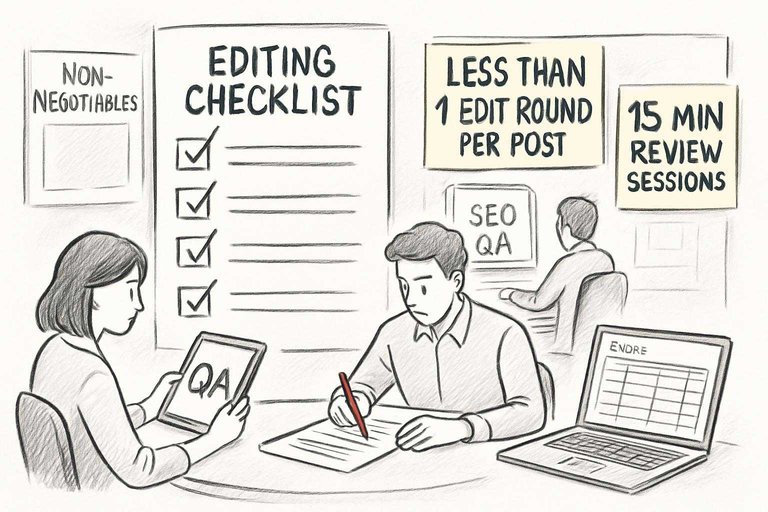
Time-box review sessions to 15 minutes—don’t let them run long. Open-ended reviews drag out a batch of 10 articles for days. Assign reviewers by specialty: one covers SEO, another just voice or tone. Recurring problems get logged in a spreadsheet. After a few cycles, the same handful of mistakes always come up. That’s where the process or training needs work.
Step 5: Establish Feedback and Improvement Loops for Scaling
Build feedback and iteration into every part of your SEO content workflow. For more ideas on simplifying your processes, check out these top resources to simplify SEO workflows so you can stay agile and data-informed in your approach.
Without it, scaling usually stalls within a few months, mainly from unchecked assumptions and rigid routines. Use automation, a consistent review schedule, and feed what you learn straight back into the editorial process.
Set Up Tracking for Post-Publish Performance Signals
Manual tracking collapses once you pass 20–30 articles. Use Google Looker Studio tied to Search Console and analytics to monitor rankings, traffic, and conversions at the URL level. Ignore vanity metrics.
Session count alone isn’t helpful unless you see corresponding scroll depth or CTA clicks—focus on real results. Weekly dashboards surface outliers: high-traffic pieces with extreme bounce rates or barely any time spent on page usually mislead and skew your averages.
Define Criteria for Scaling or Pivoting Content Series
Set clear, measurable benchmarks. Don’t trust gut feelings or vague wins.
- Expansion only happens when a piece or series sustains at least 30% higher conversion rate and 20% month-over-month organic growth for a full quarter.
- Chasing every slight uptick spreads teams thin and weakens impact.
But don’t pivot too soon. Give new series at least 60 days after optimization before making a call, or you risk misreading normal fluctuations or index lag.
Refine the Workflow With Retrospectives and SOP Updates
Skipping retrospectives leads to repeated mistakes. I’ve seen it turn into weeks of wasted effort. Bring the entire team—writers, editors, analytics—into sprint reviews, and log updates directly into SOPs so changes are tracked and shared.
Maintain a changelog with date stamps and links to previous versions so nothing falls through the cracks. SOPs need regular updating; if nothing’s changed in a month, you’re probably stuck.
Written by
Skribra
This article was crafted with AI-powered content generation. Skribra creates SEO-optimized articles that rank.
Share: