April 3, 2026
·
19 min read
Full SEO strategy breakdown for growth-focused teams
A full-funnel SEO strategy breakdown for growth-focused teams—set goals and scope, research demand and intent, design a scalable content system, and execute on-page, technical, authority, product-led pages, plus measurement and forecasting that ties to revenue.

If your SEO efforts feel busy but not compounding, the problem usually isn’t effort—it’s the lack of a single strategy that connects research, content, technical health, and authority to measurable revenue.
This pillar gives you the map. You’ll learn how to define scope and success, find demand worth winning, build a content engine that scales, ship pages that match the SERP, keep crawl/indexing clean, earn links without guesswork, and measure outcomes with realistic attribution and forecasting.
Strategy Overview Map
SEO is a growth system, not a content project. You turn search demand into pages, pages into users, and users into revenue. Think “research → build → measure → iterate,” with technical health and links acting as multipliers.
Goals and scope
Growth teams use SEO to move pipeline, revenue, activation, and retention. It’s great at capturing existing demand, like “best SOC 2 software,” and routing it into your funnel. It won’t manufacture product-market fit or fix weak onboarding on its own.
Treat SEO like distribution with constraints, not a magic content machine.
Core SEO flywheel
SEO compounds when each win creates the next input. One strong page can rank, earn clicks, attract links, and teach you what to build next. The loop looks simple, but the timing is uneven.
Demand research → content creation → rankings → engagement → links → brand demand → more demand research.
If the loop isn’t closing, you don’t have a flywheel yet. You have tasks.
Channels and surfaces
Plan for where search actually happens, not where it used to happen. Your “SEO” can show up as a snippet, a video result, or an AI summary.
- Classic SERPs (blue links)
- AI Overviews and AI answers
- Video search (YouTube, SERP video)
- Image search (Google Images)
- Local (Maps, profiles, reviews)
- App store search (ASO)
- Marketplaces (Amazon, G2, Etsy)
- Social search (TikTok, Reddit, X)
Pick the surfaces that match your buyer’s habit, then instrument them.
How SEO makes money
SEO monetizes through a few repeatable paths. Each path needs a different page type, conversion motion, and measurement setup.
- Lead gen to sales pipeline
- Self-serve signups to paid
- Ecommerce purchases and AOV
- Ad revenue from traffic volume
- Cost savings versus paid spend
If you can’t name the path per page, you’re just collecting visits.
Mental model checklist
Run SEO like an operating system: inputs, constraints, indicators, and loops. Inputs are things you control, like content velocity, internal links, and page templates. Constraints are things that cap outcomes, like crawl waste, weak differentiation, or slow pages.
Leading indicators include impressions, ranking distribution, CTR, and indexation. Lagging indicators are pipeline, revenue, retention lifts, and branded search growth. Your feedback loops are the weekly decisions: what to refresh, what to prune, what to scale.
If you can’t point to the loop, you can’t compound.
Audience Demand Research
You need a demand model that your whole team can argue with, then trust. Otherwise you ship “high volume” pages that never move pipeline.
Your goal is simple. Prioritize topics by intent, value, competition, and product fit.
ICP and jobs
Start with who actually buys, not who clicks. Your best keywords are hidden in how your ICP describes progress, not in your feature list.
Define 2–4 ICP segments and write each as a job-to-be-done statement, like: “Help a RevOps lead create clean routing in under a week.” Then map pains, triggers, and decision criteria into query language:
- Pains → “fix lead routing errors”, “reduce duplicates”
- Triggers → “migrating to HubSpot”, “new SDR team”
- Decision criteria → “SOC2 compliant”, “works with Salesforce”, “no-code”
If your ICP can’t say the phrase out loud, it’s probably not demand.
Intent taxonomy
Intent is the difference between traffic and revenue. It tells you what the searcher is trying to do next.
Use a small taxonomy that maps cleanly to content types and CTAs:
- Learn → guides, primers, glossaries → CTA: newsletter, template
- Compare → “X vs Y”, alternatives, category pages → CTA: comparison sheet, demo
- Validate → reviews, case studies, “is X worth it” → CTA: proof pack, references
- Buy → pricing, “best for”, implementation pages → CTA: talk to sales, trial
- Troubleshoot → error docs, how-to fixes → CTA: docs, upgrade prompt
If the CTA doesn’t match intent, you’re asking for a commitment they didn’t come to make.
Keyword discovery inputs
Good keyword lists come from real conversations and real logs. You want inputs that reveal wording, urgency, and objections.
- Google Search Console queries
- On-site search terms
- Sales call notes and objections
- Support tickets and chat logs
- Competitor ranking pages
- Forums and community threads
- PPC search terms report
- Product docs and release notes
If three sources repeat the same phrase, you’ve found demand, not a guess.
Prioritization scoring
Score keywords so prioritization isn’t politics. Keep the model simple enough to use weekly.
| Factor | What you score | Scale | Notes |
|---|---|---|---|
| Potential value | Pipeline impact | 1–5 | ICP + ACV match |
| Rankability | Ability to win | 1–5 | SERP strength |
| Content cost | Effort to ship | 1–5 | SMEs, assets |
| Conversion likelihood | CTA fit | 1–5 | Intent closeness |
| Strategic fit | Product focus | 1–5 | Roadmap alignment |
Use (Value + Conversion + Fit) − (Cost + rank difficulty) to force tradeoffs.
Opportunity selection rules
Rules beat vibes when volume gets tempting. You need constraints that protect focus and speed.
Pick themes and clusters using decision rules like these:
- Choose clusters where you can own 5–10 related pages.
- Prefer “pain + tool + outcome” queries over broad category terms.
- Ship quick wins where you already rank positions 6–20.
- Skip terms where the SERP is dominated by marketplaces.
- Prioritize topics your product can prove within one click.
Vanity volume is a tax. Pay it, and your roadmap gets slower every quarter.
Content System Design
You don’t need more posts. You need a system that produces the right pages, in the right order, with linked depth.
A scalable engine matches intent, proves authority, and keeps shipping when the calendar gets tight.
Pillar cluster planning
Pick one pillar per topic you want to own, like “B2B onboarding,” not “onboarding checklist.” The pillar answers the whole job, then clusters win the sub-questions and funnel readers back.
Build it like a map:
- Pillar: the complete guide, built for broad intent
- Clusters: one intent per page, like “time to value” or “activation emails”
- Internal links: cluster → pillar for authority, pillar → clusters for discovery
- Hub navigation: a visible “Start here” path, not hidden links
If your clusters can’t explain why the pillar exists, you’re keyword hunting, not building a moat.
Page types library
Standardize page types so writers ship faster and pages behave predictably in search.
- Product pages: features, proof, and next step
- Use case pages: problem, workflow, outcomes
- Industry pages: constraints, compliance, examples
- Comparison pages: criteria, scenarios, honest tradeoffs
- Alternatives pages: who it’s for, who it’s not
A library turns “write a page” into “fill a proven template,” which is where velocity comes from.
Briefs that rank
A brief is your pre-commitment to intent and differentiation.
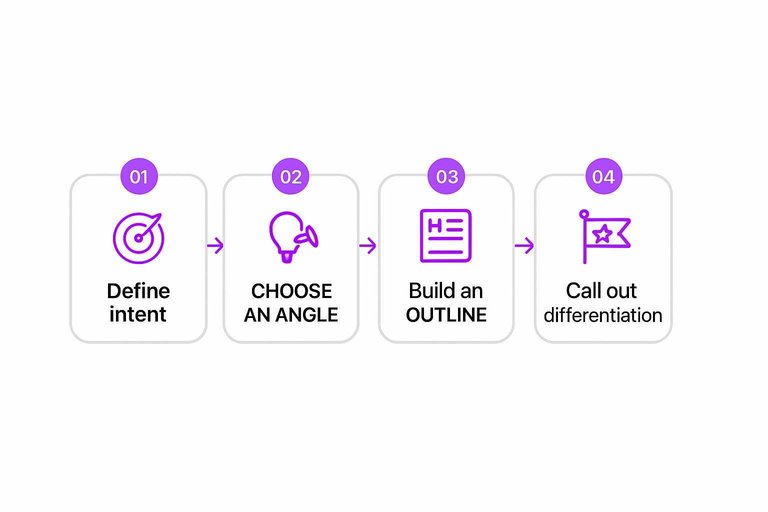
- Define intent and reader state in one sentence.
- Choose an angle that disagrees with “generic advice.”
- Build an outline with H2s tied to sub-intents.
- Add entities, examples, visuals, CTAs, and internal links—use an SEO content streamlining checklist to make sure nothing critical gets missed.
- Call out differentiation: what you’ll show that others won’t.
If you can’t state the angle out loud, the draft will drift and rankings will follow.
E-E-A-T signals
Google can’t “trust” you. It can only detect signals that look like trustworthy work.
- Author expertise: role, credentials, and relevant track record
- Firsthand evidence: screenshots, data, test notes
- Citations: primary sources, not roundups
- Policies: editorial standards, corrections, affiliate disclosure
- Reviews: user quotes, third-party ratings, case studies
Treat E-E-A-T like QA, not branding, and your content holds up under scrutiny.
Editorial quality bar
“Best result” means the page answers faster, goes deeper, and feels more reliable than anything else on page one. Think “here’s the exact workflow we used,” not “consider doing X.”
Your bar is four checks:
- Unique insight: a strong point of view or original data
- Completeness: all key sub-questions handled, no gaps
- Clarity: skimmable structure, tight examples, no fluff
- Conversion path: next step is obvious, never disruptive
Make the page useful without begging for the click, and conversions rise without the UX tax.
For a backbone on quality standards, align with Google’s guidance on helpful, reliable, people-first content.
On-Page Optimization Playbook
Standardize on-page elements so every page is easy to understand, index, and convert.
Write pages for the SERP you’re actually competing in, not your ideal outline. If the top results lead with “pricing,” your intro can’t start with history.
Treat titles, intros, and headers as promise-keepers. Match the query’s language, answer fast, then earn the scroll with depth and proof. For a broader framework that ties these elements together, see the complete SEO guide.
SERP-first writing
You’re writing for a results page with visible competitors and impatient clicks. Your title, first paragraph, and H2s must match what the SERP already trained people to expect.
Use a tight formula:
- Title: primary term + clear modifier, like “Pricing,” “Template,” or “Checklist.”
- Intro: 2–3 sentences that answer the query, then clarify who it’s for.
- H2s: mirror common SERP sections, like “Pros and cons” or “Best for.”
If your H2s don’t resemble the SERP’s shared outline, you’re fighting user intent.
Information architecture
Good structure makes your page skimmable for humans and extractable for machines. Build it so answers can be lifted into snippets without breaking meaning.
- Put one clear H1 that matches the primary query.
- Use H2s for the main intent buckets, then H3s for specifics.
- Add one short FAQ block with direct, 1–2 sentence answers.
- Use a table for comparisons, specs, or decision criteria.
- End with a “Next step” summary and one primary CTA.
If Google can’t quote your page cleanly, it won’t trust it to rank.
Internal linking rules
Internal links are your cheapest ranking lever because you fully control them. Set rules so every new page strengthens your best pages.
- Link hubs to every supporting page, and back to the hub.
- Use contextual anchors that match the destination’s primary intent.
- Keep important pages within three clicks from the homepage.
- Prevent orphans with “related” modules and hub navigation.
- Prioritize money pages in top-third links and high-traffic articles.
That’s how you turn random content into a system that compounds.
Schema and rich results
Schema is for clarity, not decoration. Use it when it reflects real page content and unlocks a result you can actually win.
Pick the minimal set that fits the page:
- Organization: your site-wide identity and social profiles.
- Article: editorial content with author and publish dates.
- Product: purchasable items with price and availability.
- FAQ: true Q&A sections, not marketing fluff.
- HowTo: step-based tasks with materials and duration.
- Review: genuine reviews with a clear subject.
- Breadcrumb: consistent navigation hierarchy.
- SoftwareApplication: apps with category, OS, and pricing model.
Add schema that matches your page type, or you’ll train Google to ignore it.
Conversion alignment
CTAs should match why someone searched, not what your sales team wants. Map CTAs to intent stages so the page converts without feeling pushy.
- Subscribe: early research, trends, and thought pieces.
- Template download: “how to” queries and operational needs.
- Calculator: pricing, ROI, and budget-evaluation queries.
- Free trial: solution-aware and comparison pages.
- Demo: high-consideration, complex workflows, multiple stakeholders.
- Contact sales: enterprise, compliance, and custom requirements.
If your CTA is one step ahead of intent, you’ll leak clicks you already paid for.
Technical SEO Foundation
If your technical foundation is shaky, great content still loses. Crawling, indexing, speed, and rendering decide whether Google even gets a fair shot.
Crawl and index control
You’re telling search engines what to fetch, what to ignore, and what to rank. Get this wrong and you’ll waste crawl budget while the wrong URLs win.
Robots.txt controls crawling, not indexing, so treat it like traffic control. For example, blocking /search can help, but blocking CSS can break rendering.
XML sitemaps are your curated invite list. Keep them clean, segmented, and limited to canonical, indexable URLs.
Canonicals pick the “winner” when many URLs show the same content. Use them for variants, not as a bandage for broken architecture.
noindex is the cleanest way to keep pages out of results while still allowing crawl. Use it for internal search, thin archives, and low-value filters.
Faceted navigation and URL parameters create infinite URL space fast. Decide which facets deserve indexation, then lock the rest behind noindex, canonicalization, or parameter rules.
Pagination needs intent: either let paginated pages index naturally, or consolidate with strong internal linking to key pages. Avoid creating hundreds of near-empty pages that look like “Page 37” land.
Parameter handling in Google Search Console can help, but it’s not your primary control. Fix it in the site first.
The goal is simple: one topic, one indexable URL, and everything else either supports it or disappears.
Site performance essentials
Performance fixes compound, because faster pages get crawled, rendered, and converted more reliably. Aim for boring speed wins that survive redesigns.
- Hit Core Web Vitals targets, especially LCP and INP
- Ship responsive images, correct sizes, and modern formats
- Reduce JS bloat, delay non-critical scripts
- Use caching layers, CDN, and long-lived static assets
- Preload critical fonts, limit variants, avoid FOIT
Speed is a ranking factor, but it’s also a reliability factor for everything else.
JavaScript and rendering
JavaScript decides whether Google sees your content or a blank shell. Your rendering choice is less about “modern” and more about predictable indexing.
SSR and SSG ship real HTML fast, so bots and users see content immediately. CSR makes the browser assemble the page, which increases the chance Google misses critical content during deferred rendering.
Hydration can introduce subtle failures, like content flashing, layout shifts, or links that only exist after scripts run. When navigation or product lists appear post-hydration, you’re betting on Google’s second wave of processing.
Verify indexability with real evidence. Use Google’s URL Inspection “View Crawled Page,” check rendered HTML for key text and links, and compare against what users see.
If your main content only exists after client-side execution, you’re optimizing for hope, not for crawlers.
Duplicate and thin content
Duplication usually comes from templates and URL variants, not bad intentions. Fix it like an inventory problem, not a copywriting problem.
- Export indexable URLs from GSC, sitemaps, and a crawl.
- Cluster by near-identical titles, headings, and body similarity.
- Identify the “keeper” URL per cluster, based on links and intent.
- Apply the right action: 301, canonical, merge content, or
noindex. - Prune thin zones like empty archives, doorway pages, and tag floods.
When every template can spawn a page, your job is to decide which pages deserve to exist.
Monitoring and alerts
Technical SEO fails quietly until traffic drops. You need alerts that catch drift, not just dashboards that look pretty.
- Watch coverage errors and sudden “Excluded” growth
- Flag crawl spikes that don’t correlate with releases
- Review logs for bot traps and wasted crawl paths
- Alert on Core Web Vitals regressions by template
- Scan for broken internal links after deployments
Treat SEO monitoring like uptime monitoring, because that’s what it is.
— Section 5: Authority and Link Growth —
Links are still the cleanest proxy for authority. The trick is earning links that match your product, your category, and your customers’ intent.
Subsections: [
{
“subheading”: “Link value basics”,
“content”: “A link works like a recommendation in a specific conversation. Relevance, placement, and editorial context decide whether Google treats it as a real vote.\n\nA "DA 80" sidebar logo strip can do less than a mid-tier blog’s in-body citation. If the surrounding text explains why you matter, the link carries meaning. If it sits in a footer, it’s mostly noise.\n\nChase links that read like a human chose them, because that’s the signal the algorithm wants.”,
“description”: “Explain why relevance, placement, and editorial context matter more than raw domain metrics.”
},
{
“subheading”: “Linkable asset ideas”,
“content”: “You need assets people cite, not assets you’re proud of. Build things that save someone time or settle an argument.\n\n- Publish original data with a clear takeaway\n- Ship a free tool that solves one job\n- Release benchmarks that define "good" performance\n- Offer templates teams can copy and use\n- Create visual explainers that teach fast\n\nMake your asset quotable, or it won’t travel.”,
“description”: “List assets that attract links: original data, tools, benchmarks, free templates, visual explainers, and expert quotes.”
},
{
“subheading”: “Outreach workflow”,
“content”: “Outreach is a production line, not a burst of motivation. Keep it simple, measurable, and repeatable.\n\n1. Prospect targets by topic overlap and audience fit.\n2. Choose one angle per target that matches their recent content.\n3. Personalize with a specific reference and a single ask.\n4. Follow up twice with new value, not "bumping this."\n5. Track relationships, links, and outcomes in one system.\n\nWhen a link lands, amplify it so the publisher looks smart for citing you.”,
“description”: “Define steps: prospecting, angle selection, personalization, follow-ups, relationship tracking, and post-link amplification.”
},
{
“subheading”: “Digital PR motion”,
“content”: “Digital PR is outreach with a news hook. You package something timely, credible, and easy to cover, then you pitch journalists who already write that story.\n\nStrong hooks look like "new data shows X," "we analyzed Y," or "here’s the trend nobody measured." Make the asset skimmable. Provide a clean chart, a sharp quote, and a method note.\n\nTreat PR wins as seed links for topic clusters. One coverage spike can become sustained authority if your supporting pages deserve the attention. For examples of how affiliate sites package reviews, directories, and editorial labs into linkable models, see <a href="https://skribra.com/blog/7-affiliate-seo-site-examples-worth-knowing-in-2026\”>affiliate SEO site examples in 2026.",
“description”: “Describe creating newsworthy hooks and pitching journalists; connect PR wins to sustained topic authority.”
},
{
“subheading”: “Risk and hygiene”,
“content”: “Links can compound, or they can rot your domain. Avoid patterns that look manufactured.\n\n- Skip paid links dressed as "sponsorships"\n- Avoid exact-match anchors at scale\n- Don’t trade links in obvious loops\n- Watch for sitewide, footer, or widget links\n- Investigate sudden spikes from low-quality domains\n\nDisavow is a scalpel, not a broom. Use it only when you have clear evidence of harm.\n\n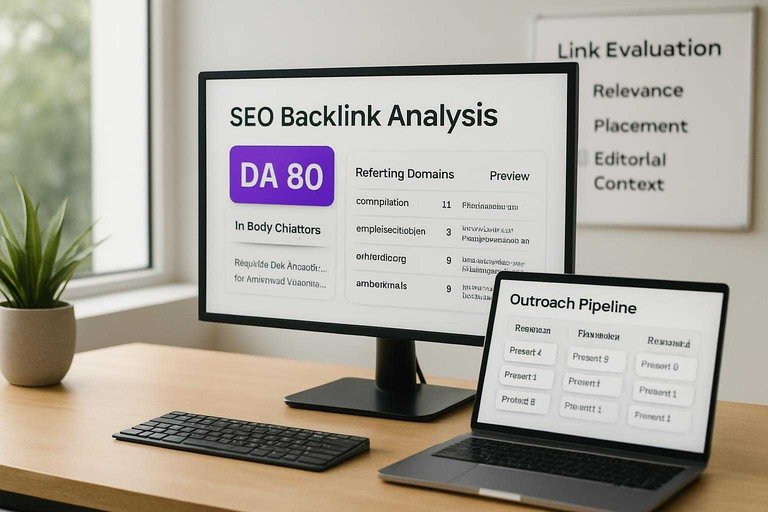 \n\n”,
“description”: “List practices to avoid penalties: paid links, spammy anchors, toxic link patterns; include disavow caveats.”
}
]
Product-Led SEO Pages
Turn product surfaces into indexable acquisition pages without sacrificing UX or engineering velocity.
Programmatic SEO fit
Programmatic SEO works when your pages are powered by a large, genuinely unique dataset. Think “cities × services,” “integrations × use cases,” or “jobs × skills,” not spun variations.
It holds up when templates stay stable, intent is obvious, and your differentiation is visible above the fold. If the same page could be built by scraping a competitor, you do not have a moat.
pSEO is a multiplier, not a rescue plan.
Template uniqueness plan
You need repeatable modules that create real differences per URL, not cosmetic swaps.
- Add 3-5 unique data points per entity, sourced from your product.
- Embed one concrete example output, like a report snippet or result.
- Ship an FAQ block driven by support tickets and query logs.
- Include comparisons to adjacent entities, like “similar tools” or “nearby options.”
- Layer UGC or editorial modules, like tips, reviews, or expert notes.
Build the modules once, then let the dataset do the scaling.
Indexation safeguards
Scale creates risk fast, so you need rules that decide what deserves Google.
- Set minimum content and engagement thresholds before indexation.
- Noindex low-supply pages, empty states, and duplicate filter combos.
- Canonical to the primary version, not the prettiest URL.
- Control pagination with indexable page one and crawlable deeper pages.
- Block thin-page explosions from faceted filters and sort parameters.
If you cannot describe your indexation policy in five bullets, you will leak crawl budget.
Google’s crawling and indexing documentation is the best reference point for these controls and tradeoffs.
Marketplace and UGC SEO
Marketplace pages win when they answer “can I trust this?” and “can I choose fast?” Profiles, listings, and reviews should surface identity, proof, and constraints without hiding behind tabs.
Duplication is your default enemy. Normalize titles, collapse near-identical listings, and canonical variants back to a single best URL.
Spam is a product problem first. Rate-limit submissions, require verification signals, and expose moderation states so low-trust content does not become your SEO footprint.
SEO in product sprints
SEO ships when it fits your team’s definition of “done,” not when someone remembers metadata.
- Write SEO acceptance criteria next to UX and performance criteria.
- Add QA checks for titles, canonicals, schema, and internal links.
- Run pre-merge regression tests on indexability and rendering.
- Monitor post-release logs for crawl spikes and 404s.
- Keep an SEO changelog tied to deploys and feature flags.
Treat SEO like reliability work. Quiet failures cost the most.
Measurement and Forecasting
Track what matters, tie SEO to revenue, and forecast impact with assumptions you can defend. If you can’t measure it cleanly, you can’t scale it confidently.
North Star metrics
You need leading indicators for direction and lagging indicators for payout. Otherwise you’ll celebrate rankings while finance asks, “Where’s the pipeline?”
Leading metrics:
- Impressions by query group
- Average position for priority terms
- Clicks and CTR by page type
Lagging metrics:
- Conversions and assisted conversions
- CAC by acquisition channel
- LTV and pipeline influenced
Treat rankings as a sensor, not a goal.
Attribution realities
SEO rarely gets clean credit because buyers rarely behave cleanly. If your org expects perfect last-click proof, you’ll underinvest in the channel that creates demand.
Common traps you should name upfront:
- Last-click bias hides early SEO touches
- Assisted conversions get discounted in reviews
- Brand demand inflates “SEO wins” later
- Offline impact never shows in GA4
Set the rule: measure contribution, not possession.
Dashboard blueprint
Your dashboard should answer six weekly questions fast. If it needs a meeting to interpret, it’s not a dashboard.
- GSC: queries, pages, CTR shifts
- GA4: landing-page engagement, conversions
- CRM: pipeline created, influenced revenue
- Content velocity: briefs, publishes, refreshes
- Technical health: CWV, indexation, errors
- Link acquisition: new referring domains, quality mix
When each block maps to an owner, the dashboard becomes a system.
Forecasting method
Forecasts should be simple enough to audit and strict enough to defend. Your job is to show the math, then show the assumptions.
- Group keywords by intent, page type, and current ranking band.
- Apply a CTR curve per ranking band, adjusted for SERP features.
- Multiply expected clicks by conversion rate per page type.
- Convert conversions to revenue using CAC, LTV, or pipeline-to-close rate.
- Layer in ramp timelines by content type and update cadence.
The forecast is only as honest as your ramp assumptions.
Experiment design
SEO experiments stop opinions from driving the roadmap. You want small bets with clear pass-fail rules.
- Title tests: CTR lift on stable impressions
- Internal link modules: ranking lift for target cluster
- Content refreshes: regain clicks on decaying pages
- Schema changes: rich result gain, CTR change
Define success before launch, or you’ll argue after results.
Turn the Strategy Into a 30-Day Execution Sprint
- Set the map: write your SEO goal, scope, and North Star metric, then confirm how SEO will make money for your business.
- Pick the first bets: complete demand research, score opportunities, and choose 3–5 topics/pages with clear intent and conversion paths.
- Build and ship: create briefs, publish SERP-first pages with internal links and schema, and fix any crawl/index issues that block indexing.
- Prove and iterate: launch a simple dashboard, forecast expected outcomes, run one experiment, and review weekly to tighten content, tech, and authority loops.
Frequently Asked Questions
- Is the strategy of SEO the same as an SEO plan or an SEO roadmap?
- Not exactly. A strategy of SEO defines the goals, priorities, and logic behind what you do, while a plan/roadmap is the time-bound execution schedule of specific tasks, owners, and deadlines.
- Do I need a separate strategy of SEO for programmatic SEO, product-led SEO, and content marketing?
- Usually no. Use one strategy of SEO with different playbooks—programmatic, product-led, and editorial—so they share the same demand model, quality bar, and measurement targets.
- How do I measure whether my strategy of SEO is working beyond traffic?
- Track conversions and revenue influenced by organic search using GA4 events + Search Console landing pages, then monitor leading indicators like non-branded impressions, rankings for high-intent queries, and organic-to-trial (or lead) conversion rate.
- How long does a strategy of SEO take to show results for a growth-focused team?
- Most teams see early movement in 4–8 weeks (indexation, impressions, ranking lift) and meaningful pipeline/revenue impact in 3–6 months, assuming consistent shipping and technical health.
- What if I don’t have the budget for link building—can a strategy of SEO still work?
- Yes. Focus on demand capture pages, internal linking, and unique data/product-led pages to earn links naturally, and use digital PR “spikes” quarterly instead of continuous link buying.
Operationalize Your SEO System
You can map the full SEO strategy, but sustaining audience research, content production, on-page updates, and measurement week after week takes real execution bandwidth.
Skribra turns your SEO plan into consistent output with AI-written, keyword-led articles, WordPress publishing, and built-in backlink exchange—start with the 3-Day Free Trial.
Written by
Skribra
This article was crafted with AI-powered content generation. Skribra creates SEO-optimized articles that rank.
Share: