February 20, 2026
·
Updated August 21, 2026
·
12 min read
How an AI SEO agency runs keyword research
An explainer on how an AI SEO agency runs keyword research end to end—turn inputs into expanded seed sets, classify intent from SERPs, score difficulty vs. opportunity, cluster into topics, and convert priorities into page maps and an operational workflow.

If your keyword research ends with a giant spreadsheet, you’re not doing research—you’re just collecting words. The hard part is translating messy signals (site data, SERPs, competitors, and risk constraints) into decisions you can publish and measure.
This explainer shows how an AI SEO agency does it systematically: what inputs it starts with, how it expands and cleans seeds, how it labels intent using SERPs, and how it scores and clusters keywords into topics. You’ll also see how those outputs become a prioritization matrix, page mapping plan, and a repeatable workflow.
Research Inputs
Keyword research is only as good as the inputs you feed it. An AI SEO agency treats inputs like constraints, because constraints decide what keywords even count as “good.”
Business primitives
You start with business facts, because “traffic” is not a goal. A keyword is only valuable when it matches your offer and your economics, like “emergency plumber Austin” versus “how to fix a leaky faucet.”
Turn primitives into constraints:
- Offer → problems you solve, in buyer language
- ICP → roles, industries, deal size, pain severity
- Margins → max CAC, payback window, LTV tolerance
- Geography → countries, cities, service radius, languages
- Seasonality → peak months, budget cycles, weather spikes
The tighter these are, the fewer keywords you regret ranking for.
Site evidence
Your site already contains demand signals and hard limits. You mine first-party data to see what Google thinks you deserve.
- Search Console queries and pages
- Analytics landing pages and paths
- Server logs and crawl patterns
- Internal search terms and refinements
- Index coverage and exclusions
If coverage is weak, fix indexation before you expand targets.
SERP environment
Keywords live inside SERPs, not spreadsheets. You profile the current results to estimate effort, timeline, and the real intent behind the query.
Capture the SERP environment:
- True competitors, not just category peers
- SERP features stealing clicks, like maps or AI overviews
- Content formats winning, like tools or listicles
- Intent volatility across days and devices
If the SERP is unstable, your “perfect” keyword may be a moving target.
Risk guardrails
Guardrails prevent rankings that create legal risk or wasted work. You define what the model must avoid, before it suggests anything.
- Flag YMYL topics and require expert review.
- Block brand-unsafe themes and prohibited claims.
- Apply compliance rules, like HIPAA, FINRA, or local ads law.
- Prevent cannibalization with one intent per URL.
- Set “no-target” lists for low-value or high-support queries.
The fastest keyword win is the one you never chase.
Seed Expansion Engine
Agencies win keyword research by building a huge candidate set, then making it clean enough to score. You want models for breadth, but you need deterministic sources for reality checks.
Seed generation
You need strong seeds or the model wanders into trivia. Seeds anchor intent around what you sell and what your pages already cover.
- Extract product nouns and modifiers from your catalog and pricing pages.
- List top pain points from sales calls, tickets, and reviews.
- Translate jobs-to-be-done into verbs plus objects, like “track invoices”.
- Pull H1s, titles, and internal search queries from existing pages.
- Tag each seed with audience, stage, and primary intent.
Bad seeds create impressive lists that never convert.
Multi-source expansion
One source always lies to you in its own way. Mixing sources gives coverage, intent variety, and a built-in bias check.
- Ask the LLM for intent variations and modifiers
- Pull autocomplete and “people also ask”
- Collect related searches and SERP suggestions
- Import competitor ranking keywords by URL
- Map category taxonomy nodes to queries
If two or more sources agree, you probably found a real demand pocket.
Normalization layer
Raw lists are noisy, and noise breaks scoring. You normalize so “best ai crm”, “AI CRMs”, and “best CRM with AI” don’t fight each other.
Canonicalize with a ruleset plus light entity resolution:
- Standardize spelling and casing, like “ecommerce” vs “e-commerce”.
- Normalize plurals and tense when intent stays identical.
- Resolve entities and aliases, like “GA4” vs “Google Analytics 4”.
- Apply locale rules, like “accountant” vs “chartered accountant”.
- Remove stopwords only when they don’t change intent.
Normalization is where your scoring stops being random.
Deduplication rules
Expansion creates near-duplicates that look different but behave the same. You cluster them so you score one idea, not fifty spellings.
- Embed each query and run cosine similarity clustering.
- Add string similarity checks for short queries and typos.
- Split clusters when SERPs differ by intent or page type.
- Keep the representative with highest volume, links, or rankings.
- Store the rest as synonyms for matching and reporting.
Your final list should be smaller than your ego, and stronger than your competitors.
Intent Classification
Intent is inferred from what Google rewards and how people phrase the query. When the SERP is full of “Top 10” lists, your product page won’t stick.
Intent drives both content shape and conversion fit. Rank with the wrong page type, and you’ll convert the wrong visitors.
Intent types
You classify intent by the job the searcher is trying to finish. The same keyword can carry two jobs, like “notion alternatives” which can be research or purchase-adjacent.
Informational queries want understanding, like “what is schema markup.” Commercial queries want options, like “best CRM for agencies.” Transactional queries want action, like “buy ahrefs” or “book a demo.” Navigational queries want a place, like “HubSpot login.”
Mixed intent is where money leaks. Treat it as a segmentation problem, not a category mistake.
SERP-as-label
The SERP already tells you what intent Google believes. You use those features as weak labels, then validate with traffic and conversion.
- Shopping ads, product grids, “Buy” buttons → transactional
- Listicles, “Top stories,” “People also ask” → informational
- Comparison pages, “Best,” review snippets → commercial
- Sitelinks, brand homepages, knowledge panels → navigational
If your target page type disagrees with the SERP, you’re fighting the grader.
Modifier signals
Modifiers are mechanical intent cues because they compress context into one word. “Best” often demands comparisons, while “pricing” demands numbers and terms.
“Near me” signals local pack eligibility and urgency. “Vs” signals evaluation, not education. “Pricing,” “cost,” and “quote” signal conversion readiness, even without a brand mentioned.
Modifiers don’t just change content. They change what you should measure—see this SEO guide for intent signals for how to translate those cues into page decisions.
Modifiers don’t just change content. They change what you should measure.
Ambiguity handling
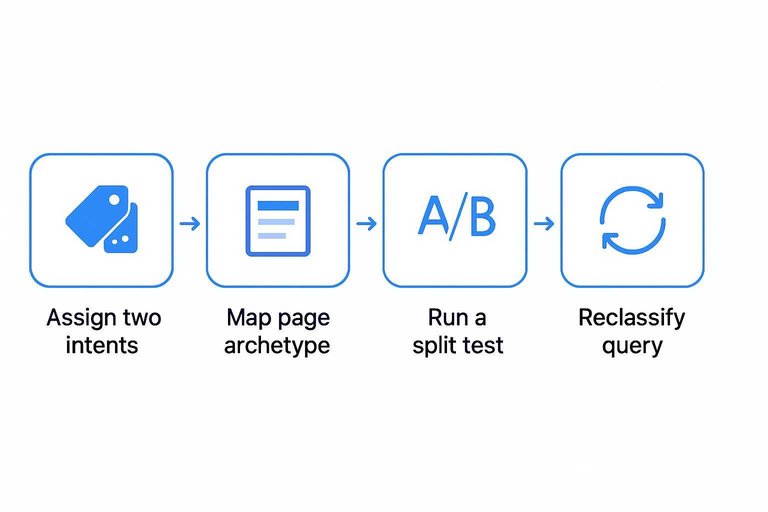
Some queries stay unclear even after SERP review. You treat those as multi-intent candidates until evidence collapses the options.
- Assign two intents with confidence scores, not one label.
- Map each intent to a page archetype you can actually ship.
- Check SERP stability across days and locations.
- Run a split test with two page types or modules.
- Keep the winner, and reclassify the query.
Ambiguity isn’t a blocker. It’s a prompt to test the page, not argue about the label.
Difficulty and Opportunity Scoring
Rankings correlate with three forces you can measure: authority, relevance, and the SERP’s shape. Authority decides if you’re allowed to compete, relevance decides if you deserve to compete, and SERP composition decides how many clicks exist to win.
If the page-one set is packed with brands, intent-matched formats, and sticky features, difficulty rises even when volume looks great. Score those forces consistently and your “hard” keywords stop being surprises.
Demand estimates
Search volume is a ceiling, not a forecast, so you estimate clicks instead of chasing ranges. You combine volume bands, position-based click curves, and SERP feature suppression to model what organic traffic is actually available.
Start with the midpoint of the volume range, then apply a click curve for your expected rank band. Reduce again for features that steal attention, like ads, local packs, and AI answers.
The number you want is “clicks you can capture,” not “searches people made.”
Competition signals
You score what’s already winning, because Google already told you what it trusts. The goal is to estimate your win-rate, not to argue with the SERP.
- Benchmark linking domains and anchor patterns
- Check topical authority across the whole domain
- Match the dominant content format and intent
- Verify freshness expectations and update cadence
- Note brand bias and SERP stability
When three signals stack against you, you’re buying a long timeline.
Gap detection
You look for competitor rankings you should own, then check if your site has a real home for them.
- Export competitor keywords, filtered to relevant intents.
- Cluster by offer, job-to-be-done, and funnel stage.
- Map clusters to existing URLs and note weak matches.
- Flag “no destination” clusters as net-new pages.
- Flag “thin destination” clusters as rebuild candidates.
A keyword gap is usually an information architecture gap wearing a keyword costume.
Composite scoring
Single metrics lie, so you blend four numbers into one: demand, win-rate, value, and effort. Each input gets a tunable weight, because a startup and an enterprise do not have the same constraints.
A common internal shape is: Priority = (Demand × Win-rate × Value) ÷ Effort, then weights adjust each term. You can overweight win-rate when you need quick proof, or overweight value when sales capacity is tight.
Tune the weights to match your business, then let the math be boring and consistent.
Clustering into Topics
A raw keyword list is just potential energy. Clustering turns it into a page plan that avoids “five pages targeting the same thing.”
Your goal is simple. One intent, one page, with supporting content around it.
Embedding clusters
Embeddings let you group keywords by meaning, not matching words. That keeps “best CRM for startups” close to “startup CRM software,” even with zero overlap.
You run each query through a vector model, then cluster by cosine similarity.
You validate clusters by checking SERP overlap, because meaning without intent is how thin pages happen.
If two queries share a SERP, treat them like one job.
SERP overlap test
Use SERP overlap when the embeddings look “maybe.” It’s the fastest way to confirm if Google thinks two queries are the same.
- Pull the top-10 organic URLs for query A.
- Pull the top-10 organic URLs for query B.
- Count shared URLs, ignoring sitelinks and tracking parameters.
- Decide: merge if 3+ overlap, split if 0–1 overlap.
- Sanity-check intent shifts like “template” vs “tool.”
If you see three or more shared URLs, you’re looking at one intent.
Canonical keyword choice
Each cluster needs one canonical query to steer the page. Without it, you’ll write a page that targets “everything” and ranks for nothing.
- Prefer the clearest intent signal.
- Prefer the highest CTR-shaped SERP.
- Prefer the query matching your product vocabulary.
- Prefer the query with linkable angle.
- Prefer the query with stable volume.
Pick the canonical keyword, then write the page title like you mean it.
Cannibalization prevention
Clusters only work if they map cleanly to URLs. Agencies assign a single “URL owner” per cluster, so two teams don’t publish competing pages.
They also set consolidation rules for legacy overlap.
Merge duplicates, 301 the weaker page, and keep one updated URL as the source of truth.
Coordination beats cleanup every time.
Prioritization Matrix
You need a way to choose between keyword clusters without defaulting to “highest volume wins.” A simple impact × feasibility matrix makes tradeoffs explicit and defensible.
| Cluster signal | Impact | Feasibility | Default move |
|---|---|---|---|
| High intent + weak SERP | High | Medium | Publish first |
| High intent + strong SERP | High | Low | Earn links, wait |
| Mid intent + easy SERP | Medium | High | Fill gaps fast |
| Low intent + hard SERP | Low | Low | Ignore for now |
| Strategic + low volume | Medium | Medium | Build pillar page |
You’re not picking keywords. You’re picking battles your site can win this quarter.

Page Mapping Blueprint
You need a one-to-one match between each keyword cluster and a page that can own it. Without that map, you get cannibalization, thin pages, and endless “quick fixes.”
- Assign each cluster to one primary URL candidate and one page type.
- Score the existing page against intent, depth, and internal-link fit.
- Decide the action: update, merge, create, or leave alone.
- Write a one-paragraph page brief: promise, sections, and primary entities.
- Set a review trigger based on rank volatility and content decay signals.
If two clusters want the same promise, you don’t need two pages. You need one better page.
Operational Workflow
Keyword research only works when it keeps changing with your market. AI gives you speed and coverage, while humans protect meaning, risk, and business fit.
Treat it like a living system. Not a spreadsheet you finish once.
Roles and reviews
AI drafts the first pass because breadth matters, fast. Strategists review because the word “best” can mean research, not purchase.
AI proposes assumptions, intent labels, and preliminary scores for every cluster. Strategists approve or override three things: the intent call, the business promise, and the final prioritization. That’s the line between “rankable” and “worth ranking for.”
Feedback loops
Use performance data to update what you believe, monthly.
- Pull rankings, clicks, conversions, and assisted conversions by URL.
- Detect SERP shifts: new features, new competitors, rewritten titles.
- Reweight scoring factors using outcomes, not opinions.
- Refresh clusters and intent labels, then flag broken mappings.
- Reprioritize the roadmap and queue new content tests.
If you don’t change the weights, you’re just collecting metrics.
Quality controls
AI moves fast, so your checks must be boring and strict.
- Flag hallucinated entities and unsupported claims.
- Detect brand conflicts, legal risks, and restricted terms.
- Merge or split duplicate clusters with overlapping SERPs.
- Catch intent vs page-type mismatches before briefs.
Fix the system first. Ideas are easy.
Reporting artifacts
You ship artifacts people can argue with, not vibes. A simple example: “We dropped ‘pricing’ keywords after low-converting demo traffic.”
Deliver four outputs: a keyword universe, a cluster map, a scoring rationale, and a changelog explaining priority moves. The changelog is the trust layer, because it shows your model learned something real—use an ultimate checklist for streamlining SEO content to keep those outputs consistent and audit-ready.
AI-Era Realities: Visibility Beyond Keywords
Keyword research for an ai seo agency now has to plan for discovery that doesn’t always look like a click from a blue link. In many SERPs, the first “answer” is a generative snapshot, a knowledge panel, a PAA module, a product carousel, or an in-SERP comparison table. That shifts the job from finding high-volume phrases to building topical authority and entities that can be cited, summarized, and selected—and measuring demand in ways that still work when traditional click-through is suppressed.
At a practical level, this changes three parts of the research model:
- We treat entities (brands, tools, frameworks, roles, problems) as the primary unit of research, with keywords as the surface expression.
- We map “visibility surfaces” (classic results, AI Overviews/LLM answers, rich results, internal search, community mentions) so research leads directly to actions that win exposure.
- We measure demand and opportunity using multiple signals—not just keyword volume—so prioritization stays accurate when SERPs become more zero-click.
Research for entities first, keywords second
In AI-shaped SERPs, the content that wins is often the content that is easiest to summarize correctly and that best matches a known entity and its relationships.
How an ai seo agency approaches entity-first research:
- Define the entity set: Your brand, competitors, product categories, integration partners, job titles (e.g., “SEO manager”), and problem spaces (e.g., “content pruning,” “technical SEO audit”).
- Map attributes and relationships: For each entity, list core attributes (features, pricing model, audience fit, differentiators) and relationships (“integrates with,” “alternative to,” “used for,” “compared against,” “best for”).
- Translate entities into query patterns: Instead of only collecting keywords like “ai seo agency,” expand into patterns that represent how users and LLMs ask questions:
- Definition & scope: “what does an ai seo agency do”
- Selection & trust: “how to choose an ai seo agency” / “ai seo agency vs freelancer”
- Comparisons & alternatives: “best ai seo agencies” / “alternatives to [agency/tool]”
- Implementation: “ai seo workflow for keyword research”
- Outcomes & constraints: “ai seo agency for ecommerce” / “ai seo agency for startups”
This entity-first layer makes clustering more durable: even if the exact phrasing shifts, the underlying entity and intent remain stable, which keeps your roadmap from constantly churn-rewriting itself.
Plan for LLM and AI Overview visibility as a separate output
Classic rankings are still valuable, but they’re no longer the only goal. Modern research should produce a visibility plan that explicitly accounts for how generative systems choose what to show.
What we add to the research outputs:
- Citable source targets: Identify pages that should be the “reference” for a concept (definitions, process, frameworks). These are structured to be easy to quote and summarize: clear headings, direct answers, consistent terminology, and supporting examples.
- Comparison and alternatives coverage: Generative answers frequently synthesize comparisons. Build dedicated assets that make comparisons explicit (who it’s for, who it’s not for, decision criteria, constraints) rather than burying them in generic service pages.
- Entity reinforcement across the site: Use consistent naming, internal links, and descriptive context so your brand/entity is unambiguous (what you do, for whom, where you operate, what makes you distinct). This helps both search engines and LLM-based systems reduce uncertainty.
- Snippet-ready blocks: Add short “in brief” sections, step lists, and definitions that can populate featured snippets, PAA, and AI Overview extracts without sacrificing depth.
This isn’t “writing for bots.” It’s writing in a way that reduces ambiguity and increases the chance your content becomes the canonical explanation a system selects.
Measure and capture demand beyond classic keyword volume
Keyword volume is increasingly a lagging indicator, and it’s often blind to emerging phrasing, brand-led discovery, and zero-click behavior. An ai seo agency should supplement volume with a set of demand and visibility signals that survive SERP changes.
Demand signals we use alongside keyword volume:
- Search Console query patterns: Rising long-tail queries, new modifiers, and impression growth—even when clicks are flat—can indicate expanding demand in zero-click SERPs.
- Brand + problem co-occurrence: Track how often your brand appears alongside problem/solution language (in search queries, community sites, and reviews). This is a leading indicator of category association.
- On-site behavior: Internal search terms, repeated navigation paths, and “service + outcome” page journeys show what people want even when they land via non-obvious queries.
- Sales and support language: Call notes, CRM fields, chat logs, and ticket tags reveal intent clusters that may not show up as neat keyword buckets.
- SERP feature presence: Record which topics are dominated by AI Overviews, knowledge panels, maps, or listings. A topic with heavy SERP features may still be worth doing, but it changes the content format and the success metric.
How we operationalize measurement:
- Create a Visibility Scorecard per topic cluster that includes impressions, feature presence, and brand/entity mentions—not just ranking and clicks.
- Define capture mechanisms for zero-click environments: newsletter signups, templates, tools, calculators, demo requests, and “next step” CTAs embedded in the content experience.
- Evaluate wins on share of exposure (impressions and presence across surfaces) and downstream outcomes (qualified leads, assisted conversions), rather than expecting every topic to behave like a classic organic click funnel.
The result is a keyword research program that stays actionable when traffic is fragmented: you still prioritize topics intelligently, but you also design content to earn visibility in generative results and to convert the attention you do earn.
Turn the model into a repeatable system
AI-assisted keyword research works when every step produces an artifact you can audit: inputs and guardrails, an expanded and deduped universe, intent labels grounded in SERPs, and transparent opportunity scores. From there, clustering and cannibalization checks turn keywords into topic units, and the prioritization matrix and page map turn topic units into publishable decisions. Treat the workflow as a loop—ship pages, measure outcomes, feed wins and misses back into the next round—so your research gets sharper every sprint.
Frequently Asked Questions
- Does an AI SEO agency still use tools like Ahrefs, Semrush, or Google Search Console for keyword research?
- Yes—most AI SEO agencies combine LLM-driven discovery with tool data for validation, including Ahrefs/Semrush for SERP metrics and Google Search Console for real queries, impressions, and cannibalization signals.
- How do you measure whether an AI SEO agency’s keyword research actually worked?
- Track keyword-to-page outcomes: indexation and impressions in 2–4 weeks, ranking movement and CTR in 4–8 weeks, and qualified leads/revenue attribution in 8–16+ weeks using GA4, Search Console, and a rank tracker.
- How long does it take an AI SEO agency to complete keyword research for a new site?
- A typical first pass takes 3–10 business days for small to mid-size sites, while enterprise sites usually take 2–6 weeks due to approvals, analytics access, and larger content inventories.
- Can an AI SEO agency do keyword research without access to my analytics or Search Console?
- Yes, but results are usually less accurate because the agency can’t see existing query demand, page-level performance, or internal cannibalization; you’ll rely more on third-party SERP data and competitor signals.
- Is an AI SEO agency the same as using an SEO AI tool like Surfer, Clearscope, or ChatGPT?
- No—tools help with parts of the process, but an AI SEO agency adds strategy, QA, and implementation coordination across technical SEO, content planning, and performance measurement.
Turn Keywords Into Content
A solid AI SEO agency workflow is only valuable if it turns research, clustering, and prioritization into consistent, published pages your site can rank for.
Skribra converts your keyword research into daily SEO-optimized articles with WordPress publishing, images, and backlinks built in—start with the 3-Day Free Trial.
Written by
Skribra
This article was crafted with AI-powered content generation. Skribra creates SEO-optimized articles that rank.
Share: