March 12, 2026
·
6 min read
How contextual backlinks pass relevance signals in Google
An explainer on how contextual backlinks pass relevance signals in Google—understand links as evidence, local context windows, source-page topicality, target-page interpretation, and weighting/dampening factors that shape what a link actually “means.”

If two pages link to you with the same anchor text, why does one move rankings while the other barely registers? The difference is rarely the link alone—it’s the context Google can infer around it.
This explainer breaks down how contextual backlinks communicate relevance: what Google reads near the link, how the source page’s topic strengthens or weakens the signal, how your target page is interpreted (even at passage level), and why certain situations dampen link value. You’ll leave knowing what to optimize—and what to stop chasing.
Relevance Signal Basics
A contextual backlink is an in-content link surrounded by meaningful text, like a sentence that cites a source. Google can treat that surrounding language as topical evidence, not just a popularity point. A link that says “see our GA4 event guide” signals something different than “click here.”
Link as evidence
A hyperlink acts like a tiny citation: it implies the target page supports a specific idea. The claim is vague without context, like linking “this resource” to a page about “pricing.”
Google needs nearby words, anchors, and sentence intent to interpret what you meant. Without that, the link is just a vote with no label.
Write the label, not just the pointer.
Contextual vs noncontextual
Some links are easy to interpret because they live inside a thought. Others are structural and repetitive, so they carry less meaning.
- Editorial in-text links: specific claim, rich local context
- Footer links: repetitive, sitewide, low topical clarity
- Blogroll links: broad endorsement, weak page-level intent
- Navigation links: structure signal, not topical evidence
- Widget links: template noise, often ignored
If the link could appear on every page, it rarely explains any page.
Why context matters
Context narrows meaning when a topic has multiple interpretations, like “jaguar” the animal versus the car. Surrounding terms, entities, and verbs help Google classify both the linking page’s section and the linked page’s likely focus.
It also reduces anchor text gaming, because “best CRM” next to “for real estate teams” is harder to fake. The nearby language becomes corroboration.
Ambiguity is the enemy of relevance, and context is the antidote.
Local Context Window
Google can treat the words near a link as the main relevance payload. Closer terms carry more weight, while distant text fades fast. Think “espresso machine” next to a link versus buried three paragraphs later.
Anchor text role
Anchor text is a compact label for the destination, like a sticky note that says “pricing” or “case study.” It helps Google map the link to a topic without needing an exact-match phrase like “best Seattle dentist.” Partial matches, brand names, and descriptive phrases still transfer relevance when the surrounding context agrees.
Surrounding sentence
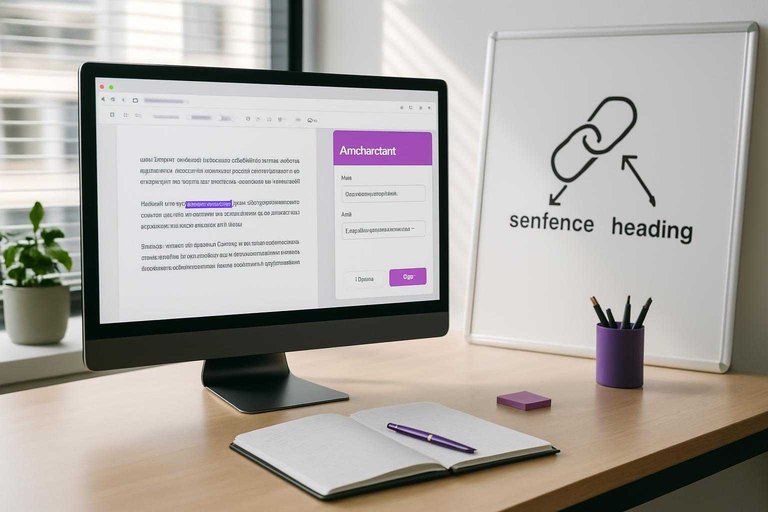
The clause around the link often carries the strongest “what is this about?” signal. Google can pick up entities, modifiers, and relationship verbs in that sentence, like “acquired,” “located in,” or “reviews.” If the sentence says “This clinic in Ballard treats TMJ” next to the link, the link inherits those associations.
Paragraph and section
Headings and section structure shape the topic Google thinks the link belongs to. They can widen relevance when the section is broad, or narrow it when the section is specific.
- H2/H3 headings define the topical container
- Topic sentences set the paragraph’s primary meaning
- Nearby lists add attribute-style modifiers
- Section boundaries reduce bleed from other topics
- CTA blocks often weaken topical clarity
If your link sits under the wrong heading, you’re donating relevance to the wrong idea.
Source Page Topicality
A backlink isn’t just a URL vote. It’s an endorsement framed by the linking page’s subject, language, and neighbors.
If the source page’s topic is fuzzy, the relevance it can pass is fuzzy too.
Topical focus strength
A tightly themed page gives Google one clean interpretation of “what this page is about.” A mixed-topic roundup forces competing interpretations, like “best CRM tools” next to “remote team snacks.”
When the page stays on one subject, the outbound link reads like a confident citation, not a random mention.
On-page corroboration
The anchor text helps, but Google looks for supporting evidence across the whole page. You want repeated, consistent topical hints that make the link’s meaning hard to misread.
- Repeat the main entity names nearby
- Use close synonyms in headings
- Include co-occurring concepts in examples
- Reference related standards, tools, or categories
- Keep terminology consistent across sections
If the page can’t “prove” the topic without the link, the link won’t prove much either.
Internal link context
Google doesn’t interpret the source page in isolation. Breadcrumbs like “Marketing > SEO > Technical SEO” and internal links pointing to similar pages act like labels on a folder.
If you need a deeper refresher on how these signals fit together, see this SEO guide.
If the site keeps routing users to the same topical neighborhood, your link inherits that neighborhood’s meaning—especially when those links are placed in context for users and crawlers.
Target Page Interpretation
Google doesn’t take a link’s surrounding text at face value. It checks whether that context fits what your target page actually covers, not what you wish it covered.
A “best running shoes” link pointing to a generic category page gets questioned fast. The context has to land somewhere real on the page.
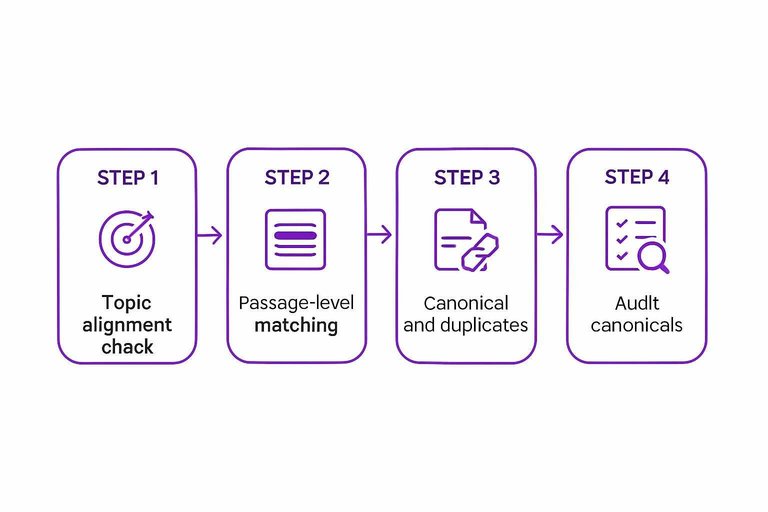
Topic alignment check
A contextual backlink passes relevance only if the target page can “cash” that context. Descriptive anchor text helps, but it can’t override a mismatched destination.
Google compares the link’s topic cues to your page’s dominant themes. If your page mostly screams “pricing” and the link screams “how-to,” the transfer gets blunted. Think “machine learning guide” linking to a vendor homepage.
Your anchor can be perfect and still lose. The page has to earn the topic.
Passage-level matching
Google can treat relevance as section-specific, not page-wide. That matters when your page covers several subtopics and only one matches the link context.
If a link mentions “crawl budget,” Google can map that context to your page’s crawl-budget section. Other sections may contribute little to that link’s relevance score. It’s like the link is voting for a passage, not the whole URL.
Build pages with obvious topical islands. Then links can land with precision.
Canonical and duplicates
Canonical choices decide which URL gets credit. Near-duplicates can also split or redirect relevance signals in messy ways.
- Canonical tags consolidate signals to the chosen URL.
- Parameter URLs may pass credit to the clean version.
- Near-duplicate pages can dilute topical focus across variants.
- Conflicting canonicals can trap signals on the wrong URL.
- Internal links can override your intended canonical path.
Audit canonicals before link building. Otherwise you’re paying for signals you don’t receive.
Weighting and Dampening
Contextual backlinks don’t hit rankings at face value.
Google-like systems weight some signals up and dampen others down, based on risk and fit.
Contextual relevance gets amplified or discounted by predictable filters.
| Factor | Amplifies relevance when… | Dampens relevance when… | What to check |
|---|---|---|---|
| Link placement | In-body, near claim | Footer, template block | Visual page scan |
| Surrounding entities | Shared topics, entities | Mixed, off-topic entities | Nearby terms |
| Anchor and co-text | Specific, natural phrase | Repetitive, exact-match | Anchor variety |
| Source trust signals | Real brand, citations | Thin site, ads heavy | About and refs |
| Link graph patterns | Few, editorial links | Link clusters, swaps | Outbound link map |
Treat weighting like a mixing desk.
Turn down anything that looks manufactured before you chase more links—and use a checklist for streamlining SEO content to keep on-page signals clean while you evaluate link risk.
Turn “links” into clear relevance signals
Treat every backlink as a mini semantic endorsement, not a raw vote. Prioritize links where the anchor, surrounding sentences, and the source page’s topical focus all corroborate the same concept—and make sure your target page cleanly matches that intent without canonicals, duplicates, or mixed topics muddying the interpretation. When you audit links, don’t just count them; read the context window, verify the source’s on-page evidence, and confirm the destination is the best, most singular answer to the topic.
Frequently Asked Questions
- Are contextual backlinks the same as in-content backlinks, or does placement in the article matter?
- They’re usually the same idea: a link placed inside the main body copy with relevant surrounding text. Links in sidebars, footers, author boxes, or templated blocks are less likely to carry strong contextual relevance signals.
- Do contextual backlinks still matter in 2026 with Google’s AI Overviews and entity-based search?
- Yes—contextual backlinks still help Google confirm topical relationships and authority, even as entity signals grow. They’re most valuable when they align with clear entities and terms on both the linking and linked pages.
- How can I measure whether a contextual backlink is actually passing relevance signals?
- Track changes in rankings for semantically related queries and watch Google Search Console for growth in impressions for that topic cluster after the link is indexed. You can also use Ahrefs or Semrush to monitor keyword movement and estimated traffic to the target page over 2–8 weeks.
- Can I use internal links instead of contextual backlinks to build topical relevance?
- Internal links can build strong topical structure and help Google understand your site, but they don’t replace third-party validation from contextual backlinks. Most sites need both: internal links for architecture and external contextual backlinks for credibility and competitiveness.
- How long does it take for contextual backlinks to impact rankings after they go live?
- You often see early movement once the linking page is crawled and the link is indexed, typically within 1–4 weeks. More stable gains usually show up in 6–12 weeks as Google re-evaluates the target page across more queries.
Earn More Relevant Links
Understanding how contextual backlinks pass relevance signals is one thing; consistently creating link-worthy pages and placing them in the right context is the hard part.
Skribra helps you publish SEO-optimized articles at scale and tap into a backlink exchange network built for contextual relevance—try the 3-Day Free Trial.
Written by
Skribra
This article was crafted with AI-powered content generation. Skribra creates SEO-optimized articles that rank.
Share: