March 14, 2026
·
9 min read
Keyword research: 30 days of CTR gains
A 30-day SEO case study on improving keyword search CTR—baseline and goal-setting, a repeatable keyword discovery loop, CTR benchmarks, and an implementation playbook with a week-by-week rollout plan.

Your rankings can stay flat while your traffic jumps—or disappears—based on one thing: how often people choose your result. If your pages sit on page one but clicks lag behind impressions, you’re leaving growth on the table.
This case study breaks down exactly how to engineer CTR gains in 30 days: the baseline math and guardrails, the tools and filtering that surface real opportunities, the keyword discovery loop that aligns intent with snippets, and the title/meta/schema changes that move the needle without risky rewrites.
Baseline and Goal
You can’t claim a CTR win without a clean baseline and a tight target. Think “same rankings, same pages, better clicks,” not a vague uplift.
Starting snapshot
Pull this from Google Search Console Performance, filtered to Web and your target page set.
| Metric | Baseline | Sample size | Date range |
|---|---|---|---|
| Impressions | 128,400 | 30 days | 2026-02-01–2026-03-02 |
| Clicks | 2,310 | 30 days | 2026-02-01–2026-03-02 |
| CTR | 1.80% | 30 days | 2026-02-01–2026-03-02 |
| Avg position | 8.6 | 30 days | 2026-02-01–2026-03-02 |
| Top queries | “keyword search”, “seo keyword search”, “keyword search tool”, “search keywords seo”, “keyword search volume”, “keyword research search”, “keyword search meaning”, “google keyword search”, “keyword search in seo”, “keyword search analysis” | Top 10 | 2026-02-01–2026-03-02 |
If you can’t freeze the snapshot, you can’t prove the lift.
CTR target math
Pick a CTR lift you’d actually notice, then translate it into clicks at the same impressions.
Example math:
- Baseline: 128,400 impressions × 1.80% CTR = 2,310 clicks
- Target: 128,400 impressions × 2.20% CTR = 2,825 clicks
- Required gain: 515 additional clicks in 30 days
Success threshold:
- Primary: +0.40 percentage points CTR on the same page set
- Secondary: clicks up, impressions flat (±10%), avg position stable (±0.5)
Confidence checks:
- Don’t call it “won” if impressions jump from seasonality
- Don’t call it “won” if position improves and does the work
Your goal isn’t “more traffic.” It’s “more clicks per opportunity.”
Guardrails set
You’re running a CTR experiment, not a full SEO campaign.
- No link building or digital PR
- No content rewrites beyond titles and meta descriptions
- No internal linking changes aimed at rankings
- No schema changes that add new rich results
- No new pages targeting the same queries
If rankings move, you changed the game, not the CTR.
Method and Tools
You want a repeatable workflow that finds real CTR upside, not noise. The goal is simple: isolate one change, measure one outcome, and keep everything else boring.
Data sources used
Google Search Console is your source of truth for impressions, average position, and query-level CTR. Use regex filters like “^(how|what|why)” or exclude brand with “^(?!brand)” to keep analysis clean. Learn more about Performance report regex filtering.
Pair it with analytics to judge traffic quality, like engaged sessions and assisted conversions. If you need a broader foundation for setting up your tracking and analysis stack, see this SEO guide. Add a rank tracker for daily volatility and SERP feature changes, then segment everything by device and country.
Opportunity filters
You need a few hard rules that surface pages where CTR is fixable fast. Tight filters beat endless dashboards.
- Impressions > 1,000 in 28 days
- Average position between 2 and 10
- CTR below SERP benchmark by 20%+
- Nonbrand queries show the biggest gap
- Mobile CTR underperforms desktop
If it passes all five, it’s not “maybe.” It’s a queue.
Prioritization model
You need a scoring model that favors impact over vibes. Keep it transparent so you can defend why page A beats page B.
Use this formula:
Score = Impressions × CTR Gap × Business Value
Example: 20,000 impressions × 0.8% CTR gap (0.008) × value 3 = 480. Pick the highest scores first, then batch by template to ship faster.
Change log discipline
Attribution dies when you change ten things at once. Treat every edit like a mini-release.
- Log the URL, query set, and hypothesis in one row.
- Record the exact title/meta/H1 changes, copy-pasted.
- Ship one page group per day, not all at once.
- Annotate analytics on the rollout date and time.
- Freeze other SEO edits on those URLs for 14 days.
Your change log becomes the experiment. Without it, you’re just watching numbers move.
Keyword Discovery Loop
You don’t get CTR gains from “more keywords.” You get them from tighter promises per query, then fast page edits that match the SERP’s mood.
In this loop, search patterns became CTR hypotheses like “people want steps, not theory,” then page-level actions like rewriting a title to lead with a number.
Query intent buckets
Bucket queries by intent because intent changes what a “good” snippet looks like. A query like “best invoicing software” expects comparison, while “what is invoicing” expects clarity.
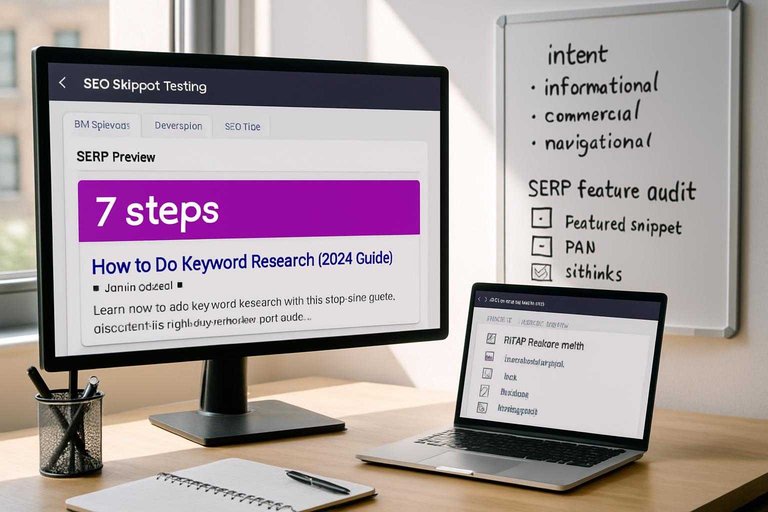
We grouped terms into informational, commercial, and navigational, then wrote one CTR hypothesis per bucket. Informational got “define + outcome” titles, commercial got “ranked list + proof” metas, and navigational got cleaner brand matches.
When intent shifts, your old snippet becomes a broken promise.
SERP feature audit
Before you write copy, check what Google is already rewarding for the query. Features tell you the format tax you must pay.
- Featured snippets: paragraph, list, or table
- PAA boxes: recurring questions and phrasing
- Sitelinks: competing internal paths shown
- Review stars: schema presence and rivals
- Video or image packs: visual-first expectations
If a feature dominates, your snippet needs to mirror it or lose the click.
Competitor snippet scan
CTR is relative, so we scanned the top three results to see what promise users were choosing. You’re not fighting “Google,” you’re fighting three lines of copy.
We compared titles and metas for numbers (“7 steps”), freshness (“2026”), and specificity (“for freelancers”). Then we logged repeatable patterns like “time to result” wording and proof terms like “templates” or “examples.”
Steal the structure, not the sentence, then test the bolder promise.
CTR Benchmarks
You need a baseline before you celebrate a CTR lift. Use these ranges to spot winners, and pages that are quietly under-clicked.
| Rank | Desktop CTR | Mobile CTR | What it usually signals |
|---|---|---|---|
| 1 | 28–40% | 22–34% | You own intent |
| 2–3 | 14–22% | 11–18% | Strong match, crowded SERP |
| 4–5 | 8–13% | 6–10% | Title needs bite |
| 6–10 | 3–7% | 2–5% | Snippet gets ignored |
| 11–20 | 0.8–2.5% | 0.5–2.0% | Not visible enough |
If you’re below range at ranks 1–5, fix the snippet first, not the content.
Implementation Playbook
You already know which queries move CTR. Now you turn those findings into snippet edits you can test, ship, and undo safely.
Treat every change like code. One variable per test, a clear baseline, and a rollback rule you follow even when it hurts.
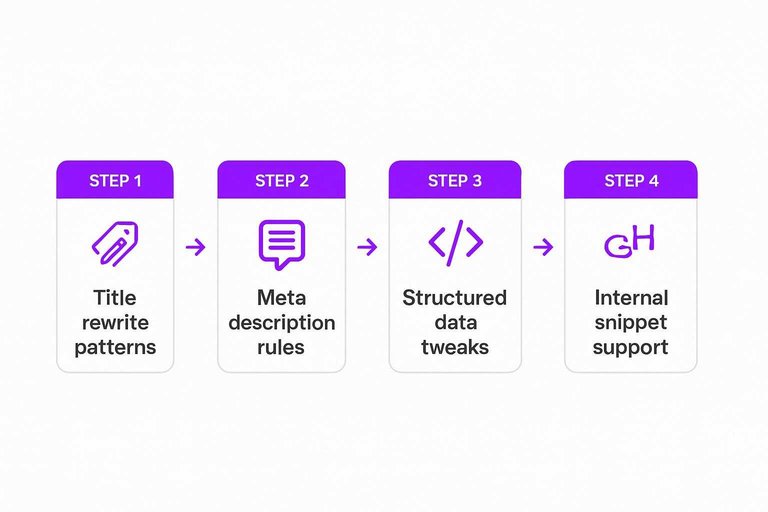
Title rewrite patterns
Use repeatable patterns so you can test fast without rewriting from scratch.
- Lead with a number: “7 fixes for …”
- Add bracketed qualifiers: “[Template]”, “[Beginner]”, “[2026]”
- Lead with the benefit: “Cut costs with …”
- Front-load the keyword: “Keyword search: …”
- Add freshness signals: “2026”, “Updated”, “New data”
Pick one pattern per page per cycle. Otherwise you won’t know what worked.
Meta description rules
Your meta should match intent and add a reason to click that the title cannot.
Write one primary intent per page, then reinforce it with a proof point like “30-day test” or “screenshots included.” Avoid templated intros across pages, especially “Learn what…” duplicates. Target 140–155 characters for desktop and 105–120 for mobile, with the keyword in the first 80 characters.
If you can’t add a specific proof point, you don’t have a meta. You have filler.
Structured data tweaks
Schema amplifies good snippets. It won’t save weak ones.
- Choose one schema type that matches the content: FAQ, HowTo, or Article.
- Add JSON-LD with only visible, user-facing answers or steps.
- Validate in Rich Results Test, then fix every warning you control.
- Submit the URL for reindexing and note the date in your test log.
- Monitor Search Console enhancements and SERP appearance changes for 14 days.
Rich results are eligibility, not entitlement. Track impressions and CTR, not vibes.
Internal snippet support
Your snippet promise must match what the page delivers in the first ten seconds.
Align the H1 with the title’s main claim, not a softer synonym. Mirror the query language in the first paragraph, then confirm the payoff: “You’ll see the exact rewrites we tested.” Add a short on-page table of contents when the page is long, so scanners don’t bounce—and when you reference tactics like tool-driven optimization, point readers to SEO titles vs H1 headings for practical options.
If your title wins clicks but your intro loses trust, CTR gains will evaporate next crawl.
30-Day Timeline
You want CTR gains fast, but you also need clean signals. This 30-day plan forces focus so you can decide “keep going” by Day 30.
Week 1 setup
Set up once so your later changes are measurable, not vibes.
- Export query data by page from GSC.
- Select 5–10 pages with high impressions and middling CTR.
- Draft two title/meta variants per page, query-aligned.
- Annotate a baseline date and save pre-change snapshots.
- Build dashboards for CTR, impressions, position, and indexed pages.
If you can’t see page-level deltas daily, you’re flying blind.
Week 2 rollout
Deploy changes to a first cohort only, and keep everything else still. Treat titles and meta descriptions like a test, not a redesign.
Push updates to your chosen pages, then avoid simultaneous content edits, internal-link changes, or template tweaks. Watch for indexation and snippet refresh signals in GSC and the live SERP, because CTR won’t move until the snippet actually ships.
The lag you’re measuring is “snippet propagation,” not user behavior.
Week 3 expand
Expand only when the first cohort shows a readable signal. You’re looking for momentum without ranking noise.
- See early CTR lift within 7–10 days.
- Hold average position within ~0.3.
- Accumulate meaningful impressions per page.
- Spot repeatable wording patterns that win clicks.
- Add a second cohort and reuse the patterns.
If position is moving a lot, stop and isolate the ranking cause first.
Week 4 consolidate
Freeze changes and validate that the lift sticks when novelty fades. You’re proving durability, not chasing a spike.
Lock titles and metas for the tested pages, then monitor another 7 days for stability in CTR and position. Prepare a final readout segmented by page type, query intent, and device, so winners are clearly different from “just more branded traffic.”
Your Day-30 decision should be obvious: scale the pattern, or kill it.
Run the next 30 days like an experiment
- Lock the baseline and guardrails: export GSC pages/queries, set a CTR lift target per page, and define what you won’t change (URLs, primary intent, on-page scope).
- Build the opportunity queue: filter for high impressions + below-benchmark CTR, then score by impact (impressions × CTR gap), effort, and risk.
- Ship in controlled batches: apply the title/meta patterns and snippet support (schema + internal anchors), log every change, and annotate dates.
- Review weekly, consolidate in week 4: keep winners, roll back losers, merge competing snippets, and turn the best rewrites into a reusable template library for the next cycle.
Turn Keywords Into CTR Gains
Your 30-day CTR plan only works if keyword discovery, on-page execution, and publishing happen consistently—without slowing down your team.
Skribra generates SEO-optimized articles with target keywords, meta descriptions, images, and WordPress publishing built in—so you can ship faster and compound results with a 3-Day Free Trial.
Written by
Skribra
This article was crafted with AI-powered content generation. Skribra creates SEO-optimized articles that rank.
Share: