March 7, 2026
·
7 min read
Keyword research for SEO beginners, explained simply
A beginner-friendly explainer to keyword search in SEO—understand search intent, use the SERP as your guide, evaluate keywords without fancy metrics, cluster by meaning, and map each intent to a single page to avoid cannibalization.

If “keyword research” feels like guessing which words will magically rank, you’re not alone—and that’s why beginners often chase high-volume terms that never convert. The missing piece isn’t a secret tool; it’s a clear way to think about what people are actually trying to do when they search.
In this simple explainer, you’ll learn a safe mental model for picking keywords, quick checks to validate intent and value, and an easy method to assign keywords to the right pages so your site doesn’t compete with itself.
What keyword search is
Keyword search is finding the exact words people type into Google when they want something.
You use those phrases to match your pages to real demand, like “best running shoes” or “how to clean white sneakers”.
Search intent basics
Intent is the reason behind a query.
Same words. Different goal. Think “fix iPhone battery” versus “iPhone battery replacement near me”.
Most queries fall into four intent types:
- Informational: “how to tie a tie”
- Navigational: “YouTube login”
- Commercial: “best budget espresso machine”
- Transactional: “buy espresso machine online”
Write for the intent first, then worry about clever wording.
Keywords vs topics
A keyword is a single phrase.
A topic is the whole cluster of questions around it, like “home coffee”.
One topic maps to many keywords at different specificity levels:
- Topic: home coffee
- Broad: “coffee maker”
- Mid: “best drip coffee maker”
- Specific: “best drip coffee maker for small kitchen”
- Problem: “coffee tastes bitter in drip machine”
Build topic coverage, then pick keywords that match each page’s job.
Beginner pitfalls
Most beginner mistakes come from treating keywords like lottery tickets.
Avoid these common traps:
- Chasing volume over fit
- Ignoring the query’s intent
- Picking terms that are too broad
- Copying competitors without context
- Never validating by checking the SERPs
If the results page disagrees with your plan, your plan loses.
The core mental model
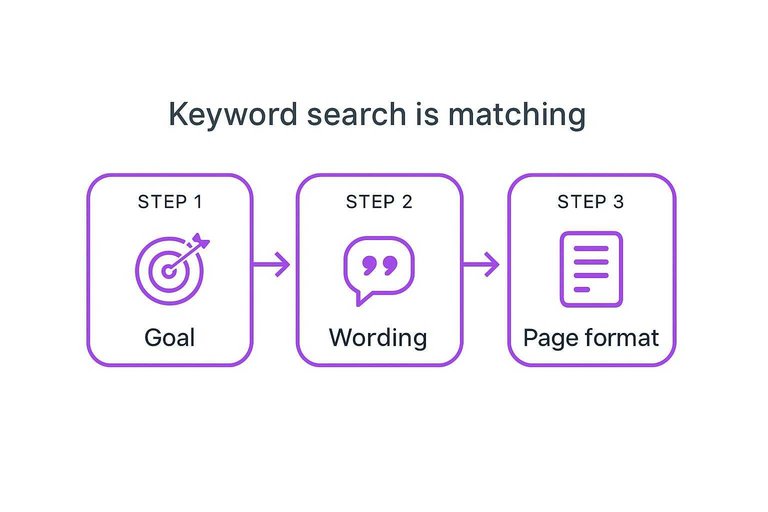
Keyword search is matching: a person’s goal, their exact wording, and the page format that satisfies them. Think “I need X” + “I typed Y” + “I want it as Z.” Relevance beats cleverness every time, like choosing “running shoes for flat feet” over a cute brand slogan.
Query as a question
Every keyword hides a question your page must answer, not a string you must repeat.
- Rewrite “best budget laptop” as “Which budget laptop is best for me?”
- Rewrite “how to clean white sneakers” as “How do I clean white sneakers without yellowing them?”
- Rewrite “NYC plumber emergency” as “Who can fix my NYC plumbing emergency right now?”
If your page can’t answer the question fast, you’re targeting the wrong keyword.
SERP as a clue
The results page tells you what Google thinks the searcher wants, and what format usually wins. Scan for ads, featured snippets, local packs, and the dominant content type, like “listicles,” “product pages,” or “how-to guides.”
Treat the SERP like a receipt for intent, then build the page that matches it.
Relevance ladder
Keywords range from vague to specific, and beginners usually win on specific.
- Head terms: broad, high volume, low clarity
- Mid-tail: narrower, some intent, mixed competition
- Long-tail: specific, clear intent, lower volume
- Problem keywords: urgent, high intent, strong conversions
- “For” keywords: audience-fit, fewer mismatches
Start lower on the ladder, where the wording tells you exactly what to write.
Safe first steps
You want keywords that match real demand, without betting your page on a guess. The safest start is listening first, then validating with free data, then choosing one clear focus for one page. If you want a broader framework beyond these basics, follow this complete SEO guide.
Start from customers
Pull keywords from the places customers already tell you what they want. Capture exact phrases, not your polished version.
- Skim FAQs and support emails for repeated “how do I…” questions.
- Mine reviews for blunt wording like “too expensive” or “easy to set up.”
- Ask sales to share common call notes, especially objections and comparisons.
- Check internal site search terms for the words visitors type when stuck.
- Paste phrases into one doc, keeping quotes exactly as written.
Those raw phrases are your unfair advantage, because competitors can’t copy your inbox.
For a helpful baseline, see Ahrefs’ keyword research beginner’s guide.
Use free tool trio
Validate your customer phrases with free sources before you write. You’re looking for real queries and related wording.
- Google Autocomplete and People Also Ask for common follow-up questions
- Google Search Console for queries you already show up for
- A free-tier keyword tool like Ahrefs, Semrush, or Ubersuggest
If two sources echo the same phrase, it’s usually safe enough to build around.
Cluster by meaning
A page can’t satisfy five different intents, even if the keywords look similar. Group phrases that mean the same thing, like “best project management tool” and “top project management software,” then pick one primary phrase and a few close variants.
Treat anything with a different job as a different cluster, like “pricing,” “templates,” or “how to use.” That’s the line that gets crossed.
One intent per page keeps your draft focused and your ranking signals clean.
Evaluate keywords quickly
You can sanity-check a keyword in five minutes before you write a single outline. Pull the SERP, ask “what are people really trying to do?”, then check if you can credibly win. Think “best running shoes” versus “how to stop heel slip”; one is a brand war, the other is a solvable problem.
Intent fit test
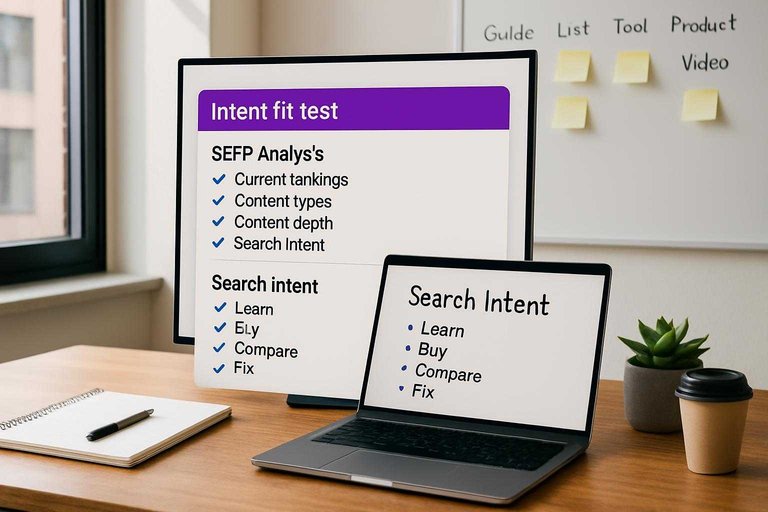
Run a fast intent check before you commit to a keyword.
- Search the keyword in an incognito window.
- Name the intent in five words: “learn”, “buy”, “compare”, or “fix”.
- Note the dominant content type: guide, list, tool, product, video.
- Confirm your page can satisfy it better or differently.
If your format fights the SERP, you’re choosing friction on purpose.
Difficulty without metrics
You can eyeball difficulty by reading the first page like a customer. If the top results are all major brands, you’re not “competing with articles”; you’re competing with trust.
Look for dominance, depth, and freshness:
- Brand-heavy results signal a credibility moat.
- Deep, updated guides signal real editorial investment.
- Forums and short posts signal a gap you can fill.
- Stale dates and thin pages signal a refresh opportunity.
- Your byline, experience, and examples reveal the credibility gap.
If you can’t beat them on proof, beat them on angle, specificity, or tools—useful aids like resources to simplify SEO workflows can speed up the process.
Value signals
A keyword can be easy and still useless, so scan for payoff clues.
- Shows urgency: “emergency”, “same-day”, “won’t start”.
- Includes purchase modifiers: “cost”, “pricing”, “best”, “near me”.
- Adds location terms: city, neighborhood, “open now”.
- Points to high-margin services: install, repair, audit, consult.
- Repeats as a question: “how to”, “can I”, “what happens if”.
If your audience would pay, book, or email after reading, you’ve found a working keyword.
Map keywords to pages
You need a simple rule for your site structure, or keyword research becomes chaos. Use one page per intent so planning stays clean, and rankings stay stable.
One intent, one page
Similar keywords usually belong on the same page because Google is matching intent, not wording. If “best running shoes” and “top running shoes” want the same comparison, they share a page.
Separate pages only when intent or audience clearly changes. For example, “running shoes for flat feet” is a different need than “running shoes size chart,” and “for women” can justify its own page if products differ.
If the searcher would be happy landing on the same page, combine the keywords.
Simple mapping workflow
Do this once, and your content plan stops feeling endless.
- Group keywords into clusters by the same search intent.
- Assign each cluster to one existing page or one new page.
- Name the page’s goal as a verb, like “compare,” “buy,” or “learn.”
- Write a one-sentence promise, like “Help you choose X in 5 minutes.”
- Pick one primary keyword, then list 3–5 close variations.
When every page has a promise, writing gets faster and editing gets ruthless.
Avoid cannibalization
Cannibalization is when your own pages compete for the same job. It looks harmless until rankings wobble.
- Two pages target the same exact phrase.
- Rankings rotate between URLs weekly.
- Clicks split across similar pages.
- Internal links use conflicting anchor text.
- New content drops an older page.
Fix it by merging pages, 301-redirecting the weaker URL, or rewriting one page for a different intent.
If you don’t choose a single “winner” page, Google will keep guessing.
Pick one keyword cluster and ship a page this week
- Choose one customer problem you can explain in plain language, then write down 10–20 real questions customers ask.
- Google 3–5 of those queries and use the SERP to confirm intent (what type of pages win, what angles repeat), then group close variants into one “meaning cluster.”
- For the best cluster, map it to a single page (or create one) with one primary query, 3–8 supporting variants, and a clear promise that matches the SERP—then publish, monitor impressions/clicks, and refine before starting the next cluster.
Frequently Asked Questions
- Is keyword search in SEO the same thing as keyword research?
- They’re often used interchangeably, but keyword research usually includes deeper steps like estimating difficulty, grouping topics, and planning content around the keywords you find.
- Do I need paid tools for keyword search in SEO, or can I do it with free tools?
- You can do solid beginner keyword search with free tools like Google Search Console, Google Trends, Google autocomplete/People Also Ask, and Bing Webmaster Tools; paid tools mainly speed up volume and competition estimates.
- How do I measure whether my keyword search in SEO is working?
- Track rankings plus outcomes: impressions/clicks in Google Search Console, organic sessions in GA4, and conversions (leads, sign-ups, sales) from the pages targeting those queries over 4–8 weeks.
- How long does keyword search in SEO take to show results after I publish?
- Most sites see early signals (indexing, impressions) in 1–3 weeks and clearer traffic movement in 6–12 weeks, assuming the page matches intent and gets crawled regularly.
- Can I use the same keyword on multiple pages, or will it hurt SEO?
- Using the same primary keyword on multiple pages often causes keyword cannibalization and weaker rankings; usually choose one primary page per main query and use variations as supporting subtopics.
Turn Keywords Into Pages
Once you understand the mental model and can evaluate keywords fast, the hard part becomes turning that research into consistent, well-mapped content.
Skribra generates SEO-optimized articles with the right keywords, meta descriptions, and formatting, then publishes to WordPress—plus access to a backlink exchange network; start with the 3-Day Free Trial.
Written by
Skribra
This article was crafted with AI-powered content generation. Skribra creates SEO-optimized articles that rank.
Share: