March 6, 2026
·
9 min read
Keyword research: volume vs intent framework
A comparison framework for keyword search in SEO that balances volume and intent — avoid volume traps, map intent types and modifiers, interpret volume in context, score intent strength, and pick a strategy with a simple model and real-world examples.

Chasing high search volume feels safe—until the page ranks and nothing converts. If you’ve ever picked “bigger” keywords and watched traffic bounce, you’ve met the gap between demand and intent.
This comparison gives you a volume vs intent framework you can apply to any keyword list. You’ll learn how to classify intent, read SERP signals, evaluate volume without getting fooled, and use a simple scoring model to choose winners across SaaS, ecommerce, and local SEO.
Why volume misleads
Search volume looks like certainty because it’s numeric, but it’s only a demand proxy. Intent looks like strategy because it’s human, but it’s often inferred from messy SERPs. Your real tradeoff is traffic potential versus conversion probability, filtered by funnel stage and what Google actually ranks.
Two competing signals
Volume estimates how many people search a phrase in a period. Intent estimates what those people are trying to accomplish when they search.
Volume breaks when the SERP steals clicks with maps, snippets, or product grids. Intent breaks when the query mixes goals, like “best running shoes” for research and purchase.
Treat volume as reach and intent as likelihood, then validate both in the live SERP.
Common decision traps
Volume tempts you because it’s a clean number, and the traps are predictable.
- Chasing volume while ignoring low click potential
- Ignoring SERP features that absorb demand
- Equating intent with only “buy now” queries
- Using averages instead of volume ranges
If you don’t model clicks and outcomes, volume becomes vanity math.
When the framework helps
You need this lens when priorities conflict and the SERP is noisier than the keyword tool. It forces a choice between building reach now and capturing revenue sooner.
It’s useful for a new site picking “winnable” demand, a revenue team mapping queries to pipeline, a refresh project pruning low-value traffic, and a PPC team porting proven intent into SEO.
Use it when you’re deciding what to ship next, not when you’re admiring a keyword list.
Define intent types
Intent is the job your searcher hires the query to do. Volume tells you how many people show up. Intent tells you what they expect to click.
Intent category map
Use this map to classify a keyword by its most common SERP behavior.
| Intent type | Typical modifiers | Common SERP features | “Feels like” query |
|---|---|---|---|
| Informational | how, what, guide | snippets, PAA, videos | “how to audit SEO” |
| Commercial investigation | best, top, vs | lists, reviews, comparisons | “best rank tracker” |
| Transactional | buy, pricing, coupon | shopping, ads, product pages | “buy Ahrefs” |
| Navigational | brand, login, app | sitelinks, brand panel | “Semrush login” |
Treat the SERP as the ground truth, not the words in the query. For a clear baseline on the four categories, see this guide on what search intent is, and refer to our complete SEO guide for how intent fits into a full keyword strategy.
Modifier cheat sheet
Modifiers are fast clues, not final answers.
- Informational: “how” / “what” / “template”
- Commercial: “best” / “top” / “vs”
- Transactional: “price” / “review” / “buy”
- Local transactional: “near me” / “open now” / “delivery”
- Navigational: brand + product, “login” / “download”
If the modifiers disagree with the SERP, believe the SERP.
Edge cases to watch
Some queries carry mixed intent, like “Notion templates pricing”. Others are head terms, like “CRM”, where Google tests many angles at once.
Local and personalized SERPs shift classification by context. “Best pizza” on mobile shows maps, while desktop shows lists. Region matters too. “Football” changes meaning by country.
Evaluate volume correctly
Treat search volume as a demand estimate, not a revenue forecast. A term like “best crm” can show huge volume but hide weak buying signals.
Search volume is directional, so compare it with intent and difficulty before you commit. Otherwise you’ll chase “big numbers” that never turn into pipeline.
| Metric | What it means | Where to get it | Common pitfall | Better alternative |
|---|---|---|---|---|
| Avg monthly volume | Estimated searches per month | GSC, GKP, Ahrefs | Treat as precise | Use as range |
| Trend direction | Demand rising or falling | Google Trends | Ignore seasonality | Compare YoY |
| Click potential | Likely organic clicks | Ahrefs, Semrush | Forget SERP features | Estimate net clicks |
| Query mix | What users really ask | GSC, PAA, forums | Assume one intent | Cluster by intent |
| Conversion signal | Buyer readiness | Ads data, CRM | Use volume as proxy | Use lead rate |
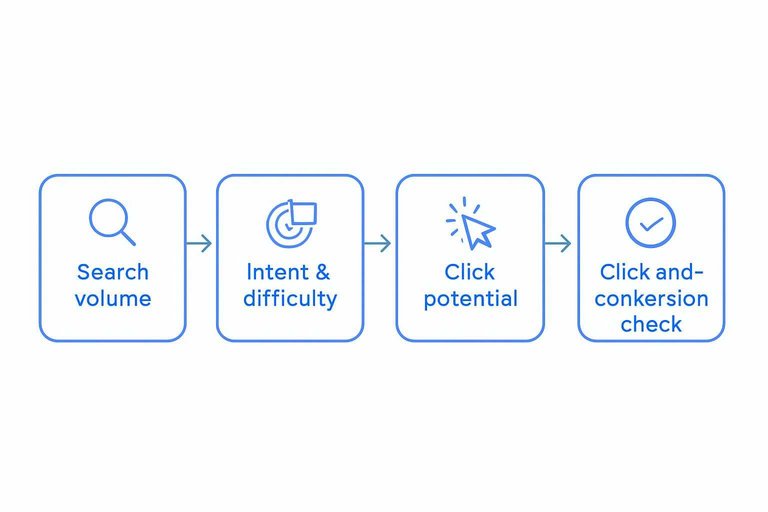
If volume doesn’t survive a click-and-conversion check, it’s just trivia.
Measure intent strength
You can’t read intent directly. You can measure it using repeatable cues from SERPs, competitors, and your own funnel data.
Use multiple signals at once, then sanity-check with a simple question: “Would a ready buyer be satisfied here?” If you need a step-by-step process for validating intent, difficulty, and SERP features in practice, use a Google keyword check walkthrough.
SERP intent signals
Google already votes on intent through layout. Your job is to score what shows up, not what you hope ranks.
- Count ads above the fold
- Note Shopping and product grids
- Watch for Local Pack presence
- Check “People also ask” depth
- Identify dominant format: guide, list, category, product
Treat SERP features like weather, not destiny; triangulate before you commit. In particular, SERP features can materially change CTR—Ahrefs found AI Overviews reduce clicks significantly in many cases.
Landing page fit
Intent gets real when a page has a next step. Match the keyword to a page type, then verify the CTA feels inevitable.
- Classify the query: guide, comparison, category, product, tool.
- Scan top competitors and label their page types.
- Pick the dominant type unless you have a clear wedge.
- Align CTA to intent: buy, book, demo, subscribe, download.
- Ensure the next step is one click away.
When CTA and query disagree, your rankings become expensive traffic.
Conversion proxy metrics
Rankings don’t prove intent. Behavior after the click does.
Use proxies that show commercial pull:
- CTR by query and position, split by device.
- Assisted conversions in your analytics model.
- Lead quality signals, like “meets ICP” rate.
- Sales cycle length by landing page entry.
- On-page actions, like pricing clicks or configurator starts.
You’ll need clean tagging, event tracking, and CRM joins, or you’ll confuse curiosity with demand.
Choose your strategy
Your keyword strategy is a business decision, not a tooling decision. Pick volume, intent, or a blend based on your model, your timeline, and your current authority. If you can’t state the tradeoff in one sentence, you’ll chase both and win neither.
When to favor volume
Choose volume when your site can actually absorb it and rank anyway.
- Leverage strong domain authority across many new pages
- Use strong internal linking to distribute relevance fast
- Build broad top-of-funnel demand and awareness
- Monetize with ads, affiliates, or email capture
- Scale content ops with repeatable briefs
Volume works when distribution is your advantage, not your bottleneck.
When to favor intent
Choose intent when every page needs to earn its keep quickly.
- Operate with limited resources and small teams
- Need revenue fast to fund growth
- Sell niche products with clear use cases
- Work long sales cycles needing qualified leads
- Face high CAC pressure and tight payback windows
Intent wins when ranking second is fine, as long as the click converts.
Blended portfolio approach
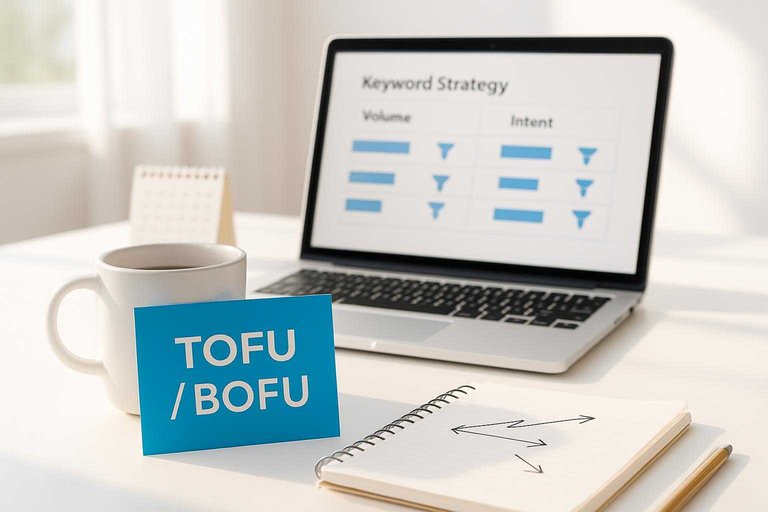
A blended approach builds a keyword mix across funnel stages, so you’re not betting the quarter on one channel. You publish some high-intent pages that convert, plus higher-volume guides that create demand and feed links internally. The compounding part is structural: internal links turn early TOFU wins into faster rankings for BOFU pages, and BOFU pages justify the budget to keep TOFU shipping—especially when you’re consistently stacking small improvements through daily SEO gains with AI.
A simple scoring model
Score keywords so you stop arguing in circles.
You want a repeatable way to pick winners and pick the right page type.
- Rate each keyword 1–5 on volume, using your tool’s ranges.
- Rate intent 1–5 based on how close it is to buying or signing up.
- Rate difficulty 1–5, where 5 means you can rank this quarter.
- Rate business value 1–5, tied to your best-margin offer.
- Compute Priority = (Volume × Intent × Business) ÷ Difficulty, then map the content type.
Set a floor for intent or business value, or you’ll “win” traffic you can’t monetize.
Examples: pick winners
SaaS keyword set
You’re choosing between traffic and revenue, and you can’t ship three pages first. Use the volume vs intent lens, then commit to one “money page.”
| Keyword | Volume | Intent | First page to create |
|---|---|---|---|
| “project management” | High | Low | Category hub |
| “project management software” | Mid | Mid | Commercial landing |
| “project management software for agencies” | Low | High | Use-case page |
Target “project management software for agencies” first with a use-case page, because it matches a buying job and a defined ICP. The hub and commercial landing can follow as you earn authority and internal links.
The fastest win is usually the narrowest promise.
Ecommerce keyword set
You’re picking between comparison intent and checkout intent, and SERPs will force you into one. Choose the variant that matches your margin, inventory, and conversion path.
- Check SERP layouts for “best”, “reviews”, and “buy” modifiers.
- If product pages rank, prioritize the “buy” variant.
- If lists dominate, target “best” with a category roundup.
- Support it with “reviews” pages for top SKUs.
- Link every support page to the chosen target.
Pick the “buy” variant when you can win on fulfillment and price, then build “best” and “reviews” as feeders.
You’re building a funnel, not three disconnected pages.
Local service set
Local keywords look similar, but Google treats them differently. Your choice changes whether you win the local pack or the organic results.
City+service is your primary target for a dedicated service page, like “Austin water heater repair.” “Near me” is usually a GBP and proximity play, so focus on categories, reviews, and consistent NAP. Informational queries belong on short guides that qualify leads, like “why my water heater is leaking.”
If you’re not improving your GBP, you’re leaving “near me” traffic to distance.
Put the framework to work on your next keyword list
- Classify each keyword by intent type and modifiers, then sanity-check with live SERP results.
- Adjust “volume” for context (seasonality, localization, brand mix, SERP features) so you’re comparing apples to apples.
- Score intent strength using SERP signals, landing-page fit, and one conversion proxy metric you can measure.
- Choose a strategy per keyword (volume-led, intent-led, or blended), then build a small portfolio that mixes quick wins with long-term growth.
Frequently Asked Questions
- Is keyword search in SEO still worth doing in 2026 with AI Overviews and “zero-click” results?
- Yes—keyword search in SEO is still the fastest way to map demand to specific pages and SERPs. You’ll just weigh click potential (ads, AI answers, SERP features) alongside volume and intent before prioritizing.
- Do I need search volume to rank, or can I target zero-volume keywords for SEO?
- You can absolutely target zero/low-volume keywords if they match high commercial intent or support a conversion page. Most “0 volume” terms still generate long-tail traffic when you cover the topic comprehensively and win related queries.
- What’s the best tool for keyword search in SEO—Google Search Console, Ahrefs, Semrush, or Keyword Planner?
- Use Google Search Console for real queries and performance on your site, then use Ahrefs/Semrush for competitive discovery and SERP analysis, and Keyword Planner for rough Google demand ranges. Most teams combine GSC + one third-party suite for the best coverage.
- How long does it take for keyword research and targeting changes to show SEO results?
- Expect early movement (indexing, impressions, rank shifts) in 2–6 weeks and meaningful traffic/conversion impact in 8–16 weeks for most sites. Competitive terms and low-authority domains often take 4–9 months to stabilize.
- Should I create one page per keyword, or group keywords by topic and intent?
- Group keywords into a single page when the intent and expected “best answer” are the same, and split pages when the SERP clearly shows different intents (e.g., “pricing” vs “how to”). This reduces keyword cannibalization and improves topical relevance.
Turn Intent Into Rankings
Balancing search volume with real intent is straightforward on paper, but it’s hard to score, prioritize, and publish consistently at scale.
Skribra helps you turn intent-led keyword choices into SEO-optimized articles with metadata, images, and WordPress publishing—plus a backlink exchange network; start with the 3-Day Free Trial.
Written by
Skribra
This article was crafted with AI-powered content generation. Skribra creates SEO-optimized articles that rank.
Share: