May 3, 2026
·
13 min read
Ranking Platform Basics: Everything Marketers Need to Know
A marketer-friendly pillar guide to ranking platforms and how to win on them — define rankings vs feeds, learn the retrieval→scoring→re-ranking model, map key ranking surfaces, and apply controllable signals, content strategy, and measurement to improve visibility across paid and organic results.


If your traffic feels like it rises and falls with no warning, you’re not “doing marketing wrong”—you’re being ranked by systems you don’t fully control. And those systems don’t just live in Google; they shape what people see in marketplaces, app stores, and social discovery.
This guide gives you a clear mental model of how ranking platforms work, the surfaces that matter, and the levers you can actually pull. You’ll leave with practical ways to build content that ranks, measure what’s real, and make paid and organic play together.
Ranking Platforms Defined
Ranking platforms are systems that order items for a user, based on predicted relevance or value. You see them when a platform decides what appears first, second, and tenth. Think “best answer,” “top product,” or “most helpful review.” Marketers use them because position changes outcomes fast.
Core concept
A ranking platform is any system that sorts content or products by relevance or expected value for a specific user. It measures signals like text match, engagement, quality, price, and past behavior. The output is an ordered list, even if you only notice the first few results.
Rank is a decision, not a display choice.
Where rankings appear
Rankings show up across more places than “SEO,” and you market inside all of them.
- Google and YouTube search results
- Amazon and marketplace category lists
- Apple App Store and Google Play charts
- TikTok and Instagram search discovery
- Review sites and LLM answer boxes
If it’s ordered, it’s optimized.
Rankings vs feeds
Rankings start with intent, like a query, category click, or filter selection. Feeds start with prediction, like “what will you watch next?” on a home screen. Hybrid surfaces blur both, like YouTube’s “Suggested” after a search.
Your job is to map intent first, then match the surface.
Why rankings matter
Rankings change unit economics and brand perception, not just traffic.
- Capture demand at the moment of intent
- Lower CAC through “free” distribution
- Build trust via third-party ordering
- Lift conversion with higher placement
- Create defensibility through compounding signals
If you can’t hold position, you don’t own the channel.
The Ranking Mental Model
Ranking platforms follow a simple pipeline: retrieve candidates, score them, order them, then learn. Think “find a shortlist, grade it fast, then reshuffle it with context.” The marketers’ edge is knowing which stage you’re actually influencing.
Candidate retrieval
Platforms can’t score the whole internet, so they first shrink the universe to a workable set. Your job is to be present in the index they search, and legible to their query understanding.
Retrieval usually mixes:
- Indexing of titles, text, attributes, and structured feeds
- Keyword and entity matching, like “Nike Pegasus” or “carry-on luggage”
- Category and facet filters, like size, price, or location
- Embedding search for “similar meaning,” even without exact words
- Query rewriting, like mapping “best” to “top-rated”
If you don’t make the shortlist, none of your “ranking factors” matter. If you want to strengthen this foundation, see this practical SEO guide.
Scoring signals
Once candidates are retrieved, platforms score each item using a few signal families. Each family answers a different question about whether you deserve the click.
- Relevance: matches query intent and attributes
- Quality: content completeness and clarity
- Engagement: predicted clicks, watch time, saves
- Authority: links, citations, creator reputation
- Freshness: recency and trend alignment
- Compliance/trust: policy, safety, authenticity
When rankings feel “unstable,” it’s often one signal family overpowering the rest.
Re-ranking layers
Initial scoring is rarely the final order. Platforms apply multiple re-rankers that optimize for different goals, like satisfaction, revenue, or retention.
A common pattern is: a lightweight model ranks quickly, then heavier models re-order the top slice. Personalization can then reshuffle results using your history, followed accounts, and inferred preferences.
Session context matters too, like what you clicked five seconds ago, what you skipped, and whether you’re “researching” or “ready to buy.” Diversity constraints may also force variety across brands, creators, or formats to prevent a samey feed.
If you only optimize for one persona, re-rankers will quietly demote you for everyone else.
Feedback loops
Platforms learn from user behavior and use it to update future rankings.
- Users click, watch, buy, return, hide, or report items.
- The system logs outcomes plus context, like query, device, and location.
- Labels are inferred, like “satisfied,” “misleading,” or “low quality.”
- Models retrain or recalibrate, shifting weights on signals.
- New rankings change what gets impressions, creating new behavior data.
If you can’t explain your own feedback trail, you’re letting the platform narrate your performance.
- Capture behavior signals like clicks, dwell, purchases, returns, hides, and reports.
- Convert signals into labels, like “satisfied,” “bounced,” or “unsafe.”
- Retrain models and recalibrate weights across signal families.
- Ship updates, then monitor online metrics and guardrails.
- Iterate as the platform chases better long-term retention.
If you optimize for the click and ignore post-click regret, the loop will punish you later.
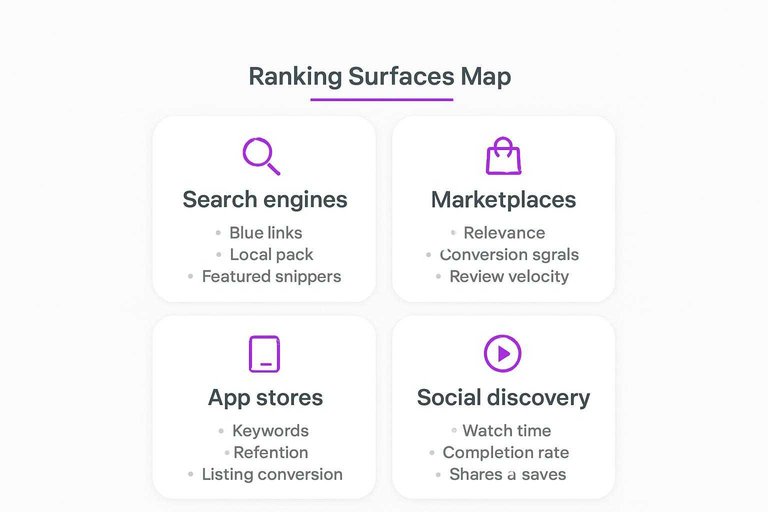
Ranking Surfaces Map
Your “rank” changes meaning by channel, even when the goal is the same: attention and conversion. A Google blue link, an Amazon listing, and a TikTok video each compete inside different UI slots and rules. Marketers win faster when they map the surface first, not the tactic.
Search engines
Search results are a stack of modules, and each module runs its own race. You can be #1 in blue links and still lose the click to a local pack.
- Blue links: relevance, authority, page satisfaction
- Local pack: proximity, prominence, reviews
- Featured snippets: extractable, direct answers
- Images: filenames, alt text, context
- News: freshness, publisher trust, topics
- Shopping: feed quality, price, merchants
- AI overviews: clarity, consensus, citations
Treat each SERP feature like a separate channel with separate levers.
Marketplaces
Marketplace ranking is closer to a sales rep than a librarian. Relevance gets you seen, but conversion signals decide who stays on top.
A listing wins when it matches intent and closes the sale. Price, Prime-like fulfillment, review velocity, and stock reliability quietly act like “trust taxes” on your rank.
App stores
App store ranking is a compound score built from intent and post-install behavior. If your app disappoints after install, you slide.
- Keywords: title, subtitle, keyword fields
- Installs: velocity, source mix
- Retention: day-1, day-7, churn
- Ratings: volume, recency, sentiment
- Crashes: stability, ANRs, error rates
- Listing conversion: views to installs
Your fastest lift often comes from improving listing conversion and retention together.
Social discovery
Social “for you” feeds rank predicted satisfaction, not information. The system builds an interest graph from what you watch, skip, and rewatch.
Watch time, completion rate, shares, and saves act like real-time votes. Creator trust signals and content integrity filters decide whether you get broad distribution.
Signals Marketers Control
You can’t change the whole algorithm, but you can change what it reads. Group your inputs into relevance, experience, trust, and commercial performance, then optimize like it’s a pipeline.
Relevance inputs
Relevance is the first gate on every platform, from Google to Amazon. If your listing doesn’t match intent, nothing else gets a fair chance.
- Write titles with primary query terms
- Match descriptions to intent and use-cases
- Add entities, attributes, and specs
- Choose correct categories and subcategories
- Align media to the query
If you’re debating “SEO vs CRO,” start here. Irrelevance kills both.
Quality and UX
Platforms reward outcomes, and outcomes come from experience. Speed, clarity, and low-friction flows turn impressions into engagement.
A practical bar: your page should feel “instant,” readable, and mistake-proof. No jumpy layouts, tiny tap targets, or videos that look like 2012.
If people hesitate or pogo-stick, your rankings eventually follow.
Authority and trust
Trust is the multiplier that decides who wins when relevance is tied. Your job is to look safe, real, and consistently validated.
- Earn recent, detailed reviews
- Maintain consistent citations and profiles
- Build backlinks and credible mentions
- Strengthen creator or brand reputation
- Stay policy-safe and verify accounts
When two results look similar, trust is the tiebreaker that quietly compounds. (For a useful official framing of how Search uses signals to evaluate reliability, see Google’s overview of delivering reliable information in Search.)
Commercial levers
Commercial inputs shape performance metrics the platform cares about. Better price-to-value, fewer disappointments, and faster delivery lift conversion and retention.
Think in moments: “in stock,” “arrives Tuesday,” “easy returns,” and “no hidden fees.” Those phrases remove doubt, and doubt is where carts die.
If you can’t outrank them on content, outrun them on offer.
Content That Ranks
Ranking platforms reward assets that hit intent fast, keep people moving, and stay easy to update. Think “answer, proof, next step,” whether it’s a page, a video, or a collection. If your asset can’t be maintained, it won’t stay ranked.
Intent-first planning
Start with intent, because the platform is trying to predict the next useful action. Your job is to make that prediction obvious.
- List your core queries, then label each: informational, navigational, commercial, transactional.
- Add platform variants like “near me,” “shorts,” “best of,” or “Reddit” modifiers.
- Write the success condition per intent: “learn X,” “find Y,” “choose,” “buy,” “do.”
- Map each intent to one primary asset and one supporting asset.
- Define the next click: internal link, collection add, checkout, or save.
When the next action is explicit, algorithms stop guessing and start recommending.
Format selection
Formats are intent containers. Pick the one that makes the expected payoff feel immediate.
- Informational → guides, FAQs, explainers
- Navigational → hub pages, collections, “start here” lists
- Commercial → comparisons, “best for” lists, demos
- Transactional → landing pages, tools, templates
- Social-native → short video, UGC, carousels
If the format fights the intent, engagement drops and rankings follow.
Information architecture
Good architecture makes one idea discoverable in many places. It also keeps your updates surgical, not scary.
Use descriptive H2s that match sub-intents like “pricing,” “setup,” or “alternatives.” Link modules to deeper pages, and link back with “related” blocks. Build collections that act like playlists, so one asset can feed multiple surfaces.
Structure is the quiet advantage that turns one asset into ten distribution points.
Refresh strategy
Refreshes win when intent stays stable. Replacements win when the job changed.
- Monitor decay: ranking drops, CTR dips, or time-on-page falls.
- Check intent drift: new SERP features, new competitors, new modifiers.
- Refresh when the outline still fits; replace when the outline is wrong.
- Update freshness signals: dates, screenshots, examples, and internal links.
- Keep one canonical version, then syndicate with clear references.
Treat content like software: ship small updates often, and deprecate cleanly.
Measurement and Instrumentation
You can’t optimize rankings with vibes. You need instrumentation that separates signal from noise, then a dashboard you’ll actually trust. Think “one source of truth,” not “five tabs and a hunch.”
Rank tracking pitfalls
Rank is a noisy metric because the platform doesn’t show one universal result. The same query can shift by user, place, and even experiment bucket.
Personalization changes ordering based on history and predicted intent. Localization swaps results by city, store coverage, or delivery radius. Device and app version can alter layouts, filters, and default sort. Inventory and availability quietly remove candidates. Experiment buckets reshuffle rankings without warning.
Reduce variance by standardizing your checks. Use fixed locations, consistent devices, logged-out or clean profiles, and repeated samples. Track rank distributions, not single points.
If your rank “drops” once, assume randomness. If it drops consistently across controlled samples, act. (You can compare this to how YouTube describes ranking with performance plus personalization in its search and discovery tips.)

Metrics that matter
Rank is a means, not the outcome. Track metrics that reflect user attention and business value.
- Measure impressions by query and category
- Track CTR from impression to click
- Monitor engagement after the click
- Attribute conversions to ranked exposure
- Tie revenue to converted sessions
If you can’t tie movement to money or retention, you’re optimizing for screenshots—and missing opportunities to scale impact with AI tools to boost organic traffic.
Causal thinking
Ranking changes often correlate with other shifts. Seasonality, promos, and inventory can move everything at once.
Use holdouts when you can. Keep a stable slice unoptimized, then compare outcomes. Use geo splits when markets are independent enough. Run pre/post analyses with controls, like similar queries or untouched categories. Compare cohorts, like new versus returning users, to spot composition effects.
Your dashboard should answer “did we cause it?” not “did it happen near us?”
Dashboard blueprint
Build a ranking dashboard that survives skeptical questions in a weekly meeting.
- Connect sources: rank checks, logs, ads, web analytics, and commerce data.
- Normalize identifiers: query, SKU, category, and campaign naming.
- Segment views: device, geo, cohort, inventory status, and experiment flags.
- Add alerts: sudden drops, tracking gaps, and anomaly thresholds.
- Annotate changes: launches, promos, feed updates, and known experiments.
The goal is fast diagnosis. If you need a detective, your dashboard is incomplete.
Ranking Platforms vs Channels
You don’t market to “the internet.” You market to ranking systems, or to channels that don’t rank.
| Type | Primary objective | Typical signals | Marketer levers |
|---|---|---|---|
| Search ranking platform | Match intent fast | Links, content, UX | Technical SEO, content, PR |
| Social feed ranking platform | Maximize session time | Watch time, saves | Creative, hooks, cadence |
| Marketplace ranking platform | Drive purchases | Conversion, reviews | Pricing, listings, inventory |
| Non-ranking channel | Deliver your message | Targeting, frequency | Budget, segmentation, offers |
If there’s a “For You” tab, you’re playing an algorithm, not a schedule.
Paid Meets Organic
Paid and organic share the same screen, so they share the same attention budget. One extra ad unit can turn your “top result” into “second glance,” especially on mobile. Treat the page like a single system, not two separate channels.
Blended SERPs
Sponsored placements reshape what gets noticed first, and your organic CTR moves with it. On Google, Shopping and Ads often push blue links down; on Amazon, Sponsored Products sit inside the results grid; on TikTok, Spark Ads can look like “just another post.”
The practical effect is a three-way trade:
- CTR shifts: ads siphon clicks from the head and fatten the long tail.
- Brand lift: repetition boosts recall, even when users click organic later.
- Demand capture: you create the query, then you harvest it organically.
If your branded searches rise after heavy spend, you’re watching paid manufacture organic demand.
Auction basics
Ad rank is an auction outcome, not a price tag. You need to understand the inputs that decide who shows and where.
- Bid: your max willingness to pay
- Quality score: expected user experience
- Relevance: match to query intent
- Predicted CTR: likelihood of engagement
- Placement: rank plus formats
If your quality is weak, higher bids just buy you expensive mediocrity.
Incrementality checks
You can’t trust last-click when ads and organic coexist. Prove lift with controlled comparisons.
- Run a geo or audience holdout with identical budgets elsewhere.
- Split brand and non-brand, then measure cross-effects.
- Watch for saturation by plotting spend vs incremental conversions.
- Re-test after creative or landing page changes.
When incremental lift flattens, you’re funding substitution, not growth.
Ethical considerations
Users spot manipulation fast, and platforms punish it faster. Disclose sponsored content clearly, avoid fake urgency, and don’t mask ads as organic results with misleading copy.
Optimize for trust signals that last: accurate claims, consistent landing pages, and policies that match the promise. If you wouldn’t quote it in a customer email, don’t run it as ad text.
Rankings are rented; credibility is earned, and it compounds.
Put the Ranking Model to Work This Week
- Pick one surface (Google, Amazon, App Store, TikTok/Instagram) and write the “job to be done” and top intents you need to satisfy.
- Audit your top 5 pages/listings for controllable signals: query/category relevance, UX speed and clarity, proof of trust/authority, and conversion/commercial levers.
- Choose one ranking bet: create a new intent-fit asset, reformat an existing one, or refresh and consolidate to fix cannibalization and staleness.
- Instrument before you ship: track page-level rankings (not just keywords), CTR/conversion, and leading indicators (engagement, saves, reviews) so you can separate correlation from lift.
- Coordinate paid with organic: use paid to validate demand and messaging, then invest in the organic path where incrementality and efficiency are strongest.
Frequently Asked Questions
- Is a ranking platform the same as an algorithm or recommendation engine?
- Not exactly. A ranking platform is the full system that retrieves, scores, and orders results across one or more surfaces, while an algorithm/recommender is usually one component that generates or scores candidates.
- Do I need a ranking platform tool to improve rankings, or can I manage it in GA4 and Search Console?
- You can start with GA4 + Search Console (and native marketplace/social analytics), but a dedicated ranking platform tool helps when you need daily position tracking, SERP/marketplace feature monitoring, competitor benchmarks, and alerting at scale.
- How long does it take to see ranking changes after updating content on a ranking platform?
- Most marketers see early movement in 1–3 weeks on fast-crawled surfaces and 4–8 weeks for more competitive queries, with clearer trend confirmation over 8–12 weeks as engagement and trust signals accumulate.
- What results should I expect from using a ranking platform—higher rankings or more revenue?
- Expect faster diagnosis and more predictable testing, which usually improves visibility first (rank/share of shelf) and then revenue if your conversion path is solid; a practical target is measurable lift in impressions/clicks within 30–60 days and conversions within 60–120 days.
- Can I use one ranking platform across SEO, Amazon, and social discovery, or do I need separate tools?
- One platform can work if it supports each surface’s data sources (SERP features, marketplace share-of-voice, social search trends) and normalizes reporting; many teams use a core platform plus channel-specific add-ons for Amazon and social.
Operationalize Your Ranking Platform
Understanding ranking surfaces and signals is the easy part; producing optimized content and measuring what moves rankings consistently is where most teams stall.
Skribra turns your ranking platform strategy into daily SEO-ready articles with WordPress publishing, auto images, and built-in backlink momentum—start with the 3-Day Free Trial.
Written by
Skribra
This article was crafted with AI-powered content generation. Skribra creates SEO-optimized articles that rank.
Share: