March 27, 2026
·
9 min read
SEO Strategy ROI Case Study: 90-Day Teardown
A practical 90-day SEO ROI case study teardown—define what “ROI” means in SEO, set a credible baseline and attribution rules, run a week-by-week execution plan, and measure costs, leading indicators, and lagging outcomes with confidence scoring.


Can you really judge an SEO strategy in 90 days—or are you just reacting to noise in rankings and clicks?
This teardown shows you how to treat 90 days like a controlled experiment: set the scope, lock in measurement and attribution guardrails, execute a tight week-by-week plan, and track the right benefits (early indicators and lagging outcomes). You’ll also see how costs show up in the real world and what to do when key bets don’t land on schedule.
What 90 Days Means
Ninety days is long enough to change fundamentals, but short enough to punish fuzzy scope. You can ship real improvements, yet you may not see full payback inside the window.
Think of it as an ROI teardown, not an SEO fairy tale. The goal is to isolate what moved, why it moved, and what it cost.
Scope of teardown
A 90-day teardown works when the work stays inside the existing site and brand constraints. You’re measuring execution, not rewriting the business.
Included: technical fixes, content updates, internal linking, and light outreach for existing assets. Excluded: full rebrands, domain migrations, major IA overhauls, and platform switches.
If the project needs a “launch day,” it’s probably not a 90-day ROI teardown.
ROI definition
ROI here is a simple equation with messy inputs, so you have to name the mess. Otherwise, you’ll call “wins” that were just timing.
Inputs: labor cost, agency fees, tools, engineering time, and opportunity cost of delayed work. Outputs: qualified leads, pipeline influence, revenue where trackable, plus proxy signals like conversions from organic landing pages.
Treat long-tail benefits like compounding interest, not instant cash.
Effort tiers
Not every 90-day plan has the same horsepower. Pick the tier that matches your constraints, then judge results against that reality.
- Lite: fix critical tech issues, refresh top pages, add basic internal links
- Standard: expand content clusters, tighten templates, improve entity coverage, light outreach
- Intensive: rebuild key pages, ship schema at scale, aggressive pruning, sustained outreach
Your tier determines your ceiling, not your ambition.
Decision criteria
Use a viability lens before you start, not after you’re emotionally invested.
- Define the first signal you expect, like indexation, rankings, or conversions.
- Check attribution confidence, based on tracking, seasonality, and parallel campaigns.
- Confirm operational capacity to sustain changes, especially content and engineering.
If you can’t measure it and maintain it, you’re buying a short-lived spike.
Baseline Reality Check
You need a clean baseline before you touch anything. Otherwise, you’ll credit SEO for noise and call it ROI.
Your goal is comparability. Same definitions, same windows, same conversion rules.
Business context
Write down the business model before you open a dashboard. SEO only matters once it hits revenue, cash flow, or pipeline.
Capture these basics: market category, typical sales cycle length, gross margin band, and the conversion path from search to sale. For example, if your path is “blog → demo → sales call,” then rankings without demo starts are vanity.
Tie every SEO metric to a step in that path. That’s where ROI becomes real.
Measurement setup
Instrument first, then optimize. Otherwise, you’ll argue about numbers instead of decisions.
- Analytics with consistent channel grouping
- Google Search Console verified, shared access
- Conversion tracking for leads and revenue
- CRM tagging for source and landing page
- Annotations for every meaningful change
If you can’t trace a lead to a landing page, you can’t claim ROI.
Starting benchmarks
Take snapshots before changes start. You want a “before” you can defend later.
- Indexed pages count and index coverage issues
- Top queries, pages, and click share
- Conversion rates by landing page type
- Content inventory with intent and funnel stage
- Technical health notes and known risks
Your future story is only as credible as this baseline.
Attribution guardrails
SEO never runs alone. Seasonality, promos, PR, and site releases will distort your trendlines.
Use annotations for launches, campaign dates, pricing changes, and major content pushes. Compare cohorts too, like new pages versus untouched pages, or branded queries versus non-branded queries.
When the lift only appears in the “touched” cohort, you’re closer to causality.
90-Day Work Plan
A 90-day SEO sprint works when you treat it like product delivery, not a research project. The goal is simple: remove blockers fast, then ship fewer things with higher certainty. If you need a refresher on the fundamentals before you sprint, start with this SEO guide for beginners. Effort usually balloons in templates, migrations, and “just one more” content review cycle.
Weeks 1–2 triage
You’re buying speed here, not perfection. Fix what stops crawling, indexing, and discovery before you touch big content bets.
- Verify crawl and index blockers: robots, noindex, canonicals, redirects.
- Audit top templates for title, headings, internal links, and thin copy.
- Patch internal linking from hubs to money pages, using consistent anchors.
- Refresh quick-win pages: update sections, tighten intent match, improve SERP snippet.
- Establish tracking: GSC segments, key queries, and page groups by template.
If you can’t trust discovery and measurement, every “improvement” is guesswork.

Weeks 3–6 build
This is the construction phase. You’ll move fastest by building around intent you already know exists.
- Map proven intents to pages, then merge or redirect duplicates.
- Ship on-page upgrades: headings, copy structure, FAQs, and comparison blocks.
- Add schema where it clarifies meaning: product, article, FAQ, breadcrumb.
- Create content briefs for new pages, with query sets and internal link targets.
- Publish in batches tied to one template, then QA once.
Most timelines slip when page consolidation becomes political, not technical.
Weeks 7–10 amplify
You’re turning solid pages into assets people will reference. Expect effort to balloon in approvals, pitch angles, and follow-ups.
- Pitch one clear story per asset, not “our blog is good.”
- Secure partner links from integrations, suppliers, and associations.
- Reclaim unlinked mentions with a direct, single-request email.
- Seed assets in niche communities where practitioners share resources.
- Update internal links again, pointing from new posts to core pages.
If distribution feels awkward, your asset is probably too generic.
Weeks 11–13 stabilize
You’re protecting the gains from entropy. Do QA across templates, then prune pages that compete or never had a job.
Run cannibalization checks in Search Console, looking for multiple URLs trading the same queries. Prune, merge, or re-angle content, then document what you changed and why for the next cycle.
Stability is what makes a sprint compound instead of reset.
Costs You’ll Actually Pay
You can’t estimate SEO ROI if your cost model is missing the quiet line items.
| Cost category | What you’re buying | Where it hides | Typical trigger |
|---|---|---|---|
| Strategy + planning | Roadmap, priorities | “Discovery” phase | New initiative |
| Technical fixes | Crawl, speed, index | Dev backlog | Platform changes |
| Content production | Pages, updates | “We’ll write it” | New keywords |
| Content operations | Briefs, reviews, QA | Meetings, approvals | Many stakeholders |
| Tools + data | Crawlers, tracking | “Free trial” renewals | Reporting needs |
One place teams often undercount is the content production + operations combo: writing, optimizing, formatting, and then actually getting posts published consistently. If you’re looking for resources to simplify SEO workflows, platforms like Skribra can consolidate several of those “quiet” line items by generating SEO-structured drafts (including keywords and meta elements) and pushing them straight to WordPress, which can reduce the people-hours that otherwise hide in reviews, handoffs, and stalled publishing queues.
If you don’t price the hidden column, your ROI story is fiction.
Benefits to Measure
In 90 days, SEO rarely “pays back” in clean revenue charts. It does produce signals you can price into ROI conversations if you define them upfront. Treat the first 90 days as an evidence-building window, not a verdict.
Early indicators
You need early signals because rankings and revenue often lag the work. These indicators show whether the system is responding.
- Impression growth on priority queries
- Rank lifts on existing pages
- Crawl and indexation stability
- CTR gains from snippet changes
- Assisted conversions from organic visits
If two or more move together, you have momentum worth funding.
Lagging outcomes
Some outcomes need more time because Google needs more evidence and users need more cycles. These are still ROI-relevant, but they mature later.
New-page rankings take longer because they start with zero trust. Revenue attribution takes longer because journeys are multi-touch and noisy.
Price these as “options” you’re buying now, then set the checkpoint when they can reasonably cash out.
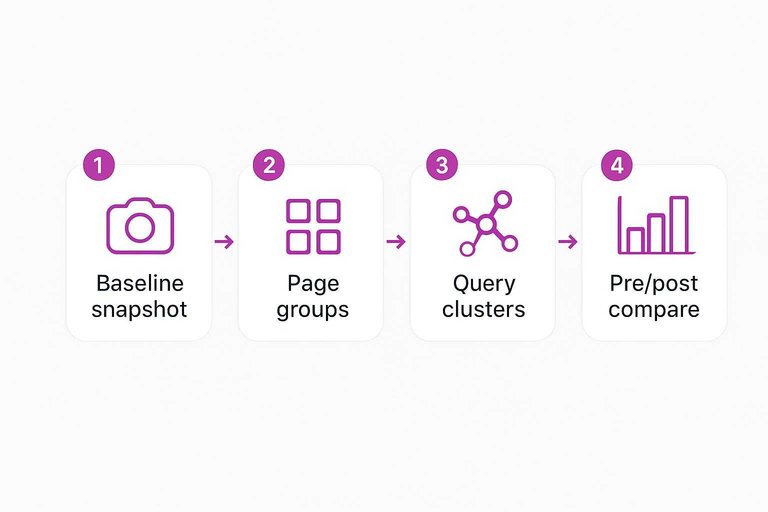
Measurement method
Use a method that survives scrutiny, not a screenshot that wins an argument. You want comparisons that control for page type and intent.
- Capture a baseline snapshot for pages, queries, and conversions.
- Build page groups by template, intent, and change type.
- Cluster queries by topic and funnel stage, then track them together.
- Track conversion cohorts by first-touch date and returning behavior.
- Compare pre/post with annotations for releases and external events.
When the structure is right, you can argue causality without overclaiming it.
Confidence scoring
ROI debates fail when every metric gets treated as equally “real.” A simple confidence score forces you to separate signal from noise.
Call it low confidence when only one tool agrees, or when seasonality can explain it. Call it high confidence when Search Console, analytics, and crawl logs point the same way, with fewer moving parts.
Score the evidence first, then decide how aggressively to forecast.
Case Study Teardown
Starting situation
The site had a small team and a slower publishing cadence than its competitors. It also ran on legacy templates that resisted change, so even simple SEO fixes queued behind bigger product work.
Intent mapping was the real fog. Keyword lists existed, but they were not tied to specific pages, funnels, or query intent, so pages competed with each other.
That’s how you end up “doing SEO” while the search engine sees mixed signals.
Key bets made
You needed a few moves that could compound, not a hundred tiny edits.
- Fix one crawl and rendering bottleneck
- Refresh pages already ranking and converting
- Build a tight intent cluster with internal links
- Standardize titles, headings, and templates
The bet was focus: fewer things shipped, but each one mattered.
What went sideways
Even good plans lose to process and priorities.
- Dev work slipped behind product deadlines
- Reviews stalled with too many approvers
- Stakeholders changed, priorities shifted
- Keywords targeted the wrong intent stage
When intent is off, execution speed doesn’t save you.
Lessons learned
ROI came from removing one technical constraint and then concentrating effort on pages that already had traction. New content helped most when it filled a clear intent gap and linked into the refreshed winners.
ROI did not come from broad keyword expansion, “SEO hygiene” tickets with no owner, or articles written before intent mapping was agreed. Next sprint, you’d lock intent-to-page mapping first, pre-negotiate dev slots, and cap reviewers to keep throughput real.
Fix the system first. Ideas are easy.
Run Your Own 90-Day Teardown
- Define the 90-day scope and ROI rule: pick the pages, markets, and conversion actions that count—and decide what “worth it” means before you start.
- Lock the baseline and guardrails: document starting benchmarks, tracking setup, and attribution assumptions so mid-sprint changes don’t rewrite the story.
- Execute the plan in phases: triage first, build next, amplify after, then stabilize—log every major change with dates.
- Track costs and benefits together: record hours/tools/content spend alongside leading indicators (indexing, CTR, rankings for target intents) and lagging outcomes (qualified leads, revenue influence).
- Score confidence and decide: separate signal from noise, capture what worked/failed, then choose to scale, pivot, or stop based on evidence—not hope.
Turn 90 Days Into Growth
A 90-day SEO plan only pays off when the work ships consistently—keywords, formatting, and publishing cadence without slipping as priorities shift.
Skribra generates and publishes SEO-optimized articles daily, so your 90-day work plan turns into measurable rankings and traffic—try the 3-Day Free Trial.
Written by
Skribra
This article was crafted with AI-powered content generation. Skribra creates SEO-optimized articles that rank.
Share: