May 31, 2026
·
10 min read
SEO tools vs manual SERP checks for competitor keywords
A clear comparison of SEO tools vs manual SERP checks for competitor keyword research—use a decision framework, understand data-quality gaps (personalization, volatility, sampling), optimize speed/workflow, and choose the right approach for cost, measurement depth, and scaling.


Are you trusting a rank tracker that doesn’t match what you see in Google—or wasting hours manually checking SERPs that change by the minute? Competitor keyword research gets messy fast when personalization, local packs, and constant volatility collide.
This comparison helps you choose the right approach for the job. You’ll learn when tools are the better bet, when manual checks are worth the effort, how to combine both into a reliable workflow, and what each method can (and can’t) measure as you scale.
Decision Framework
You’re choosing between automation and direct observation. One gives you coverage and repeatability, the other gives you nuance and trust. Think “dashboard numbers” versus “I saw the SERP with my own eyes.”
When tools win
Tools win when scale and consistency matter more than perfect SERP fidelity.
- Track thousands of keywords across many pages
- Refresh rankings daily or hourly
- Monitor multiple cities, countries, or languages
- Separate mobile and desktop visibility
- Export reports for clients and leadership
If your work repeats, automate it, then spend time on decisions.
When manual wins
Manual checks win when you need to understand the SERP, not just score it.
- Review a small, high-value keyword set
- Do one-off competitor discovery and mapping
- Inspect intent shifts and SERP features
- Validate suspicious rank jumps or drops
- Work within a tight budget
When the SERP is the product, screenshots beat charts.
Hybrid reality
Most teams do both because rankings are data and a live marketplace. Tools watch the trend line, but humans catch the “why,” like a new local pack, a forum takeover, or a sudden AI Overview. Use the tool to alert you, then confirm manually before you change content or strategy.
Decision questions
Answer these to pick your default workflow.
- How many competitor keywords must you track each month?
- How often do you need fresh rankings: weekly, daily, or intraday?
- How many locations and devices must you compare?
- What budget do you have for tools versus labor time?
- How much SERP context do you need beyond rank positions?
Your answers don’t pick a side, they set your mix.
Data Quality Differences
SEO tools and manual SERP checks both “measure rankings,” but they don’t measure the same SERP. One captures a repeatable snapshot. The other captures your lived, messy reality.
Personalization factors
Manual checks feel real because they are real. They’re also warped by your context, like searching “best running shoes” from your work laptop.
Tools usually standardize these variables:
- Location: set city or ZIP
- Device: desktop or mobile
- Language: interface and content
- History: clean profiles
- Logged-in state: usually logged-out
If you don’t control those inputs, you aren’t comparing competitors. You’re comparing environments.
Google also explains why results can differ based on signals like location, language, device, and recent interactions.
Feature visibility
SERP features change what “ranking” even means. Tools may track positions, but miss what steals attention.
- Ads: top slots, shopping units
- Local pack: map results, proximity bias
- AI overviews: instant answers, fewer clicks
- Videos: carousels, YouTube dominance
- People Also Ask: query expansion, intent hints
- Sitelinks: brand gravity, navigational bias
If a tool ignores a feature, your “#1” can still lose traffic.
Ranking volatility
Spot checks reward confidence, even when the SERP is unstable. Tool crawls smooth that noise, but can miss the moment your competitor surged.
Fresh indexing, news cycles, and intent shifts can reshuffle results within hours. A scheduled daily crawl may report “no change” while the top of the page flips twice. A single manual check can catch a spike, then trick you into thinking it’s a trend.
Treat rankings like a time series, not a verdict.
Sampling bias traps
Your conclusions are only as good as your sample. Most competitor keyword reads fail because the sample is lazy.
- Check only head terms
- Search during peak hours
- Use one browser profile
- Ignore mobile-only layouts
- Overreact to one screenshot
Fix your sampling first, or your competitor “strategy” becomes a weather report.
Speed and Workflow
Manual SERP checks feel fast for one query, especially when you need visual proof. Tools win when you need the same answer every week, across markets, without rebuilding the process.
The real difference is workflow gravity. One approach produces scattered evidence, the other produces a system you can route into decisions—often by leaning on resources to simplify SEO workflows.
Manual workflow
Manual checks work when you need high-trust snapshots and nuance. You pay for that trust in setup time and cleanup.
- Open incognito and disable signed-in personalization.
- Simulate geo and device with a VPN and user-agent switch.
- Capture screenshots of the full SERP state.
- Log ranking URLs and note SERP features present.
- Store evidence in a dated folder with links.
If you can’t reproduce it next week, it wasn’t a process.
Tool workflow
Tools turn competitor tracking into a repeatable pipeline. You trade some SERP “feel” for speed, history, and consistency.
- Create a project with your domain and core keyword set.
- Add competitor domains or specific competing URLs.
- Pick target locations and devices for tracking.
- Schedule daily or weekly rank tracking.
- Tag keywords by intent, funnel stage, or topic cluster.
Once it runs unattended, your job becomes acting on deltas, not gathering evidence.
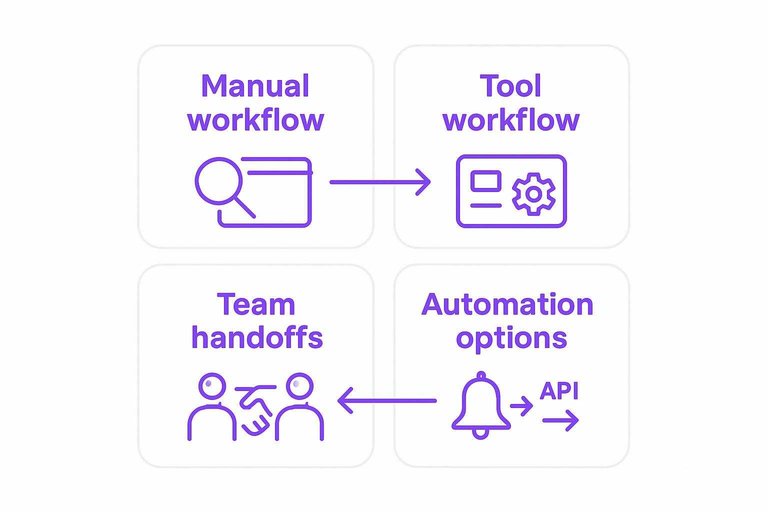
Team handoffs
Workflow breaks when people can’t see why a keyword moved or what changed on the page. Tools usually keep context closer to the data through annotations, comments, and version history.
A shared dashboard with notes like “Google added a map pack” travels better than a spreadsheet cell and three screenshots. Screenshots still help when you need to show layout shifts or odd SERP tests.
Collaboration isn’t about access. It’s about preserving decisions and the evidence behind them.
Automation options
Automation matters when you track lots of competitor keywords across markets. You want the system to raise its hand when something changes.
- Set alerts for rank and SERP feature changes.
- Pull data via API into your warehouse.
- Export to Looker or Google Sheets on a schedule.
- Email scheduled reports to stakeholders.
Manual work still shows up for SERP screenshots, edge-case verification, and “why did this happen” investigations.
Cost and Scaling
You’re paying for answers, not just software. The real question is how your cost-per-insight behaves when keyword counts and check frequency grow.
| Approach | Direct costs | Hidden costs | Cost-per-insight as you scale |
|---|---|---|---|
| Manual SERP checks | Staff hours | Context switching | Rises fast |
| SEO rank tracking tool | Monthly subscription | Setup, tagging | Falls with volume |
| Hybrid: tool + spot checks | Subscription + hours | Process discipline | Stable, best-fit |
| Outsourced manual tracking | Retainer or hourly | QA, rework | Unpredictable |
If you track weekly across hundreds of terms, manual becomes a tax, not a method.
What You Can Measure
SEO tools and manual SERP checks both tell you “who ranks,” but they differ on what you can measure reliably. Tools scale measurement across hundreds of keywords, while manual checks reveal the messy context behind each result. Use both when you need numbers and explanations.
Core metrics
Some metrics are stable in tools, while others need a human eye to confirm what actually changed.
| Metric | SEO tools | Manual SERP checks | Reliability notes |
|---|---|---|---|
| Rank position | Strong | Strong | Tools vary by location |
| Ranking URL | Strong | Strong | Canonicals can confuse tools |
| Title/snippet changes | Mixed | Strong | Rewrites need screenshots |
| SERP feature presence | Mixed | Strong | Features shift by device |
| Est. traffic/visibility | Strong | Weak | Depends on tool model |
Treat tools as your scoreboard and manual checks as your replay review.
Intent interpretation
Manual review is how you catch intent shifts before your dashboard does. You can see when the SERP flips from “how-to” to “best,” or from articles to product pages.
Look for patterns like:
- Content type winning: category pages, lists, tools, videos
- Query framing: “price,” “near me,” “template,” “alternatives”
- SERP composition: brands, forums, AI answers, local packs
- On-page promise: the exact angle in the title and snippet
Tools show movement; manual checks tell you what Google is rewarding today.
Competitive breadth
Tools help you find competitors you didn’t know you had. Manual checks usually start with your assumed rivals, which can be wrong.
With domain discovery, you can surface:
- Publishers ranking on informational terms
- Marketplaces and aggregators stealing clicks
- Niche sites that own long-tail clusters
- New entrants growing fast
If you only check the competitors you can name, you miss the ones taking your traffic quietly.
Change detection
Changes happen at the page level, not the domain level, and the fastest signal depends on what changed.
- New pages ranking for your terms
- Cannibalization across competitor URLs
- Content refreshes and republished dates
- Link spikes to a specific page
- Template changes affecting titles and snippets
Tools usually spot rank shifts first, but manual checks prove the cause in minutes—especially if you’re following a clear process like this step-by-step SEO guide.
Common Pitfalls
Wrong competitor keyword conclusions usually come from trusting a single view of the SERP. One tool chart or one “I googled it” moment can lie, especially when intent shifts and features crowd results.
Tool blind spots
Tools simplify reality, and that simplification breaks in predictable places. Know where they bend the SERP so you don’t build strategy on a mirage.
- Limited databases miss long-tail demand
- Data lag hides recent rank flips
- Keyword sampling overstates “coverage”
- Localization gaps blur city-level SERPs
- SERP features misclassified as rankings
Treat tool data as a map, not the terrain.
Manual blind spots
Manual checks feel “real,” but they’re easy to rig without noticing. One inconsistent browser setup can turn your notes into fan fiction.
- Tiny samples distort keyword patterns
- Confirmation bias favors your narrative
- Inconsistent setups change the results
- Poor documentation breaks trend analysis
If you can’t reproduce the check, you can’t trust the conclusion.
For practical ways to reduce bias in manual checks, see ways to depersonalize Google SERPs.
Validation checks
You need a quick routine that catches the biggest errors without creating busywork. A few deliberate checks beat hours of random peeking.
- Spot-check the top gainers and losers in the tool.
- Confirm the ranking URL and the page type manually.
- Re-run the query in a clean profile and a set location.
- Compare against a second source with different crawling.
- Log date, location, device, and observed SERP features.
Do this weekly, and you’ll spot “data problems” before they become strategy.
Best-Fit Scenarios
Pick based on scale and decision speed, not ideology. If your goal is “catch shifts weekly,” tools win; if it’s “verify one claim,” manual wins.
| Site size | Primary goal | Best approach | Why it fits |
|---|---|---|---|
| 1–20 pages | Validate one keyword | Manual SERP checks | See intent, ads |
| 20–200 pages | Find quick wins | Light tool + manual | Broaden, then verify |
| 200–2,000 pages | Track competitor moves | SEO tools | Trend lines, alerts |
| 2,000+ pages | Prioritize at scale | Tools + sampling | Automate, then spot-check |
| Any size | High-stakes decisions | Manual + tool cross-check | Reduce false signals |
When the cost of being wrong is high, triangulate with both and document the call.
Pick a Method, Then Prove It With a Quick Cross-Check
- Start with your decision questions: Do you need breadth and change detection (tools) or nuanced intent/feature visibility (manual)?
- Run the primary method at scale, but set a fixed validation cadence (e.g., 10–20 priority keywords per week) using the other method.
- Compare deltas by device, location, and SERP features; if the gap is consistent, adjust your tool settings or your manual protocol.
- Document the workflow for handoffs so your competitor keyword insights stay repeatable, auditable, and fast.
Frequently Asked Questions
- How can I find keywords of competitors for free without paid SEO tools?
- Use Google Search with your core terms and note recurring competitor pages, then expand with Google Autocomplete, People Also Ask, Related searches, and Google Search Console (if you rank on the same topics). For faster coverage, pair this with the free tiers of tools like Ahrefs Webmaster Tools or Semrush (limited queries).
- Is “find keywords of competitors” the same as copying their keyword list?
- No. Finding competitor keywords identifies themes and queries they win visibility for, while copying their list often includes irrelevant terms, branded queries, and low-intent keywords that won’t fit your site or goals.
- How do I verify a competitor keyword is actually driving traffic (not just ranking)?
- Check the keyword’s search intent and SERP layout, then validate with third-party traffic estimates (Similarweb) plus engagement signals like internal links, content depth, and updates on the ranking page. If you can, corroborate with your own GSC by targeting the query and watching impressions/clicks over 2–4 weeks.
- How often should I refresh competitor keyword research in 2026?
- Most sites should refresh monthly for core topics and quarterly for long-tail expansions. In fast-moving niches (news, SaaS, finance), a weekly check on priority keyword groups usually catches new pages and SERP shifts early.
- What should I do if my competitor keyword research shows different results in different locations or devices?
- Treat it as a segmentation signal: track keywords separately by country/state and by mobile vs desktop when intent or SERP features change. Use a neutral setup (incognito, logged out) and a rank tracker with location/device settings to keep comparisons consistent.
Turn Competitor Keywords Into Content
Once you’ve weighed tools vs manual SERP checks, the real challenge is turning competitor keyword insights into consistent, publish-ready pages without bottlenecks.
Skribra converts keyword opportunities into daily SEO-optimized articles with metadata, images, and WordPress publishing—plus a backlink exchange network to help you scale faster. Start with the 3-Day Free Trial.
Written by
Skribra
This article was crafted with AI-powered content generation. Skribra creates SEO-optimized articles that rank.
Share: