January 29, 2026
·
12 min read
SEO Traffic Growth Explained for Low DA Businesses
An explainer on how low-DA businesses can grow SEO traffic predictably—map constraints and flywheels, choose queries within reach, ship durable quick wins, scale programmatically with guardrails, and measure with impressions/CTR plus crawl and index health.


If your domain authority is low, SEO can feel like shouting into a stadium where Google already knows the winners. You publish, you wait, and the rankings barely move—so you assume you “need more links” or “more content,” without knowing what would actually change the outcome.
This explainer breaks down the mechanics behind traffic growth for low-DA sites: what you can realistically rank for, which on-page upgrades move the needle fastest, how to scale pages without indexing blowback, and what to measure so you can predict growth before rankings catch up.
Growth Mechanics Map
SEO growth for low-DA sites is compounding demand capture with three hard limits: authority, crawl, and intent matching. You don’t “create demand.” You earn the right to show up for it, query by query.
Constraints First
Low DA sites lose before the click. Google sees weaker trust, slower discovery, and thinner link equity, so your best pages can underperform.
You’ll feel it in four places:
- Trust signals: sparse mentions, weak brand queries, thin author credibility.
- Indexation friction: orphan pages, crawl waste, slow recrawls.
- Limited link equity: few strong links, weak internal distribution.
- Update fragility: rankings swing when systems recalibrate.
Fix constraints early. Otherwise every new page becomes a lottery ticket.
The Growth Flywheel
Growth happens when one win makes the next win easier. You’re building a system that turns content into signals.
- Expand topic coverage to widen query reach
- Tighten internal links to push equity
- Improve CTR to earn more clicks
- Earn backlinks from visible, useful pages
- Increase engagement to reduce pogo-sticking
If two parts move together, you’re building a flywheel, not posting blogs.
Traffic Math Model
Traffic is a multiplicative model, not a vibe. For low-DA sites, authority mostly decides which impressions you can access.
Use this mental equation: pages × impressions × CTR × conversions. More pages raise your surface area, but authority shifts you into harder terms with bigger demand.
Work the easiest multiplier first. For low DA, that’s usually impressions from reachable intent.
Query Reach Boundaries
Low-DA sites don’t fail because SEO is “hard.” They fail because they aim outside their current reach.
Your reach is set by competition, intent, and trust signals. Those limits move when your signals compound—especially when you follow a clear SEO guide for growth.
SERP Competition Shapes
Head terms are short, high-demand queries like “accounting software.” Chunky mid-tail queries add constraints like “accounting software for contractors,” and long-tail queries get specific like “how to set up job costing in QuickBooks.”
DA matters most on head and chunky mid-tail, because the winners usually have brand demand, link depth, and constant engagement. On low-intent long-tail, DA often matters less because Google just needs a clean answer, like “what is net 30 payment.”
Your first wins come from specificity, not bravado.
Intent-Fit Thresholds
Even when your content matches intent, you can still miss the ranking threshold.
- SERP is dominated by brands users already trust
- Google shows features that absorb clicks
- Results prefer “tools” over articles
- Query implies expertise you haven’t signaled
- Competitors match intent with stronger proof
Treat “good content, no rankings” as a trust problem, not a writing problem.
Authority Expansion Levers
Your reach expands when Google sees repeated proof, not a one-off spike. Think of it like raising your “allowed difficulty” by stacking signals around a topic.
Topical density comes from covering the cluster, not polishing one post. Earned links move the ceiling fastest, especially from relevant sites, not “SEO” sites.
Entity reinforcement happens when your brand, people, and product are consistently described the same way across the web. Internal PR pages like “About,” “Case Studies,” “Pricing,” and “Reviews” turn anonymous content into a company Google can trust.
Build the proof system first, then aim higher.
Fast Wins That Stick
You want session growth without tripping quality flags or eating your own rankings. The move is disciplined prioritization, not content volume, and it works even with low DA.
Low-DA Keyword Filtering
Pick fights you can win, then win them fast. You’re filtering for SERPs where Google already tolerates “smaller” sites.
- Check the top 10 for 3+ weak domains, not just one outlier.
- Favor SERPs with forums or UGC ranking, because intent is flexible.
- Scan for thin results, like 400-word pages or templated copy.
- Avoid SERPs packed with ads, maps, and shopping blocks.
- Confirm you can match the format: list, tool, or direct answer.
If you see three or more weak results, you’re looking at a crack you can widen.
Refresh vs New Build
You’re deciding where to place your next bet: improve an existing asset or open a new lane. The right call depends on intent drift, link equity, and how “settled” the rankings look.
If the page still matches intent and has links, update it and keep the URL. If two pages split the same intent, merge them, then 301 the weaker one. If intent changed and the old URL is misleading, redirect it to the closest match. If the SERP wants something you don’t have, ship a net-new page with a clear angle, like “pricing,” “templates,” or “examples.”
Your goal is one strong page per intent, not five pages “kind of” answering it.
Internal Link Sculpting
Internal links are your low-DA force multiplier, because you control them. Use patterns that concentrate authority and make crawlers care.
- Build hub-spoke clusters around one primary page.
- Reinforce breadcrumbs to repeat hierarchy signals.
- Use partial-match anchors, not exact-match spam.
- Place links high on the page, not buried in footers.
Do this right and you’re not “adding links.” You’re changing crawl priority. (See Google’s SEO link best practices for internal linking and anchor text guidance.)
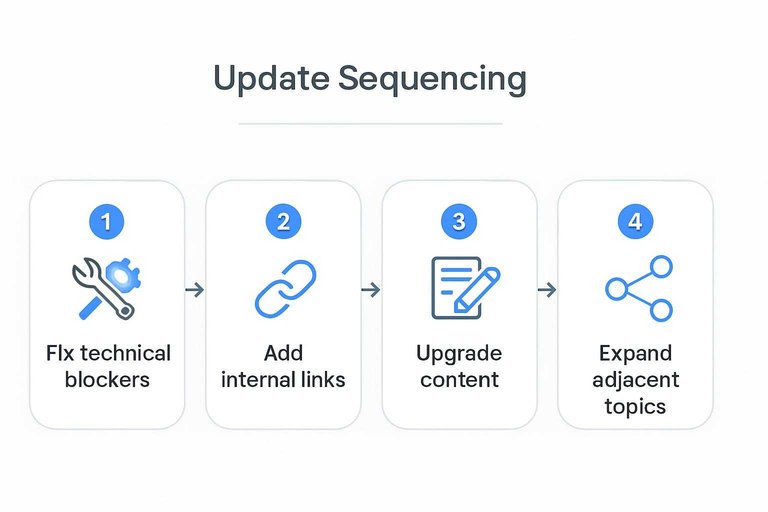
Update Sequencing
Sequence beats hustle, because Google recrawls in waves. You want each wave to land on a cleaner site.
- Fix technical blockers first, like noindex, canonicals, and broken templates.
- Add internal links next, so crawlers find upgraded pages faster.
- Upgrade content after, once discovery and indexing are stable.
- Expand into adjacent topics last, using new internal paths.
- Time releases before expected recrawls, then watch logs and GSC.
Ship changes in the order Google can reward them, not the order your team prefers.
Programmatic Scale Safely
Programmatic pages can grow traffic fast, even with low DA, because you win long-tail intent at volume. You also create risk fast, because “templated + thin” looks identical to spam at scale.
Template Differentiation
Unique value has to be visible on the page, not implied in your database. If two URLs read like the same answer, Google will treat them as one, or as none.
Hard rules you can enforce in templates:
- Add page-specific data blocks: prices, specs, availability, or calculated ranges.
- Add real comparisons: “A vs B” tables using attributes that change per page.
- Add local constraints: delivery windows, service radius, permits, or climate limits.
- Add screenshots or photos: your UI, your reports, your results, not stock.
- Add a workflow: “How to do X in your tool” with page-specific steps.
If your template cannot produce one of those per URL, don’t ship that URL.
Indexing Guardrails
You want Google to crawl the pages that can win, not the pages that merely exist. Guardrails keep your crawl budget pointed at money keywords, not filter sludge.
- Noindex low-demand pages until they earn impressions
- Canonical near-duplicates to the strongest primary URL
- Block or parameter-handle infinite facets and sorts
- Prioritize XML sitemaps by revenue and search demand
- Cap internal links to filtered combinations and empty states
If Google spends time on your faceted junk, your real pages wait in line.
SERP Cluster Testing
Programmatic SEO works when you scale what the SERP already rewards. Small-batch tests tell you which clusters have traction before you flood the index.
- Launch 10–30 URLs in one tight intent cluster.
- Track impressions, CTR, and average position for 14–21 days.
- Improve titles and above-the-fold value where impressions exist.
- Prune or noindex URLs with no impressions after fixes.
- Expand only the clusters showing early lift.
Your best signal is not rankings on day one. It’s “Google is willing to show you.”
Content Upgrades That Move SERPs
Ranking jumps come from clearer relevance and higher believability, not longer pages. Think “upgrade the answer,” like adding a decision rule or constraint, not adding 600 filler words.
Information Gain Signals
Google rewards pages that teach something specific, not pages that echo the top results. Add the parts competitors avoid, like “works for B2B only” or “fails when traffic is under 1,000 visits.”
Original observations: what changed, what broke, what surprised you. Constraints: “only if your CMS supports schema” or “only for non-branded queries.” Edge cases: what to do when intent splits or SERP features steal clicks. Decision tables: “if X, do Y,” in plain language.
That’s how you stop being “another guide” and become the reference.
Snippet and Feature Capture
You want to win the SERP layout, not just the blue link. Build blocks that answer fast, then support deeper reading.
- Lead with a 40–60 word definition
- Add a 3–5 step process block
- Include one tight comparison table
- Answer 5–8 PAA questions verbatim
- Use labeled images and short captions
If you don’t format the answer, someone else will own the feature.
Trust Modules
Low DA can still rank when your page proves it knows what it’s saying. Put the proof near the claim, like “measured across 42 pages” or “validated in Search Console.”
Use visible author credentials, primary-source citations, and clear policies. Add case metrics, screenshots, and a short “how we know” section that explains your method. Even one line like “sample size: 18 queries, 90 days” changes how your page reads.
Trust isn’t a vibe. It’s a module you can ship.
Links Without the Mirage
Low-DA sites don’t lose because they lack links. They lose because they chase the wrong ones. Your job is to earn authority where it compounds, not where it decorates.
Link Targets That Matter
You want links that change rankings, not links that look good in a report. Aim at pages that can absorb authority and pass it forward, like a clean hub page.
One practical rule: earn links to a hub, then route visitors and internal links to the money page. Another: watch Search Console for pages with rising impressions, then push those over the line with links. Skip dead-end assets like one-off infographics that never rank and never lead anywhere.
A link is only “good” if it strengthens a path to revenue.
Digital PR as Distribution
Digital PR works when you treat it like distribution, not begging. You’re giving a journalist a usable angle that fits their beat.
- Pull a dataset: product usage, pricing, benchmarks, or outcomes.
- Find a sharp claim: “Most teams overspend by 23%.”
- Package proof: chart, methodology, and one quotable sentence.
- Build a tight list: writers already covering that topic weekly.
- Pitch the story, not your company, with a clean link target.
If your pitch doesn’t create a headline, it won’t create a link.

Internal Authority Recycling
You already have equity sitting in old pages. Move it into the cluster you’re trying to grow.
- 301 redirect retired pages into the closest live hub
- Consolidate overlapping posts into one stronger canonical page
- Re-point internal links from outdated URLs to your target hub
- Add “best next step” links from high-traffic legacy pages
- Update anchors to match the cluster’s primary terms
Treat old URLs like spare parts, not nostalgia. (For canonical and consolidation options, see Google’s guide to consolidate duplicate URLs.)
Measurement That Predicts Growth
You can’t wait for rankings to “settle” when your DA is low. Use signals that move first, like impressions, CTR shape, and index coverage.
Example: a page can jump from 50 to 500 impressions before it cracks page one.
Impressions Over Ranks
Average position lies when you have mixed intent and volatile SERPs. Impressions tell you your reach expanded, even when rank looks flat.
Break impressions down by cluster, page type, and intent. Watch for a cluster’s impressions rising while clicks lag, like “email outreach templates” growing faster than “cold email subject lines.”
If impressions climb in one slice, you found a growth lane worth doubling down on.
CTR Curve Diagnosis
Your CTR curve shows whether you earned attention or just got shown more. Query-level deltas reveal what changed before traffic does.
- Compare CTR vs position by query
- Flag title-to-intent mismatches
- Separate brand vs non-brand CTR
- Note SERP feature crowding effects
- Track deltas after snippet edits
When CTR drops at the same rank, the SERP changed or your message got weaker.
Crawl and Index Health
Indexing problems cap growth, no matter how good your content is. You want to catch crawl waste and template errors before they stall impressions.
- Watch crawl spikes and correlate to deploys.
- Track “discovered, not indexed” by template and directory.
- Inspect patterns in “crawled, not indexed” for thin or duplicate signals.
- Fix canonical, robots, and internal link gaps on affected templates (use this checklist for streamlining SEO content to standardize what gets fixed).
- Measure impression recovery in 7–21 day windows.
Tie every fix to an impression rebound window, or you’re just doing busywork.
Common Low-DA Traps
You can publish weekly and still get flat traffic if your SEO system rewards activity, not outcomes.
| Trap | What it looks like | Root cause | Fix |
|---|---|---|---|
| Keyword “copycats” | Same SERP, same angle | No unique POV | Add original data |
| Blog-only strategy | No links earned | No linkable assets | Build tools/pages |
| Intent mismatch | Visits, no wins | Wrong query intent | Map intent first |
| Over-optimizing | Stuffed headings | Chasing checklists | Write for clarity |
| Thin internal links | Orphan posts | No topic structure | Add hubs & paths |
If you see two or more of these, stop publishing and redesign your funnel first.
Build a 30‑Day Growth Sprint You Can Repeat
- Set your constraint and target: choose one conversion goal, estimate traffic needed, and define a weekly content output you can sustain.
- Pick reachable queries: filter for low-DA-friendly SERPs and intent-fit keywords, then group them into tight SERP clusters.
- Ship durable wins first: refresh the best candidates, add internal links to sculpt authority, and sequence updates from highest-impact URLs outward.
- Scale carefully: launch templates only after cluster testing, add indexing guardrails, and differentiate pages beyond swapped keywords.
- Measure leading signals: watch impressions, CTR shifts, and crawl/index health; then recycle internal authority and pursue links that support the pages that already show demand.
Frequently Asked Questions
- Does domain authority still matter for SEO traffic growth in 2026?
- Usually, yes—authority-related signals still correlate with how quickly and how broadly you can rank, especially for competitive queries. Low-DA sites can still grow by focusing on high-intent long-tail topics and building trust signals over time.
- How long does SEO traffic growth take for a low-DA site to show meaningful results?
- Most low-DA sites see early movement in 4–8 weeks (indexation, impressions, a few long-tail rankings) and meaningful traffic growth in 3–6 months with consistent publishing and internal linking. Faster gains typically come from targeting low-competition, high-intent queries and improving existing pages.
- What are the best metrics to track SEO traffic growth besides keyword rankings?
- Track Google Search Console impressions, clicks, average position by page group, and query count in the top 3/10/20, plus crawl stats and index coverage. In GA4, watch organic sessions, engaged sessions, and conversion rate from organic to confirm growth is producing outcomes, not just visits.
- Can I get SEO traffic growth without building backlinks?
- Yes for many long-tail and local queries, especially if you nail intent, internal linking, and topical coverage, but growth usually plateaus without some authority lift. Even a small number of relevant links (industry sites, partners, digital PR) often unlocks more competitive terms.
- Should I update old content or publish new content to drive SEO traffic growth faster?
- Update content when a page already has impressions but ranks around positions 8–30, because small relevance and trust upgrades can move it onto page 1 quickly. Publish new content when you’re missing entire query clusters or need more entry points to grow impressions and internal link paths.
Grow SEO Traffic on Low DA
If low authority is capping your query reach and causing inconsistent wins, Skribra ships daily SEO-optimized content, safe scale, and real link support—start with a 3-day free trial.
Written by
Skribra
This article was crafted with AI-powered content generation. Skribra creates SEO-optimized articles that rank.
Share: