May 11, 2026
·
Updated July 28, 2026
·
10 min read
Topical authority SEO vs keyword SEO for blogs
A clear comparison of topical authority SEO vs keyword SEO for blogs—define both approaches, weigh speed-to-traffic and planning effort, score them head-to-head on risk/resilience, and match each to your monetization and intent goals.

If you’ve ever watched a perfectly written post sit at page three, you already know the problem: “good content” isn’t a strategy. The real question is whether you should build a tight topic cluster that signals expertise—or chase individual keywords that can rank fast.
This comparison helps you choose without guesswork. You’ll see how each approach works, what “winning” looks like, where traffic shows up first, and which option better fits your time, tools, and business model—affiliate, ads, or product-led growth.
Quick verdict map
Topical authority SEO builds depth across a subject, using clusters, entities, and internal links to prove you’re “the” resource. Keyword SEO aims for page-level wins, where each post targets one query like “best email popups” and optimizes hard.
If you need traction fast, keyword SEO usually wins early. If you need durable growth, topical authority usually wins later.
Two approaches defined
Topical authority SEO is coverage-first: you publish a cluster like “cold email,” then fill every key subtopic and entity. Think “deliverability,” “SPF/DKIM,” “open rates,” and “follow-ups,” all interlinked.
Keyword SEO is query-first: you pick a single term, publish one page, and optimize title, headers, intent match, and on-page basics. It’s the “one page, one job” model.
When your SERP is crowded, the difference is depth signals versus precision signals.
Best for whom
Pick based on your stage and your ability to publish consistently.
- New blog: keyword SEO for early wins
- Growing blog: hybrid, leaning topical clusters
- Established blog: topical authority for moat
- Small team: keyword SEO with strict prioritization
- High cadence team: topical authority with planned clusters
If your cadence is shaky, topical plans stall and keyword wins keep compounding.
Decision in 60 seconds
Answer three questions and commit for the next 90 days.
- Do you need traffic in 4–8 weeks to prove ROI?
- Can you publish and update 2–4 related posts per month per topic?
- Does your niche shift fast, like AI tools or crypto regulation?
Your answers tell you whether you need quick targets, a coverage system, or a volatility hedge.
What ‘winning’ means
You’re comparing speed to first results, downside risk, and how well the approach scales with your team. You’re also judging link dependence, conversion intent match, maintenance load, and whether results are easy to attribute.
Topical authority often wins on scalability and resilience. Keyword SEO often wins on measurement clarity and faster feedback loops.
Pick the criteria that match your constraints, not the ones that sound impressive.
How each works
Topical authority and keyword SEO are two different ranking engines you can feed. One builds subject-level trust across many URLs. The other tunes one URL to match one search demand.
Topical authority mechanics
Topical authority comes from consistent coverage that makes your site the safest bet on a subject. Think “running injuries” covered as a system, not a lucky post.
Clusters do the work:
- A hub page frames the topic and links outward.
- Spoke posts answer sub-questions, like “shin splints vs stress fracture.”
- Internal links confirm relationships and guide crawlers.
- Entity depth shows you understand the real things in the topic.
- Breadth plus updates signal you stay current.
When Google sees connected, maintained coverage, it treats your site like a reference, not a one-off.
Keyword SEO mechanics
Keyword SEO wins by matching a specific query pattern with a specific page. You pick a term like “best budget standing desk” and build one URL to satisfy that SERP.
The mechanics are narrower:
- Keyword research finds demand and intent.
- SERP matching copies the format Google already rewards.
- On-page basics align title, headings, and sections.
- Backlinks raise the page’s competitive ceiling.
- Iteration improves CTR, depth, and freshness.
You’re not proving you own the whole topic, you’re proving this page deserves this result.
Content architecture choices
Your structure decides whether Google sees a library or a pile of articles. Pick an architecture that matches how you plan to win.
- Hub-and-spoke: best for topical authority across a subject.
- Pillar page: best for consolidating competitive subtopics on one URL.
- Standalone posts: best for isolated keywords and fast experiments.
- Hybrid clusters: best when topics and keywords overlap.
If your links don’t imply relationships, you’re betting on coincidence. For a deeper breakdown of how to structure pages and links, see this practical SEO guide.
Common misconceptions
“Topics replace keywords” is false because topics are made of queries. Google still ranks pages, not vibes.
“More posts equals authority” fails when posts don’t connect or add new entities. Ten thin articles on “email marketing tips” won’t beat one maintained cluster.
“One post can rank for everything” breaks at intent boundaries. A single URL can’t satisfy “what is,” “best,” and “buy” equally well.
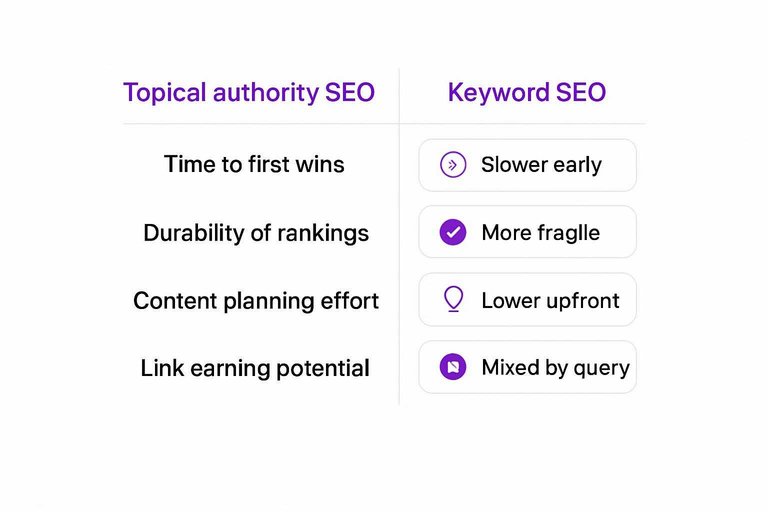
Head-to-head scoreboard
You’re choosing between a topic-first system and a query-first tactic. Use this scoreboard to pick what fits your blog’s constraints.
| Criteria | Topical authority SEO | Keyword SEO | Winner + note |
|---|---|---|---|
| Time to first wins | Slower early | Faster early | Keyword: quicker traction |
| Durability of rankings | Strong compounding | More fragile | Topical: fewer resets |
| Content planning effort | Higher upfront | Lower upfront | Keyword: simpler backlog |
| Link earning potential | Higher naturally | Mixed by query | Topical: clearer assets |
If you need wins in weeks, go keyword-first. If you want years of growth, build the topic map. For an official view of what resilient performance looks like, see Google’s guidance on helpful, reliable, people-first content.
Speed to traffic
New blog reality
New blogs start with thin trust, so Google tests you in the shallow end first. You feel it as a “sandbox” phase, even if nobody admits it exists.
For months 0–6, keyword SEO is usually faster because you can target low-competition queries with clear intent. Topical authority work still matters, but it tends to pay later unless you already have distribution or links.
Low-competition plays
Early traffic comes from keywords where the SERP is weak and intent is narrow. You want queries that look like someone asking a coworker, not a research paper.
- Long-tail questions with specific constraints
- Problem queries with obvious fixes
- Comparison terms with clear alternatives
- Local or geo-modified queries
If your post answers the exact query, you can rank before you’re “trusted.”
When topics catch up
Clusters start compounding once you have enough connected pages for Google to see a pattern. Internal links get stronger, rankings broaden, and refreshes start lifting multiple posts.
That tipping point often shows up when you own a subtopic end-to-end and updates reliably improve pages. After compounding kicks in, topical authority SEO becomes the winner for sustained growth.
Clear winner call
Speed winner for early clicks: keyword SEO. Use topical authority first only under two conditions.
- If you already have strong backlinks or brand searches.
- If your niche has few standalone keywords and needs depth to rank.
- Otherwise, ship keyword-targeted posts for 3–6 months.
- Then build clusters around what starts ranking.
You’re buying time with keywords, then cashing in with topics.
Content planning load
Research time cost
Topical authority planning starts with coverage: entities, subtopics, and “what’s missing” across the whole site. Keyword SEO planning starts with a list: pick terms, check difficulty, and group by intent.
For a solo blogger, keyword list building usually wins on time. You can ship with “best X for Y” keywords today, instead of mapping a whole knowledge graph first.
Editorial workflow
The real load shows up after research, in how you keep publishing consistent.
- Topical authority workflow: build topic map, write cluster briefs, enforce internal links, schedule refreshes
- Keyword SEO workflow: pick keyword, write SERP-led brief, publish, update if rankings drop
- Topical authority QA: check coverage gaps, entity mentions, cannibalization, hub integrity
- Keyword SEO QA: check intent match, on-page basics, title test, snippet format
- Refresh cadence: topical runs on calendar; keyword runs on performance
Topical authority is more operationally demanding, because it punishes inconsistency across many connected posts. If you want a repeatable process, use this checklist for streamlining SEO content. Google also emphasizes that strong site structure matters—see its note on the importance of link architecture.
Tooling needs
Keyword SEO can run on basics: Google Search Console plus one keyword tool, then a simple sheet. Topical authority pushes you toward topic maps, entity extraction, internal link auditing, and periodic content audits to find “thin” nodes.
Topical authority is more tool-dependent, because you can’t manage coverage with intuition at scale.
Risk and resilience
Keyword-first blogs often look strong until an update changes the scoring rules. Then the “perfectly optimized” page turns into a liability.
Topical authority work spreads risk across a cluster, builds consistent intent coverage, and looks more like helpful publishing than ranking hacks. Safer. Boring. Durable.
Algorithm update exposure
Topical authority aligns better with “helpful content” because it proves coverage, intent satisfaction, and real-world depth. It also supports E-E-A-T signals through author consistency, credible citations, and internal references that look like expertise.
Keyword SEO can still win, but it often leans on template patterns, exact-match targeting, and aggressive on-page cues. That’s the line that gets crossed.
If you want resilience, build topical authority and let keywords serve the cluster, not the other way around.
Cannibalization risk
Overlap happens when you publish fast without a map. It’s more common in keyword SEO, but clusters can also collide.
- Target near-identical intents with different keyword phrasing
- Publish “best X” and “X guide” without distinct angles
- Create multiple pages for the same funnel stage
- Forget internal links, so Google picks randomly
- Add “SEO rewrites” that duplicate meaning
Map one primary intent per URL, then link variants into the canonical page. That’s the difference between coordination and coincidence.
Backlink sensitivity
Links become the bottleneck when you compete in SERPs where everyone has authority and citations. In those spaces, the best page without links is still invisible.
With few links, keyword SEO usually depends on picking low-competition terms and nailing on-page relevance. Topical authority can win earlier because internal links, breadth, and behavioral satisfaction stack signals across many pages.
If you’re link-poor, topical authority is the safer bet because it builds momentum without begging for backlinks.
Conversion and intent
Affiliate/product intent
Revenue-first blogs live and die on commercial SERPs. Those are the “best X for Y,” “X vs Y,” and “X review” queries where readers already want to buy.
Keyword SEO wins here because you can target BOFU pages directly, map them to offers, and measure earnings per click fast. Topical authority helps later, but it usually starts with softer intent and longer payback.
Ad and newsletter growth
Ads and newsletters need volume plus habit. You want repeatable content that earns clicks, then turns visits into return visits.
- Keyword SEO: trend-chasing posts that spike pageviews
- Keyword SEO: “what is” explainers that rank long-tail
- Topical authority: evergreen hubs that pull many queries
- Topical authority: series content that builds return visits
- Topical authority: internal links that push subscriptions
Topical authority wins for scale because it compounds through clusters, not single posts.
Full-funnel coverage
Buyers rarely land on your BOFU page first. They start with a problem, then narrow options, then pick a tool.
Topical clusters support that path naturally: TOFU guides (“why your sleep is broken”), MOFU comparisons (“melatonin vs magnesium”), and BOFU pages (“best magnesium glycinate brands”). Topical authority wins for long-term LTV because it owns the journey, not just the last click.
Choose your lane, then commit for 90 days
Pick keyword SEO if you need earlier traction from low-competition queries and you can stay disciplined about targeting one intent per URL. Pick topical authority SEO if you’re building a durable moat in a niche and can publish consistently within a structured content architecture. Whichever you choose, align your planning, internal linking, and updates to that model for the next 90 days—most “it didn’t work” outcomes come from mixing both halfway.
Frequently Asked Questions
- How do I build topical authority SEO without writing hundreds of posts?
- Start with 10–20 tightly related articles that cover the core subtopics end-to-end, then expand using a gap list from Google Search Console and tools like Ahrefs or Semrush. A smaller, complete cluster with strong internal links usually beats a large set of loosely related posts.
- How can I measure topical authority SEO on my blog?
- Track growth in non-branded impressions and the number of ranking keywords across a topic cluster in Google Search Console, plus improvements in average position for related queries. In Ahrefs/Semrush, watch “topical” keyword footprint and competing pages within the same cluster.
- How long does topical authority SEO take to show results for a new blog?
- Most blogs see early movement in 6–12 weeks once a cluster is published and indexed, with more reliable traffic gains in 3–6 months. Faster results usually require consistent publishing (1–3 posts/week) and strong internal linking across the cluster.
- Do I need backlinks for topical authority SEO to work?
- You usually need some links to compete, but topical authority can reduce the number required by strengthening relevance and internal PageRank flow. For low-to-medium competition topics, a handful of quality links to key hub or “money” pages often moves the needle.
- Should I use a pillar page and topic clusters for topical authority SEO, or is that optional?
- A pillar-and-cluster structure is often the easiest way to signal coverage because it creates clear internal link pathways and consolidates intent. It’s optional, but most blogs get cleaner architecture and faster crawling when they use a hub page plus supporting articles.
Build Topical Authority Faster
Your verdict map and scoreboard make the trade-offs clear—but turning topical coverage into consistent publishing still takes time, planning, and execution bandwidth.
Skribra generates SEO-optimized articles daily, helps map clusters, and publishes to WordPress automatically so you can compound topical authority—plus you can start with a 3-Day Free Trial.
Written by
Skribra
This article was crafted with AI-powered content generation. Skribra creates SEO-optimized articles that rank.
Share: