February 19, 2026
·
Updated August 20, 2026
·
13 min read
Organic Traffic Case Study: 90-Day Growth Breakdown
An organic traffic case study that shows how to define “growth” and evaluate progress over 90 days — baseline and decision criteria, measurement setup (GA/GSC/events), the metrics that actually matter, a practical 90-day execution plan, and a week-by-week framework with a real page-level example.

If you’ve ever launched “SEO improvements” and then stared at a noisy traffic chart, you already know the hard part isn’t doing the work—it’s proving what changed and why.
This case study breaks a 90-day organic growth effort into clear definitions, clean measurement, and weekly actions you can replicate. You’ll see how to set a baseline, choose the right leading indicators, tie SEO activity to business intent, and interpret page-level outcomes without over-claiming or guessing.
What “growth” means
In a 90-day window, organic traffic “growth” is less about a spike and more about evidence of repeatable lift. You’re looking for a clear story: pages get discovered, rankings stabilize, and the right visits move closer to revenue. Viability is when content, SEO, and demand line up enough that continuing investment feels rational, not hopeful.
Business context
Organic growth only matters relative to how your site makes money and how visitors convert. An affiliate blog, a local service site, and a B2B SaaS doc center can all “grow” while producing very different business value.
Define your conversion path and constraints up front:
- Monetization: ads, affiliate, lead gen, subscriptions, or product sales.
- Conversion path: one visit, many visits, or sales-assisted by email and retargeting.
- Constraints: dev bandwidth, compliance, brand approvals, and content expertise.
If you can’t describe success in one funnel diagram, traffic numbers will mislead you.
Starting baseline
Before you claim “growth,” you need a baseline that isn’t lying to you. These checks prevent you from optimizing for tracking bugs or seasonal noise.
- Confirm indexation and canonicalization match your intended pages.
- Validate analytics tags, consent mode, and attribution settings.
- Note seasonality, launches, and marketing campaigns during the window.
- Split brand vs non-brand queries and landing pages.
- Inventory existing content: winners, losers, duplicates, and thin pages.
If baseline is fuzzy, every win is arguable.
90-day scope
Ninety days is enough time to remove friction and surface buried value. It’s rarely enough time to publish your way out of weak demand or build deep authority from scratch.
Realistic moves in 90 days include technical hygiene, content refreshes, internal linking improvements, and small experiments on titles and formats. You measure fast feedback loops, not a finished moat.
Treat this window like a viability test, not a victory lap.
Decision criteria
Use a simple rubric so “keep going” is a decision, not a vibe.
| Criterion | Leading indicators | Cost to continue | Go/No-go |
|---|---|---|---|
| Content viability | Impressions rising | Writer time | Go if repeatable |
| SEO viability | Indexing improves | Dev time | Go if stable |
| Demand fit | Non-brand clicks grow | Patience | Go if qualified |
| Operational fit | Process gets faster | Team attention | Go if sustainable |
| Opportunity cost | Other channels paused | Budget focus | No-go if painful |
If the leading indicators move but effort stays chaotic, fix operations before scaling.
Measurement setup
Before you interpret organic traffic movement, lock down your tracking stack. Use a clean analytics platform (GA4 or similar), Google Search Console, and a lightweight dashboard or spreadsheet for shared reporting.
Trustworthy data is less about “more tools” and more about fewer surprises. If your totals disagree or your channels drift, you’re debugging noise, not growth—especially if you’re following a broader playbook like this SEO guide for measurement basics.
Analytics hygiene
Clean inputs first, because every downstream chart inherits your errors.
- Filter bot and referral spam at the source where possible.
- Validate tagging on key templates, then spot-check critical journeys.
- Confirm channel grouping rules match your definitions of “organic.”
- Reconcile key totals between tools using the same date range.
Once numbers line up, you can argue about performance instead of plumbing.
Search Console use
Search Console is for demand signals, not conversion truth.
Segment by query and page, then separate branded from non-branded so the brand doesn’t mask content performance.
Skip “average position” as a headline metric, because a few high-impression terms can distort it.
Treat GSC like a diagnostic lens, and you’ll spot opportunities before analytics shows traffic.
Event tracking
Events connect traffic to intent, so you can measure quality, not just visits.
- Lead submit
- Signup complete
- Add to cart
- Scroll depth thresholds
- Micro-conversions like pricing clicks
If events are stable, you can tie SEO work to business behavior without guesswork. (See GA4’s recommended GA4 events to keep naming and intent consistent.)
Reporting cadence
Weekly reviews catch leading indicators like impressions, indexation, and page-level clicks.
Monthly reviews handle lagging outcomes like qualified leads, revenue-adjacent events, and content cohort performance.
Annotate every release, migration, template change, and campaign launch, even if it “shouldn’t matter.”
Your best analysis starts with a timeline, not a trend line.
Metrics that matter
In a 90-day SEO case study, you need metrics that show direction, not “good” numbers. Map each metric to a stage of impact, then read it like a diagnostic. This is also where having a consistent, structured publishing workflow (for example, using a platform like Skribra to keep SEO basics like keywords, meta descriptions, and formatting standardized) makes the signals easier to interpret—because you’re comparing performance, not fighting inconsistent inputs.
Demand signals
Impressions tell you whether Google is testing your pages for more searches. They move before clicks, so they’re your earliest visibility hint.
Watch query mix and topic coverage alongside impressions:
- Query mix: branded vs non-branded, head vs long-tail, informational vs commercial
- Topic coverage: how many distinct themes your pages appear for
- Page-to-query fit: whether impressions land on the intended page
If impressions rise but the mix gets less relevant, you’re growing noise, not demand. A practical guardrail is keeping topic briefs and on-page SEO elements consistent across new posts, so you can tell whether impressions are expanding in the themes you actually meant to target—not just wherever Google can place you.

Ranking movement
Rankings are messy in 90 days, so track patterns, not single keywords.
- Shift in rank distribution buckets
- Page-level winners and losers
- Volatility by template and topic
- Cannibalization across similar pages
When “up” and “down” happen together, you’re usually looking at internal competition or intent mismatch. This is easier to diagnose when your content templates and internal targeting rules are repeatable—otherwise, you can mistake inconsistent page structure (or overlapping keyword targets) for “algorithm volatility.”
Click behavior
CTR only makes sense in context, because the SERP is part of your funnel. A drop can be a ranking gain with new features stealing attention.
Interpret CTR changes against what users actually see:
- SERP features pushing you down: snippets, PAA, ads, local packs
- Title and snippet alignment with intent: promise vs payoff
- Query intent shifts: research clicks vs shopping clicks
If impressions climb and CTR falls, fix the snippet before you rewrite the page. Tight title/meta discipline helps here: when your meta descriptions and headings follow a consistent intent-first pattern, you can isolate whether CTR issues are SERP changes or messaging misalignment, instead of guessing which pages have “odd” snippets.
On-site quality
Traffic quality shows up on the landing page first. Diagnose by page and intent, then follow the path.
- Segment engagement by landing page and query intent.
- Compare conversion rate by intent group, not sitewide.
- Review next-page paths to see where users stall.
- Flag exits that happen before key “proof” content appears.
- Add or reposition content that resolves the missing question.
If your best rankings bounce, the problem is usually expectation, not writing. One thing that helps in a 90-day test is publishing with consistent formatting and “proof placement” (FAQs, examples, internal links to next steps) so engagement differences reflect intent fit—not random layout differences between articles.
Revenue alignment
Organic should earn credit even when it doesn’t close the deal. Use assisted conversions to see whether search introduces the right users, then check what they do later.
Evaluate alignment with a few grounded checks:
- Assisted conversions by landing page type: informational vs commercial
- Downstream behavior: return visits, brand searches, direct conversions
- Lead or purchase quality proxies: fit, deal size bands, retention signals
If organic “grows” but assisted value stays flat, your targeting is drifting from revenue. This is where steady, intentional content production matters: when you can reliably ship pages across the intent spectrum (informational that introduces, commercial that converts) and publish them cleanly to your CMS, it’s much easier to see whether growth is translating into qualified demand rather than just broader traffic.
The 90-day plan
You need a plan that ships weekly, not a deck that ages weekly. The goal is simple: remove technical friction, upgrade what already ranks, then publish new pages your site can actually win.
Each workstream should move a different metric lever. Technical work lifts crawl and index stability. Content work lifts rankings and engagement. SERP work lifts click-through without needing new positions.
Technical triage
Fix the blockers first because they cap everything else. You’re aiming for cleaner crawling, fewer duplicates, and faster rendering.
- Resolve crawl and index anomalies
- Repair redirect chains and loops
- Normalize canonicals and duplicates
- Clean sitemap URLs and freshness
- Remove key page-speed bottlenecks
When crawl paths are boring, rankings get interesting.
Content refreshes
Refreshing beats rewriting because you keep the URL’s history. The job is intent alignment plus better extraction by Google.
- Pick pages with impressions and weak clicks.
- Update intent match to the current SERP.
- Improve structure with tighter headings and scannable sections.
- Add missing entities, examples, and clarifying definitions.
- Republish with visible change notes and updated timestamps.
If a page already gets seen, make it deserve the click.
New content build
New pages should target intent you can satisfy and compete for. Imagine choosing between “best laptops” and “laptop battery calibration for designers”; one is a war, one is winnable.
Start with intent buckets like learn, compare, or solve, then filter by realistic competition. Favor topics where you have internal expertise, firsthand process, or proprietary context. Skip “empty volume” keywords where the SERP is dominated by major brands or aggregators you can’t out-author.
Your edge isn’t volume. It’s credibility plus focus.
Internal linking
Internal links move authority and clarify meaning without waiting for new backlinks. You’re shaping paths for users and crawlers.
- Build hubs that map to your main intent buckets.
- Add contextual links from high-traffic pages to priority targets.
- Fix orphan pages by linking them from hubs and related articles.
- Standardize anchor text to describe the destination clearly.
If you can’t navigate your site in five clicks, Google won’t either. If you need help scaling this effort, these best AI tools for organic traffic can speed up link discovery, content updates, and on-page QA. (Google’s SEO Starter Guide basics also emphasize links as a core discovery path.)
SERP packaging
Packaging turns visibility into qualified visits. You’re not chasing clever copy; you’re matching what the snippet promises to what the page delivers.
Test titles and meta descriptions against the dominant SERP pattern, not your brand voice guide. Add schema where it fits the page type, like FAQ, HowTo, Article, Product, or Breadcrumb. Align your H1 and opening lines with the snippet angle so the click doesn’t bounce.
Rankings are exposure. Packaging is revenue-adjacent.
Quality guardrails
Guardrails prevent “growth” from becoming index bloat. You’re protecting trust signals while you publish faster.
- Add E-E-A-T signals and real author context
- Control duplication across templates and variants
- Run editorial review for accuracy and clarity
- Avoid AI-thin pages and filler sections
Publish less fluff. Earn more compounding. (Google’s guidance on helpful, reliable, people-first content is a solid north star here.)
Weekly breakdown framework
Use this 90-day cadence to separate diagnosis from execution. You’ll review a small set of signals, ship a specific change, then watch the first metric that should react.
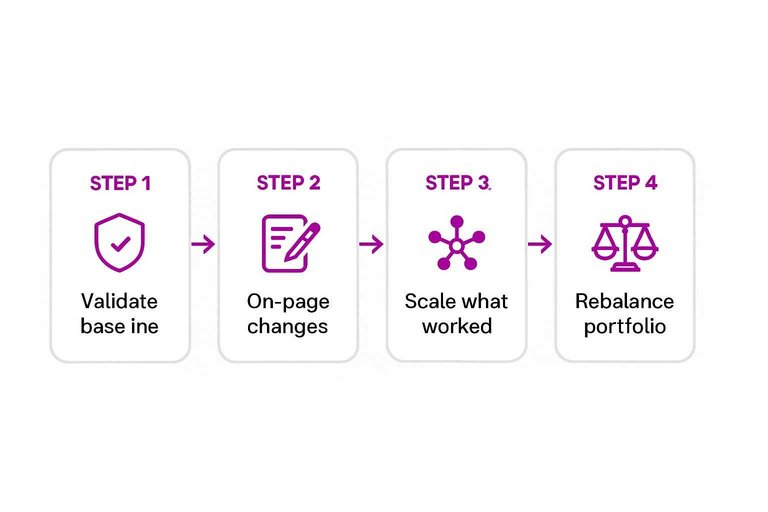
Weeks 1–2
Start by proving your data is trustworthy and your pages can be discovered. Early wins are mostly technical and prioritization, because Google can’t rank what it can’t reliably crawl.
Validate baseline: GSC coverage, sitemap accuracy, robots, canonicals, and key templates. Fix crawl and indexation blockers, then pick a first content set using impressions and low-hanging queries.
Impressions should move before clicks, because visibility usually leads behavior.
Weeks 3–4
Ship the first on-page changes fast, then watch movement at the query and page level. You’re looking for directionality, not perfection.
- Refresh the first batch of priority URLs
- Add internal links from relevant, higher-authority pages
- Rewrite titles for primary intent alignment
- Edit meta descriptions for clearer promise
- Improve headings for query coverage
If pages gain impressions but not clicks, your snippet is the bottleneck.
Weeks 5–8
Now scale what worked, and stop doing what didn’t. Production ramps, but it should stay tethered to Search Console feedback.
Build topic hubs with a strong hub page and supportive spokes. Iterate weekly using GSC: queries that appear but rank mid-pack, pages with high impressions and weak CTR, and clusters where internal links change outcomes.
CTR and rank distribution become your early truth, because they show whether you’re earning the click.
Weeks 9–12
Treat the site like a portfolio you rebalance. You’ll merge overlap, cut dead weight, and push your winners into deeper intent.
- Consolidate cannibalized pages into one primary URL per intent.
- Prune or redirect low-value pages that dilute crawl and equity.
- Expand winning topics with comparisons, FAQs, and adjacent use cases.
- Tighten conversion paths with clearer next steps and internal CTAs.
Rankings are nice, but revenue follows clarity and fewer competing URLs.
Real-world example
Imagine one page that already gets steady impressions for a single, clear job-to-be-done. You change it once, then watch signals for 90 days without “testing” ten variables at once. That’s how you learn without fooling yourself.
Page selection
Pick a page where intent is obvious and outcomes are trackable. You want enough impressions to see movement, but not so many moving parts that attribution turns into vibes.
A good candidate usually looks like this:
- One dominant query cluster with consistent intent
- A measurable conversion event tied to the page
- Stable seasonality, or at least predictable swings
- Existing rankings in the “striking distance” range
The goal is clarity, not heroics.
Changes made
Make changes you can defend with a searcher-first explanation. Keep it to a small set of upgrades that align with the page’s intent.
- Rewrite thin sections to answer the main question faster
- Add FAQs that mirror real follow-up concerns
- Improve internal links from relevant, high-context pages
- Update the title for clarity and intent match
- Strengthen credibility signals with sources and author details
If you can’t explain the edit without mentioning Google, cut it.
Interpreting impact
Start with impressions, then clicks, then conversions. Each one answers a different question, and mixing them creates fake certainty.
Impressions tell you visibility changed, often from rankings or indexing. Clicks tell you the snippet and intent match improved, or the SERP got tougher. Conversions tell you the page experience delivered, but only after the right visitors arrive.
When impressions move without clicks, suspect SERP features, title mismatch, or weaker positions. When clicks move without conversions, suspect intent drift, UX friction, or a promise you didn’t keep.
Lessons learned
Treat this like a diagnosis, not a victory lap. Keep what worked, and stop doing what only looked busy.
- Clear intent alignment usually beats “more words”
- Internal links help most when they add context, not volume
- FAQs work when they reduce hesitation, not when they stuff keywords
- Title tweaks can swing clicks without changing rankings
- Credibility signals matter most on “risky” decisions
Repeat the parts that improved user clarity, and be ruthless about the rest.
Use This 90-Day Template on Your Next SEO Push
- Define “growth” upfront: pick the business context, baseline window, 90-day scope, and the decisions the data must support.
- Lock measurement before changes: confirm analytics hygiene, configure Search Console views, track key events, and set a reporting cadence.
- Track a balanced scorecard: demand signals, rankings and URL movement, click behavior, on-site quality, and revenue alignment.
- Execute the plan in waves: technical triage first, then refresh existing pages, build net-new content, strengthen internal links, and improve SERP packaging with quality guardrails.
- Review weekly and attribute carefully: compare against baseline, annotate changes, isolate page-level impacts, and document lessons to feed the next 90 days.
Execute Your 90-Day SEO Plan
A clear 90-day framework only works if you can publish consistently, track the right metrics, and iterate week after week without losing momentum.
Skribra turns that plan into daily SEO-optimized articles with WordPress publishing, keywords, and formatting built in—start with the 3-Day Free Trial.
Written by
Skribra
This article was crafted with AI-powered content generation. Skribra creates SEO-optimized articles that rank.
Share: