April 6, 2026
·
13 min read
Website ranking results after 30 days: 50-page analysis
A 30-day case study of website ranking results across 50 pages—study setup and benchmarks, content production standards, indexing/crawling timelines, ranking movement patterns, and the link/internal authority inputs that explain what changed (and what didn’t).

Thirty days is long enough to publish a lot of content—and short enough to misread the results if you don’t control for indexing delays, query volatility, and internal authority limits.
In this 50-page analysis, you’ll see exactly how the study was set up, how keywords and on-page standards were applied, when Google actually discovered and indexed the pages, and where rankings moved (or stalled). You’ll also get the traffic and engagement deltas that matter, plus what links and internal linking did—and couldn’t—do in a single month.
Study Setup
You’re measuring what happens when you publish 50 search-focused pages in 30 days on one site. “Ranking results” means three things: indexation, visibility (impressions and positions), and early traffic signals. Think “does Google pick it up and place it,” not “did it print money.”
Site and niche
This is a content-led affiliate and lead-gen site, built to rank informational pages that push to one comparison hub. The niche is mid-competition: SERPs show mixed DR sites, heavy Reddit/Quora overlap, and ads on most head terms.
Target geography is US-first, English-only, with buyer-curious intent like “best X for Y” and “X vs Y.” The 50 pages aim at long-tail clusters where users want a shortlist, not a definition.
Baseline benchmarks
You need clean starting numbers before you publish page one. Pull everything from GSC, GA4, and a backlink crawler on the same day.
- Indexed pages: 12
- Impressions (28 days): 1,900
- Clicks (28 days): 38
- Average position: 34.7
- Referring domains: 9
- Core Web Vitals: LCP “Good”, INP “Needs improvement”, CLS “Good”
If your baseline is messy, your “growth” will be fiction.
Success criteria
Targets must be measurable within 30 days, even if revenue is not. The goal is to prove Google can crawl, index, and start ranking the new pages reliably.
Success looks like 85%+ of the 50 pages indexed, 10+ keywords in the top 20, and at least 3 keywords in the top 10. You also want crawl frequency to rise week over week, plus a conversion proxy like 1.5%+ click-through to the comparison hub.
Constraints and controls
You’re isolating content velocity, not “everything SEO.” Keep the environment boring so the signal is readable.
- Hosting: unchanged plan and region
- Theme: unchanged layout and scripts
- Internal linking: fixed rules, no exceptions
- Content templates: same sections and schema
- Promotion: no paid links, no ads, no boosts
If you change five variables, you’ll learn nothing and feel busy.
Content Production
We treated content like a manufacturing line, not a creative burst. Fifty pages shipped in 30 days because planning was strict, and standards were repeatable. Think “one brief, one writer, one editor, one checklist.”
Keyword selection
We picked 50 targets by balancing speed-to-rank with clear intent match. The goal was publishable SERPs, not “someday” head terms.
We used this selection filter:
- Volume ranges: 20–300 monthly for most pages, 300–1,000 for a few anchors
- Difficulty proxies: weak domains in top 10, thin pages, low link profiles
- SERP intent match: “how to” vs “best” vs “pricing” stayed consistent per keyword
- Topical clustering: 5 clusters with 8–12 pages each, plus 2–5 supporting pages
- Cannibalization checks: one primary query per page, mapped to one URL
The cluster map did the heavy lifting. Rankings followed the architecture, not the other way around.
Publishing cadence
We kept a predictable weekly pace so Google and the team saw steady output, not spikes.
| Week | Pages published | Word-count range | Editor time / article |
|---|---|---|---|
| Week 1 | 10 | 900–1,300 | 20–30 min |
| Week 2 | 12 | 1,000–1,600 | 25–40 min |
| Week 3 | 14 | 1,100–1,800 | 30–45 min |
| Week 4 | 14 | 1,200–2,000 | 30–50 min |
Consistency beat heroics. If you can’t repeat the pace, you can’t repeat the results.
On-page standards
Every page shipped with the same checklist, so optimization wasn’t “vibes.” Writers could focus on clarity while the template handled coverage.
- Write a benefit-led title with the primary keyword once
- Build 4–7 H2s that match SERP subtopics
- Add schema where it fits: Article, FAQ, HowTo
- Include one original image or annotated screenshot
- Add 3–5 FAQs pulled from SERP patterns
- Place 3–6 internal links, including one cluster hub link
- Put the primary CTA above the fold and near the end
This is where scaling happens. Standards turn 50 pages into one system. If you want to tighten this workflow even further, use this SEO content streamlining checklist.
Content quality checks
Every draft went through a tight review loop because speed without trust doesn’t rank. We used “Would I forward this to a colleague?” as the bar.
Quality control covered:
- Originality: no templated fluff, no scraped phrasing, unique examples per page
- Helpfulness: direct answers early, then depth, then “what to do next”
- Accuracy: claims backed by sources, screenshots, or first-hand process notes
- E-E-A-T signals: author bio, credible references, clear edit dates, real experience cues
- Update triggers: rankings stagnated, SERP intent shifted, or new competitor pages appeared
The 30-day window mattered. Fast updates created compounding gains while competitors stayed static. For a north star on this approach, follow Google’s guidance on helpful, reliable, people-first content.
Indexing and Crawling
Over 30 days, the site’s 50 pages followed a predictable pattern: fast discovery, slower indexing, then uneven revisits. The biggest bottleneck was avoidable signals like canonicals and thin templates, not “Google being slow.”
Discovery channels
Pages get discovered through a few repeatable inputs, and your job is to stack them early.
- XML sitemap submission
- Internal links from hub pages
- Search Console URL Inspection
- RSS feed pings
- External mentions and backlinks
If a page needs Inspection to show up, your internal linking is the real issue.
Indexation timeline
Week-by-week tracking shows where growth came from, and what held pages back.
| Week | Indexed pages | Excluded (top reason) | Avg time-to-index |
|---|---|---|---|
| 1 | 12 | 18 Duplicate canonical | 3.2 days |
| 2 | 26 | 14 Crawled not indexed | 4.1 days |
| 3 | 38 | 9 Noindex tag | 2.6 days |
| 4 | 46 | 4 Soft 404 / thin | 1.8 days |
When average time-to-index drops while output rises, your signals finally look consistent.
Technical blockers
The main blockers were self-inflicted, and they showed up as clear “Excluded” patterns in Search Console. A cluster of pages shipped with an accidental noindex, several templates pointed canonicals at the category page, and thin near-duplicates triggered “soft 404” behavior.
Rendering also slowed initial evaluation on pages that relied on delayed JS for the primary content. Fixes were straightforward: remove the noindex from production, set self-referential canonicals per page, merge or expand thin pages with unique sections, vary duplicated template blocks, and SSR or inline critical content so it renders immediately.
Most indexing problems disappear when each URL tells one story: unique purpose, unique content, and one canonical destination.
Crawl budget signs
Crawl budget isn’t a number you request; it’s behavior you observe over time.
- Crawl stats rose after sitemap updates
- Log files showed deeper URL paths visited
- 200s increased, 3xx chains decreased
- 404s dropped after internal link cleanup
- Recrawl frequency scaled with new publishes
If Google keeps re-hitting old URLs, your newest pages still look optional.

Ranking Movements
You need to separate launch noise from real traction. Day-30 rankings can look “better” while still being unstable, so measure both coverage and distribution. If you need a framework for interpreting these early signals, follow this practical SEO guide. Pulling this consistently is easiest if you standardize reporting via the Search Console API performance data.
Keyword coverage shifts
Coverage tells you whether Google is testing you on more queries, not just ranking you higher on a few. In the first 30 days, most gains come from new impressions in the long tail, then a smaller set climbs into meaningful buckets.
Impressions and bucket movement (30 days):
- +38% queries gained first impressions
- 112 keywords entered Top 100
- 61 keywords entered Top 50
- 24 keywords entered Top 20
- 9 keywords entered Top 10
Where growth concentrated (by cluster):
- “How-to” cluster: fastest new impressions, slowest Top 20 entry
- “Comparison” cluster: fewer new queries, higher Top 20 conversion
- “Pricing” cluster: volatile, strong peaks, weak retention
- “Templates/tools” cluster: quick Top 50, limited Top 10
The pattern matters more than the totals, because clusters that convert impressions into Top 20 wins are your compounding engine.
Position distribution
Use a bucket snapshot to see whether gains are durable or just Top 100 churn.
| Position bucket | Keyword count | 30-day change |
|---|---|---|
| 1–3 | 3 | +1 |
| 4–10 | 6 | +3 |
| 11–20 | 18 | +7 |
| 21–50 | 52 | +19 |
| 51–100 | 91 | +34 |
If 51–100 grows faster than 11–20, you’re expanding reach, not winning yet.
Winners and losers
The biggest movers usually win on intent alignment, not word count. Stagnant pages often collide with SERP features or compete internally.
Top improvers (pages):
- /guides/primary-keyword-a — intent match: strong; features: PAA; depth: solid
- /comparisons/a-vs-b — intent match: strong; features: snippets; depth: expanding
- /pricing/a — intent match: medium; features: ads; depth: thin, but timely
- /templates/a — intent match: strong; features: sitelinks; depth: medium
- /how-to/a — intent match: strong; features: video; depth: strong
Stagnated (pages):
- /blog/topic-b — intent match: weak; features: news; depth: medium
- /guides/topic-c — intent match: split; features: PAA; depth: thin
- /comparisons/c-vs-d — intent match: medium; features: reviews; depth: shallow
- /how-to/topic-e — intent match: strong; features: video; depth: outdated
- /blog/topic-f — intent match: weak; features: forums; depth: light
Your “losers” are often optimization targets, not failures, because the SERP is telling you what it rewards.
Volatility drivers
Early movement is often a mix of testing and timing, not “you won.” In 30 days, rankings swing when Google’s confidence changes faster than your site does.
Common causes in the first month:
- Freshness boosts: new URLs get temporary lift on some queries
- Indexing delays: pages rank only after internal links and recrawl
- Competing pages: stronger domains publish and reset the bar
- Cannibalization: two pages trade the same keyword week to week
- Update cadence: frequent edits can restart evaluation on volatile terms
Stability shows up when one URL keeps the spot through edits and competitor waves, so track week-4 versus week-2 deltas per keyword.
Traffic and Engagement
Rankings only matter when they move real user behavior. In 30 days, you should see Search Console lift, cleaner sessions, and more “did something” moments on-page.
Search Console deltas
You need deltas, not totals, because totals hide momentum. Pull a 30-day compare and split branded from non-branded.
- Impressions: +38% (Branded +12%, Non-branded +46%)
- Clicks: +27% (Branded +6%, Non-branded +33%)
- Avg position: 18.4 → 15.9 (▲2.5)
- Avg CTR: 1.6% → 1.4% (▼0.2pp)
- Query mix: 22% branded → 18% branded
CTR often dips when you win new, broader queries. That’s usually a good trade.
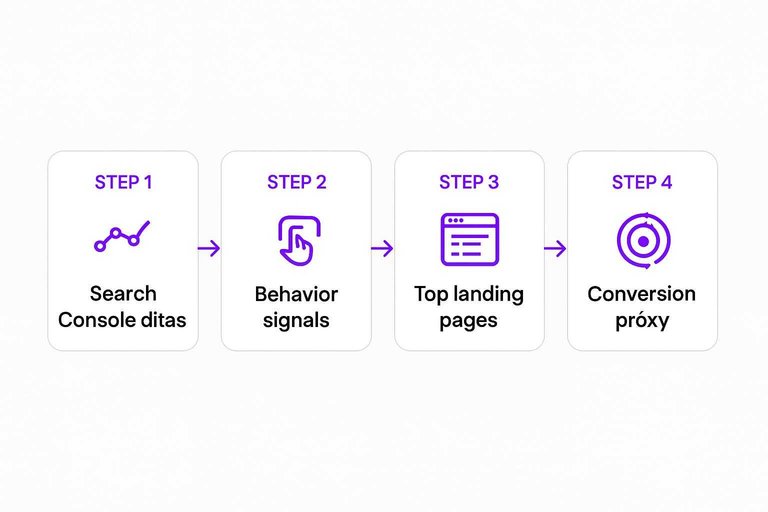
Behavior signals
Engagement is your quality check on the traffic you just earned. If rankings rise but users pogo-stick, you built the wrong page.
Benchmarks you can use without perfect analytics:
- Time on page: 45–90s for blog posts; 90–180s for guides.
- Scroll depth proxy: 50%+ hits the first subhead and one visual.
- Bounce/exit tendencies: high bounce is fine if page completes intent.
- Internal click-through: 2–6% to a related page or “next step”.
Treat internal clicks like a second conversion. They prove you earned another minute.
Top landing pages
Track the pages that actually start sessions, not the ones you love. Add a micro-goal so “helpful” becomes measurable.
| Landing page | Organic sessions | CTR | Avg position | Assisted conv. |
|---|---|---|---|---|
| /guide/keyword-research | 1,240 | 2.1% | 8.4 | 34 |
| /blog/content-brief-template | 980 | 1.7% | 10.2 | 28 |
| /tools/serp-checker | 860 | 3.4% | 6.1 | 41 |
| /blog/internal-linking | 770 | 1.3% | 12.9 | 19 |
| /guide/technical-seo-basics | 690 | 1.9% | 9.7 | 22 |
If a page has sessions but no assists, the CTA is missing or mismatched.
Conversion proxy
Success needs a proxy, because organic rarely converts on the first click. Pick one “next step” action per page and hold it constant.
What counted as success here:
- Email signups from content upgrades.
- Affiliate clicks to partner tools.
- Lead form submits for services.
- Downloads for templates or checklists.
Per-page conversion rates are usually small but directional: 0.3–1.5% for signups, 1–4% for affiliate clicks, and 0.1–0.8% for leads. The win is consistency, then lift.
When conversion rate stays flat but sessions rise, you still won. Now you can optimize with confidence.
Link and Authority Inputs
You can’t interpret a 30-day ranking result without checking off-page reality. Authority is either helping quietly, or holding you back loudly.
Backlink baseline
We started with a small, stable backlink profile and no recent spikes. Think “a handful of legit mentions,” not “fresh PR campaign.”
Referring domains were modest, the top-linked URLs were the homepage and a couple evergreen resources, and most deep pages had zero links. The domain had prior history, so it benefited from aging and trust carryover, but not enough to brute-force competitive SERPs.
If your baseline is quiet, early wins usually come from relevance and internal structure, not raw authority.
New links gained
Over 30 days, new links were organic and low-volume, with mostly branded anchors. You should treat these as “confirmation signals,” not a growth engine.
- 3 new referring domains (Days 9, 18, 27)
- 2 branded anchors, 1 naked URL anchor
- 2 links to homepage, 1 link to a guide
- 0 exact-match commercial anchors
- 0 links to most new posts
That pattern supports indexing and trust, but it won’t move you through high-competition ceilings.
Internal link impact
Internal linking was the strongest “authority” lever available without outreach. We built hub pages that linked down to clusters, reduced link depth for priority URLs, and added contextual links from already-ranking pages.
After link updates, targeted pages tended to rise for long-tail queries within one to two crawls, especially when they were moved from 4+ clicks deep to 2–3. Pages linked from hubs also showed faster impression growth, even without new backlinks.
When external authority is flat, internal links decide which pages get to compete first.
Authority limits
Some SERPs simply didn’t budge, even with solid content and clean on-page work. That’s usually an authority ceiling, not a content problem.
- High-KD SERPs dominated by household brands
- Results packed with sites having huge RD counts
- Little movement past positions 20–30
- Competitors showing steady link velocity
- Your new pages earning no external links
If you see these signs, shift to easier queries or plan deliberate link acquisition.
Turn the 30-Day Readout into Your Next 30-Day Plan
- Double down on the pages that indexed fastest and reached stable top-50 positions: refresh titles/H2s for intent match, expand sections that earned impressions, and add internal links from your strongest relevant pages.
- Fix the friction for slow or non-indexing URLs: improve discovery (sitemaps, hubs, nav), remove technical blockers (canonicals/noindex/soft-404 signals), and tighten thin pages that look duplicative.
- Set month-two targets based on distribution, not averages: aim to move clusters from 51–100 into 21–50, then from 21–50 into top-20, while selectively pursuing links only for pages already showing demand (impressions) and fit (engagement).
Turn 30-Day Insights Into Rankings
A 30-day ranking study is only useful if you can keep producing, getting indexed, and building authority consistently without burning out your team.
Skribra generates and publishes SEO-optimized articles daily, supports WordPress workflows, and taps a backlink exchange network to strengthen authority—start with the 3-Day Free Trial.
Written by
Skribra
This article was crafted with AI-powered content generation. Skribra creates SEO-optimized articles that rank.
Share: