February 1, 2026
·
11 min read
What Is an AI Writing Tool for E-Commerce Brands
An explainer on what an AI writing tool for e-commerce brands actually is—and how to evaluate and implement one—covering core capabilities, how inputs and retrieval affect quality, the highest-impact use cases, and the risks/guardrails that keep voice and compliance intact.

If your team is rewriting the same product benefits across PDPs, ads, emails, and support macros, the bottleneck isn’t creativity—it’s throughput and consistency. And the moment you scale content, brand voice drift and risky claims start sneaking in.
This explainer breaks down what an AI writing tool for e-commerce brands really does, how it works under the hood, where it delivers the most value, and what guardrails you need so outputs stay accurate, compliant, and on-brand—without adding another tool nobody trusts.
E-commerce Writing Landscape
E-commerce copy is a throughput problem, not a talent problem. When you have 500 SKUs and a launch on Friday, every channel needs words now. One inconsistent claim like “waterproof” can spread from a PDP to ads, then into returns.
Brand copy pressures
Copy shows up everywhere because commerce happens everywhere. Each new SKU multiplies pages, variants, translations, and experiments across your stack.
Your copy map usually includes:
- PDPs and variant descriptions
- Paid ads and landing pages
- Email flows and SMS
- SEO category pages and blog
- Support macros and chat scripts
- Marketplaces like Amazon
Volume turns “one more update” into a queue you can’t drain.
What tools replace
Before AI tools, you stitched together people and processes to ship copy. Each option works, until scale makes the tradeoffs hurt.
- Manual writing: highest control, slowest throughput
- Templates: fast starts, brittle for edge cases
- Freelancers: flexible capacity, uneven brand voice
- Agencies: strategic polish, high cost and lag
You’re not choosing “best writing.” You’re choosing which bottleneck you can tolerate.
When tools fail
AI writing tools break in predictable ways when inputs are weak or rules are missing. The failures are costly because they look plausible.
- Generic tone that sounds like every brand
- Incorrect claims like “clinically proven”
- SEO stuffing that hurts readability
- Duplicate copy across SKUs
- Compliance misses on regulated terms
- Hallucinated specs, materials, or certifications
If you can’t trace a sentence back to a source, it’s a liability.
Mental model preview
Treat AI writing like a production line, not a magic pen. You feed it facts and rules, it generates drafts, humans review, then you publish and learn from results.
The loop looks like: inputs (facts + rules) → generation → review → publish → learn. Run it per channel, then reuse the same inputs everywhere.
Your advantage comes from the system, not the prompt.
Definition That Matters
An AI writing tool for e-commerce brands is a system that turns your product facts and brand rules into publishable copy at scale. Think: you feed it specs, claims, and “sound like us,” and it outputs PDP text, ads, and emails.
Plain-language definition
An AI writing tool for e-commerce is software that drafts and adapts product content fast, while staying on-brand, accurate, and channel-ready. It turns “10 oz, BPA-free, 2-year warranty” into copy that fits a PDP, an ad, or an email.
Core capabilities
You use these tools to produce more usable copy with fewer bottlenecks.
- Generate new copy from product inputs
- Rewrite existing copy for clarity or conversion
- Summarize long specs into shopper-friendly bullets
- Localize copy across languages and regions
- Control tone to match your brand voice
- Assist SEO with keywords and structure
- Create variants for A/B testing
The real win is throughput without turning your brand voice into mush.
What it is not
It isn’t your strategy team, and it won’t decide positioning or offers. It also isn’t legal, a source of truth, or an autopilot that publishes without review.
Treat it like a fast copy engine with guardrails, not a replacement for judgment.
How It Works
An AI writing tool turns your raw commerce inputs into channel-ready copy, fast. The real work is controlling quality and risk as the text moves through the pipeline.
Inputs that drive quality
Your outputs only get as strong as your inputs. A “write me a great PDP” prompt fails when your product facts are thin.
Product data does the heavy lifting: titles, attributes, fit, materials, and compatibility. Reviews add voice-of-customer phrasing, like “runs small” or “holds up in rain.” Specs and compliance notes prevent errors, like wattage limits or allergy claims. Imagery notes capture what photos imply, like “model wears size M” or “finish is matte.” Brand voice guides and policies set boundaries, like “no medical claims” and “never call it eco-friendly without proof.” Channel constraints finish the job, like Amazon bullet limits or SMS character caps.
If your inputs disagree, the model will pick a side, so fix the source first.
Prompts and templates
Templates keep structure consistent across thousands of SKUs. Prompts fill the blanks with product facts, then enforce rules.
- Select a template: PDP blocks, bullets, ads, subject lines, metadata.
- Inject product fields: attributes, benefits, proof points, exclusions.
- Apply brand voice: tone, banned words, claim rules.
- Apply channel rules: length, formatting, required tokens.
- Output with checks: reading level, duplication, keyword placement.
Templates turn copy from “creative” into predictable production.
Models and retrieval
The model writes the sentences, but retrieval supplies the facts. Without grounding, you get confident fiction, like a made-up “stainless steel core.”
Most systems pair an LLM with retrieval from your catalog, PIM, DAM, and policy docs. The tool pulls the most relevant snippets, then writes only from that context. Some setups also cite sources internally, so reviewers can trace claims to a field or document.
Grounding is your best defense against hallucinated specs and risky claims.
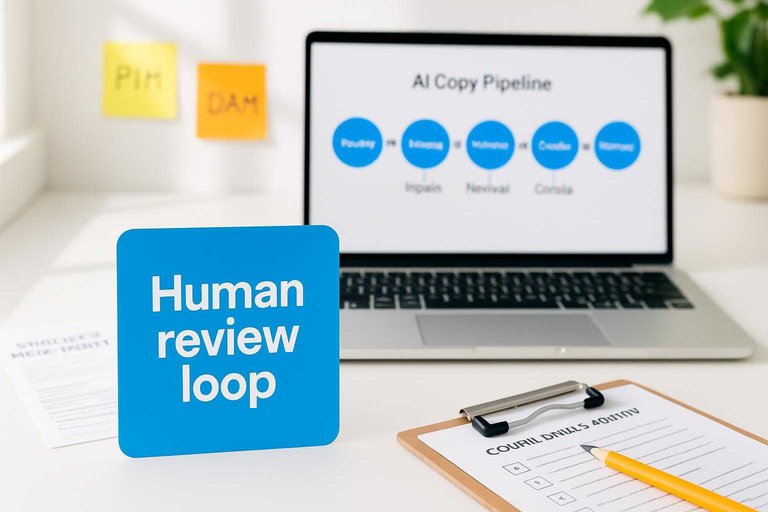
Human review loop
Humans decide what ships, and they should have clear gates. Review is faster when each role checks a narrow slice.
- Merchandiser validates facts: attributes, variants, bundle contents, naming.
- SEO checks intent: keywords, headings, AI-powered SEO content creation, duplication thresholds.
- Compliance audits claims: regulated terms, disclosures, approved language.
- Brand approves voice: tone, terminology, positioning, competitor mentions.
- Escalate failures: missing data to PIM owner, policy issues to legal, edge cases to brand lead.
When acceptance criteria are explicit, reviewers stop rewriting and start approving.
E-commerce Use Cases
AI writing tools earn their keep when they sit close to revenue and repetition. Think “same product, five channels” or “same question, 1,000 tickets.” That’s where speed, consistency, and testing start compounding.
Product detail pages
On PDPs, the job is simple: remove doubt fast, without overpromising. Good AI output turns raw attributes like “400gsm cotton” into a clear benefit like “warmer without bulk,” then keeps the tone consistent across variants.
It also helps you scale the unsexy parts that move numbers. Bullets that scan. FAQs that prevent returns. Size, fit, and care notes that say “hang dry” before a customer ruins it.
Acquisition channels
Acquisition copy breaks when you reuse one message everywhere. Use AI to adapt the same offer to each platform’s rules and reader intent.
- Write paid ads by angle, not by product
- Draft landing pages per keyword cluster
- Produce SEO briefs with intent and outline
- Generate meta titles and descriptions at scale
- Tailor marketplace listings to constraints
If your CTR rises but CVR drops, your copy is overselling.
Retention channels
Retention is where voice and timing matter more than cleverness. AI helps you ship consistent lifecycle messaging without sounding like a different brand every week.
- Build email flows for each lifecycle stage
- Write SMS offers with clear limits
- Draft push notifications per segment
- Create loyalty content tied to perks
- Automate review requests and prompts
Measure downstream, not opens. Revenue per recipient wins.
Support and trust
Support writing is high stakes because one wrong line becomes policy. AI is most useful when it rewrites approved answers into tone-safe variants, using your actual policies.
That includes help-center articles, chat macros, and templated responses for refunds, delays, and defects. You reduce tickets by being clear early, then you avoid chargebacks by being precise.
Key Features Checklist
You’re not buying “AI.” You’re buying fewer listing mistakes, faster launches, and consistent brand voice at scale.
- Brand voice controls and style rules
- Product data ingestion from PIM/feeds
- Templates for PDPs, ads, and emails
- Bulk generation with QA checks
- Human approval and audit trails
If it can’t ingest your catalog and survive review, it’s a demo, not a tool.
Risks and Guardrails
AI writing tools can move faster than your merchandising team. They can also ship errors at the same speed.
Treat the model like a junior copywriter on a tight deadline. Helpful, but never the final authority—especially once you understand the key differences vs human writers.
Accuracy failure modes
Most e-commerce failures are boring: one wrong number, one wrong fit, one risky claim. AI makes those mistakes look confident, which is the dangerous part.
Hallucinations show up as invented features like “military-grade aluminum” or “BPA-free” with no source. Outdated specs sneak in after a supplier update, so your PDP says “5000mAh” while the carton says “4500mAh.” Wrong compatibility is common too, like “fits iPhone 15” when the cutout matches iPhone 14.
The sneakiest errors are tone-based: misleading superlatives like “best on the market” and near-duplicate copy across SKUs that hides real differences. If your content looks polished but generic, accuracy is already slipping.
Compliance and claims
Compliance breaks when AI writes like marketing, not like legal. Your workflow needs tripwires in the categories that get regulated fast.
- Regulated categories: supplements, cosmetics, medical, kids, food, finance
- Substantiation: studies, test results, certificates, supplier attestations
- Disclaimers: “results vary”, “not medical advice”, “for external use only”
- Allergy and safety: ingredients, warnings, “keep out of reach” language
- Regional rules: EU vs US claims, state props, shipping restrictions
If you can’t point to a source, treat it as a claim you can’t make.
Brand voice drift
Brand voice drifts when ten people prompt ten different ways. It happens fastest in peak season, when freelancers and agencies jump in.
One team writes “obsessed,” another writes “premium performance,” and a third writes like a spec sheet. The PDPs still convert, but your brand starts feeling like a marketplace.
Lock voice with a short style guide, a few gold-standard examples, and a real review pass for hero SKUs. Consistency is a system, not a vibe.
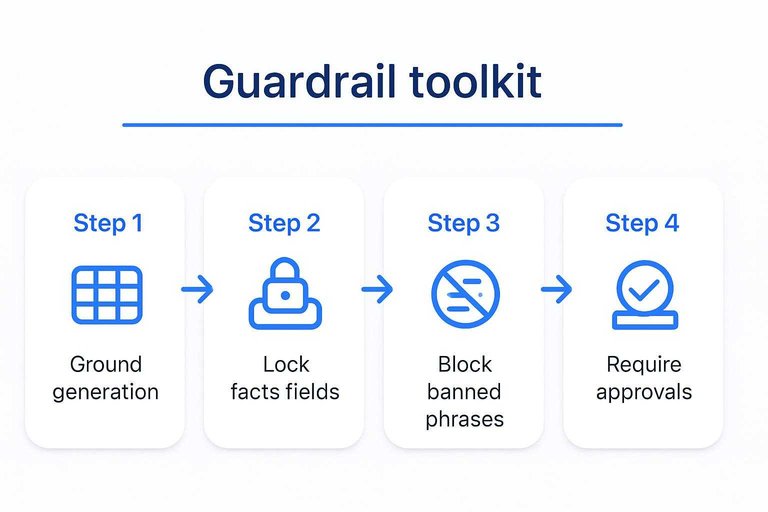
Guardrail toolkit
Guardrails work when they fit the e-commerce assembly line. You want controls that run every time, not heroic reviews.
- Ground generation to your catalog, spec tables, and approved claims.
- Lock “facts fields” like dimensions, materials, compatibility, and certifications.
- Block banned phrases and unsupported superlatives at the prompt and QA layer.
- Run plagiarism and near-duplicate checks across your full SKU set.
- Require approvals, then store audit logs with who changed what.
When something goes wrong, audit logs turn a fire drill into a fix.
Buying Decision Framework
You’re not buying “AI.” You’re buying a production system for product content across your channels.
Pick criteria that match your catalog shape, your publishing cadence, and your tolerance for brand or legal risk.
Fit questions
Answer these before you book demos, or you’ll get dazzled by features.
Use them to force clarity on scope, constraints, and ownership.
- How many SKUs, variants, and attributes change weekly?
- Which channels matter most: PDP, Amazon, ads, email, socials?
- How many locales, currencies, and tone guides must it support?
- What claims are regulated: supplements, cosmetics, medical, finance?
- Who edits, approves, and publishes, and where does work happen?
If you can’t answer these fast, you’re choosing vibes, not fit.
Data and integrations
Your outputs are only as current as your inputs, and e-commerce data rots quickly.
A tool that “connects” but lags a day can ship wrong sizes, prices, or claims.
Look for connectors to PIM/ERP/CMS, plus native Shopify or Magento support.
Check DAM access for approved images, labels, and spec sheets.
Tie in analytics so you can test copy against conversion, not opinions.
Ask about sync frequency, conflict handling, and what happens on failed imports.
Evaluation scorecard
Score tools side by side, using the same rubric for every vendor.
Keep it simple, then weight what you actually fear messing up.
| Option | Quality | Control | Integrations | Collaboration | Security | Cost |
|---|---|---|---|---|---|---|
| Vendor A | ||||||
| Vendor B | ||||||
| Vendor C | ||||||
| In-house build |
Your best pick is the one that stays reliable at scale, not the one that demos best.
Implementation Playbook
Start with one high-volume page type, like collection pages, because repetition reveals wins fast.
You want proof, not a platform project.
- Pick one use case with clear KPIs, like PDP descriptions.
- Build a brand brief and a prompt template, then lock them.
- Run a 2-week pilot with human review and QA checklists.
- Measure impact in analytics, then revise prompts and rules.
- Scale to adjacent surfaces, like emails and ads, with guardrails.
If you can’t measure it in two weeks, you’re not piloting yet.
Choose one use case, add guardrails, then scale
Treat an AI writing tool as a copy system, not a copy machine: the wins come from strong inputs, brand rules, and a tight human review loop. Start with one high-volume workflow (like PDP enrichment or email variations), measure quality and lift, and document what prompts, sources, and approvals worked. Once accuracy, compliance, and voice are stable, expand to adjacent channels with the same guardrails so speed never outruns trust.
Frequently Asked Questions
- Is an AI writing tool the same as an AI copywriter for e-commerce product descriptions?
- No. An AI writing tool is software that generates and manages copy from structured product data and brand rules, while an “AI copywriter” usually refers to the model or service creating text without the same workflow controls.
- Do AI writing tools for e-commerce connect to Shopify, BigCommerce, or PIM/ERP systems?
- Most production-grade AI writing tools offer integrations via API or prebuilt connectors to platforms like Shopify and to PIMs/ERPs, so they can pull attributes (title, specs, materials) and push approved copy back to your catalog.
- How do you measure ROI from an AI writing tool for e-commerce brands?
- Track output and quality metrics (SKUs published per week, edit time per SKU, approval cycle time) and commercial impact (conversion rate, organic traffic, return rate, support tickets) using GA4/Shopify analytics plus A/B tests on PDP copy.
- How long does it take to train an AI writing tool on a brand voice for e-commerce?
- Most teams can get usable brand-voice consistency in 1–2 weeks with a style guide and sample “gold” listings, then improve over the next 4–8 weeks by reviewing edits and locking in reusable templates.
- Can you use an AI writing tool for e-commerce in multiple languages without hiring translators?
- Yes, many tools generate multilingual copy, but you still need human review for legal claims, measurements, and local terminology; a common workflow is AI draft + in-market reviewer for the top 20% revenue SKUs first.
Operationalize AI Content at Scale
After you’ve mapped use cases, guardrails, and an implementation playbook, the next hurdle is producing e-commerce content consistently without sacrificing SEO quality.
Skribra automates research-to-publish SEO articles with WordPress publishing, images, and integrations—so you can keep your pipeline moving. Start with the 3-Day Free Trial to validate fit fast.
Written by
Skribra
This article was crafted with AI-powered content generation. Skribra creates SEO-optimized articles that rank.
Share: