January 30, 2026
·
10 min read
When to Use an SEO Writing Assistant for Agencies

Why Manual Content Work Sometimes Beats Automation — and Why
AI writing tools increase content volume, but skilled human writers deliver higher quality in high-stakes scenarios.
Recognizing the specific strengths of manual creation—protecting reputation and interpreting complexity—lets agencies and clients allocate resources effectively and avoid generic outputs.
Where Human Expertise Protects Brand Voice
Communicating a unique brand personality or handling nuanced messaging in regulated or competitive industries demands nuance that automated tools miss.
AI-generated content follows tone guides but lacks the contextual judgment needed for crisis communications or sensitive topics.
In sectors where misinterpretation causes PR crises or regulatory issues, manual writing keeps feedback cycles and interpretation tightly managed, reducing messaging errors and protecting brand equity.
When Subject Matter Depth Outpaces Templates
Healthcare, SaaS, and legal services require granular accuracy beyond automated pattern-matching.
Human writers research primary sources, consult experts, and update content with regulatory changes—a process that avoids outdated or misleading information.
In fields where errors cause compliance risks or erode trust, agencies relying only on automated drafts produce content flagged by subject-matter reviewers within weeks of publication.
When SEO Writing Assistants Outperform Human-Only Drafting
Manual production breaks down for agencies once content needs pass 50-100 pieces a month.
Integrating SEO writing tools with human review scales output, maintains structural and technical SEO standards, and cuts redundant manual work. For deeper insight into the advantages, see how AI transforms SEO content creation to boost efficiency and output quality.
SEO assistants excel when limited human resources would otherwise cause missed deadlines or lower-quality drafts.
Scaling Content Across Hundreds of Pages Efficiently
Managing large site structures with duplicative pages—like location landers, ecommerce categories, or product variants—overwhelms manual writers and delays production for months.
Outdated templates pile up.
SEO assistants automate repetitive structure and keyword work, keeping page elements consistent across large sets.
Review teams shift to spot-checking (5-10% sample), instead of endlessly rewriting large batches.
Meeting Tight Deadlines with Lean Teams
Content teams under five writers stall on deadlines when deliverables surge past 15-20 per week.
SEO assistants generate first drafts within hours, letting writers focus on refining tone and context.
This division cuts turnaround times and prevents overruns—key for avoiding client churn when deadlines slip in competitive agency environments.
What Breaks Down When Agencies Over-Rely on Automation
Relying too much on SEO writing assistants destabilizes organic search results and frustrates user engagement.
This shows up as uniform content and limited innovation, driven by optimizing for tool feedback over original strategy. If you’re looking to address these issues, consider exploring ways to fix content bottlenecks with smart AI for a more balanced approach.
The Subtle Costs of Undifferentiated Content
Automated generators produce high volumes of SEO-optimized text, but frequent use leads to repetitive structures and phrasing across a portfolio.
Tools that surface popular keyword variants create near-identical on-page elements, especially for sites in the DA 10-30 range.
Large language models repeat phrasing that’s already common in search results, and Google’s Helpful Content System flags this as unoriginal.
Within 2-4 months of switching to mostly AI-generated drafts, rankings fall and engagement metrics like time on page and social shares drop.
Predictable content erodes brand authority—when material lacks a unique perspective, users and search engines ignore it, causing measurable losses in organic visibility and audience trust. Understanding the pros and cons of AI in SEO provides further insights into these challenges.
Limits of Tool-Driven Iteration Cycles
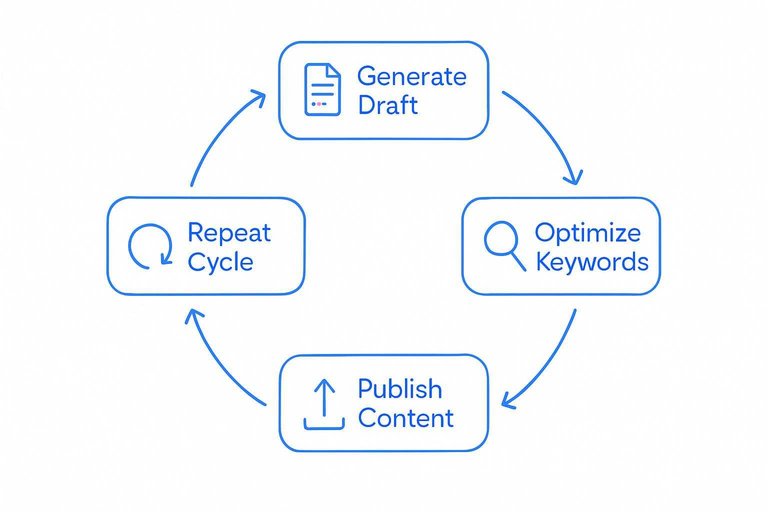
Automated SEO workflows follow a cycle: generate a draft, optimize for target keywords using tool feedback, publish, and repeat.
This locks content into a consistent template, prioritizing incremental keyword improvements over experimentation.
Within 3-6 months, topic and format diversity drops as teams avoid anything that doesn’t deliver short-term gains on dashboards.
This blocks new formats or insights from emerging, causing portfolios to underperform on long-tail queries and lose opportunities for backlinks.
As Google gives more weight to expertise and original viewpoints, automation-driven strategies produce flat content that struggles in the evolving SERP landscape.
Notably, this approach often fails when content needs to address highly specialized topics or nuanced audiences, as automation tools typically lack the depth needed to satisfy expert readers or niche communities.
Where SEO Writing Assistants Deliver Unique Strategic Levers
SEO writing assistants excel when rapid adaptation and real-time optimization determine success.
They outperform manual processes when agility and current data decide outcomes, especially during sharp ranking or traffic changes.
Rapid SERP Alignment in Dynamic Niches
In volatile sectors like finance, tech, and health—where ranking factors shift weekly—SEO assistants monitor live SERP attributes such as structure, keyword prominence, and semantic relevance.
Automated analysis lets content pivot within 24-48 hours of an algorithm update, preserving rankings that slower workflows would lose.
Agencies in these fields maintain or recover top spots before manual review can start, leading to stronger client retention and better results during fast-changing SERP conditions.
Real-Time Data Integration for On-Page SEO
During urgent news cycles, trending topics, or major launches, SEO assistants process live data from Google Trends or recent SERPs.
This delivers actionable on-page adjustments—like adding new keywords or subtopics—within hours.
In time-sensitive campaigns, this boosts page indexing and ranking: content ranks for emerging queries within 2-4 weeks, while manual workflows miss the critical window.
Agencies targeting newsjacking or trending topics gain increased traffic and stronger topical authority through this data-driven speed.
Choosing the Right Workflow: Questions Agencies Need to Ask
Agencies using SEO writing assistants face direct operational challenges.
Clear intent—rooted in measurable project pipelines and compliance needs—defines which technologies and processes drive real returns and consistent quality.
Is Project Scope Favoring Scale or Substance?
High-volume projects—like creating 50+ blog posts monthly, delivering hundreds of product descriptions, or expanding multi-location landing pages—demand automation and standardized workflows.
In these scenarios, SEO writing assistants enforce baseline quality and keep output within defined guidelines at scale.
For work focused on depth or original analysis—such as long-form articles over 1,500 words or proprietary research—custom editorial review stays critical. Writing assistants support data gathering and draft optimization, but human subject-matter expertise handles final edits and sharpens messaging to avoid shallow coverage.
Assess your monthly content targets: Agencies producing more than 20 pieces each month gain from automated workflows. Those delivering fewer than 10 complex assets get stronger results from hybrid or manual processes. Align workflow choices tightly with these realities to boost efficiency while meeting content goals.
How Does Your Niche Shape the Best Toolset?
Regulated fields—such as healthcare, finance, and legal—face strict review cycles and external compliance checks. In these sectors, agency workflows dedicate up to 40% of production time to post-generation fact-checking and documentation, even when using SEO writing assistants. Skipping this risks regulatory penalties and reputational harm.
In less-regulated sectors—travel, lifestyle, general e-commerce—the priority shifts to quick turnaround and strong search visibility. Here, assistants automate keyword integration and brief standardization, letting content teams handle two to three times more volume while managing factual oversight risk.
Regulatory demands shape workflow: Agencies in compliance-heavy spaces must keep human review at the forefront. In low-regulation niches, agencies can use automation aggressively—as long as basic accuracy and brand voice stay in check.
However, automated content tools often falter when producing highly specialized or citation-heavy material—for example, legal statutes or peer-reviewed medical content—requiring manual expertise that AI-generated outputs can’t reliably replace.
Trade-Offs That Define Your Agency’s Competitive Edge
Using SEO writing assistants forces deliberate process choices, each with clear operational and reputational impacts.
Decisions about automation, human oversight, and review cycles shape both cost structure and the agency’s reputation for expertise and client satisfaction.
Cost Pressures Versus Differentiation
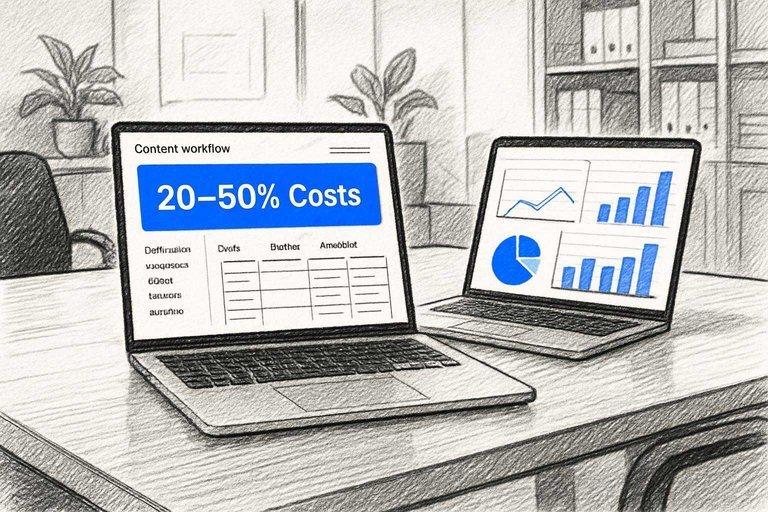
Automated content workflows cut per-asset costs by 20–50% in high-volume scenarios (as shown in content production tools like SEMrush or Ahrefs), especially for research, drafting, and first-round optimization. This drives efficiency for agencies serving clients with over 30 monthly content pieces.
Agencies automating every stage produce content that blends in with typical automated outputs. This erodes brand voice and subject credibility—often reflected in lower engagement metrics in the next one or two months. To stay competitive, agencies must commit manual editorial effort to high-value pages—service landing pages and in-depth resources—where human expertise moves the needle for clients and supports premium positioning. The importance of maintaining brand authenticity in automated content is a key consideration here.
Turnaround Time Versus Editorial Control
Automation shortens turnaround times by 30–50% on bulk projects, essential when SLAs demand delivery in under 72 hours. This speed up, though, usually reduces editorial oversight, increasing risks of tone drift, small factual errors, and generic copy—gaps that show in the first cycle of work.
Agencies need clear rules: use assistants for all content between 250–750 words or when batch deadlines drop under a week, but enforce manual review for long-form, evergreen, or top-funnel pieces. This keeps operations fast without giving up editorial standards, helping to keep client trust and reflect agency quality in the most visible content.
Decision Roadmap: Matching Assistant Use to Your Agency’s Scale
Bringing in an SEO writing assistant at the right stage boosts agency throughput and quality.
But these gains aren’t equal for every agency or growth phase. Agencies with fewer than 10 full-time content staff see little upside from rapid automation—manual oversight is still manageable and controls quality closely.
Larger agencies—especially those scaling to handle onboarding surges or producing over 30 pieces per month—capture the most value. Automation fills resource gaps and drives efficiency here.
Use this roadmap to pinpoint triggers, operational controls, and risks when adopting writing assistants. Weigh each factor against your current scale and workflow maturity.
When Automation Accelerates Growth Safely
Agencies with documented editorial standards and organized content briefings see automation double draft output once workloads pass 20 articles per month—without missing deadlines.
Automating initial drafts, keyword research, and technical SEO frees strategists for bigger-picture planning and direct client work.
Experienced editors who review AI-generated content and adjust prompts drive fast productivity gains. These improvements show up in 2–4 weeks.
Regular prompt checks and workflow updates keep quality and strategic guidance steady as output scales.
Critical Warning Signs for Pulling Back
Track editing time per article. If it rises above 30% of total hours, or if rankings and engagement drop over 10% in 1–2 months, automation creates quality risks.
Recurring client complaints about accuracy or brand fit—or staff spending extra time rewriting drafts—signal that human oversight is falling behind.
Staff pushback, especially if they say automation ignores expertise, also means it’s time to rethink. Fix these issues before Google or clients question your credibility.
Hybrid Models That Outperform Either Extreme
Mixing automation with human expertise outperforms fully manual or fully automated workflows. Agencies hand off bulk, repetitive work like research gathering or meta tag creation to AI, but keep voice, narrative, and strategy with senior staff.
Run automation for 60–80% of drafts on common topics; limit it to below 30% for branded or niche work. Hold reviews every 4–8 weeks to adjust the mix and optimize for quality and efficiency.
Agencies using these hybrid models cut costs, keep performance steady, and raise client satisfaction compared to single-mode approaches.
Written by
Skribra
This article was crafted with AI-powered content generation. Skribra creates SEO-optimized articles that rank.
Share: