February 17, 2026
·
Updated August 18, 2026
·
11 min read
Why contextual backlinks don’t move rankings after 60 days
A practical troubleshooter for diagnosing why contextual backlinks aren’t improving rankings after 60 days — triage tracking and indexing, assess link quality and discovery, uncover on-page bottlenecks, and account for off-page headwinds with a root-cause matrix and fix plan.

You built “contextual” links, waited two months, and… nothing. No lift in rankings, no meaningful change in impressions—just a nagging feeling the links didn’t count.
This troubleshooter helps you pinpoint what’s actually happening. You’ll learn how to verify tracking and indexing, judge whether the linking pages have real equity, confirm Google can discover the links, and identify on-page or SERP factors blocking movement—then turn the diagnosis into a focused 60‑day fix plan and monitoring routine.
Triage the Symptoms
No movement after 60 days can be real. It can also be a reporting artifact that looks like failure.
Your job is to define “success” tightly, then isolate four buckets: measurement, indexing, relevance, or link equity.
Define success metrics
You can’t debug “nothing happened” until you pin down what “happened” would look like. Pick a small keyword set, a fixed baseline date, and a reasonable expectation band.
Track 5–10 target queries, record starting positions, and set a movement threshold like “+3 spots” or “top 20 entry.” Note volatility windows, like core updates, where a “flat” line can hide daily swings.
If your expected lift is smaller than normal SERP noise, your backlink test is underpowered.
Check tracking integrity
Most “no movement” stories start with tracking errors. Eliminate the boring stuff first.
- Track the wrong URL variant
- Mix different intent keywords
- Ignore location or device mismatch
- Miss a canonical mismatch
- Hit tool sampling limits
If any one of these is true, you’re not measuring rankings. You’re measuring confusion.
Verify indexing signals
A contextual backlink can’t pass value if Google hasn’t reliably processed the linking page. Same for the target page, especially after recent changes.
Check that the linking URL and your target URL appear in a site: query, and confirm Google can fetch them. Expect recrawl lag on low-authority sites, and delays after redirects, canonicals, or major content edits.
If the link source gets crawled monthly, “60 days” is just two coin flips.
Separate ranking from traffic
Traffic can stay flat even when rankings improve. SERP layouts and click behavior can erase gains.
- CTR drops from new SERP features
- More ads push organic down
- Seasonality shifts query volume
- Brand results steal clicks
- Snippet rewrites reduce appeal
Trust Search Console for positions and impressions. Use analytics for demand and behavior.
Diagnose Link Quality
Contextual links can sit “in content” yet still behave like dead weight. You’re diagnosing why the page, the placement, or the mechanics don’t transfer usable authority. For a deeper framework on evaluating and improving these signals, see this complete SEO guide.
Relevance mismatch
A link can be editorial and still be off-topic. When the linking page’s entities and intent don’t match your target, Google files it under “weak association.”
Look for topical drift in three places:
- Linking page topic and primary entities
- The sentence-level context around the link
- The target page’s query intent and entity set
Example: a “best CRM” page linking to your “email deliverability” guide with a forced “marketing tools” sentence. That’s a relevance miss.
Fix alignment first. If entities don’t overlap naturally, equity won’t translate into rankings.
Weak page equity
Some pages can link to you and still have nothing to give. You’re looking for pages that don’t earn, keep, or distribute authority.
- Has few or zero internal links
- Has thin, unoriginal content
- Shows low crawl frequency
- Sits as an orphaned URL
- Has weak engagement proxies
If the page can’t rank or get crawled, your link is mostly a receipt, not a lever.
Anchor text dilution
Anchor text is a label, but the surrounding text is the explanation. When those signals conflict, your link becomes harder to interpret.
Generic anchors like “click here” often add no topical clarity. Over-optimized anchors can trip spam pattern alarms, especially across multiple domains.
The more your anchors and nearby phrasing wobble between topics, the less associational strength you get. Consistency beats cleverness.
Hidden link attributes
A link can look normal and still be gated. You’re checking for attributes and delivery methods that reduce or block pass-through.
- rel=“nofollow”, “sponsored”, or “ugc”
- JavaScript-inserted link only
- Iframe-embedded placement
- Redirects before the target
- Blocked resources affecting rendering
If Google can’t parse it cleanly, it can’t credit it cleanly. Audit the mechanics, not the markdown.
Confirm Crawling and Discovery
Google can’t credit a link it can’t reliably fetch and interpret. Your job is to prove the source URL, the link, and the destination get revisited often enough to matter.
Link discoverability
Contextual links can sit in places Google visits once, then rarely returns. Think “page 17 of an archive,” a faceted URL with parameters, or a paginated category that keeps shifting.
If the source page has weak internal links, low traffic signals, or endless crawl paths, Google may discover the link but not refresh it. That’s when 60 days feels like “nothing happened,” because the link never becomes a stable input.
Get the link onto a consistently crawled URL, or shorten the click path from the homepage.
Server and render issues
Even “live” links can be invisible to Google when fetch and render fails. Check for blockers that make crawling intermittent.
- Trigger 5xx spikes during peak traffic
- Stall requests with slow TTFB
- Block JS/CSS needed for rendering
- Restrict crawling via robots rules
- Serve different content with geo gating
If Googlebot sees errors or empty renders, the link credit never stabilizes.
Destination page freshness
Google reevaluates pages on its own schedule, and stale URLs slip down that queue. A “refreshed” date with the same content, or a thin paragraph added at the bottom, often won’t trigger meaningful reprocessing.
If the destination page hasn’t changed in substance, the new link may get recorded but not weighed. Relevance scoring tends to update when the page itself looks newly worth attention.
Ship a real update that changes what the page answers, not just what it says.
Index bloat interference
Index bloat dilutes signals because Google can’t tell which URL should win. Watch for patterns that create many “almost the same” pages.
- Publish near-duplicate articles for minor variations
- Generate tag pages that mirror categories
- Create faceted pages that index by default
- Compete with multiple URLs for same intent
Fix duplication first, or your new backlinks spread across the wrong URLs.
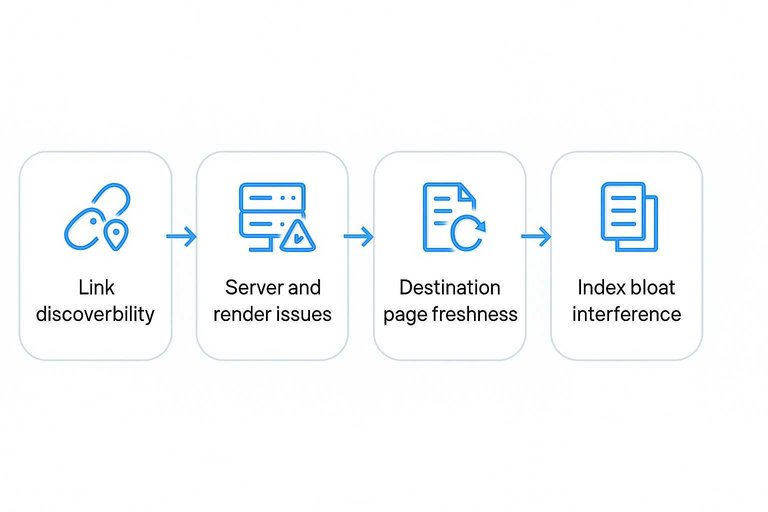
Modern indexing delays and crawl prioritization
Even when a contextual link is real and crawlable, it may sit in a “discovered but not processed” state for longer than you expect. Google increasingly triages what it crawls, how often it recrawls, and what it prioritizes for indexing based on perceived value and stability. That means your link can exist for 60+ days without becoming a reliable ranking input—especially if the source page, destination page, or the linking site itself is low on crawl priority.
To debug this, separate link discovery (Google found the URL and can fetch it) from link indexing/processing (Google has reprocessed the page enough to use the link signals).
How to verify discovery vs. indexing
-
In Google Search Console (destination property):
- Open Links → Top linking sites / Top linking pages. If the new source URL isn’t showing, either Google hasn’t discovered it, hasn’t associated it to the destination, or hasn’t refreshed link reports yet.
- Use URL inspection on the destination URL and check the Last crawl info. If the destination hasn’t been crawled since the link went live, you’re waiting on reevaluation.
- Use URL inspection on the source URL (only if you control that site’s GSC property). If it’s not indexed (or shows inconsistent canonicals), Google may not be processing the page where the link lives.
- In Indexing → Pages, look for “Discovered – currently not indexed” or “Crawled – currently not indexed” patterns on the source site. A link on a page stuck there is unlikely to pass stable credit.
-
In server logs (your site):
- Confirm Googlebot is actually requesting the destination URL after the link goes live (look for
Googlebotuser agents and reverse-DNS verify when possible). - Check whether Googlebot is repeatedly hitting non-canonical variants (parameters, trailing slashes, alternate hosts) instead of the exact ranking URL. If crawl budget is being spent on variants, link signals can lag.
- If you also have access to the referring site’s logs, verify Googlebot requests the source URL after publication and again later. One crawl shortly after publish isn’t enough if the page isn’t recrawled.
- Confirm Googlebot is actually requesting the destination URL after the link goes live (look for
What to do if indexing is the bottleneck
- Move the link to a URL that already earns frequent recrawls (hub pages, evergreen guides, strongly linked category pages).
- Improve crawl priority: tighten internal linking to the source page, reduce crawl traps (endless facets/pagination), and make canonicals unambiguous.
- Make the destination worth reprocessing: substantive content changes, clearer topical focus, and fewer competing duplicates help Google justify faster reevaluation.
If you can’t prove Googlebot has revisited both the source and the destination since the link went live, you’re not measuring backlink “impact”—you’re measuring an indexing delay.
Spot On-Page Bottlenecks
New contextual links only help if your page can convert authority into relevance. If the page disappoints the query, Google treats links like noise, not a signal.
Intent misalignment
Links can’t rescue a page that answers the wrong job. If the SERP wants “best X” and you publish a generic guide, you’ll stall even with fresh links.
Check intent against the top results:
- Format mismatch: guide vs product page vs category page
- Missing comparisons: “X vs Y”, pros/cons, alternatives
- Incomplete answers: no pricing, steps, specs, or outcomes
- Wrong audience level: beginner fluff for expert queries
Fix the format first, then earn links to the version Google already prefers.
Topical coverage gaps
Your links point to a page, but the page must look complete. Competitors often win by covering the “obvious” pieces you skipped.
Common gaps competitors include:
- Clear definitions and terms
- Key subtopics and variants
- FAQs pulled from PAA
- Real examples or use-cases
- E-E-A-T signals: author, sources, proof
If you’re missing two or more, links won’t stick because relevance can’t form—use a process like fixing content bottlenecks with smart AI to quickly surface what’s absent.
Internal linking leakage
You can earn great links and still starve the target page. Internal routing decides whether equity reaches the page or dissipates elsewhere.
Look for silent killers:
- Weak internal anchors like “click here” or “learn more”
- Links pointing to a different URL variant
- Canonical tags sending signals away from the target
- Heavy outbound linking above the fold
Route internal links like plumbing, or your best backlinks feed the wrong page.
Snippet and SERP fit
Sometimes rankings moved, but your snippet killed the click signal. Other times you never qualified for the SERP features that dominate visibility.
Run these SERP-fit checks:
- Title and H1 misaligned
- Thin or generic meta description
- Missing or invalid schema markup
- Not eligible for key features
If your snippet doesn’t match the SERP’s pattern, “no movement” can be a visibility problem, not a link problem.
Identify Off-Page Headwinds
New contextual links can be real and still do nothing. Off-page forces can cancel them out before you ever feel the lift. Think relative strength, shifting filters, and trust gates.
Competitor link velocity
You can add ten solid links and still lose ground if competitors add three better ones. Rankings are a race, not a scoreboard, and Google compares your page against theirs in the same query set.
Watch the relative gap: if the #1 page picks up a DR80 editorial plus fresh mentions, your DR50 guest post links may barely register. That’s why “we built links” isn’t a result; “we outpaced the set” is.
If your velocity isn’t beating theirs, you’re treading water.
Algorithmic dampeners
Some link profiles get quietly discounted instead of penalized. You won’t see a warning, just flat rankings.
- Repeated link spam patterns
- Unnatural, exact-match anchors
- Shared network footprints
- Sudden, unnatural link bursts
- Low-trust site neighborhoods
Clean links don’t just help; they keep your best links from being muted.
Google has also stated that SpamBrain can neutralize the impact of unnatural links, which often looks exactly like “nothing happened.”
Brand and entity trust
Links pass less value when Google doesn’t trust the entity receiving them. If your site looks like a thin affiliate with a vague “About” and a dead-simple contact form, links can land but not stick.
Sparse citations do the same thing: no consistent NAP, no credible profiles, no third-party mentions. Even a great contextual link can feel like “who is this?” to the graph.
Build the entity, then the links compound.
SERP landscape shifts
You can win the link battle and still lose the click battle. The SERP can change faster than your link equity settles.
- New SERP features crowd clicks
- Forum or UGC packs expand
- Video results take top spots
- AI overviews absorb demand
- Search intent shifts mid-cycle
If the SERP moves, your links may be improving a position that no longer matters.
Root Cause Matrix
You have contextual backlinks, 60+ days passed, and rankings barely moved. Use this matrix to diagnose the constraint fast, not guess “more links.”
| Symptom | Likely diagnosis | Quick validation | Fastest next move |
|---|---|---|---|
| Pages indexed, no lift | Wrong page targeted | Link points to homepage | Re-point to money page |
| Lift then flatline | Query intent mismatch | SERP shows different format | Rebuild page to intent |
| No crawl change | Links not discovered | No referrer logs | Add internal links, resubmit |
| Many links, no trust | Low-authority neighborhood | Linking sites look spammy | Replace with cleaner sources |
| Rankings volatile | Cannibalization | Two pages share keywords | Merge, redirect, re-internalize |
Validate one row, then act hard on it. More links only help after the bottleneck is gone.
60-Day Fix Plan
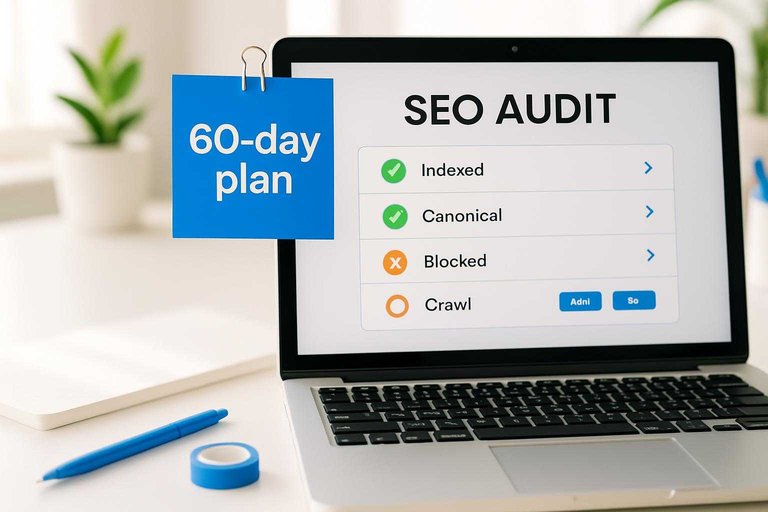
You already have contextual backlinks, but Google may be discounting them for relevance, crawl, or trust signals. Use this 60-day plan to turn “exists” into “counts” before the next index and link graph updates.
- Audit the links as Google sees them: confirm the linking page is indexed, canonical, and not blocked.
- Tighten topical alignment: update the linking page and your target page to share exact entity terms.
- Fix the destination’s link-worthiness: improve above-the-fold clarity, add unique data, and cite sources.
- Create crawl pressure: link to the linking pages from their site, and to your target page internally.
- Re-crawl and re-measure weekly: track index status, referring page changes, and SERP movement by intent.
If rankings still don’t budge after two full crawl cycles, the issue isn’t “link quantity.” It’s link trust or relevance.
You can tighten step #1 by following Google’s guidance on how to specify a canonical URL so link signals consolidate to the version you’re actually measuring.
When to Build More
You’re 60+ days in, and rankings barely moved. Decide with evidence, not vibes.
Use this table to pick the next action based on what you can actually observe.
| What you see | Likely cause | Do this next | Wait before judging |
|---|---|---|---|
| New links indexed, no lift | Page mismatch | Rewrite intent, add sections | 14–21 days |
| Few links indexed | Discovery lag | Improve internal links, resubmit | 14 days |
| Links indexed, impressions up | Early momentum | Keep cadence, add variants | 21–45 days |
| Rankings bounce weekly | SERP volatility | Build fewer, upgrade content | 30 days |
| Strong links, weak CTR | Snippet weakness | Fix titles, add schema | 7–14 days |
If you can’t name the bottleneck, don’t buy more links—change the page or the plumbing first.
Validation and Monitoring
Use this checklist to confirm your fixes worked and to credit movement to links, not noise. Treat it like a lab log, not a victory lap.
- Verify target URL is indexed and canonicalized correctly
- Confirm linking pages are indexed and still dofollow
- Track rankings with tags for pages, keywords, and link dates
- Separate on-page changes from link work using a change log
- Watch SERP shifts like intent changes, features, and competitors
If you can’t isolate the variable, you’re not measuring links. You’re measuring the weather.
Run the 60‑Day Reality Check and Act on the Bottleneck
If rankings haven’t moved after 60 days, don’t assume links “don’t work”—assume a constraint is masking their impact. Use the matrix to pick the most likely root cause, execute the 60‑day fix plan on the destination page and discovery signals, and watch leading indicators (indexing, impressions, query mix) before you judge rank. Only after validation should you decide whether to build more links, consolidate pages, or shift targets to a better-fit SERP.
Frequently Asked Questions
- Do contextual backlinks still matter in 2026, or has Google devalued them?
- Contextual backlinks still matter when they come from relevant pages that Google crawls and trusts. Most “no impact” cases come from weak source pages, thin surrounding context, or links that aren’t consistently discovered and counted.
- How many contextual backlinks should move rankings for a keyword?
- Usually you need enough contextual backlinks to close the authority gap versus the top 3–10 results, not a fixed number. A practical benchmark is to compare your target URL’s referring domains and link quality to ranking competitors using Ahrefs, Semrush, or Majestic.
- How long does it normally take for contextual backlinks to affect rankings?
- Most sites see the first measurable movement within 2 to 8 weeks after the link is crawled, with clearer impact often showing in 8 to 16 weeks. If nothing changes after 60 days, it’s a sign the links aren’t being valued or other ranking factors are overpowering them.
- Can internal links replace contextual backlinks for ranking improvements?
- Internal links can redistribute existing authority and often produce faster wins, but they can’t create new off-page authority the way contextual backlinks do. Use internal linking to amplify the target page while you earn or fix external contextual backlinks.
- Should I use contextual backlinks to the homepage or directly to the ranking page?
- Usually direct contextual backlinks to the most relevant ranking page move the needle faster because the signal lands where it’s needed. Send some links to the homepage only when you’re building overall brand authority or supporting a cluster that will pass equity internally.
Turn Backlinks Into Rankings
If contextual backlinks haven’t moved rankings after 60 days, the issue is usually discovery, link quality, or on-page bottlenecks—not just link volume.
Skribra helps you publish SEO-optimized content consistently and tap into a quality backlink exchange network to support your 60-day fix plan—start with the 3-Day Free Trial.
Written by
Skribra
This article was crafted with AI-powered content generation. Skribra creates SEO-optimized articles that rank.
Share: