February 7, 2026
·
Updated June 3, 2026
·
12 min read
Why SEO Traffic Growth Stalls After 100 Blog Posts
A practical troubleshooter for diagnosing why SEO traffic plateaus after publishing 100+ posts—spot stall symptoms, validate analytics and Search Console data, pinpoint root causes (coverage, quality, authority, technical), and apply consolidation plus a new growth engine to restart compounding gains.

You published consistently, hit 100 blog posts, and expected the curve to keep climbing—then everything just… stalls. Rankings hover, traffic flatlines, and leads stop scaling even though you’re “doing SEO.”
This troubleshooter helps you find the real constraint fast. You’ll map the symptom you’re seeing, verify your data isn’t lying, and work through the most common plateau causes: coverage gaps, quality debt, authority bottlenecks, and technical limiters. Then you’ll leave with a clear fix path—consolidate what’s dragging you down and build a repeatable growth engine.
Stall Symptoms Map
After 100 posts, “stalled” can be normal friction or real decay. Your job is to separate a seasonal plateau from an SEO ceiling using quick, boring checks.
Start with a 90-day view, then verify it’s organic, not brand or direct, doing the weird thing.
Traffic flatlines
A plateau is flat organic sessions with stable rankings. A drop is fewer sessions even when impressions or positions hold.
Check three fast filters: a 90-day organic trend line, last year’s same months for seasonality, and the share of brand/direct versus non-brand organic. If non-brand organic is flat while brand/direct rises, you’re not “growing SEO,” you’re just getting better known.
Once it’s clearly non-brand organic stagnation, you can stop blaming timing and start fixing constraints.
Rankings don’t move
If traffic is flat, rankings usually show the real bottleneck. Pull these signals from GSC and whatever tracker you trust.
- Average position stays within a 1–2 spot band
- No net new top-10 keywords in 60–90 days
- Impressions rise, clicks don’t, CTR slides
- Rankings oscillate, but never break new highs
- More pages rank, but only positions 20–60
If impressions grow without top-10 wins, Google is sampling you, not rewarding you.
Leads stop scaling
You can have stable sessions and shrinking leads when intent drifts. It happens when you publish more TOFU posts while your BOFU pages stay static.
Look at conversions by landing page type: TOFU guides might keep traffic steady, while BOFU pages like “pricing,” “comparison,” or “{category} for {industry}” quietly lose share. That’s how you end up saying, “Traffic is fine, but pipeline feels light.”
Fix intent alignment before you chase more volume, or you’ll scale the wrong audience.
Confirm Data Integrity
Bad inputs make good strategy look broken. Before you change anything, prove your traffic and indexing data is trustworthy.
Steps
- Validate tracking is firing on every template, including blog pagination and tags.
- Compare Google Analytics vs Search Console sessions for the same landing pages.
- Check index coverage for recent posts, then spot-check with
site:yourdomain.com "post title". - Verify canonical, noindex, and robots rules on new posts and category pages—if you need a refresher, use this SEO guide to confirm best practices.
- Audit sudden URL changes: redirects, trailing slashes, and parameter handling.
Root Cause Matrix
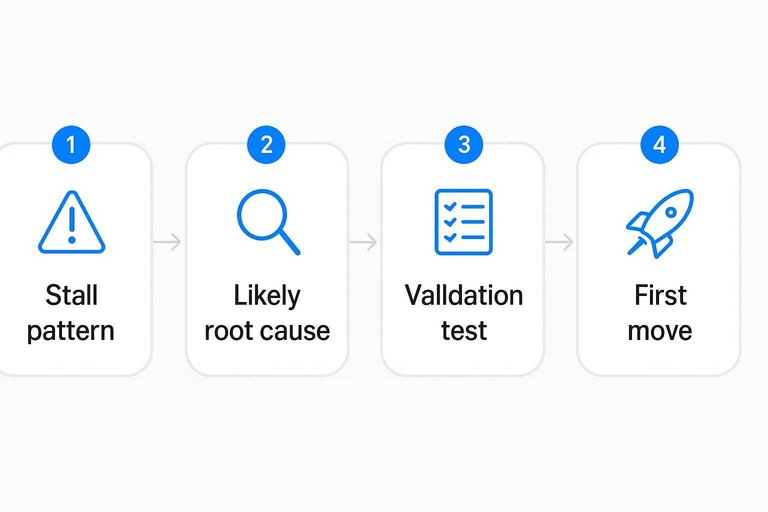
Stalls after 100 posts usually come from a few repeatable patterns. Use this matrix to match what you see to the likeliest cause and the fastest proof.
| Stall pattern you see | Likely root cause | Fastest validation test | First move |
|---|---|---|---|
| Impressions flat sitewide | Demand mismatch | Check top 50 queries | Re-scope topic map |
| Impressions up, clicks flat | Snippet loses | Compare CTR vs peers | Rewrite titles, test SERP |
| Clicks up, traffic flat | Cannibalization | One query, many URLs | Merge, redirect, re-canon |
| Traffic up, leads flat | Intent mismatch | Review top landing paths | Add mid-funnel pages |
| New posts don’t rank | Weak internal links | Crawl depth and links | Build hub, add links |
Pick one row and run the test today. Speed beats certainty here.
Coverage Gaps
After 100 posts, traffic often stalls because your content map has holes. You published “a lot,” but you didn’t build paths that help Google and readers discover more.
No topic clusters
Isolated posts don’t compound because nothing points into them or out of them. In a crawl, they show up as orphan URLs and “hub” pages that are just tag lists.
If you’re seeing dozens of one-off articles like “How to do X” with no shared parent page, you’re missing a cluster. Build one strong hub that explains the category, then link every supporting post back to it.
That’s when rankings start to behave like a portfolio, not a lottery.
Intent mismatch
Your keyword might be right, but your page type can be wrong. Intent mismatch caps you even with solid on-page SEO.
- Targeting “buy” queries with blog tutorials
- Writing guides where the SERP wants product pages
- Skipping comparisons for “X vs Y” keywords
- Missing pricing for “cost” searches
- Ignoring alternatives for “best” queries
Match the page to the SERP, or you’ll keep ranking in positions that never get clicked.
SERP feature shifts
Even when rankings hold, clicks can drop because the SERP changed. AI overviews, featured snippets, and video packs answer the question before your result.
You’ll spot it in Search Console as “impressions up, CTR down” for the same queries. Pull the query list, compare date ranges, then manually check the current SERP layout.
When the SERP steals attention, you need a new angle, not another H2.
Keyword ceiling
You can publish endlessly and still cap out if you only target tiny terms. The ceiling shows up as lots of long-tail pages with no path to mid-tail wins.
- Cannibalizing similar long-tail queries across multiple posts
- Skipping mid-tail “category” keywords entirely
- Avoiding head terms competitors already own
- Rewriting the same intent with new titles
If you don’t take territory in mid-tail, your growth curve will flatten on schedule.
Content Quality Debt
After 100+ posts, your problem often shifts from “not enough content” to “too much weak content.” Thin, stale, and overlapping pages dilute relevance, steal internal links, and drag crawl efficiency. One “okay” post rarely hurts you, but 40 of them will.
Thin pages pileup
Thin pages are the quiet tax on your whole site, because they consume crawl budget without earning trust. You need simple thresholds that trigger a review, then confirmation from real query data.
Flag a URL as thin when you see:
- Low unique value: no original examples, tools, or opinions.
- Weak engagement: short clicks, low scroll, fast back-to-SERP.
- No equity: few internal links, zero external links.
- Overlap: same points repeated across multiple posts.
Confirm with a crawl plus Google Search Console.
Check word count, templates, and near-duplicate clusters in your crawler.
Then pull GSC queries for that URL and ask, “What unique need does it satisfy?”
If you can’t answer that in one sentence, Google can’t either.
Cannibalization
Cannibalization happens when you publish “one more angle” and accidentally compete with yourself. The fix is a quick audit that assigns each query a single owner.
- Export GSC queries with clicks, then group by query.
- Spot queries showing multiple URLs in the results.
- Look for rank “ping-pong” between those URLs across weeks.
- Choose one primary page per query, based on intent match.
- Merge, redirect, or canonicalize the rest to the primary.
Until each query has one home, your rankings will keep oscillating.
Aging content
Old content doesn’t just underperform; it can mislead, which kills trust signals. Use visible staleness cues, then rank fixes by impression volume.
Signs your content is stale:
- Outdated stats, benchmarks, or year references.
- Steps that no longer work in the product.
- Screenshots from old UI versions.
- SERP intent shifted from guides to tools.
- Competitors answer with fresher examples.
Prioritize updates by impressions first, not by your favorites.
High-impression decay is a compounding leak.
E-E-A-T gaps
You can write a “complete” post and still look unqualified to rank, especially in sensitive topics. Missing expertise signals are easy to overlook because they live outside the main body copy.
Add proof where it belongs:
Include an author bio with credentials and a real track record.
Show firsthand evidence, like screenshots, experiments, or results.
Cite primary sources, not recycled roundups.
Publish policy pages, like editorial standards and corrections.
On YMYL topics, the content isn’t judged alone; you are too.
Authority Bottlenecks
You can publish 100 posts and still not earn trust at scale. The pattern is predictable: links go to the wrong places, and nothing accumulates. Think “busy blog” energy, not “reference site” gravity.
Link deficit
Publishing volume can hide a weak link profile for months. Rankings stall when your links don’t map to the pages that need power.
- Too few referring domains to money pages
- Too many links pointing at the homepage
- Low topical relevance from linking sites
- Links clustered on old “viral” posts
- Little anchor text variety beyond your brand
If your best links don’t touch your revenue pages, authority won’t compound.
Unlinkable assets
Opinion-only posts rarely earn citations, even when they’re smart. “Here’s my take” isn’t a source, so writers don’t reference it.
Linkable assets look like utility, not vibes:
- Original data and surveys
- Free tools and calculators
- Templates and swipe files
- Benchmarks and pricing comps
- Curated directories with criteria
Build one asset per quarter, and your link growth stops being accidental.
Internal linking decay
Your internal links rot quietly as the blog expands. Rebuilding them restores flow, and it tells Google what matters.
- Create topic hubs that link to every supporting article.
- Find and fix orphan pages, then place them in a hub.
- Replace vague anchors with descriptive, intent-matching anchors.
- Update navigation to feature hubs, not just latest posts.
- Track crawl depth and reduce clicks to key pages.
When crawl depth drops, your best pages start acting like your best pages. You can also validate crawl pressure and discovery issues in Search Console via the Crawl Stats report.
Technical Growth Limiters
After 100 posts, your problem is rarely “more content.” It’s discovery and efficiency. If Google keeps tripping over your plumbing, new pages arrive late or not at all.
Crawl budget waste
When crawl paths explode, Google spends time on junk instead of your new posts. Faceted URLs, duplicates, and parameter pages create endless near-copies like “?sort=latest” or “/category?color=blue.”
Validate it with data, not vibes. Check server logs for repeated hits on parameter pages, and compare with GSC Crawl stats and Index coverage for “Crawled — currently not indexed.”
Fix the crawl traps, and your next 20 posts get discovered like they matter.
Indexing suppression
Indexing fails quietly, and your traffic chart pays the price. Run these checks, then confirm each in GSC.
- Scan for accidental noindex on templates
- Audit canonicals for wrong target pages
- Find soft-404s and “empty” content
- Remove redirect chains and loops
- Fix sitemap errors and thin tag pages
If GSC can’t show a clean, indexable URL, ranking never even starts.
Performance regressions
Performance usually decays one template change at a time. Measure, fix, then retest.
- Measure CWV by template in PageSpeed and CrUX.
- Isolate template bloat like sliders, trackers, and heavy embeds.
- Fix images and fonts with compression, lazy-load, and preload.
- Reduce JavaScript with removal, defer, and code-splitting.
- Retest, then monitor rankings and CWV in GSC.
Speed fixes compound because Google crawls and users convert faster.
Structured data gaps
Missing schema doesn’t always block rankings, but it blocks eligibility and CTR. When competitors win rich results, your blue link looks like the “plain option.”
Prioritize the basics that map to your content and templates. Article for posts, Breadcrumb for navigation context, Organization for identity, and FAQ only when the page truly contains Q&A.
Your snippets are part of your growth engine, not decoration.
JavaScript rendering traps
Modern stacks can “look fine” to users and still under-deliver to Google, especially when the blog gets big and templates get more dynamic. The failure mode is simple: key content exists, but it’s delayed, injected, or fragmented in ways that make crawling and indexing unreliable.
Common traps to look for:
- Content only appears after client-side rendering, hydration, or user interaction.
- Lazy-loaded components hide primary copy, headings, or internal links.
- Infinite scroll replaces pagination without crawlable, linkable URLs.
- Canonical, meta robots, or structured data are injected by JavaScript and sometimes fail to render.
- Headless CMS previews leak into production with duplicate URLs.
Validate with reality checks, not assumptions:
- Use Google’s URL Inspection to compare what Google says it crawled vs what you see in a browser.
- Test a few templates with JavaScript disabled to see what’s actually in the initial HTML.
- Spot-check internal links: if your nav, related posts, or hub links don’t exist in the source, they don’t reliably pass discovery.
If you find gaps, fix the template so critical content and internal links render server-side (or at least in the initial HTML), and treat “pretty after hydration” as a performance feature—not an indexing strategy. For scale-heavy environments, see how enterprise SEO works at scale for governance and operational guardrails that keep thousands of pages aligned.
Fix: Content Consolidation
You have enough posts. Your problem is fragmentation.
- Export your URLs with clicks, impressions, and top queries.
- Flag pages with overlapping intent, thin depth, or zero clicks in 90 days.
- Pick one “keeper” URL per topic, then merge the best sections into it.
- 301 redirect pruned URLs to the keeper, then update internal links and sitemaps.
- Refresh the keeper for 2026 intent: tighter intro, better examples, stronger entities.
Consolidation turns 12 weak pages into one page Google can trust. Use canonicalization and redirects correctly to consolidate duplicate URLs without sending conflicting signals.
Fix: New Growth Engine
Your growth stalled because your posts stopped reinforcing each other. You need a system that compounds: clusters, linkable assets, distribution, and a steady refresh loop.
Think “one pillar, many spokes,” not “another random post.” That’s how you turn 100 posts into a network.
Rebuild topic map
Pick 3–5 pillars because focus creates internal gravity and clearer rankings. Then map subtopics by intent so each page has a job.
Define one primary URL per query set, and treat everything else as support.
When two URLs chase the same intent, you’re not expanding coverage. You’re splitting wins.
Create linkable assets
You need pages people cite, not just pages they skim. Build assets that earn links, then wire them into your clusters.
- Data study: pitch journalists, earn links, feed pillar pages
- Calculator: target comparison posts, embed internally, attract tools pages
- Template: reach communities, drive shares, power “how-to” clusters
- Glossary: capture definitions, win sitelinks, support every pillar
If your outreach has nothing worth referencing, you’re asking for favors. Give people something to link to.
Refresh cadence
Set a refresh rhythm because SEO decays quietly. Treat updates like product work, not random cleanup.
- Plan a quarterly refresh sprint with owners and a fixed scope.
- Pull top pages by impressions, then sort by slipping position.
- Update winners first: content gaps, examples, internal links, schema.
- Annotate changes, then compare pre/post in Google Search Console.
- Repeat with a simple log: page, change, date, outcome.
If you can’t measure the update, you can’t scale the habit.
Optimize for CTR
Rankings plateau when your snippet stops winning clicks. Rewrite titles and metas for outcomes, using language like “template,” “checklist,” or “in 10 minutes.” If you’re hitting workflow friction, see fixing content bottlenecks with smart AI to speed up iteration without breaking quality.
Add rich results where you’re eligible, and match your page format to what the SERP rewards now.
Your fastest growth lever is often the one above the fold. The snippet.
Restart Compounding Growth With a 30-Day Reset
- Pick the dominant symptom (flat traffic, stuck rankings, or stalled leads) and confirm tracking is clean in GA/GSC before changing anything.
- Use the root cause matrix to choose one primary constraint (coverage, quality, authority, or technical) and ignore “nice-to-fix” items for now.
- Consolidate first: merge cannibal pages, prune/redirect thin posts, and strengthen internal links to the single best URL per intent.
- Then rebuild the engine: refresh on a set cadence, publish into clear topic clusters, add one linkable asset per cluster, and optimize titles/snippets for CTR so the next 100 posts actually compound.
Frequently Asked Questions
- Does publishing more than 100 blog posts still help SEO traffic growth in 2026?
- Usually yes, but only when new posts expand topical coverage or earn new links. After ~100 posts, growth more often comes from strengthening clusters, updating winners, and building authority—not just increasing volume.
- How long should it take to see SEO traffic growth after refreshing or consolidating old posts?
- Expect early movement in 2 to 6 weeks (re-crawls, re-indexing, rank volatility) and clearer traffic impact in 8 to 16 weeks. Faster changes happen on high-authority sites or when updates target pages already ranking in positions 5–20.
- What KPI should I track to prove SEO traffic growth is compounding again (not just random spikes)?
- Track non-branded organic clicks and the number of keywords in top 3/top 10, segmented by topic cluster. In Google Search Console, consistent week-over-week gains in “queries with impressions” plus improving average position across a cluster usually signals compounding.
- Can programmatic SEO or AI content fix stalled SEO traffic growth after 100 posts?
- It can, but only if it produces unique pages with distinct search intent and supports internal linking and quality thresholds. If the pages are templated duplicates, they often increase index bloat and slow growth instead of accelerating it.
- Should I stop publishing new posts when SEO traffic growth stalls, or keep posting?
- Keep publishing, but reduce volume and raise intent depth until performance rebounds. A common approach is a 60/40 split for 4–8 weeks: 60% updates/consolidation and 40% new cluster pages that fill proven gaps.
Restart SEO Traffic Momentum
Once you’ve mapped stall symptoms, verified data integrity, and addressed consolidation, the hard part is sustaining consistent coverage, quality, and authority gains week after week.
Skribra helps you build a new growth engine with daily SEO-optimized content, WordPress publishing, and built-in backlink exchange—so you can push past the 100-post plateau with a 3-Day Free Trial.
Written by
Skribra
This article was crafted with AI-powered content generation. Skribra creates SEO-optimized articles that rank.
Share: