February 16, 2026
·
Updated August 3, 2026
·
12 min read
Why your SEO agency's AI-generated content isn't ranking
A practical troubleshooter for diagnosing why AI-generated SEO content fails to rank—separate visibility from rankings, identify indexing/crawl blockers, fix intent and E‑E‑A‑T gaps, reduce over-optimization and thinness, and repair internal linking and scale QA.

Your agency shipped dozens of AI-written pages, but rankings didn’t move—or they rose briefly and then vanished. Is Google “detecting AI,” or is something more basic breaking the page’s ability to compete?
This troubleshooter helps you pinpoint the real failure mode fast. You’ll run quick triage checks, rule out indexing and rendering issues, align pages to SERP intent, add the E‑E‑A‑T and information gain signals AI drafts usually miss, and clean up internal linking and publishing processes so improvements stick.
Triage the Problem
Before you blame “AI content,” confirm you’re seeing a ranking problem and not bad measurement. A page can be “published” and still be invisible because of indexing, canonicals, or intent mismatch.
Ranking vs visibility
You’re looking for symptoms that separate “Google can’t find it” from “Google won’t rank it.” The difference shows up fast in Search Console and in the SERP itself.
- Indexed but not ranking: Usually relevance, weak authority, or thin duplication signals.
- Impressions without clicks: Usually poor query match, weak snippet, or SERP feature crowding.
- No impressions at all: Usually not indexed, canonicalized away, or blocked from serving.
Treat impressions as your “eligibility” signal, not your “quality” score.
Fast diagnostic checks
Do these checks in order, because each one narrows the search space. Keep notes like “indexed, canonical = self, impressions = 0.”
- Check GSC Performance for impressions and queries.
- Check GSC Indexing for “Indexed” vs “Discovered.”
- Run a
site:example.com "target phrase"query. - Use URL Inspection to confirm last crawl and indexing.
- Verify canonical, robots, and rich result eligibility.
If you can’t prove indexing and eligibility, content quality is a distraction.
Decide the failure mode
Pick one dominant failure mode per URL, or you’ll chase ghosts. Mixed signals happen, but one usually leads.
- Not indexed: Crawl, canonical, noindex, duplication, or internal linking gaps.
- Indexed but suppressed: Weak helpfulness, low trust, or “same as everyone” content.
- Ranks then drops: Freshness decay, intent mismatch revealed, or quality reevaluation.
- Ranks for wrong intents: Keyword mapping errors, unclear topic, or template-driven copy.
Name the failure mode first, then fix the system that creates it.
Indexing and Crawl Barriers
Publishing 200 AI pages is easy. Getting Google to crawl, render, and keep them indexed is the hard part.
When pages look duplicated or technically fragile, Google treats them as optional. Your “published” URLs become ghosts.
Duplication and canonicals
AI at scale creates patterns fast. Google notices faster.
Templated intros like “In today’s fast-paced world…” and repeated H2s across dozens of URLs blur uniqueness. If your canonical tags also point to a hub page, a category, or the wrong locale, you consolidate signals away from the page you want ranking.
That’s the line that gets crossed: you didn’t just duplicate content. You told Google which page should win, and it wasn’t your target.
Quality indexing signals
Do this in order, or you’ll waste time on re-crawl requests.
- Merge or rewrite thin and duplicate clusters into one stronger page.
- Add internal links from real traffic pages with specific anchors.
- Update XML sitemaps to include only index-worthy URLs.
- Request indexing only after the on-page changes ship.
Indexing requests don’t create quality. They only retest what you already published. For a deeper framework you can apply across templates and clusters, see this SEO guide for indexing.
Rendering and speed issues
Even good content won’t rank if Google can’t reliably fetch and interpret it.
- JavaScript rendering gaps hide main content.
- Blocked resources break layout and signals.
- Slow TTFB reduces crawl throughput.
- Soft 404s look like empty pages.
- Pagination traps multiply useless URLs.
If crawling is expensive, Google spends its budget elsewhere. Your “scale” becomes self-sabotage.
Intent Mismatch
AI content often nails the keyword and still fails the assignment. You get a page about “best project management software” that reads like a dictionary, not a shortlist. Google watches the bounce, the pogo-sticking, and the weak clicks.
SERP intent patterns
Before you write, check what Google already rewards for that query. If the top results are “how-to guides” and you publish a feature page, you’re asking for a mismatch.
Look for these repeatable SERP winners:
- Guides and listicles for “best,” “top,” “vs,” “alternatives”
- Product pages for branded and “pricing” queries
- Tools and calculators for “estimate,” “calculator,” “template” queries
- Local packs for “near me,” “open now,” and service keywords
- Forums for messy, subjective “what should I choose” searches
Match the dominant format, depth, and angle, then differentiate inside that box. That’s how you stop writing the wrong kind of page.
Query-to-page mapping
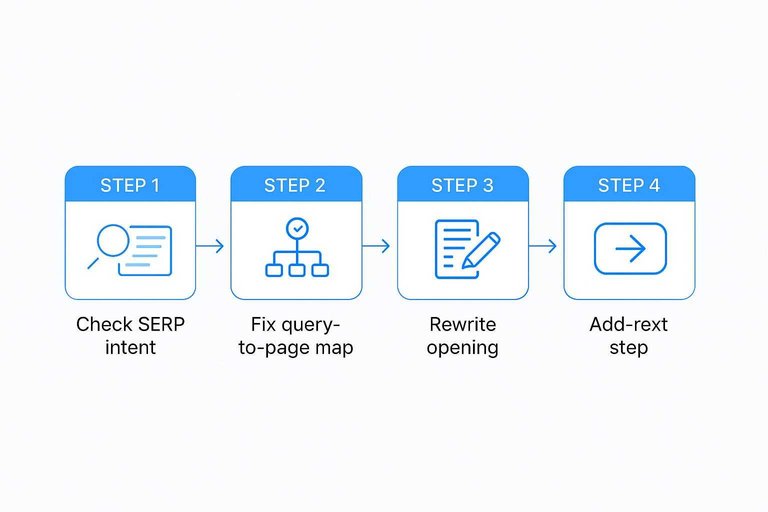
Most AI content fails in planning, not prose. Your map from query to page type is off.
Common mapping errors:
- One page targets four different intents
- Bottom-funnel query gets a top-funnel explainer
- Modifiers get ignored: “for teams,” “for schools,” “cheap,” “enterprise”
- “People Also Ask” subtopics get skipped
- Comparison query gets a generic overview
Fix the map first, then write. Rankings follow alignment, not volume.
Rewrite for task success
Treat the query like a job your page must complete. If the searcher can’t finish the task, they leave.
- Rewrite the opening to confirm the exact intent in one sentence.
- Add decision criteria the reader can actually use.
- Include one concrete example for each major option.
- Answer the key PAA questions with short, direct sections.
- Add a clear next step: buy, compare, download, or contact.
When your page completes the job, engagement stops being a problem. Then ranking becomes possible.
E-E-A-T Deficits
Credibility is the quiet ranking factor your competitors are stacking. AI pages often read smooth, but they don’t look lived-in.
Missing firsthand signals
If your page could have been written without touching the tool, Google and readers can feel it. “We tested it” lands differently when there’s no evidence you actually did.
Competitors show receipts: screenshots, logged results, real constraints, and the ugly edge cases. They include mini case studies, sample inputs and outputs, and photos from the process. They share tested procedures with specific steps, timing, and failure modes.
Add one verifiable artifact per key claim, or you’ll keep losing to pages that look real.
Authority proof checklist
Your content needs trust scaffolding, not just good phrasing. Add signals a reviewer can verify in seconds.
- Add an author bio with relevant experience
- List credentials, licenses, or certifications
- Cite primary sources and standards
- Include original images or screenshots
- Publish methodology and test conditions
- Show last updated timestamps
- Link editorial policy and review process
- Provide About and Contact pages
If a skeptical reader can’t audit you fast, you don’t get the click—or the ranking.
YMYL risk controls
Finance, health, and legal pages get less benefit of the doubt. A confident paragraph with no sourcing can be treated like misinformation.
You need expert review that’s visible, not implied. Use clear disclaimers, limit claims to what you can prove, and cite primary sources like regulations, studies, or official guidance. Avoid definitive promises, especially around outcomes, safety, or compliance.
In YMYL, conservative beats clever, and “show your work” beats “sound smart.” If you’re weighing when AI is acceptable versus when a human expert is non-negotiable, see AI content vs human writers.
For how Google frames quality and intent with AI, reference Google’s guidance about AI-generated content.
Over-Optimized Text
Over-optimization is the fastest way to make “AI content” feel cheap, even when it’s technically correct. Google doesn’t need to detect a model to suppress you; it only needs enough low-value signals to decide users won’t be satisfied.
Keyword pattern symptoms
These patterns show up when someone optimized for a crawler, not a reader. They’re also the easiest footprints to spot at scale.
- Repetitive exact-match internal anchors
- Unnatural, keyword-stuffed headings
- Boilerplate FAQs pasted everywhere
- Entity stuffing without new meaning
- Identical paragraph rhythm across pages
If you can predict the next sentence, so can the algorithm.
Readability and voice
Robotic tone reads like “here are the benefits” content, and users bounce fast. When there’s no point-of-view, nobody cites you, links you, or shares you.
On-page fixes
Fix the page like a human editor would, not like an SEO checklist would. Keep the keywords, but kill the patterns.
- Simplify headings into real questions and clear claims.
- Cut filler sentences that say nothing new.
- Add one unique insight, example, or constraint per section.
- Use natural phrasing, including synonyms and implied terms.
- Vary internal anchors to match intent, not exact keywords.
Do this across templates, and your whole site stops looking mass-produced.
Thin Content Footprint
Long AI content can still be thin when it adds zero new information to the SERP. If every paragraph rephrases what already ranks, you’re competing on vibes. Google can’t reward “more words” when the reader gets no new leverage.
Subsections: [
{
“subheading”: “Information gain test”,
“content”: “Run a simple audit: your page versus the top three results, side by side. You’re hunting for what only you provide, not what you can paraphrase.\n\nPull the ranking pages into a doc and mark every concrete item: tools mentioned, datasets cited, screenshots, edge cases, step-by-step processes, and real examples. Then mark your draft the same way and count the uniques: original templates, fresh numbers, a named workflow, or a specific "if X, do Y" rule. If you can’t point to at least a few items a competitor cannot copy from memory, you didn’t add information.\n\nThat’s the line between "helpful" and "interchangeable."”,
“description”: “Explain how to compare against top results and identify what’s missing: tools, datasets, examples, edge cases, or process details.”
},
{
“subheading”: “Upgrade with assets”,
“content”: “Add assets that make your page harder to replace and easier to use. The goal is to ship something a reader can apply in minutes.\n\n- Fill-in templates for common tasks\n- Simple calculators with clear inputs\n- One-page checklists for execution\n- Copy-paste code snippets or prompts\n- Decision trees for common scenarios\n\nWhen you add assets, you stop competing on wording and start competing on utility. If you’re troubleshooting why autoblogging output keeps getting flagged as thin, this <a href="https://skribra.com/blog/9-autoblogging-mistakes-that-trigger-thin-content-issues">autoblogging thin-content mistake checklist can help you pinpoint the specific pattern.”,
“description”: “List assets to add: templates, calculators, checklists, code snippets, decision trees, comparison tables, and downloadable PDFs.”
},
{
“subheading”: “Section-level rewrites”,
“content”: “Rewrite only the parts that leak value, not the whole article. You want dense sections that earn their place.\n\n1. Identify sections with no specifics, just advice.\n2. Add one concrete example for each major claim.\n3. State constraints, thresholds, or edge cases that change the answer.\n4. Introduce a named framework readers can reuse tomorrow.\n\nDo this and your content stops sounding "correct" and starts being useful.”,
“description”: “Give steps: prioritize weak sections, add examples per claim, include constraints, and create a unique framework readers can apply.”
}
]
Internal Linking Failures
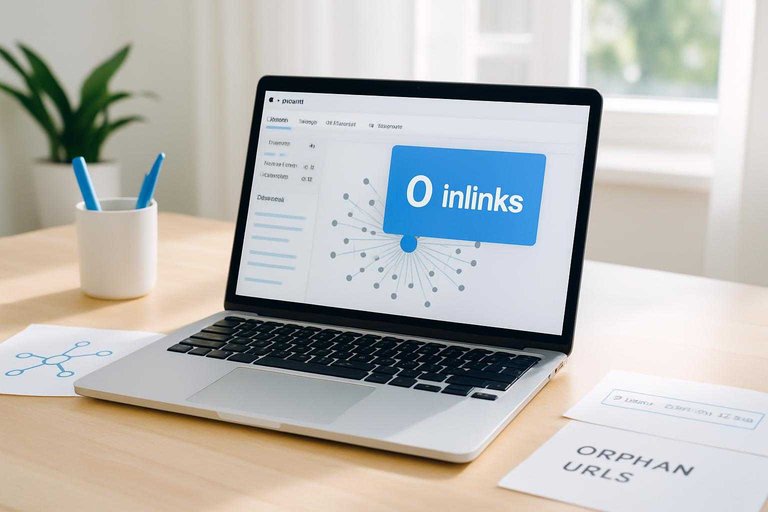
AI pages fail quietly when your site doesn’t “vote” for them. They get published, indexed, then left to float with no meaningful internal links.
Without links, PageRank can’t reach the page and Google can’t place it in your topical map. You end up with lots of content and very little reinforcement.
Orphan page detection
Orphans happen when pages exist in URLs, not in your link graph. Find them fast, then decide whether to link, merge, or kill.
- Crawl report: “0 inlinks” pages
- GSC: Internal Links report gaps
- Analytics: landings with no referrers
- Sitemap-only URLs with traffic
If a page only exists in a sitemap, it’s basically a suggestion.
Topic cluster design
A topic cluster is a hub page with spokes that answer narrower questions. It gives Google a clear hierarchy and gives users a path.
Your hub targets the head term, while supporting articles cover subtopics and comparisons. Use anchors and nearby copy that sound like a human sentence, like “see our pricing checklist,” not “best pricing checklist software cheap.”
If your anchors read like prompts, you’re teaching Google to distrust your intent.
Linking repair steps
Fixes work when you treat internal links like infrastructure, not decoration.
- Build hub pages for each priority topic.
- Add contextual links from your highest-authority pages.
- Fix breadcrumbs so every page has a crawlable path.
- Standardize navigation for your key sections.
Do this once, and every new page ships with distribution baked in.
Make sure you follow link best practices for Google so your internal links are crawlable and count.
AI Content at Scale
Scaling AI content is rarely the problem. Scaling weak operations is.
When your agency mass-publishes “good enough” drafts, you don’t get 50 new pages. You get a sitewide quality tax that drags everything down.
Briefs that fail
Most AI SEO pages don’t fail in the draft. They fail in the brief.
If your prompt sounds like “write an SEO blog about X,” you’ll get generic copy, generic structure, and generic rankings.
A good brief must specify:
- Search intent and job-to-be-done
- Clear angle and point of view
- 2–3 real examples to include
- Allowed sources and required citations
- Primary CTA and conversion goal
Your brief is the strategy. The model only executes.
Quality assurance pipeline
Quality has to be enforced, not hoped for. Build QA gates that stop bad pages early.
- Check plagiarism and near-duplication
- Verify facts, claims, and numbers
- Review SERP gaps and missing sections
- Run a style and tone pass
- Validate internal links and anchors
If QA is optional, mediocrity becomes your default.
Publishing throttles
Publishing speed is a lever, not a KPI. Use throttles to protect quality signals.
- Release content slowly, in small batches.
- Decide “update vs publish” before writing anything.
- Prune or merge low performers after enough data.
- Measure impact on rankings and crawl behavior.
Scale only after the system proves it can hold quality.
Competitor Reality Check
You and your competitors can target the same keywords and still get very different results. Rankings usually follow proof, not promises.
| Competitor advantage | What they publish | What Google reads | Your fix |
|---|---|---|---|
| Firsthand experience | Original photos, screenshots | Real-world signals | Add field notes |
| Clear point of view | Strong claims, specificity | Intent satisfaction | Take a stance |
| Better internal links | Hubs, contextual anchors | Topical depth | Build content clusters |
| Stronger credibility | Authors, references | Trust signals | Add expert sources |
| Faster iteration | Updates, pruning | Freshness, focus | Refresh monthly |
If their pages look “similar” but rank, you’re missing the non-keyword signals that decide winners.
Google’s stance on AI-generated content in 2026 (and how to align)
Google’s guidance has been consistent on one core point: it’s not “AI content” that’s the problem—it’s unhelpful content. If an AI SEO agency is producing pages that don’t add clear value beyond what already exists, Google’s systems can treat that output as low quality, regardless of whether it was written by a human, a model, or a mix of both.
In practice, many AI-driven workflows fail because they optimize for volume and surface-level completeness (keywords covered, headings filled, FAQ appended) instead of demonstrable usefulness. The result is content that looks “right” but behaves like spam: interchangeable, unoriginal, and detached from real user needs. Aligning with Google’s current stance means building an editorial and production process where AI supports quality—rather than substituting for it.
Quality and helpfulness: what Google actually rewards
Google’s helpful content signals are reinforced by what users do after they click. If people bounce, pogo-stick back to results, or don’t engage because the page didn’t solve the problem, that’s a pattern your rankings can’t hide from.
To align, an AI SEO agency needs to ship pages that:
- Demonstrate first-hand understanding of the query. Include decision criteria, constraints, edge cases, and trade-offs that only show up when you’ve actually worked with the problem.
- Make the user’s next step obvious. Templates often describe; helpful pages guide. Add checklists, step-by-step flows, and “if/then” paths that map to real scenarios.
- Add something net-new. Original explanations, proprietary frameworks, annotated examples, screenshots you created, or comparisons you assembled—anything that isn’t a remix of the current top results.
- Avoid “coverage for coverage’s sake.” A page that tries to answer everything often answers nothing well. Go deep on the job-to-be-done rather than expanding word count.
Spam policies: when AI output crosses the line
Google’s spam policies target manipulative behaviors and scaled production of low-value pages. AI makes it easier to mass-produce content, which is why many AI programs accidentally recreate patterns Google is designed to suppress.
Common AI-driven risk patterns include:
- Scaled, templated pages with minimal differentiation (location pages, service variants, programmatic “best X for Y” lists) where the only change is swapped nouns.
- Expired-domain or repurposed-site tactics used to publish unrelated AI content under an existing authority footprint.
- Near-duplicate rewrites of competitor content that add no unique perspective or utility.
- Auto-generated pages targeting long-tail queries without real intent validation (creating pages because keywords exist, not because users need that page).
If your site has a sudden expansion of similar pages, thin category descriptions, or repetitive introductions and conclusions, it can look like scaled content abuse even if there was no malicious intent.
How to use AI without triggering “unhelpful” patterns
AI can be aligned with Google’s expectations when it’s treated as a drafting and research assistant inside a quality-controlled system.
A practical alignment checklist for an AI SEO agency:
- Start with information gain requirements. Before drafting, define what the page must contribute that isn’t already ranking: unique examples, a point of view, a process, a comparison matrix, or real-world constraints.
- Build human verification into the workflow. Require SMEs or practitioners to validate claims, add nuance, and remove generic filler. If no one can stand behind the content, it’s not ready.
- Cite and attribute where appropriate. Don’t invent sources or imply experience you don’t have. When referencing standards, documentation, or official guidance, link to the primary source.
- Tighten to the intent, not the keyword map. Delete sections that exist only because a tool suggested them. A shorter page that fully resolves the query often outperforms a longer one that rambles.
- Differentiate at the template level. If you must scale, ensure each page has a unique angle: different examples, different decision criteria, different internal links, different media, and different “next steps.”
- Track engagement signals and rewrite aggressively. Treat publishing as the start. If pages aren’t satisfying the query, refresh them with clearer answers, better structure, and more specific guidance.
What to do if you suspect an algorithmic demotion
If rankings dropped after a large AI content push, assume the issue is systemic. Google’s systems evaluate site-wide patterns, so a subset of low-value pages can drag down the perceived quality of the domain.
Actions that tend to help:
- Audit for low-value clusters. Group pages by template/type and identify which clusters are thin, duplicative, or misaligned with intent.
- Consolidate or remove pages that can’t win. Merge overlapping articles, redirect duplicates, and noindex pages that exist only to capture marginal keywords.
- Rewrite “money pages” first. Prioritize pages tied to conversions and core topics. Add expertise, specificity, and proof of real-world understanding.
- Improve transparency. Clear authorship, editorial review notes, and accurate about/contact pages won’t fix weak content—but they reduce trust gaps when quality is otherwise strong.
The goal isn’t to prove you didn’t use AI. The goal is to prove the page deserves to exist and is the best next click for the query.
Run the 30‑Minute Fix-First Audit
- Pick the failure mode: Is the page indexed but not ranking (relevance/quality), not indexed (technical/signals), or ranking for the wrong queries (mapping/intent)?
- Confirm crawl + index health: Check canonicalization, duplication, rendering, speed, and whether Google is choosing a different URL than you intended.
- Match SERP intent before rewriting: Compare top results’ format and task, then adjust the page to solve the same job-to-be-done with clearer structure.
- Add proof and information gain: Inject firsthand experience, sources, original examples/assets, and section-level upgrades that create a defensible reason to rank.
- Repair discovery + scale controls: Fix orphaning with cluster links, throttle publishing, and enforce a QA pipeline so each new AI page meets the same bar as your best human-edited work.
Frequently Asked Questions
- Should I fire my AI SEO agency if the AI-generated content isn’t ranking after 90 days?
- Not automatically. Give them 90 days only if they can show measurable leading indicators (indexation stability, impressions growth in GSC, improved query mix, and new links/internal links); if those aren’t moving within 4–8 weeks, you likely need a new strategy or partner.
- How can I tell if my AI SEO agency’s content is being “suppressed” by Google versus just stuck in competition?
- Check Google Search Console for pages that are indexed but get near-zero impressions across many queries and stay flat for 6–8 weeks, even after internal links and updates. If competitors rank quickly for similar intent while your pages don’t earn impressions, that’s usually a quality/value signal problem, not just competition.
- Can an AI SEO agency still rank content in 2026, or is AI content a lost cause?
- AI-assisted content can rank in 2026 when it adds clear information gain (original data, expert input, real examples, unique POV) and is edited to meet user intent. Pure “prompted” content without proof, experience, or differentiation usually plateaus or declines.
- What should I demand from an AI SEO agency in their content brief to improve rankings?
- Require a brief that includes the exact search task (not just keywords), unique sources to cite (internal data, SMEs, screenshots, quotes), and a “what will be new vs top 5 results” section. Also specify deliverables like FAQs, comparison tables, and update cadence (e.g., refresh at 30 and 90 days based on GSC queries).
- Is it better to use AI SEO tools in-house instead of hiring an AI SEO agency?
- Often yes if you have a subject-matter expert and an editor who can QA accuracy, add original insights, and ship updates weekly. An agency is usually worth it when they can also deliver technical fixes, editorial ops, and measurable performance reporting—not just content production.
Fix AI Content That Ranks
If your agency’s AI posts aren’t moving the needle, the issue is usually execution: intent, E-E-A-T signals, internal links, and crawlability working together.
Skribra turns those ranking factors into a repeatable workflow—daily SEO-optimized articles, WordPress publishing, and backlink exchange support—so you can scale without the thin-content traps; start with the 3-Day Free Trial.
Written by
Skribra
This article was crafted with AI-powered content generation. Skribra creates SEO-optimized articles that rank.
Share: