June 2, 2026
·
8 min read
7 AI SEO platform mistakes costing organic clicks
A hands-on troubleshooter for fixing AI SEO platform mistakes that quietly drain organic clicks — align KPIs to real objectives, clean and validate inputs (crawl/GSC/analytics), restore SERP context, stop cannibalization loops, improve over-optimized AI content, and sanity-check technical “fixes.”

If your AI SEO platform says you’re doing everything right but clicks keep slipping, the problem usually isn’t “more keywords” or “more content.” It’s that the system is optimizing the wrong thing, on messy inputs, with little understanding of what the SERP is actually rewarding.
This troubleshooter helps you isolate seven common failure points—objective mismatch, data gaps, SERP feature blindness, cannibalization, over-optimization, and technical changes that backfire—so you can correct the workflow, not just the output.
Misaligned SEO objectives
AI SEO platforms are great at optimizing whatever you measure. If your objectives are off, you’ll get “wins” that don’t pay rent.
Wrong KPI mapping
If your dashboard celebrates rankings while clicks fall, your KPI wiring is broken. Fix the mapping between what you track and what you actually ship.
- Rankings rise, clicks stagnate on the same URLs
- Search volume grows, conversions stay flat on landing pages
- More indexed pages, more zero-click queries in GSC
- More keywords tracked, fewer sessions on priority content
Quick KPI-to-task mapping
- Clicks per query → rewrite titles, improve snippet match
- Qualified sessions → align intent, upgrade internal linking
- Conversions → refine CTA, match offer to query
- Revenue pages coverage → build clusters, fix cannibalization
If a KPI doesn’t trigger a concrete task, it’s a vanity metric.
Intent drift signals
Intent drift happens when the platform chases keyword patterns, not buyer intent. You can spot it fast by reading the SERP like a product spec.
Check these signals:
- SERP features dominate: maps, shopping, “Top stories,” or videos crowd out blue links.
- Query modifiers shift: “best,” “vs,” “template,” “near me,” “pricing,” “login,” “examples.”
- Landing-page mismatch: you rank with a blog post for a “pricing” query.
Imagine a page optimized for “best project management tool” that starts targeting “project management template.” You’ll attract browsers, not buyers.
When modifiers and page type don’t match the SERP’s pattern, your platform is optimizing the wrong job.
Goal reset workflow
Reset goals inside the platform so it optimizes for outcomes, not activity.
- Pick primary pages that must win, like money pages and key hubs.
- Assign target queries per page, grouped by shared intent and SERP pattern.
- Define success checks, like click lift, qualified sessions, and conversion actions.
- Set reporting cadence in-platform, with alerts for drops on priority URLs.
- Tie every recommendation to an owner and a shipping date.
Once goals are explicit, you’ll notice which “SEO wins” you should ignore—use a clear SEO guide for setting objectives to keep KPIs tied to outcomes.
Garbage input data
AI SEO platforms don’t “discover” truth. They extrapolate from whatever you feed them.
If your crawl, GSC, or keyword set is incomplete, the recommendations get confident and wrong.
Crawl coverage gaps
Missing URLs create fake winners and invisible losers, especially on large sites. Verify coverage before you trust any audit output.
- Blocked by robots.txt or headers
- Canonical points elsewhere
- Parameter loops and traps
- Auth walls and IP blocks
- Crawl budget throttled
If you can’t explain what’s missing, you can’t trust what’s “optimized.”
GSC and analytics sync
Most “click insights” issues come from mismatched sources, not bad SEO. One bad connector choice can rewrite your entire narrative.
A wrong GSC property drops whole subdomains or folders. Sampling and view filters hide long-tail queries and low-volume pages. Timezone mismatches shift day-to-day trends, which breaks annotations and tests. Attribution differences can make “SEO wins” look like paid or email.
Fix the wiring first, or you’ll optimize for ghosts. For a closer look at how the core metrics are defined, review Google’s documentation on the Performance report in Search Console.
Keyword list pollution
Dirty keyword sets push irrelevant tasks and muddy reporting. Clean them until every term has a real page-home.
- Deduplicate by intent, not spelling.
- Remove irrelevant locales and language variants.
- Separate branded terms into their own bucket.
- Drop keywords that don’t match any page topic.
- Map remaining keywords to specific URLs.
Clean inputs turn “AI ideas” into actual page decisions.
SERP context blindness
AI SEO platforms can generate clean recommendations that fail in messy SERPs. Forums, video packs, local intent, and product grids change what “good content” even is.
Treat the SERP like the spec. Your tasks should conform to it, not argue with it.
Feature mismatch
A platform might recommend “write a blog post” because the keyword looks informational. But the SERP might reward a video carousel, a local pack, a product grid, or forum threads.
Imagine “best running shoes for flat feet” showing mostly category pages and filters. A 2,000-word blog post can be perfectly written and still lose.
Match the format first, then optimize within that format.
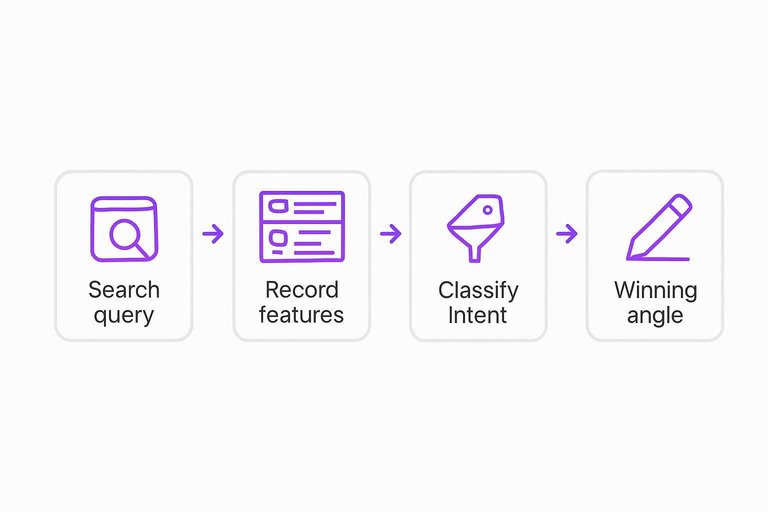
Manual SERP spot-check
Run this before you accept any high-effort task.
- Search the query in an incognito window and note the first impression.
- Record dominant features: forums, video pack, local pack, shopping, snippets.
- Classify intent: learn, compare, buy, find local, solve fast.
- Note E-E-A-T cues: author bios, firsthand photos, UGC depth, brand signals.
- Write the winning angle in one line, then map tasks to it.
If your plan doesn’t fit what Google is already rewarding, you’re optimizing the wrong thing.
Choose the right format
Once you see the SERP pattern, swap the deliverable, not just the keywords.
- Replace a blog with a category page and filters.
- Add a comparison block for “X vs Y” SERPs.
- Ship a template or checklist for “how to” queries.
- Add an FAQ section when PAA dominates.
- Publish a short video when video packs lead.
Format is leverage. Get it right and every other optimization starts working.
Keyword cannibalization loops
AI SEO platforms love coverage. They also love variations. When those variations become separate pages, you get self-competition and weaker clicks.
Cannibalization symptoms
Cannibalization hides in plain sight, because each page looks “reasonable” in isolation. You need a few repeatable signals that scream overlap.
- Rotating URLs for one query in GSC
- Rankings that swap positions weekly
- Thin variants with near-identical intent
- Internal links split across two answers
- Titles that differ by one word
If you see URL rotation plus split internal links, you’re watching a loop, not growth.
One-query-one-page rule
You need a default decision your platform cannot “outvote.” Make one URL the owner of the query, then enforce it.
- Pick the primary URL with best links and cleanest intent match.
- Merge unique sections from variants into the primary page.
- 301 redirect true duplicates; noindex weak holdouts you must keep.
- Update internal links to point only to the primary URL.
- Add a platform rule: block new pages targeting that exact intent.
Once the rule exists, your platform stops creating “helpful” duplicates and starts compounding signals.
Canonical and redirect sanity
After consolidation, your technical signals must agree. If canonicals say one thing and redirects say another, bots will keep testing alternates.
Set the primary page to self-canonical. Redirect merged URLs directly to it, one hop only. Keep only the primary URL in your sitemap, and remove the rest. Google’s guidance on consolidating duplicate URLs covers how these signals should align.
Over-optimized AI content
AI rewrites can hit every keyword and still lose clicks. The page starts sounding interchangeable, so the searcher chooses a result that feels real.
Imagine a product comparison page where every section uses the same safe phrasing. It ranks, but it doesn’t convince—use an AI SEO tools for content teams to add specificity and proof without bloating the copy. If you want a benchmark for what “lift” can look like when the workflow is working, see AI SEO platform results after 30 days.
Subsections: [
{
“subheading”: “Thinness red flags”,
“content”: “Thin pages look “optimized” but feel empty, so people bounce back to the results.\n\n- Generic intro with no stakes\n- Repeated subheads across sections\n- No specifics, numbers, or names\n- Examples that could fit any site\n- Advice with no constraints\n\nIf you can swap your brand name and nothing changes, you’ve got thinness.”
},
{
“subheading”: “E-E-A-T upgrades”,
“content”: “You don’t need more words. You need proof you touched the work, own the page, and can be checked.\n\n1. Add one first-hand detail per key claim.\n2. Name an editor or reviewer with a role line.\n3. Cite primary sources where possible, with dates.\n4. Add one unique image or annotated screenshot.\n5. Publish a clear owner and update policy in-page.\n\nDo this and your “AI page” starts reading like a maintained asset.\n\n \n\n”
\n\n”
},
{
“subheading”: “Snippet-first rewriting”,
“content”: “Most CTR losses happen before anyone reads your body copy. Fix the title, H1, and first screen so intent is answered immediately.\n\nWrite titles like a promise, not a keyword pile. Use the H1 to clarify who it’s for and what decision it helps. Then open with a direct answer, a tight qualifier, and one concrete proof point, like a screenshot, a rule of thumb, or a quick comparison.”
}
]
Broken technical fixes
AI SEO platforms love to ship “safe” technical tweaks at scale. Many of them collide with your CMS, templates, and crawl reality.
| Platform-generated change | Why it backfires | Validate before deploying |
|---|---|---|
| Canonical tag rewrite | Points to wrong URL | Crawl sample pages |
| Robots.txt tightening | Blocks key folders | Test in GSC |
| Nofollow internal links | Starves PageRank flow | Check link graph |
| Auto 301 redirect rules | Chains or loops | Run redirect crawl |
| “Thin page” noindex | Deindexes valuable pages | Compare queries + pages |
Treat technical fixes like code. Stage, test, then ship.
Run a Fast Triage Before You Publish Another Fix
- Reconfirm the objective and KPI mapping: pick one primary outcome (clicks, qualified leads, revenue) and validate that your AI recommendations optimize for it.
- Validate inputs: verify crawl coverage, reconcile GSC with analytics, and remove polluted keyword lists (duplicates, irrelevant intent, brand noise).
- Ground everything in the SERP: spot-check the live results, note dominant formats/features, and adjust page type and content structure accordingly.
- Resolve page-level conflicts: enforce one-query-one-page, then review canonicals/redirects to ensure the “winner” URL is the one being indexed and ranked.
- Ship quality upgrades, not just optimization: rewrite for the snippet, add E-E-A-T signals, and avoid thin, template-like sections.
- Sanity-check technical changes: confirm the fix actually deployed, didn’t block rendering/indexing, and didn’t introduce new duplication or internal-link breaks.
Frequently Asked Questions
- How do I choose an AI SEO platform that won’t tank my organic clicks?
- Pick a platform that shows its data sources (GSC/GA4/crawl logs), explains why each recommendation exists, and supports staging/QA workflows so changes are validated before rollout.
- Is an AI SEO platform better than using ChatGPT or other AI writing tools for SEO?
- An AI SEO platform is usually better for auditing, prioritization, and workflow because it connects to site and performance data, while standalone AI writing tools mostly help with drafting content without knowing your rankings, pages, or click trends.
- What should I track to know if my AI SEO platform is actually improving SEO?
- Track Google Search Console clicks, impressions, CTR, average position, and query-to-page mapping, then confirm changes in crawl/indexation and conversions in GA4 to make sure gains aren’t just vanity metrics.
- How often should I review or override AI SEO platform recommendations?
- Review recommendations in a weekly or biweekly cadence, and override anything that conflicts with brand voice, legal/compliance needs, or obvious SERP intent signals you can verify manually in the live results.
- Can an AI SEO platform cause a manual action or other Google penalty?
- Most issues are algorithmic (rank/CTR drops), not manual actions, but risky automation—like scaled low-value content or manipulative link tactics—can increase penalty risk, so keep human review and publish-quality standards in place.
Fix Your AI SEO Platform
Avoiding misaligned goals, bad inputs, and SERP-blind content is hard when you’re also trying to publish consistently and fix technical gaps.
Skribra turns those best practices into a repeatable workflow with SEO-optimized articles, WordPress publishing, and built-in backlink support—start with the 3-Day Free Trial.
Written by
Skribra
This article was crafted with AI-powered content generation. Skribra creates SEO-optimized articles that rank.
Share: