June 6, 2026
·
Updated July 28, 2026
·
13 min read
AI SEO Platform Case Study: 30-Day Results
A practical case study blueprint for evaluating an AI SEO platform in 30 days—baseline and hypotheses, platform fit and integrations, metrics that matter, week-by-week execution, and a clear interpretation playbook to separate signal from noise.

Thirty days is enough time to ship real SEO changes—but also enough time to fool yourself with noisy rankings, seasonal swings, and “activity metrics” that don’t translate into impact.
This case study walks you through a disciplined 30-day evaluation of an AI SEO platform: how to set a clean baseline, define success criteria, instrument tracking, map workflows and access, and run a week-by-week execution plan. You’ll also get an interpretation playbook to validate what moved, why it moved, and what to do next.
Case Study Setup
This 30-day test measures whether an AI SEO platform improves your workflow and SEO hygiene on a real site. “Results” means observable process and site-signal changes, not promised ranking or traffic lifts.
Site Baseline
The test site is a content-led website with existing evergreen pages and a small weekly publishing cadence. Indexation is mostly stable, but coverage is uneven across topics and page types.
Content inventory includes older posts, a handful of pillar pages, and a few thin or overlapping articles that compete internally. Technical health is serviceable, yet there are routine issues like missing metadata, weak internal links, and inconsistent headings.
Search visibility looks pattern-based rather than campaign-based, with a few pages carrying most impressions and many pages barely participating. Any movement in 30 days should be read as operational signal first, not as a final SEO outcome.
Test Hypotheses
We’re testing whether the platform changes output quality and reduces SEO mistakes under normal constraints.
- Accelerate topic research and clustering
- Produce clearer, more complete content briefs
- Improve internal linking coverage and consistency
- Reduce recurring on-page and technical errors
- Expand topical coverage with less duplication
If these move, you usually see better SEO signals later, even if rankings lag.
Success Criteria
Success is measured across quality, speed, and governance, with SEO signals as supporting evidence. The point is repeatability, not one-off wins.
Leading indicators include brief completeness, QA pass rate, internal link additions, and fewer preventable errors in new pages. Lagging indicators include changes in impressions, clicks, and average position, which can drift slowly.
If your leading indicators don’t improve, waiting for lagging metrics is wishful thinking.
Instrumentation Plan
We’re collecting enough data to explain “why,” not just “what happened.”
- Google Search Console: queries, pages, coverage
- Analytics: landing pages and engagement
- Crawl reports: templates, links, indexability
- Rank tracking: monitored keyword sets
- Content QA logs: issues and fixes
- Platform exports: prompts, briefs, changes
Without logs, a 30-day test becomes vibes and anecdotes.
Guardrails
To reduce confounding factors, the operating environment stays boring and consistent. Same publishing cadence, same content templates, and the same level of developer availability.
The approval workflow stays intact, including editorial review and any legal or brand checks. Only the research, briefing, optimization, and QA steps are allowed to change.
If you change the system mid-test, you’re measuring chaos, not the platform.
Platform Fit Check
Before you care about 30-day lifts, check fit. A platform that fights your workflow will create busywork, not leverage.
Workflow Mapping
Map every place AI could touch work, so you control scope and reviews.
- Define your current flow from idea to publish.
- Mark AI touchpoints: discovery, briefs, drafts, on-page, links, audits, reporting.
- Assign a human owner to each touchpoint.
- Add review gates before any CMS write or template change.
- Decide what stays manual for the first month.
If you can’t draw the map, you can’t manage the blast radius. If you need a baseline, start with this practical SEO guide.
Roles And Access
AI tools fail quietly when no one owns outputs or approvals.
- SEO lead sets targets and guardrails
- Editor enforces structure and tone
- Writer validates claims and sources
- Engineer controls templates and deploys
- Analyst sanity-checks tracking and dashboards
Tight permissions beat heroic cleanup after a bad push.
Data And Integrations
An AI SEO platform is only as useful as its inputs, and your inputs live in different systems. Connect your CMS for inventory and publishing, Google Search Console for queries and pages, analytics for engagement signals, a crawler for technical issues, and your keyword sources for demand context.
Watch for freshness and sampling traps. GSC and analytics can lag, filters change views, and some connectors sample or aggregate data, which hides edge-case pages.
If the data is fuzzy, the recommendations will be confident nonsense.
Risk Surface
Most platform risk comes from automation without verification.
- Hallucinated facts and citations
- Over-optimized, unnatural copy
- Duplicate pages and cannibalization
- Brand voice drift at scale
- Unsafe automation of site changes
Automate last, after you can spot the failure modes fast.
Metrics That Matter
Thirty days is enough time to validate your process, not to “prove SEO.” You want leading indicators and diagnostic signals that show whether the machine is working.
Measure what you can change quickly: coverage, quality, technical hygiene, and execution speed. Outcomes can follow later, if the foundations are real. This is also where tooling choices show up fast: a system like Skribra, which bakes in SEO formatting and metadata and can publish straight to WordPress, should translate into clearer throughput and more consistent QA signals within a month—assuming your standards are defined.
Coverage Signals
Topical coverage is your fastest feedback loop because it’s mostly under your control. It answers one question: are you building a coherent map, or a pile of pages?
Track three signals:
- Entity/intent mapping: each page owns a distinct job-to-be-done.
- Gaps closed: missing subtopics get dedicated pages or sections.
- Overlap detection: near-duplicate intents get merged or re-scoped.
If you’re using an AI-assisted workflow, the risk is rarely “not enough content,” it’s uneven intent ownership. Treat coverage as a map with rules, and ensure whatever you publish (whether drafted manually or generated) is assigned to a specific entity/intent slot before it ships.
If two pages can swap titles and still “fit,” you have overlap, not coverage.

Content Quality QA
Quality checks catch failure modes before Google does. They also keep reviewers from arguing taste instead of standards.
- Verify factual accuracy against primary sources
- Add citations where claims need support
- Check uniqueness versus your existing pages
- Confirm intent match for the target query
- Ensure on-page completeness: headings, FAQs, media
Platforms that generate at scale can help by standardizing the repeatable parts (structure, meta descriptions, keyword alignment), but QA still needs a clear bar for claims, sourcing, and intent. If your process includes automatic formatting (as with Skribra), use that consistency to make QA less about layout policing and more about substance.
If QA is subjective, publishing becomes political, and velocity dies.
Technical Hygiene
Technical hygiene is the quiet constraint that caps every other improvement. In 30 days, you’re watching for systemic blockers, not chasing edge-case errors.
Prioritize signals that affect discovery and consolidation:
- Crawlability: bots can reach key templates and new pages.
- Indexation controls: noindex, robots, and redirects behave as intended.
- Canonicals: consolidation is consistent, not contradictory.
- Internal linking depth: important pages aren’t buried.
- Template issues: duplicated headings, thin modules, broken schema.
If your workflow publishes directly into WordPress, pay extra attention to template-driven issues—because any repeated module bug will propagate as fast as you can ship. Fix repeatable template bugs first, because they scale faster than your content team.
Search Console Reads
Search Console won’t “confirm wins” in 30 days, but it will show direction and weirdness. You’re reading patterns, not celebrating numbers.
- Watch impressions trend by page group, not single URLs
- Track query mix shifts toward intended intents
- Monitor indexing statuses for new and updated pages
- Flag coverage anomalies: spikes, drops, exclusions
- Look for cannibalization clues in query/page overlap
If you’ve increased publishing cadence with automation, tighten your segmentation: group pages by template, topic cluster, and publish batch so you can spot whether issues are content-specific or process-specific.
When GSC looks noisy, segment harder; the signal is usually hiding in the cuts. (Use the Page indexing report to interpret statuses and exclusions consistently.)
Behavioral Diagnostics
On-site behavior is a diagnostic, not a trophy metric, over short windows. You’re looking for intent mismatch, broken journeys, and confusing page promises.
Use three reads:
- Landing-page paths: do users find the next obvious step?
- Mismatch indicators: fast backtracks, pogo-like navigation, low scroll on “how-to” pages.
- Short-window restraint: small samples lie, especially on new pages.
Higher output only helps if page promises stay aligned. If your production system standardizes headings and on-page sections, use that consistency to compare behavior across similar intents—then treat outliers as a brief/intent problem, not a “Google hates us” problem.
Treat behavior as a bug report queue, not a verdict on the strategy.
Operational Throughput
Throughput tells you if the platform is actually usable. In 30 days, workflow wins beat ranking wins.
- Measure time-to-brief from request to draft-ready
- Measure time-to-publish from draft to live URL
- Track revision cycles per content type
- Monitor QA pass rate on first review
- Track reviewer workload and bottlenecks
This is where an integrated system can be meaningfully measured: if Skribra’s WordPress publishing and standardized SEO elements are doing their job, you should see shorter time-to-publish and fewer avoidable revisions (formatting, missing meta, incomplete sections). If throughput doesn’t improve, “AI SEO” is just a new way to be stuck.
30-Day Execution
Week 1: Audit
You start by turning a messy site into a map you can act on. The goal is an ordered backlog, not a pile of observations.
Run a content inventory to capture every indexable URL, its intent, and its role. Crawl the site to surface crawlability issues, status codes, canonicals, and template patterns. Cluster queries by intent and topic so each page has a clear job. Then prioritize by effort versus impact and assign owners, inputs, and acceptance criteria.
If week one ends without a backlog, you did analysis, not execution.
Week 2: Build
You build the system that produces pages consistently. Deliverables matter because they keep writers, editors, and SEO aligned.
- Write briefs with intent, angle, and must-cover entities
- Create outlines that match the query cluster structure
- Design an internal link plan with hubs and spoke targets
- Recommend schema types and required properties per template
- Publish editorial guidelines for tone, headings, and citations
If you can’t reuse these next month, you built content, not a machine.
Week 3: Publish
Publishing is where good plans get diluted by process. You protect quality with gates and repeatable checks.
Route each page through approval with a single owner for final calls. Apply on-page optimization from the brief, including title rules, headings, and entity coverage. Add internal links exactly as planned, and verify they resolve and render. Log every change as it ships, including what changed, where, and why.
If you can’t explain what changed, you can’t trust what moves.
Week 4: Iterate
Week four is for tightening loops, not chasing vanity spikes. You’re looking for repeatable improvements and obvious waste.
- Refine briefs using search intent feedback and SERP review
- Adjust templates to fix recurring on-page gaps
- Prune duplication by merging or re-scoping competing pages
- Fix technical findings that block crawling or indexing
- Update underperforming pages with clearer targeting and links, using daily SEO gains with AI to speed up iteration
The win is a cleaner system that produces fewer mistakes next cycle.
Change Log Discipline
Thirty-day signals are noisy, and your memory lies. A change log gives you a truth source when rankings, clicks, and crawl stats wobble.
Log every meaningful action in one place, tied to a URL or template. Capture the date, the exact change, who did it, and the reason. Include non-content changes too, like redirects, navigation updates, or noindex toggles. Review the log weekly to spot clustered changes that could confound attribution.
Without a log, you’ll credit the wrong lever and repeat the wrong work.
Interpretation Playbook
Early SEO movement is easy to misread, especially inside a 30-day window. You need a way to spot real traction, ignore noise, and choose a next move without guessing.
Leading vs Lagging
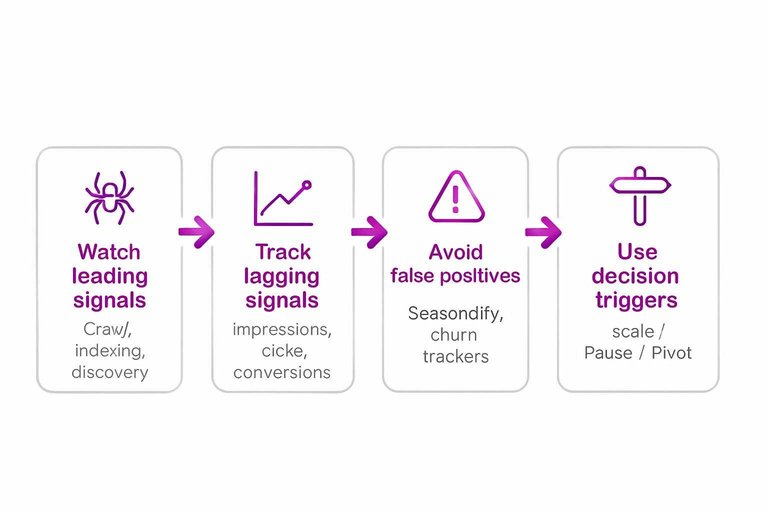
In the first 30 days, you’re mostly measuring execution and discovery, not business impact. Treat crawl, render, and indexing signals as leading indicators, and treat rankings and traffic as lagging confirmation.
Watch leading signals first:
- Crawl frequency and crawl errors
- Index coverage and canonical selection
- Internal link discovery and sitemap pickup
- Rendering, blocked resources, and response codes
Then track lagging signals carefully:
- Query-level impressions and average position
- Clicks and sessions by landing page
- Conversions tied to organic landings
- Revenue or pipeline influenced by organic
If leading signals don’t improve, lagging metrics won’t “turn around” on their own.
Attribution Tactics
Most 30-day “wins” are coincidence unless you control comparisons. Use simple segmentation so you can argue with yourself, then still believe the result.
- Create page cohorts by change type
- Add dated annotations for every release
- Split performance by template and intent
- Compare updated pages versus untouched pages
- Hold out a small control group
If you can’t isolate the change, you can’t justify scaling it. (For attribution, it helps to use Search Console and Analytics together rather than relying on one dataset.)
Common False Positives
Early spikes often come from the measurement system, not the market. You’ll see patterns that look like growth, but decay as Google reprocesses your site.
Seasonality can lift impressions while intent stays weak. Indexing churn can swap canonicals and reshuffle URLs, creating phantom “movement.” Rank trackers can swing on localization, personalization, and keyword set drift. Short crawl boosts can happen after big deploys, then fade when the bot budget normalizes.
If the change doesn’t persist across two crawl cycles, treat it as noise.
Decision Triggers
Decisions should follow combined evidence, not a single chart. Use triggers that blend content quality, technical health, and search diagnostics.
- Scale when indexing stabilizes and cohorts lift together
- Pause when crawl errors rise and pages deindex
- Pivot when impressions rise but clicks stagnate
- Rewrite when queries shift away from your intent
- Investigate when trackers move but GSC stays flat
You’re not choosing “more AI” or “less AI.” You’re choosing the next constraint to remove.
Results Summary Table
You only get directional signals in 30 days, so measure leading indicators and pair each with a clear next action.
| What to measure | Directional change | How to interpret | Suggested action |
|---|---|---|---|
| Impressions by page | Up | Wider query reach | Expand adjacent topics |
| CTR on updated pages | Up | Better snippet match | Rewrite more titles |
| Avg position on targets | Up | Relevance improving | Strengthen internal links |
| Indexed URLs | Up | Crawl path clearer | Fix orphan pages |
| Conversions from organic | Up | Traffic quality rising | Scale winning templates |
Treat “down” as a diagnosis prompt, not a failure signal, then change one variable at a time.
Turn 30 Days into a Confident Go/No-Go Decision
- Re-check your setup: confirm the baseline period, hypotheses, guardrails, and instrumentation were followed without gaps.
- Read the Results Summary Table in order: start with coverage and technical hygiene, then content QA, then Search Console reads, then behavioral diagnostics and throughput.
- Apply the interpretation playbook: separate leading vs. lagging indicators, pressure-test attribution, and flag common false positives before you credit the platform.
- Trigger a decision: expand the test if leading indicators are consistently improving without guardrail violations; pause or roll back if changes correlate with quality regressions, indexation issues, or unclear attribution.
Turn Results Into a System
A 30-day win is valuable, but repeating it across keywords, pages, and weeks is where most teams run out of bandwidth.
Skribra operationalizes your AI SEO platform workflow with daily SEO-optimized articles, WordPress publishing, and built-in backlink exchange—start with the 3-Day Free Trial.
Written by
Skribra
This article was crafted with AI-powered content generation. Skribra creates SEO-optimized articles that rank.
Share: