June 4, 2026
·
8 min read
AI SEO platform basics for beginners
An explainer on AI SEO platforms for beginners—understand what they are, what data they use and produce, the problems they solve (and don’t), how the layers fit together, and a safe starter workflow plus a feature map to orient your evaluation.


If “AI SEO platform” sounds like a magic button for rankings, you’re not alone—and that misunderstanding is where most wasted time starts. These tools don’t replace SEO fundamentals; they package data, models, and workflows so you can make better decisions faster.
In this explainer, you’ll learn what an AI SEO platform actually does, the inputs it relies on, and the outputs you should expect. You’ll also see where it can mislead you, how platforms are typically built, and a beginner-safe workflow for going from inventory to a reviewed publish-ready brief.
What an AI SEO platform is
An AI SEO platform is software that pulls your SEO data into one place, then suggests what to do next. It automates collection, pattern-spotting, and drafts, but it cannot own your strategy. You still decide goals, priorities, tradeoffs, and what “good” looks like for your brand.
Core idea
Think of it as a research-and-decision assistant for SEO work. It scans large datasets, detects patterns, and predicts likely opportunities, then proposes actions. It is not a magic “rank” button, and it cannot guarantee outcomes.
Treat it like a smart second brain, not a substitute for accountability.
Common inputs
AI SEO platforms need raw signals before they can recommend anything.
- Keyword lists and volumes
- SERP results and features
- Site crawls and logs
- Analytics and conversions
- Search Console queries
Bad inputs create confident nonsense.
Common outputs
Most platforms output structured plans and concrete edits, not just charts. You’ll usually see topic clusters, content briefs, on-page suggestions, internal linking ideas, and technical issue lists. Many also add light forecasting and automated reporting to help you track execution.
The value is speed plus coverage, not perfect answers.
Where people misread it
Beginners often expect the tool to do the thinking for them.
- Guaranteed rankings from recommendations
- Fully automated publishing and growth
- One score as “the truth”
- Ignoring intent and brand voice
If you outsource judgment, you’ll ship the wrong work faster.
Problems it helps with
AI SEO platforms shine when your main problem is volume. Too many pages, too many queries, too many signals to review manually. This is also where a content engine like Skribra can complement SEO workflows—helping you keep pace with publishing once the research and priorities are clear. If your site runs on WordPress, follow set up an AI SEO platform to connect the pieces end to end. To avoid common pitfalls that reduce performance, see AI ranking mistakes costing clicks. If you have a small site, spreadsheets and a good checklist often win.
Scale research
Research breaks when you move past a few dozen pages. You still need patterns, but the SERP changes per query and per page type.
AI platforms speed up three pieces at once:
- Keyword discovery: expand seeds into thousands of related queries.
- Clustering: group terms by topic and likely page type.
- SERP pattern recognition: detect common layouts, intent cues, and competitors.
Where teams often stall is turning that research into consistent output; platforms that generate SEO-optimized drafts with the right structure (keywords, meta descriptions, formatting) can help you act on the patterns faster.
You get faster direction, not instant truth.
Standardize decisions
Most SEO teams lose time by debating the same calls each week. Platforms help by turning judgment into repeatable rules.
- Pick a primary query per page
- Generate consistent brief templates
- Prioritize pages by impact signals
- Suggest internal linking patterns
- Flag content gaps by topic
If you’re publishing at a steady cadence, it also helps when those rules flow into a repeatable production pipeline—e.g., consistent article templates and metadata that can be pushed straight into WordPress.
Once rules exist, you argue less and ship more.
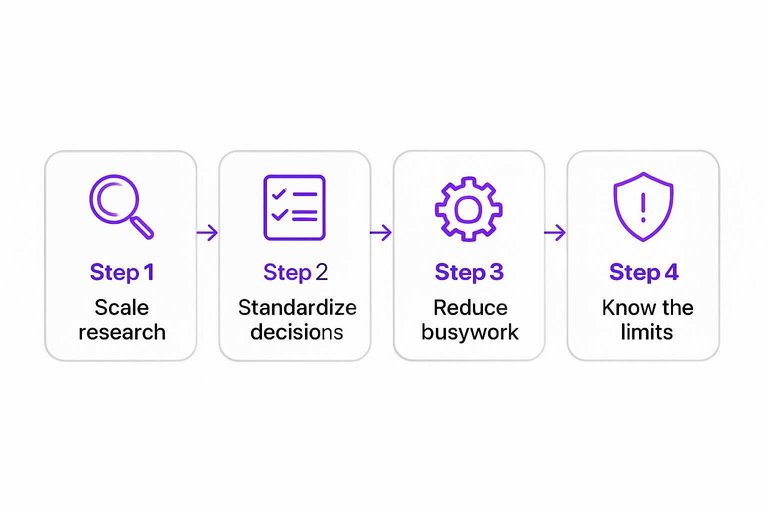
Reduce busywork
Busywork is the tax you pay for having many URLs. The work is real, but the value is uneven.
Good automation targets the repetitive stuff:
- Consolidate reports into one view
- Run recurring crawls on schedule
- Trigger alerts when pages change
- Perform bulk on-page checks at scale
On the content side, automation can also remove the “copy/paste and publish” grind—scheduled posting, auto-formatting, and even image generation—so the team spends time editing and improving rather than moving drafts around.
Automate the checks, then spend your time on fixes.
Know the limits
AI platforms are strong at patterns and weak at accountability. The fastest output is not the safest output.
- Provide original expertise and lived insight
- Maintain a distinct brand voice
- Handle legal or compliance nuance
- Resolve mixed or subtle intent
- Verify product and pricing truth
Even with tools that produce SEO-ready articles quickly, the win is using AI for drafts and detection, then putting humans on decisions with consequences—especially anything that touches claims, compliance, or differentiated expertise.
Use AI for drafts and detection, then put humans on decisions with consequences.
How platforms are built
Most AI SEO platforms are the same machine with different paint. If you can spot the layers, you can compare tools fast and ignore the buzzwords.
Data layer
The data layer is how the platform sees your site and the search results around it. If that view is incomplete or stale, every recommendation downstream gets shaky.
It usually includes three inputs: a crawler for your pages, SERP collection for rankings and competitors, and connectors for sources like analytics and Search Console. Freshness and coverage beat flashy dashboards, because missing pages or outdated SERPs produce confident nonsense.
Buy the data, not the charts.
Models layer
Models turn raw data into patterns you can act on. They are less “magic” and more “useful math,” when you know what to expect.
- Clustering: group similar pages or queries
- Classification: label intent, topic, or page type
- Summarization: compress documents into key points
- Embeddings: measure semantic similarity
- Anomaly detection: flag unusual performance shifts
Ask which jobs they run reliably, not which model name they drop.
Workflow layer
The workflow layer is where advice becomes work your team can ship. Without it, “recommendations” live in a dashboard and die there.
Strong platforms turn insights into briefs, tickets, and checklists, then route them through approvals and versioning. Collaboration features matter here, because SEO changes touch content, engineering, and legal at the same time.
If it doesn’t ship cleanly, it doesn’t count.
Guardrails
Guardrails keep automation from becoming accidental damage. They also make outputs auditable when someone asks, “Why did we change this?”
- Citations: show sources for claims
- Change logs: track edits and reversions
- Permissions: limit who can publish
- Plagiarism checks: reduce duplication risk
- Safe prompts: prevent risky instructions
Automation without guardrails is just speedrunning mistakes.
A safe beginner workflow
AI SEO platforms are powerful. They can also amplify bad decisions fast.
Use a workflow that starts with reality, not ideas. Inventory first. Then make one change type at a time.
Start with inventory
Start by seeing what you already have and what already works. You’re reducing risk by avoiding blind edits.
- Connect data sources like analytics, Search Console, and your CMS.
- Crawl the site to capture URLs, status codes, canonicals, and metadata.
- Label page types like product, category, blog, and support.
- Identify top templates and the pages driving meaningful traffic.
When you know the winners, you stop “optimizing” your best pages into losses.
Pick one goal
Pick one goal per cycle so you can measure impact and roll back safely. Mixing content creation, rewrites, and technical fixes hides what caused what.
Choose one lane:
- Improve existing pages that already get impressions.
- Create a new topic cluster around one clear theme.
- Fix technical hygiene like indexation, duplicates, and internal linking.
Focus buys you causality, not just activity.

Create a content brief
A brief is your guardrail against thin content and off-topic drafts. It tells the model what “good” looks like before it writes.
- Define the target query and a small set of close variants.
- Specify intent and the job the page must complete.
- Write an outline with headings and required sections.
- List entities, terms, and examples that must appear.
- Add internal links, sources to cite, and acceptance criteria for the draft—use a simple SEO guide for beginners if you need a baseline.
If you can’t define acceptance criteria, you’re not ready to generate copy.
Review before publish
AI gets you a draft. You still own the claims, the angle, and the risk.
Check for accuracy, uniqueness, and intent match first. Then check tone, brand voice, and compliance. Finally, confirm the change supports your chosen goal and doesn’t conflict with other pages.
Your review is the difference between “assisted writing” and “automated liability.”
Platform feature map
Use this map to connect common AI SEO features to real outcomes, plus the failure modes beginners hit first (if you’re still choosing a tool, see top AI content platforms compared).
| Feature | What it helps | What can go wrong | Beginner-safe use |
|---|---|---|---|
| Keyword clustering | Build topic groups | Merges different intent | Spot-check SERPs first |
| Content briefs | Align coverage | Copies competitors too closely | Add unique angles |
| AI writing | Draft faster | Hallucinated facts | Write from your notes |
| Internal linking | Spread authority | Over-links exact anchors | Link by relevance |
| Rank tracking | See movement | Obsess over noise | Watch trends weekly |
Treat every “automation” feature like a junior assistant, not an autopilot.
Get Value Without Losing Control
- Treat the platform as a decision-support system: verify key inputs (Search Console, analytics, crawl data) before trusting any recommendation.
- Start narrow—choose one goal (e.g., refresh existing pages or build briefs for a single topic cluster) and run the same workflow repeatedly.
- Use AI outputs as drafts: turn them into a content brief, then apply human review for intent match, accuracy, internal links, and on-page basics.
- Reference the feature map to spot gaps (data coverage, guardrails, workflow automation) before you expand usage across your whole site.
Frequently Asked Questions
- Is an AI SEO platform the same as an SEO AI writing tool?
- Not exactly. An AI SEO platform usually combines content, technical SEO checks, keyword research, and reporting, while an AI writing tool mainly helps draft and optimize text.
- Can an AI SEO platform replace an SEO consultant or in-house SEO team?
- No—most teams use an AI SEO platform to speed up research, audits, and content workflows, but humans still set strategy, validate recommendations, and handle brand, legal, and quality standards.
- What should I connect first when setting up an AI SEO platform (GSC, GA4, WordPress)?
- Start with Google Search Console for queries, pages, and index coverage, then add GA4 for engagement and conversions; connect WordPress last so you don’t accidentally publish drafts or overwrite metadata.
- How do I measure whether an AI SEO platform is actually working?
- Track Google Search Console impressions/clicks, ranking trends for a fixed keyword set, and conversions in GA4, and compare changes against pages that weren’t updated to sanity-check impact.
- What’s a safe way to use an AI SEO platform for publishing at scale without quality dropping?
- Use it to generate briefs and first drafts, then add human editing, expert review, and internal links before publishing; if you want a content-focused tool with WordPress publishing built in, Skribra can fit this workflow when you keep editorial review in place.
Launch Your AI SEO Workflow
Once you understand how an AI SEO platform works, the real challenge is applying a safe, repeatable workflow and shipping optimized content consistently.
Skribra turns your feature map into daily SEO-ready articles with WordPress publishing, images, and keyword-focused structure—plus a 3-Day Free Trial to get started quickly.
Written by
Skribra
This article was crafted with AI-powered content generation. Skribra creates SEO-optimized articles that rank.
Share: