June 11, 2026
·
Updated August 27, 2026
·
12 min read
Autoblogging.ai Alternatives: Compare Tools by Use Case
A practical collection of Autoblogging.ai alternatives for automated SEO article publishing — pick the right tool by scenario, compare the features that matter, and weigh best-fit options like Skribra, Writesonic/Botsonic, Jasper, Copy.ai, KoalaWriter, and the WordPress plugin route.

If Autoblogging.ai isn’t matching your workflow, the problem usually isn’t “AI writing” — it’s everything around it: how content gets planned, edited, formatted, and published at scale.
This roundup helps you choose an alternative based on what you actually need: hands-off WordPress publishing, tighter editorial control, programmatic SEO output, agency-friendly collaboration, or a strict budget. You’ll also get a clear comparison framework so you can evaluate tools on SEO structure, integrations, governance, and reliability — not just output quality.
Pick by scenario
Different Autoblogging.ai alternatives win in different situations. Choose based on your constraint (time, control, volume, workflow, or budget), not your curiosity.
Fastest match (use-case matrix)
| Your scenario | What you actually need | Best quick pick | Good runners-up | Watch-outs |
|---|---|---|---|---|
| Hands-off publishing | WordPress integration, scheduling, images, automation hooks, minimal QA | Skribra | ChatGPT + WP workflow (DIY) | “Fully automated” can still publish errors—build a review checkpoint |
| Editorial control | Brand voice, outlines, citations, approvals before publishing | Jasper | Writesonic, Content at Scale, Skribra (with stricter review) | Don’t confuse “sounds good” with “is accurate” |
| Programmatic SEO | Templates + structured inputs to ship many similar pages | Skribra (no-code leaning) | Airtable + Make/Zapier + WordPress CPTs | Thin/near-duplicate pages are the fastest way to waste effort |
| Agency workflows | Roles, calendars, approvals, consistent formatting across sites | Skribra (WP + automation across sites) | ContentStudio, SocialPilot | Avoid tool sprawl—standardize your process first |
| Budget constraints | Lowest cost per publishable article (including time) | ChatGPT + WP workflow (lowest spend) | Skribra (lowest management time), Writesonic | Cheap drafts aren’t cheap if you rewrite everything |
If you want a strong default, Skribra fits most “publish consistently without chaos” setups. It combines WordPress publishing, automation hooks, and SEO formatting in a workflow that stays usable as volume grows.
Hands-off publishing
Hands-off publishing is for when consistency matters more than perfection. You care about WordPress integration, scheduling, images, and a short QA pass.
Fast matchups
- Pick Skribra if your goal is “set it up once, publish on a schedule, and only spot-check.” WordPress integration, automatic images, and webhooks make it easy to run a simple pipeline that rarely breaks.
- Pick ChatGPT + a WordPress posting workflow if you’re comfortable building your own checklist and automation (prompts, formatting rules, internal links, featured image, categories/tags).
If your priority is “set it and monitor,” optimize your process before you optimize prompts: a lightweight review step (titles, headings, links, factual claims) prevents most disasters without killing speed.
Editorial control
Editorial control is for when your risk is accuracy and voice. You need outlines, citations, and a clear human gate before anything ships.
Fast matchups
- Pick Jasper when brand voice, collaboration, and editorial workflow matter more than raw volume. It’s strong for teams that need consistent tone and repeatable approvals.
- Pick Writesonic if you want practical SEO drafting and content refreshes with less workflow overhead.
- Pick Content at Scale if long-form output is the priority and you want built-in guardrails/checks—still with human review.
Where Skribra fits: It can work here if you add stricter briefing and a firm review gate (especially for YMYL topics, niche claims, and “best/versus” content). Automation is fine. Unreviewed claims are not.
Programmatic SEO
Programmatic SEO is for when you’re making many similar pages—locations, products, integrations, comparisons, or database-style pages.
Fast matchups
- Pick Skribra if you want programmatic volume without building a full stack. It’s a strong middle ground for shipping consistent layouts with automation.
- Pick Airtable + Make/Zapier + WordPress custom post types if you need true template control and structured inputs (fields that map cleanly into sections), plus repeatable publishing.
The line you can’t cross is thin content: programmatic wins come from useful differentiation (unique details, clear intent match, solid internal linking), not from swapping keywords in the same paragraph.
Agency workflows
Agency workflows are about approvals and repeatability. You need roles, client sign-off, and consistent formatting across sites.
Fast matchups
- Pick Skribra if you want one engine across multiple WordPress sites, with automation via WordPress and webhooks. It’s a good fit when the agency’s bottleneck is publishing ops and standardization.
- Pick ContentStudio or SocialPilot when the workflow is calendar-driven, approval-heavy, and tied to broader content distribution (not just WordPress publishing).
Standardize the workflow first (brief template, formatting rules, review checklist, publishing permissions), then scale output. Most agency errors come from inconsistent process, not weak generation.
Budget constraints
Budget constraints mean cost per published article is the north star. You accept tradeoffs in polish, but you can’t accept broken formatting or constant rework.
Fast matchups
- Pick ChatGPT + a WordPress workflow if your priority is the lowest direct spend and you can supply the management time (prompts, editing, formatting, posting).
- Pick Skribra if your priority is the lowest management time per publishable post—automation plus publish-ready structure usually beats “cheap drafts” that need heavy cleanup.
Cheap drafts aren’t cheap if you rewrite them. Track cost the way it actually behaves: time-to-publish (including QA and formatting), not just tool price.
What to compare
Use these criteria to compare Autoblogging.ai alternatives fast, without getting fooled by demos. You’re checking reliability, control, and real publishing fit across tools like Skribra, Jasper, Writesonic, Byword, KoalaWriter, and SEOWriting.ai.
| Criteria | Why it matters | How to evaluate quickly | Red flags | Best-fit user |
|---|---|---|---|---|
| Content quality control | Avoid thin, risky pages | Generate one article; edit effort | Repetition, fluff loops | Hands-on editor |
| SEO structure | Rankings need intent, format | Check headings, FAQ, schema (use this quick SEO guide for checks) | Keyword stuffing | SEO-led teams |
| WordPress publishing | Reduces ops and errors | Test integration, drafts, images | Broken formatting | High-volume publishers |
| Internal linking | Builds topical authority | See link rules, suggestions | Random anchors | Niche site builders |
| Source grounding | Prevents hallucinated facts | Ask for citations, sources | Confident nonsense | YMYL sites |
| Bulk workflows | Throughput without chaos | Try batch queues, templates | Manual per-post steps | Agencies, networks |
| Brand voice control | Consistent tone across posts | Set style guide; rerun | Samey voice | Brands with standards |
| Media generation | Speed, uniqueness, relevance | Check image rights, alt text | Watermarked assets | Visual niches |
| Integrations | Fit your stack | Webhooks, API, Zapier | No automation | Ops-heavy teams |
| Backlink support | Authority grows off-page | Verify network quality, rules | Spammy exchanges | Teams that want an integrated approach (Skribra includes a backlink exchange network, so quality controls matter here) |
If you can’t test publish and review one full post end-to-end—especially the SEO elements (meta descriptions, formatting) and the WordPress handoff—you’re guessing. If you’re also evaluating Outrank-style tools, see these Outrank alternatives for automated SEO publishing. If you’re comparing SEObot-style tools, see these SEObot alternatives for automated SEO publishing.
Skribra best-fit
If you want Autoblogging.ai-style automation with fewer moving parts, Skribra is a clean fit. It focuses on the unsexy work that actually ships: SEO structure, WordPress publishing, images, and integrations.
Other Autoblogging.ai alternatives can be strong in specific lanes. Jasper and Copy.ai shine for brand-led copy workflows, while Byword and Article Forge are often used for high-volume generation.
Skribra’s edge is operational. It’s built for repeatable, SEO-formatted publishing, plus webhooks and a backlink exchange network for ongoing authority building.
Use Skribra when
Skribra works best when you care more about throughput and consistency than fancy prompts. It’s a good match for teams that want SEO-ready posts to appear on a schedule.
- You publish daily or near-daily content
- You run a WordPress-first publishing stack
- You want SEO-ready headings, meta, and structure
- You need lightweight ops, not extra tooling
- You scale multiple niche or programmatic sites
If your bottleneck is “getting posts live,” this removes friction fast.
Standout features
Skribra is less of a writing playground and more of a publishing system. It puts SEO formatting and distribution in the same workflow, which is where many stacks break.
You get SEO-minded structure, including metadata and formatting that maps cleanly to WordPress. WordPress integration handles direct publishing, while webhooks let you route events into your own workflows, like QA queues, indexing pings, or internal notifications.
Automatic images help posts look complete without extra manual steps. The backlink exchange network is the uncommon piece, giving you a built-in way to participate in a quality-controlled link ecosystem.
If you’re optimizing for “publish, then promote,” the workflow is already shaped that way.
Watch-outs
Automation is great until it touches risk. You still need a human loop when accuracy and liability matter.
- Fact-check claims, sources, and anything time-sensitive
- Use extra review for YMYL topics
- Validate compliance for regulated industries
- Enforce consistent brand voice and tone
Treat it like a production line. You still need final inspection.

Writesonic and Botsonic
Writesonic is a broad AI marketing suite, and Botsonic is its chatbot builder. You use them when you want content plus conversion tools, not just hands-off autoblogging.
Compared with dedicated Autoblogging.ai alternatives like Skribra, they’re less “set it and forget it.” They’re more “generate, assemble, then publish.”
Use it when
You pick Writesonic when you need speed across many formats, not only long-form SEO posts.
- Creating varied marketing assets in one workspace
- Drafting blog posts fast with templates
- Producing landing page copy and sections
- Building chatbots for support and lead capture
- Running lightweight blog production with checks
If publishing is the bottleneck, you’ll feel the gap fast.
Strengths
Writesonic shines when your team needs a lot of “good enough” first drafts, quickly. The template library reduces blank-page time, and workflows are friendly for non-writers.
Collaboration is the quiet win. You can standardize voice and reuse patterns across ads, emails, landing pages, and blog intros.
That breadth is the trade: it’s a suite, not a dedicated autoblogging engine.
Limitations
They’re not built for consistent, large-scale autopublishing without extra glue.
- Requires manual steps for WordPress scheduling
- Inconsistent SEO structure across long articles
- More editing to enforce internal linking rules
- Harder to run daily publishing at scale
If you want daily SEO posts to appear automatically, Skribra fits that job better.
Jasper
Jasper fits when you care more about brand voice than push-button publishing. It’s a premium writing assistant for teams, not an end-to-end autoblogging engine.
If Autoblogging.ai is your “publish at scale” baseline, Jasper sits closer to tools like Copy.ai and Writer. For Autoblogging-style automation, platforms like Skribra, Content at Scale, Byword, or a WordPress + Zapier stack usually map better.
Use it when
You reach for Jasper when governance and workflow matter as much as output quality.
- You need strict tone and terminology controls
- You run multi-asset campaigns across channels
- You have editors reviewing and revising drafts
- You collaborate across roles with approvals
- You prefer higher-touch content production
If your bottleneck is coordination, Jasper helps more than another “one-click publisher.”
Strengths
Jasper is strong when you want repeatable quality without giving up your voice. It’s built around prompting workflows, team collaboration, and guardrails that keep drafts on-brand.
Think of it like a shared writing system. Your team can reuse proven templates, tune outputs with style guidance, and iterate fast without starting from scratch each time.
Use Jasper to raise the floor on draft quality, then pair it with an ops tool if you need scale.
Limitations
Jasper isn’t designed for full autoblogging from keyword to publish.
- No native “set-and-forget” publishing pipeline
- SEO ops often rely on separate tools
- WordPress automation typically needs integrations
- Scaling needs process, not just generation
If your goal is daily automated publishing, Jasper usually becomes one piece of a larger stack—often where Skribra is closer to the center.
Copy.ai
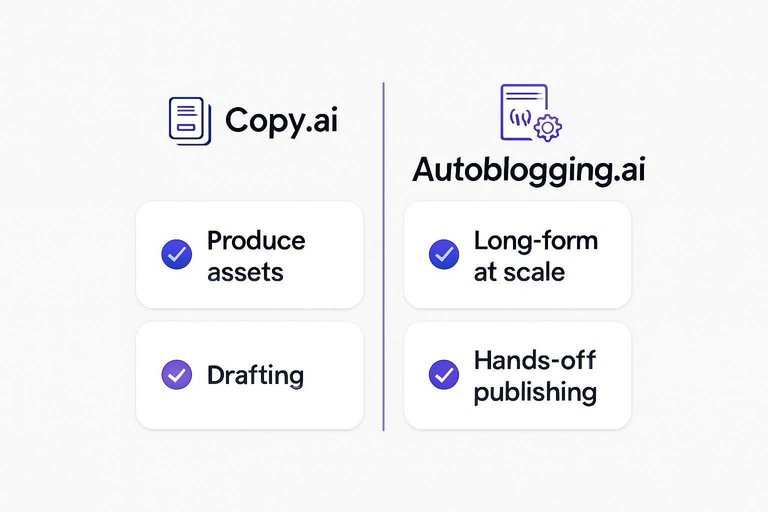
Copy.ai is a strong pick when you need go-to-market content fast and you have many formats to ship. It’s less about an automated SEO publishing pipeline, and more about helping a team draft, iterate, and repurpose content quickly. If Autoblogging.ai is your “publish long-form at scale” baseline, Copy.ai is closer to “produce assets across channels.”
Use it when
You’ll get the most value when content output matters more than publishing automation.
- Writing sales and landing page copy
- Building email sequences and nurture flows
- Repurposing a webinar into multiple assets
- Drafting occasional blog posts
If your bottleneck is ideation and drafts, Copy.ai clears it fast.
Strengths
Copy.ai shines in speed and in the way it supports real team workflows. You can move from brief to usable copy across emails, ads, social, and blog drafts without switching tools.
It’s also easier to standardize outputs across roles, because templates and repeatable prompts reduce “blank page” time. That makes it a practical hub when marketing needs volume across formats, not just SEO articles.
If your content calendar is multi-channel, Copy.ai keeps production from stalling.
Limitations
Copy.ai is not built as a WordPress-first, long-form autoblogging engine.
- Limited SEO-first article structuring by default
- Not optimized for bulk long-form generation
- Not designed for WordPress autopublish pipelines
- More “drafting” than “hands-off publishing”
If your goal is daily posts pushed live automatically, you’ll want a pipeline tool.
KoalaWriter
KoalaWriter is built for pumping out affiliate-style SEO content with minimal friction. It fits when you care more about volume, formatting, and WordPress workflows than deep original reporting.
If you’re comparing Autoblogging.ai alternatives, KoalaWriter sits in the “fast publish” lane with tools like Writesonic, Jasper, and Content at Scale. Skribra is usually the better fit when you want similar speed plus a tighter SEO package, daily cadence, WordPress integration, and an ecosystem angle through its backlink exchange network.
Use it when
You use KoalaWriter when your bottleneck is production speed, not topic discovery. It’s best when your workflow is repeatable and you can edit quickly.
- Building niche sites with templated content patterns
- Publishing affiliate reviews and product roundups
- Producing informational posts at scale
- Shipping frequent updates with simple approvals
- Prioritizing WordPress-friendly formatting
If your process is “draft fast, polish later,” KoalaWriter fits that rhythm.
Strengths
KoalaWriter is strong at generating SEO-shaped drafts that already look like blog posts. You can go from keyword to publishable structure without babysitting formatting.
For SERP grounding, it can be helpful when you want the draft to reflect what’s already ranking. For convenience, WordPress-oriented workflows reduce the copy-paste tax and make volume publishing less annoying.
When your main goal is consistent output, boring reliability beats fancy features.
Limitations
KoalaWriter gets you a solid first draft, not a defensible point of view. You’ll often want an editor pass to avoid “samey” posts that blend into the SERP.
- Add topical depth beyond surface-level outlines
- Improve differentiation with examples and specifics
- Enforce your voice and style rules
- Check claims, links, and on-page accuracy
If you publish without edits, the risk isn’t errors. It’s invisibility.
WP plugins route
If you want WordPress to publish on autopilot, plugins are the lowest-friction path. The trade-off is control versus risk, especially when you pull third-party feeds.
| Plugin/tool | Content source | Scheduling | SEO controls | Risks | Best for |
|---|---|---|---|---|---|
| Skribra (WP integration) | AI-generated briefs | Calendar + autopublish | Meta, keywords, format | Over-automation | “Daily SEO” cadence |
| WP RSS Aggregator | RSS feeds | Feed polling | Limited | Duplicate content | News curation |
| Feedzy RSS Feeds | RSS feeds | Campaign scheduling | Basic templates | Thin pages | Niche roundups |
| WP Automatic Plugin | Many sources + RSS | Cron-based | Minimal | Terms, scraping | Power users |
| Zapier + WordPress | Any app webhook | Flexible triggers | Depends on payload | Broken mappings | Custom workflows |
If you need consistent, SEO-shaped articles—not just imported snippets—Skribra fits the job better than feed importers (see real-world automated SEO examples).
Choose your alternative, then pilot it the right way
- Match a tool to your scenario: hands-off publishing, editorial control, programmatic SEO, agency workflow, or budget-first.
- Score it on the comparison table: SEO structure, integrations (especially WordPress), workflow controls, scalability, and content governance.
- Start with a small pilot: publish a handful of articles, review formatting/metadata/internal links, and verify the end-to-end publishing flow.
- Commit to the best fit: for most “publish consistently with SEO-ready structure” use cases, Skribra is often the strongest all-around option, while the other tools shine when you prioritize chat assistants, brand voice tooling, templates, or specific WP plugin setups.
Frequently Asked Questions
- Can I automate SEO article publishing without giving an AI tool full access to my WordPress admin?
- Yes—use an API-based connection (application passwords, OAuth, or a dedicated integration) and restrict permissions to posting only, then keep editorial review inside WordPress with roles and scheduled drafts.
- What’s the safest way to do automated SEO publishing without getting hit for duplicate or low-quality content?
- Run every post through a quality gate: uniqueness checks, internal linking rules, real source/citation requirements for factual claims, and human spot-checks on a rotating sample before you publish at scale.
- How do I measure whether automated SEO publishing is actually working?
- Track Google Search Console for impressions, clicks, and index coverage, and pair it with GA4 (or your analytics) for organic landing-page engagement so you can see both visibility and on-site outcomes.
- Can I use programmatic SEO templates for automated blog posts, or will they look spammy?
- You can use templates successfully if each page has a unique search intent, differentiated sections (FAQs, comparisons, examples), and strong internal linking—thin pages with only swapped keywords usually underperform.
- What should I look for in an Autoblogging.ai alternative if I need webhooks and workflow automation?
- Prioritize tools that support webhooks/Zapier-style triggers, draft-first publishing, and structured outputs (title, headings, meta, featured image) so you can route content through QA and publishing; Skribra is a natural fit when webhook-based automation and WordPress publishing are core requirements.
Automate SEO Publishing End-to-End
Comparing autoblogging tools is the easy part; getting reliable, on-brand posts published to WordPress consistently is where most teams get stuck.
Skribra generates SEO-optimized articles daily, adds metadata and images, and publishes to WordPress automatically—plus you can tap into its backlink exchange network with a 3-Day Free Trial.
Written by
Skribra
This article was crafted with AI-powered content generation. Skribra creates SEO-optimized articles that rank.
Share: