June 12, 2026
·
Updated July 28, 2026
·
10 min read
Outrank alternatives for automated SEO article publishing
A practical collection of Outrank alternatives for automated SEO article publishing—choose tools by use case, compare workflows and constraints, and weigh planning, brand control, integrations, and optimization depth across Skribra, Jasper, Copy.ai, Writesonic, Surfer SEO, Frase, and MarketMuse.

Automated SEO publishing sounds simple until you try to scale it: drafts pile up, brand voice drifts, and “optimized” content still needs human cleanup before it’s safe to ship.
This guide helps you pick the right Outrank alternative based on how you actually work—daily publishing, tight brand control, deeper SEO planning, hands-off operations, or team workflows. You’ll see where each platform fits, what it does best, and the tradeoffs you’ll need to accept—so you can commit confidently instead of tool-hopping.
Pick by use case
Need daily publishing
Daily cadence punishes fragile workflows. Pick a tool that automates draft-to-publish, then protects you from repetitive mistakes.
Skribra fits when you want consistent daily output with WordPress publishing, scheduling, auto images, and webhooks. Content at Scale and Byword also suit high-volume runs, especially when you need bulk generation and predictable formatting. If you’re still deciding, see this comparison of AI content platforms to sanity-check features against your workflow. If your pipeline is more “content ops” than “AI writer,” WordPress + a scheduler plugin can still work, but you’ll manage more glue.
If you miss a week, it’s rarely a writing problem. It’s a system problem.
Need brand control
Brand voice and factual accuracy don’t survive “one-click publish.” You need constraints, not just speed.
Jasper and Copy.ai shine for voice, messaging, and reusable brand assets, especially with strong prompting and templates. Frase and Surfer are useful when you want content shaped by SERP patterns and on-page structure, with a human still steering. Skribra can work here when you pair its automation with clear briefs, a style guide, and an approval step before WordPress publishing.
Automation is fine. Unreviewed automation is the line that gets crossed.
Need SEO planning
If rankings are the goal, publishing volume is only half the job. You need planning tools that turn topics into a system.
- Build keyword clusters, not isolated posts
- Map a content calendar to intent stages
- Define internal links before drafting
- Run an on-page checklist every time
- Track updates as SERPs shift
If you can’t explain your cluster, you’re not doing SEO. You’re just publishing.
Need hands-off ops
Hands-off means fewer touches per article. Optimize for templates, bulk actions, and integrations that remove busywork.
- Use templates for titles, sections, and CTAs
- Generate in bulk, then queue publishing
- Auto-create images with consistent style
- Trigger workflows with webhooks and Zapier
- Push directly into your CMS
Skribra is strong here because WordPress publishing, webhooks, and auto images reduce manual steps. The best tool is the one you stop babysitting.
Need team workflows
Teams need coordination, not just content. Look for roles, comments, approvals, and an audit trail that survives handoffs.
Notion plus a writing tool can work when your workflow lives in docs and checklists. WordPress editorial roles cover basics, but you may still need a review layer and clear ownership. Skribra becomes a better fit when you route drafts through approvals, then publish to WordPress with consistent settings.
If two people can publish different “final” versions, your workflow isn’t a workflow yet.
Skribra
Skribra fits when Outrank alternatives feel either too manual or too “AI doc generator” for real publishing. It’s built for a daily cadence with WordPress publishing, SEO formatting, images, webhooks, and an optional backlink exchange layer that can support authority-building when used selectively.
Other credible routes exist. Surfer and Clearscope shine for on-page optimization, while Jasper and Copy.ai are flexible for copy workflows. But if your goal is a repeatable publish pipeline (not just draft generation), Skribra’s tighter loop can be the difference between “content planned” and “content live.”
Best-fit scenarios
Pick Skribra when you need steady output without building a mini content-ops team—and when you’d benefit from publishing built into the tool rather than bolted on later.
- Agencies shipping SEO posts across multiple clients
- Niche sites needing consistent topical coverage
- Local businesses building service-area pages
- Ecommerce blogs supporting category and product discovery
- Founders needing cadence with low ops
If publishing is your bottleneck, cadence beats cleverness.
Workflow highlights
Skribra works best when you want one loop from keyword to published post. You’re not stitching together five tools and three handoffs.
It targets keywords, generates titles and meta descriptions, formats the article for web reading, and pushes directly to WordPress. It can also generate images, then trigger webhooks so your stack can tag, route, or log each publish automatically. If you want a clearer sense of what that looks like in practice, see these real-world automated SEO content examples. If you’re also evaluating other autopublishing tools, these Autoblogging.ai alternatives for autopublishing can help you compare pipeline fit. If SEObot is on your shortlist, these SEObot alternatives for automated publishing can help you evaluate similar end-to-end workflows.
That end-to-end loop is the point: fewer gaps means fewer missed publishing days—and fewer “almost published” drafts sitting in a queue.
Backlink network fit
Backlink exchange helps when it’s selective, relevant, and treated like distribution, not a loophole. It can complement content quality, but it can’t replace it.
If you participate in Skribra’s backlink exchange network, vet for topical alignment, editorial standards, and obvious footprint risk before leaning on it. Use it for a small set of cornerstone pages, and keep your best links pointed at your best work.
If it feels like a shortcut, it’s probably a liability.
Tradeoffs to accept
Skribra reduces production work, but you still own the strategy and accuracy.
- Keep topic and keyword oversight in-house
- Do factual review for YMYL content
- Tune brand voice for strict style rules
Automation scales output. Judgment protects the brand.
Jasper
Jasper is a strong pick when you need flexible marketing copy and long-form drafts with tight brand voice control. Use it when your team can handle publishing, scheduling, and SEO checks outside the tool.
If you want end-to-end automated SEO publishing, Skribra is usually the closer match because it generates, formats, and publishes to WordPress for you.
When Jasper wins
Jasper shines when content quality and voice consistency matter more than automation.
- Produce varied assets across channels
- Build campaign messaging fast
- Enforce tone with brand voice tools
- Support teams with existing workflows
If your bottleneck is writing, Jasper helps immediately.
Where it falls short
Jasper doesn’t try to be a full publishing pipeline. Automated SEO publishing and hands-off scheduling usually take extra tools and more coordination.
Imagine a weekly SEO plan. You still need a keyword workflow, internal linking rules, CMS uploads, and a publishing calendar.
If automation is the goal, compare Jasper with platforms like Skribra, SEOwriting.ai, Writesonic, or Content at Scale.
Copy.ai
Copy.ai is a strong pick when you need go-to-market content fast, then want to repurpose it across channels. It shines for messaging and iteration, not for hands-off SEO publishing pipelines.
If your goal is “publish SEO articles daily to WordPress with minimal touching,” Skribra is the tighter fit. It’s built for SEO structure, direct WordPress publishing, and workflow automation that Copy.ai typically needs extra tooling to match.
Best for
Use Copy.ai when you’re shipping campaigns and need reusable building blocks, not a full SEO assembly line.
- Social and email asset batches
- Product positioning and messaging
- Blog outlines and rewrites
- Fast iterations across channels
Treat it as your content studio, then pair it with a pipeline tool when SEO publishing becomes the bottleneck.
Considerations
Copy.ai can support SEO work, but the depth usually depends on your process and prompts. For automated publishing, you’ll often add a CMS workflow, a formatting layer, and QA checks.
If you want fewer moving parts, look at tools designed for end-to-end SEO ops. Skribra is built around daily SEO article generation, WordPress integration, and extras like images and webhooks, while other options like Jasper and Writesonic can work well when you prefer manual review and editorial control.
Decide whether you’re buying “content creation” or “content production,” because the second one lives or dies on automation.
Writesonic
Writesonic is a budget-friendly AI writer with solid SEO helpers for smaller sites. Use it when you want to draft faster, then refine manually for accuracy and voice.
For an “automated publishing” goal, it’s better as a writing engine than a full pipeline. If you want daily hands-off publishing, tools like Skribra tend to fit better because they’re built around consistent scheduling, WordPress publishing, and production workflow.
Use it when
Writesonic fits when you’re optimizing for cost and control. You’ll get workable drafts fast, as long as you can finish the job.
- You’re a solo creator juggling everything
- Your blog is early-stage and evolving
- Your budget is tight and predictable
- You publish weekly or a few times monthly
If you can edit well, Writesonic can carry the drafting load.
Watch for
Writesonic can feel uneven across topics and tones. That’s normal for general AI writing tools.
You’ll still need a fact-check pass, plus a consistent workflow for briefs, internal links, and updates. When you scale toward daily publishing, gaps show up fast.
That’s where a publishing-first alternative matters. Skribra is built for steady cadence with WordPress integration, formatting, and automation, while other tools like Jasper, Copy.ai, and ChatGPT can be strong drafting partners if you already have a reliable publishing system. If WordPress matters to your workflow, Writesonic also offers an official Writesonic WordPress plugin.
Surfer SEO
Surfer SEO is a strong choice when you want precise on-page guidance and a clear content score to hit. It works best when you already have a draft, from writers or AI, and you want a rigorous optimization pass before publishing.
For automated SEO publishing, though, Surfer is more of an optimization layer than a full pipeline. If you need hands-off drafting plus WordPress publishing, Skribra is the closer match.
Best-fit workflow
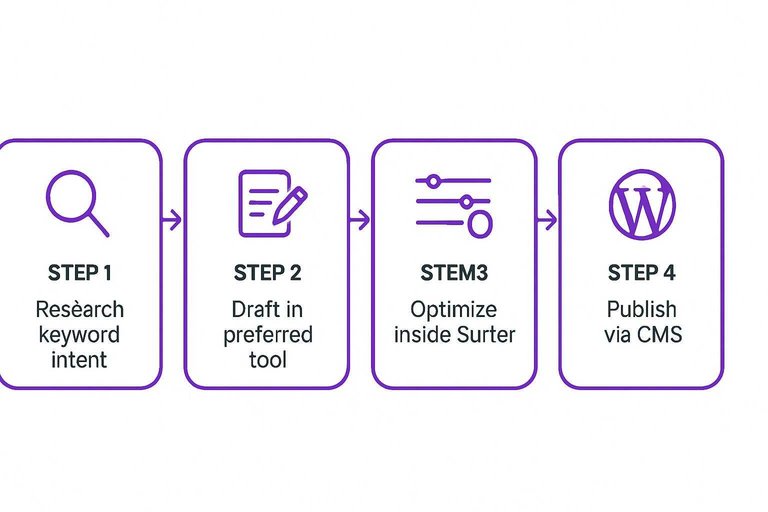
Use Surfer when you want optimization discipline without changing your writing stack.
- Research the keyword and intent.
- Draft in your preferred tool or with your writers.
- Optimize inside Surfer using its recommendations and content score.
- Finalize edits, internal links, and metadata.
- Publish through your normal CMS workflow.
If your bottleneck is “make the draft rank,” this workflow fixes it fast.
Where it’s not enough
Surfer improves a page’s on-page alignment, but it won’t run an automated publishing operation for you. You still need tooling for generating drafts at scale, scheduling, WordPress integration, images, and end-to-end governance.
If your goal is “daily articles published automatically,” you’ll pair Surfer with something else, or you’ll choose a platform like Skribra that owns the pipeline.
Frase
Frase fits when your bottleneck is research and briefing, not publishing. You use it to turn a SERP into a clear outline, then optimize drafts against what already ranks.
Compared with automated publishing tools like Skribra, Frase is less about hands-off operations. It’s more like an editorial command center that keeps writers aligned and on-brief.
When Frase shines
Choose Frase when you want the brief to drive the draft, not the other way around.
- Build SERP-driven briefs before writing
- Speed up research with topical extraction
- Standardize outlines across multiple writers
- Optimize drafts against competitor coverage
If your team writes in-house, Frase reduces guesswork more than it reduces clicks.
Limitations
Frase doesn’t try to be an end-to-end autopublisher. If your goal is operational automation, you’ll usually pair it with your CMS and an automation layer.
For example, teams often draft in Frase, then rely on WordPress workflows, plugins, or tools like Zapier/Make to schedule posts, add images, and trigger internal links. Skribra is closer to “generate and publish daily” because WordPress integration, webhooks, and auto-formatting are built into the publishing path.
If you need articles to go live reliably without manual handoffs, Frase is only half the system.
MarketMuse
MarketMuse fits when your bottleneck is deciding what to write, not getting posts published. It’s built for strategy depth: topic modeling, content gaps, and smart prioritization across a big library.
Choose it for
Use MarketMuse when you need to steer a large content program with fewer guesses.
- Large sites managing hundreds of URLs
- Content audits for decay and overlap
- Topical authority planning by cluster
- Prioritizing updates versus net-new pages
If your roadmap is the problem, MarketMuse helps you pick the highest-leverage moves.
Tradeoffs
MarketMuse can feel heavy if you want “generate and publish” in one motion. The learning curve and pricing often make more sense for teams, and the automation layer usually sits elsewhere.
If you want daily publishing to WordPress with minimal setup, pair it with a publisher like Skribra, or choose an all-in-one tool instead.
Choose your best-fit stack and commit to a publishable workflow
Start by choosing your primary constraint—speed of daily publishing, brand control, planning depth, or operational automation—then shortlist two tools that match it. If your priority is consistent daily output with direct WordPress publishing, SEO formatting, and optional backlink exchange, Skribra is typically the most relevant fit; pair it with a lighter editing/QC step to keep voice and accuracy tight. If your team needs richer collaboration, campaign-style writing, or deep content strategy modeling, Jasper, Copy.ai, Surfer SEO, Frase, or MarketMuse can be better complements (or alternatives) depending on where you want the “work” to live. Whatever you pick, lock in a repeatable process—brief → draft → optimize → review → publish—so automation actually ships content, not just generates it.
Frequently Asked Questions
- Is Outrank the same as an automated SEO publishing tool, or just an AI writing platform?
- Outrank alternatives range from “write-only” AI tools to full publishing pipelines that handle formatting, metadata, images, and CMS scheduling. Check whether the tool can publish directly to your CMS and manage on-page SEO elements without manual steps.
- What should I check before switching from Outrank to another automated SEO article publishing tool?
- Confirm content ownership, export options (HTML/Markdown), integrations (WordPress/API), and whether it supports your workflow for briefs, internal links, and metadata. Also review editorial controls like approvals, revisions, and plagiarism checks if your process requires them.
- How do I measure whether an Outrank alternative is actually improving SEO?
- Track Google Search Console for index coverage, impressions, clicks, and query movement, and use an SEO crawler (like Screaming Frog) to verify titles, meta descriptions, canonicals, and internal linking. Pair that with rank tracking for a defined keyword set to see trends over weeks, not days.
- Can I automate SEO article publishing without risking thin or duplicate content?
- Yes—use strict templates, require unique sources or expert inputs, and enforce human review for factual accuracy, intent match, and internal links before publishing. Run plagiarism and duplication checks and keep a consistent standard for what “publish-ready” means.
- What’s the best Outrank alternative if I want daily WordPress posts published automatically?
- Choose a platform that supports direct WordPress publishing, automatic formatting and metadata, and a reliable scheduling/approval workflow; that’s what reduces manual work at high volume. Skribra is one option built specifically around daily SEO articles with WordPress publishing and automation features like webhooks.
Automate Publishing, Outrank Alternatives
Comparing tools by use case is only the start—the real advantage comes from consistently shipping optimized posts without added manual work or delays.
Skribra generates SEO-ready articles and publishes them to WordPress automatically, complete with keywords, meta, formatting, images, and backlinks—start with the 3-Day Free Trial.
Written by
Skribra
This article was crafted with AI-powered content generation. Skribra creates SEO-optimized articles that rank.
Share: