June 8, 2026
·
Updated August 27, 2026
·
10 min read
SEObot Alternatives: Tools for Automated SEO Publishing
A practical collection of SEObot alternatives for automated SEO article publishing—pick tools by use case, compare the right workflow features, and weigh differentiators like WordPress integrations, editorial controls, programmatic scaling, and quality safeguards.

If SEObot isn’t matching your workflow, the problem usually isn’t “AI content” — it’s how the tool handles publishing, control, and scale. Maybe you need truly hands-off posting, or you need guardrails so your site doesn’t fill with lookalike pages.
This collection helps you choose an alternative based on how you publish: programmatic SEO, agency production, internal teams, or niche sites. You’ll also get a clear comparison checklist and an honest look at where Skribra fits best versus options like Byword, Jasper, Writesonic, Content at Scale, and Frase.
Pick by use case
Automation is only half the job. The other half is quality control, approvals, and getting content live without breaking your workflow.
Use the map below to choose an alternative to SEObot based on how you publish. Then decide where humans must stay in the loop.
Hands-off publishing
If you need daily posts to go live with minimal effort, prioritize a tool that writes, formats, and publishes on schedule. The risk is silent quality drift, so you still need lightweight checks.
Skribra fits best when WordPress scheduling, auto-formatting, and consistent cadence matter most. Content at Scale and Byword can also work for high-volume drafting, but you may spend more time on QA and final publishing flow.
Pick the tool that can publish cleanly, not just generate text.
Programmatic SEO
If you generate hundreds of pages from templates and datasets, you need structured generation and repeatable layouts. The failure mode is thin pages that look different but say the same thing.
Byword is strong for database-driven, template-based generation at scale. Pair it with a workflow tool like Make or Zapier for routing, and use a platform like Skribra when you want programmatic output plus a simpler WordPress publishing path and operational guardrails.
Your bottleneck becomes template quality, not model quality.
Agency production
Agencies need multi-client separation, approvals, and consistent brand voice across writers and editors. Publishing is rarely the hard part; coordination is.
Look at Jasper for brand voice and team workflows, and Copy.ai for structured go-to-market content ops. For sites where you also want automated SEO articles shipping steadily to client WordPress installs, Skribra is often the most direct fit because it’s built around ongoing publishing.
Choose the system that reduces review friction per client.
Internal SEO teams
Internal teams usually want fast AI drafts, then tight editorial control. You need briefs, collaboration, and predictable output formats.
Surfer pairs well for on-page SEO guidance during editing, and Clearscope is a common choice for content optimization workflows. Skribra is the better fit when you want those drafts to keep coming daily, with publishing integration and less manual orchestration.
Optimize the workflow, then scale the volume.
Niche authority sites
Authority sites win on topical depth, internal linking, and consistent category coverage. Automation helps, but only if it builds a coherent knowledge hub.
Skribra is a strong choice when you want frequent, SEO-structured posts with WordPress publishing and the option to participate in a backlink exchange network. For research-heavy niches, tools like Frase can help shape outlines and questions, then you can publish through a simpler pipeline.
Your edge is coverage strategy, not clever prompts.
What to compare
You’re comparing more than “who can publish posts.” You’re choosing an automation system that can help—or quietly damage—your site.
- Editorial control and guardrails (e.g., does it keep formatting consistent and reduce the chance of off-brand outputs?)
- SEO hygiene and on-page quality (keywords, meta descriptions, headings, and internal structure should be handled cleanly—this is an area where platforms like Skribra put a lot of emphasis)
- Source handling and factual risk
- Automation depth and integrations (including practical publishing workflows like WordPress integration and webhooks)
- Cost structure and scaling limits (especially if you’re aiming for a daily publishing cadence)
Get these five right first. Then compare tools like Skribra, SEObot, Byword, Autoblogging.ai, and Jasper on equal ground—see Autoblogging.ai alternatives for autopublishing and Outrank alternatives for automated SEO publishing if you want a current benchmark. (If you’re scaling fast, make sure you understand Google’s scaled content abuse policy.)
Skribra (best-fit)
Skribra is the closest match to SEObot when you want automated publishing, SEO-ready structure, and WordPress delivery in one flow. Other alternatives can be strong in slices—Surfer for on-page guidance, Jasper for drafting, or Zapier for glue—but Skribra is built for the full daily pipeline.
Use Skribra when
You want a system that runs daily with minimal babysitting.
- Publish on a daily cadence
- Push directly to WordPress
- Output SEO-ready formatting
- Maintain a consistent content calendar
- Run a low-ops content pipeline
If your bottleneck is “publishing reliably,” Skribra is the cleanest fit.
Key differentiators
Skribra differentiates itself by treating automation as a first-class feature, not an add-on. That matters when you’re trying to scale publishing without building your own stack.
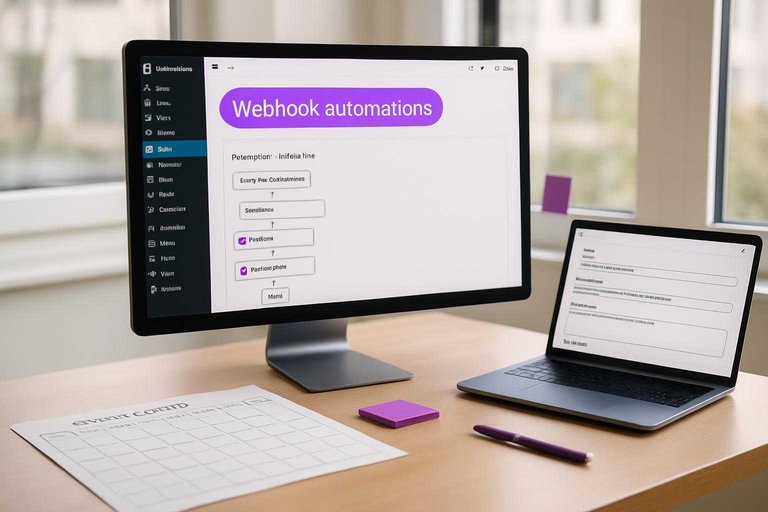
Webhook automations let you connect triggers and downstream workflows without heavy engineering. Automatic image generation reduces the “blank post” problem, while keyword and meta handling helps you ship posts that look finished in WordPress. For a sense of what this looks like in practice, see real-world automated SEO content examples. The backlink exchange network is a unique angle, but it’s not universal; it fits best when you can vet partners and stay aligned with your risk tolerance.
Choose Skribra when you want one tool to carry the workflow, not a pile of tools to manage it.
Tradeoffs to note
Automation doesn’t remove responsibility; it changes where you spend attention. You still need a human layer where mistakes are expensive.
Topic selection needs strategy, or you’ll publish lots of pages nobody searches for. Fact-checking is still on you, especially for YMYL, pricing, or regulated claims. Compliance and brand voice tuning also take iteration, because “consistent” can become “generic” fast.
Treat Skribra as your publishing engine, then put your standards upstream.
1) Byword AI
Byword is a strong SEObot alternative when you need long-form drafts fast and you want automation through an API. It fits programmatic SEO workflows where templates, variables, and bulk runs matter more than handcrafted narrative. Avoid it if your bar is “publish-ready without editing,” or if you must guarantee sourced, verifiable claims every time.
Use Byword when
Choose it when your workflow is system-driven and you can edit after generation.
- You build API-first publishing pipelines
- You need bulk long-form drafts
- You rely on templates and variables
- You publish in multiple languages
- You want fast first drafts
If your bottleneck is throughput, Byword removes it.
Watch-outs
Byword can produce uneven quality across topics, especially where nuance or originality matters. You’ll still need an editorial layer for structure, internal links, and on-page intent matching. Sourcing is the hard part: if your policy requires citations, you must enforce it in your process.
Scaling thin content is easy. Ranking it is not.
2) Jasper
Jasper is a strong pick when your constraint is brand voice, not publishing automation. It shines inside marketing teams that need consistent messaging across channels, then route drafts through reviews.
If your goal is hands-off, daily autopublishing like SEObot-style tools, Jasper needs more plumbing. Pair it with a dedicated SEO stack, or choose an autopublish platform like Skribra when automation is the core requirement.
Use Jasper when
Choose Jasper when you need copy that sounds like you, across many surfaces.
- Enforcing a consistent brand voice
- Producing campaign and launch copy
- Collaborating with marketing stakeholders
- Running review and approval workflows
- Creating formats beyond blog posts
If your bottleneck is messaging and approvals, Jasper clears it fast. Jasper’s Brand Voice controls are built specifically for this kind of consistency.
Watch-outs
Jasper doesn’t replace an SEO system. It gives you great drafts, but you still need a plan for keywords, internal links, and publishing.
Teams often add separate tools for keyword research, content briefs, and technical checks. For fully automated pipelines, you’ll likely rely on integrations, custom scripts, or a platform built for autopublish.
That’s where Skribra tends to be the cleaner fit versus Jasper, while Jasper stays the better writer’s room.
3) Writesonic
Writesonic fits when you want fast, budget-friendly drafts with light SEO guidance. It can cover a lot of routine content, but you still need a real editing layer.
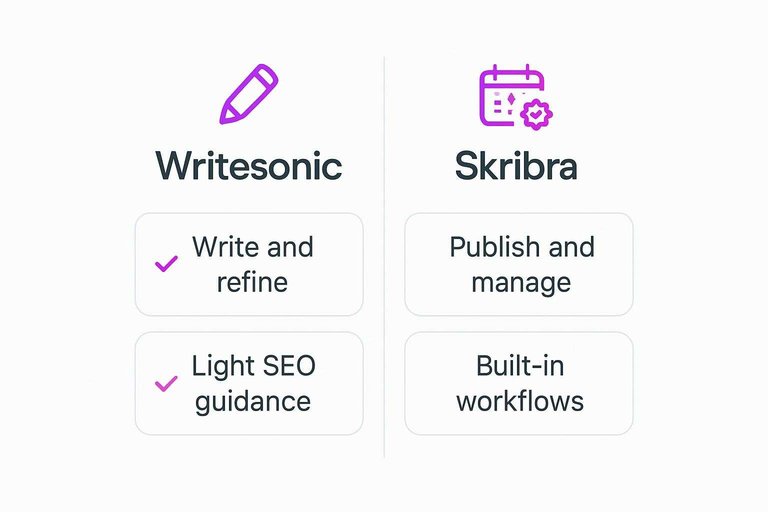
If you’re comparing SEObot-style automation, Writesonic is more “write and refine” than “publish and manage.” For hands-off daily publishing with built-in workflows, tools like Skribra usually align better.
Use Writesonic when
You need speed and acceptable first drafts, not a fully managed content engine.
- You run SMB content with limited budget
- You need quick outlines or briefs
- You want simple SEO-ready drafts
- You publish occasionally, not daily
- You have an editor to polish
If your process already includes a human editor, Writesonic can be the draft factory.
Watch-outs
At scale, the gaps show up in process, not prose.
You’ll likely need stronger editorial control to maintain real expertise, consistent voice, and topic depth. You’ll also need a separate internal linking plan and a clear topical map, or coverage gets scattered.
If your goal is “publish daily with structure,” Skribra’s automation and WordPress workflow is usually the cleaner fit.
4) Content at Scale
Content at Scale is built for teams who care most about volume and cadence. You use it when you need lots of SEO drafts fast, then rely on a strong editing layer to make them publishable.
If you want more control over publishing, brand voice, and workflow automation, compare it with Skribra and similar pipelines. Skribra is the better fit when you want draft-to-WordPress publishing plus automation hooks, while still moving quickly.
Use it when
You choose Content at Scale when the operation is speed-first and your formats are repeatable.
- Publishing many posts across many similar pages
- Reusing standardized outlines across one niche
- Prioritizing speed over custom workflow controls
- Running an editor-led, draft-heavy pipeline
- Producing content for broad keyword coverage
If your bottleneck is drafting, it’s a strong lever.
Watch-outs
High-volume drafting tools shift the work downstream. Your editing process becomes the real product.
Expect a heavier lift on originality, SERP fit, and expertise signals.
- Editing burden: facts, tone, and structure still need human passes
- Originality expectations: you must add unique angles and examples
- SERP fit checks: verify intent, format, and competing page patterns
- Expertise signals: add real experience, sources, and clear authorship
If you can’t staff editorial QA, choose a more controllable pipeline like Skribra, or a modular stack using tools like Byword, Jasper, or Writesonic with your own checks and publishing gates.
5) Frase
Frase is a strong pick when your bottleneck is SERP understanding, not publishing logistics. Use it to turn messy SERPs into clear briefs, then hand those briefs to an autopublisher.
If you want “research to WordPress” in one motion, tools like Skribra fit better than Frase alone. Frase complements autopublishers more than it replaces them.
Use Frase when
Choose Frase when you need better inputs before you generate content.
- Build content briefs from SERP patterns
- Compare competitor angles and headings
- Tighten outlines to match intent
- Expand FAQs and PAA coverage
Pair it with an autopublisher like Skribra when you want briefs to become posts automatically.
Watch-outs
Frase is not a full autopublishing stack. You still need generation, editing, images, internal links, and a CMS workflow.
If SEObot is your baseline, Frase is the “research brain” while Skribra is closer to the “publishing engine.”
Choose your best-fit alternative and run a quick pilot
- Match the tool to your use case first (hands-off publishing vs. programmatic SEO vs. team workflows), then shortlist 2–3 options.
- Compare what will actually break (or streamline) your pipeline: CMS integration, templates/briefs, editing and approvals, internal linking, image handling, webhooks, and QA controls.
- If you want daily SEO articles with WordPress publishing plus automation extras (like webhooks, auto images, and a backlink exchange network), pilot Skribra alongside one runner-up.
- Publish a small batch, review accuracy and SERP fit, and only then scale the workflow that produces pages you’re comfortable keeping live.
Frequently Asked Questions
- Are SEObot alternatives safe to use for automated SEO article publishing without getting penalized?
- They’re usually safe when you add human QA and enforce originality, accuracy, and helpfulness standards before publishing. The biggest risks come from auto-publishing unreviewed content that’s thin, inaccurate, or overly templated across many pages.
- What’s the best way to set up a review workflow for automated SEO article publishing?
- Use a two-step gate: (1) editorial fact-check + brand/intent alignment, then (2) on-page SEO checks (title/H1, internal links, schema, images/alt text) before anything goes live. If you must automate publishing, route posts to “draft” first and require approval in your CMS.
- Can I use Frase with an auto-publisher instead of replacing SEObot entirely?
- Yes—Frase often works best upstream to generate SERP-driven briefs, headings, and topic coverage, then you feed that structure into your generator/publisher. This setup keeps research quality high while still letting you scale production.
- How do I measure whether an automated SEO publishing tool is actually improving organic traffic?
- Track Google Search Console (impressions, clicks, queries, and page-level performance) alongside index coverage and crawl stats, then confirm engagement signals in GA4. Compare cohorts of auto-published pages vs. manually produced pages by topic and publish date to spot quality gaps.
- Which SEObot alternative is best if I want WordPress auto-publishing with SEO-ready formatting?
- Choose a tool that can push posts to WordPress as drafts, supports consistent templates (headings, tables, FAQs), and lets you control categories, tags, and internal links. If you specifically want WordPress delivery plus SEO-ready formatting in one workflow, Skribra is a natural option to evaluate.
Automate Publishing Without Tradeoffs
Comparing SEObot alternatives is the easy part—choosing a tool that reliably ships SEO-ready posts to your CMS every day is where most teams get stuck.
Skribra generates and formats SEO-optimized articles and publishes directly to WordPress, so you can scale output without adding headcount—start with the 3-Day Free Trial.
Written by
Skribra
This article was crafted with AI-powered content generation. Skribra creates SEO-optimized articles that rank.
Share: