June 24, 2026
·
8 min read
How SEO timelines work for new pages
An explainer on how SEO timelines work for new pages—use the Discovery→Processing→Evaluation→Stabilization mental model, understand what actually starts the clock, diagnose why new URLs lag, anticipate volatility phases, and apply practical steps that speed up indexing and ranking confidence.

You publish a new page, hit “index,” and then… nothing. No impressions, no rankings, and no clear signal whether the content is good or simply invisible.
SEO timelines feel mysterious because multiple systems have to line up: crawling, indexing, quality evaluation, and then repeated re-checks as the web (and your site) changes. This explainer gives you a simple timeline mental model, shows what really starts the clock, and helps you separate normal early volatility from issues you can fix right now.
Timeline Mental Model
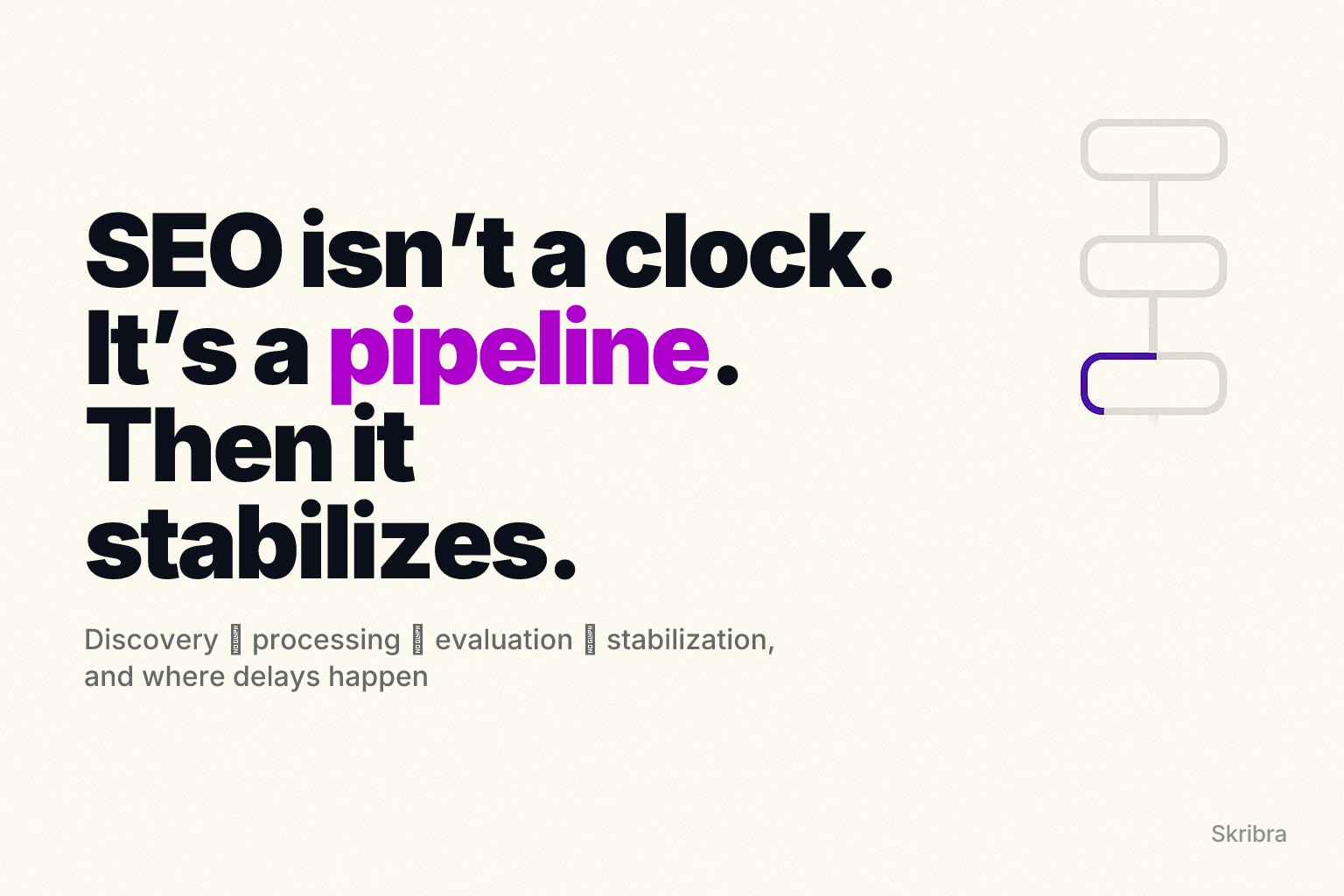
SEO time isn’t a countdown. It’s a pipeline: discovery → processing → evaluation → stabilization.
Each stage can bottleneck for different reasons, so two “new pages” rarely move at the same speed. Treat the timeline like systems work, not a calendar.
Discovery
Search crawlers can’t rank what they can’t find. Your job is making the URL easy to bump into.
Discovery usually happens through:
- Internal links from already-crawled pages
- XML sitemaps and sitemap indexes
- Feeds, hubs, and category pages
- External links from other sites
Internal linking is the lever you control most. A page linked from a popular hub gets found faster than an orphan.
Processing
After a crawler finds a URL, indexing systems decide what it “is.” They fetch it, interpret it, and fit it into the index.
Processing often includes:
- Rendering the page, sometimes with JavaScript
- Choosing the canonical URL version
- Extracting main content and structured data
- Pulling out links and media references
- Detecting duplicates and near-duplicates
Heavy JS, conflicting canonicals, and lots of similar pages add ambiguity. Ambiguity adds delay.
Evaluation
Once indexed, the page competes. Search systems estimate relevance and quality using available signals.
Early evaluation tends to be noisy because signals are incomplete:
- The page has little interaction history
- Few sites have linked to it yet
- The site’s topical map may be unclear
- The query space may be crowded
You might see brief visibility, then a drop, then a return. That’s testing, not punishment.
Stabilization
Rankings settle when the system has enough evidence to stop “guessing.” That evidence often comes from repeated crawling, user behavior patterns, and link discovery.
Stabilization strengthens when:
- The content stays consistent across crawls
- Internal links remain stable and contextual
- External mentions and links accumulate naturally
- Query matching becomes clearer over time
Major edits can reopen earlier stages, especially processing and evaluation. Updates aren’t free; they restart parts of the pipeline.
What Starts the Clock
Your SEO “timeline” doesn’t start when you hit Publish. It starts when search engines can reliably discover and evaluate the page.
Search Console and server logs show the milestones you can actually observe—if you need a refresher on the fundamentals, see this SEO guide for getting started.
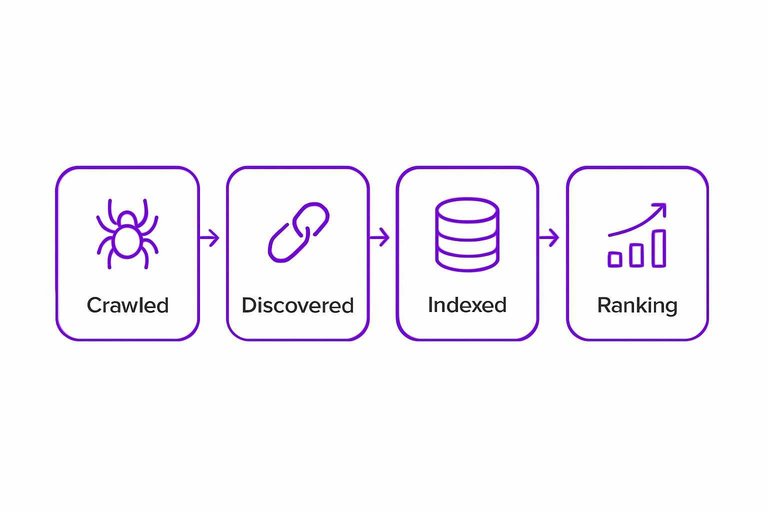
| Milestone | What it means | How you observe it | What you can do |
|---|---|---|---|
| Published | Page exists for humans | Browser, CMS | Add internal links |
| Crawled | Bot fetched the URL | Server logs | Improve crawl paths |
| Discovered | URL found via links | Search Console | Submit sitemap |
| Indexed | Eligible to rank | Search Console | Fix noindex/canonicals |
| Ranking | Appears for queries | Search Console, SERPs | Improve intent match |
Track from “crawled” and “indexed,” not “published,” or you’ll chase ghosts.
Why New Pages Lag
New pages start with thin evidence. Search engines move carefully because early guesses are expensive.
Older sites move faster because the system already trusts the host, understands patterns, and crawls it often. New URLs have to earn both attention and confidence.
Crawl Budget Signals
Crawling is the gateway to everything else. If your site gets crawled lightly, new pages wait.
Search engines prioritize crawl frequency using signals like:
- Host health: uptime, speed, error rates, and redirect chains
- Internal importance: prominent links, hub pages, and fresh sitemaps
- URL patterns: clean structures versus endless parameters and faceted traps
Treat crawl like a scarce resource. Make the new page cheap to fetch and obvious to find.
Indexing Friction
Indexing is a quality filter, not a courtesy. Engines skip pages that look redundant or ambiguous.
Common blockers that slow or prevent indexing:
- Noindex tags or robots disallow rules
- Weak canonicals pointing elsewhere
- Near-duplicate pages with minor changes
If your page looks like “more of the same,” it becomes optional. Reduce ambiguity and give it a unique job.
Link Graph Delay
Authority doesn’t teleport. It moves when crawlers discover links and then reprocess the pages that contain them.
A new page often launches with few inbound paths, so engines must first find it through internal links, sitemaps, or external mentions. Then they need another pass to update how link equity and relevance flow through that neighborhood.
That’s the lag you feel. You’re waiting on discovery plus propagation, not just “ranking.”
Behavioral Feedback Loops
Search engines learn from exposure. New pages get limited impressions, so the learning rate starts low.
When a page appears for queries, engines can observe clicks, quick returns, and long-click satisfaction. If exposure stays tiny, confidence grows slowly because there’s not enough interaction to validate the page for that intent.
You can’t optimize signals no one sees. First, earn impressions by matching narrower, clearer queries.
Ranking Volatility Phases
New pages rarely move in a straight line. Search systems probe, compare, and re-score your page as new evidence arrives — which is why consistent publishing and clean, crawlable formatting matter as much as any single “perfect” post.
Initial Testing
A new page can flash into view, then vanish. That’s the system running small tests and correcting early guesses.
Early on, query matching is still calibrating:
- The page gets tried on a few close queries.
- Engagement and long-click signals stay noisy.
- Freshness gives a temporary seat at the table.
- Similar pages in the index provide the benchmark.
This phase is where disciplined, repeatable SEO basics help: clear on-page structure, relevant keywords, and accurate meta descriptions reduce ambiguity while the system is “sampling” your page. If you’re publishing at scale, a workflow that standardizes those elements (for example, using a platform like Skribra to generate SEO-formatted drafts with metadata) can make early tests less chaotic.
Treat early rankings like a lab result, not a forecast.
Reassessment Cycles
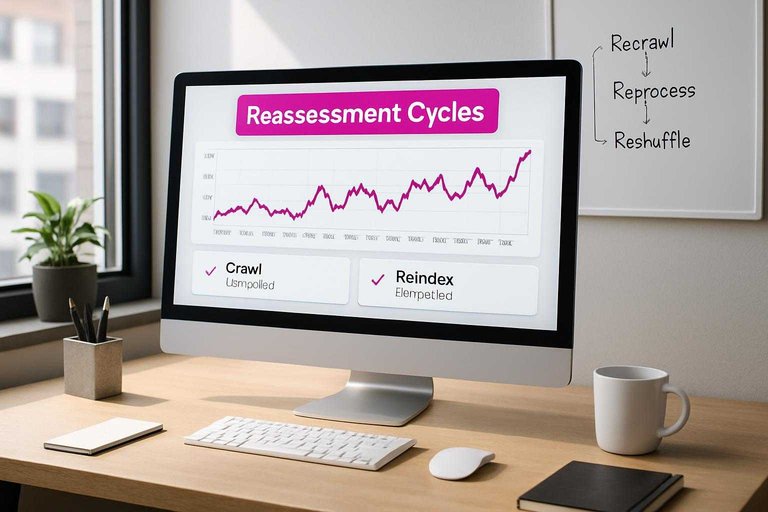
Rankings reshuffle when your page gets re-crawled and reprocessed. Edits can help, but they also restart parts of the evaluation.
Common triggers for a wobble:
- A recrawl updates what’s actually on the page.
- Re-indexing changes extracted entities and topics.
- Link graphs update as new edges appear.
- Template or internal link changes alter context.
If you’re iterating often, make changes intentionally and keep your publishing pipeline consistent. For teams pushing frequent updates through WordPress, tools that publish with stable formatting and predictable SEO fields (Skribra’s WordPress integration is an example) can reduce “accidental” variance that prompts unnecessary re-interpretation.
Change the page with intent, then give it room to settle.
Plateau Causes
Plateaus happen when the system can’t find a strong reason to promote you further. Most stalls map to one of these constraints:
- Intent mismatch versus the dominant SERP.
- Weak differentiators against similar pages.
- Thin link support and weak authority signals.
- SERP ceiling from entrenched competitors.
When you hit a plateau, stop “more content” and start “clearer advantage.” That can mean tightening intent alignment, expanding coverage where competitors are demonstrably stronger, and building credible link support. If link scarcity is a limiting factor, participating in a quality-controlled backlink exchange network (such as Skribra’s) can be a practical way to add supportive edges—so long as relevance and standards stay high.
When you hit a plateau, stop “more content” and start “clearer advantage.”
Breakout Conditions
Breakouts happen when you add evidence the system trusts. You’re not begging for a rerank; you’re giving the model new inputs.
The usual unlocks are structural:
- Stronger links that change perceived authority.
- Better topical coverage that wins more queries.
- Improved internal prominence via hubs and navigation.
- New demand that widens the query pool.
This is where compounding systems beat one-off heroics: a steady cadence of well-structured, keyword-aware articles, published reliably, plus intentional authority building. A setup that automates daily SEO-optimized content production and streamlines publishing (e.g., Skribra paired with WordPress), while also supporting link growth through a curated exchange network, can help you create the kind of sustained “new evidence” that triggers step-change improvements.
Engineer the next tier by upgrading signals, not by refreshing dates.
What Speeds It Up
You can’t force Google to trust a brand-new page. You can remove friction so discovery, indexing, and evaluation happen sooner.
- Link to the page from a high-traffic, crawlable hub page on your site.
- Include the page in your XML sitemap and ensure it returns a clean 200 status.
- Eliminate render blockers for critical content and verify robots and canonicals.
- Add specific supporting links from closely related pages using descriptive anchor text, and consider unlocking daily SEO gains with AI to scale internal linking and on-page improvements.
- Strengthen confidence signals with clear authorship, sources, and consistent internal structure.
Fix the pipeline first, then worry about rankings.
Set Expectations, Then Work the Levers You Control
Treat a new page like a process, not a launch: it has to be discovered, processed, evaluated, and only then stabilized. If you’re stuck, check the “clock starters” first (crawlable URL, internal links, canonical, sitemap, indexing signals), then remove friction (rendering, duplication, thin intent match) and add clarity (strong page purpose, entity coverage, supporting links). Expect early ranking tests and resets; your job is to make the page easy to crawl, unambiguous to index, and clearly valuable enough to earn links and engagement over time.
Frequently Asked Questions
- Do SEO times differ for blog posts vs landing pages vs product pages?
- Yes—SEO times usually vary by page type because Google needs different signals (intent match, depth, trust, and links) to evaluate each. Blog posts often move faster for long-tail queries, while commercial pages may take longer to earn confidence for competitive terms.
- How can I tell if my page is indexed but not ranking yet?
- Check Google Search Console: if the URL appears in the Pages report as indexed but shows few or no impressions in Performance, it’s indexed but not earning visibility. You can also use the URL Inspection tool to confirm the last crawl and whether Google selected a canonical.
- What should I do if my new page isn’t getting crawled for weeks?
- Add prominent internal links from high-crawl pages, include the URL in your XML sitemap, and request indexing in Google Search Console. Also verify robots.txt, meta robots, canonical tags, and server responses so Google can fetch and render the page without blockers.
- Do backlinks still affect SEO times for a brand-new page in 2026?
- Yes—relevant, trustworthy links often speed up evaluation by improving discovery and confidence signals. Internal links help immediately, and a small number of strong, contextually relevant external links can matter more than many low-quality ones.
- Should I keep publishing more pages to improve SEO times, or focus on updating the new page?
- Do both, but prioritize fixing the page if it’s not meeting intent or has weak internal links, then publish related supporting content to build topical coverage. Tools like Skribra can help maintain consistent, keyword-aligned publishing so new pages get stronger internal link support over time.
Shorten Your SEO Ramp
Understanding SEO timelines is one thing; consistently publishing, optimizing, and earning trust signals fast enough to beat the lag is another.
Skribra helps you accelerate the “what speeds it up” phase with daily SEO-optimized articles, WordPress publishing, and built-in backlink opportunities—start with the 3-Day Free Trial.
Written by
Skribra
This article was crafted with AI-powered content generation. Skribra creates SEO-optimized articles that rank.
Share: