SEO Titles vs H1 Headings: Which Drives More Clicks?
A practical comparison of SEO titles vs H1 headings for earning more clicks—how SERP snippets drive click-through, how on-page scanning shapes engagement, when matching vs diverging builds trust, and a step-by-step optimization playbook to prevent rewrites and improve persuasion.
Sev Leo is an SEO expert and IT graduate from Lapland University, specializing in technical SEO, search systems, and performance-driven web architecture.
If your page ranks but no one clicks, it’s tempting to blame “the headline.” But which headline—the blue link in Google, or the big H1 on the page?
This comparison breaks down where clicks actually happen and how each element influences them. You’ll get a quick verdict, clear winner-by-scenario calls for SERPs vs on-page behavior, and simple rules for when to match your SEO title and H1 (and when not to) without creating confusion or triggering title rewrites.
Quick verdict first
Your SEO title (the title tag) is the line that most often earns the click from Google’s results page. Your H1 is the on-page headline that helps the click feel “right” once people land.
Here, “clicks” means three different behaviors: the click into your page from a search result, the click deeper into your site, and the click from a shared link. Expect the SEO title to win the SERP, and the H1 to win on-page behavior.
What each is
The SEO title is the page’s title tag, usually shown as the blue link in Google. The H1 is the main visible headline on the page.
You typically set both in your CMS or theme, but you don’t fully control what Google shows. Google can rewrite the visible SERP title, while your H1 stays what your page renders.
Where clicks happen
Not all “clicks” are the same, and the winner changes by location. A SERP click is the tap from Google into your page, while internal clicks happen after the landing.
Social clicks sit in between, because the share preview often uses different fields. Scope matters here: we’re comparing what drives the first click versus the next click.
Winners by scenario
Different surfaces reward different text.
Google SERP click: SEO title
Social share click: SEO title
In-page scanning: H1
Internal navigation click: H1
Bookmark/tab recall: SEO title
If you optimize only one, you’re optimizing only one moment.
Decision shortcut
Optimize the SEO title for the promise that earns the SERP click. Optimize the H1 for the clarity that confirms the promise.
Align them when the page has one primary intent and one primary query. Separate them when you need a tighter SERP hook but a clearer on-page explanation.
How clicks are influenced
Clicks come from two moments: the decision on the search results page, then the decision after the page loads. Your title tag mostly wins the first moment, while your H1 either confirms the win or destroys it fast.
SERP snippet logic
Google builds a result snippet to match the query, not to honor your HTML. It may show your title tag, swap in your H1, or pull anchor text when it thinks those fit better.
Your controllable inputs are simple: a clear title tag, a strong H1, descriptive internal anchors, and a clean site name setup. If those agree, rewrites tend to stay “on message.”
The move is to design for rewriting, not to pretend it never happens.
On-page scanning
After the click, visitors scan before they read. The H1 is the fastest check for “am I in the right place?”
Most people look at the H1, the first screen of copy, and any obvious next steps like buttons or links. If the H1 matches their intent, they scroll or choose a deeper link.
Treat the H1 like the receipt for the promise your title made.
Intent and promises
Different intents need different promises, and titles and H1 share the job. Your title wins attention, and your H1 confirms precision.
Informational: Title frames the question; H1 states the exact answer.
Transactional: Title signals outcome; H1 names the offer and terms.
Navigational: Title clarifies destination; H1 confirms brand and page.
Comparison: Title highlights options; H1 defines the decision criteria.
Write the title for the SERP, then make the H1 the first proof.
When mismatch hurts
A title–H1 disconnect feels like bait-and-switch, even when it is accidental. People back out, refine the query, and pick a result that sounds consistent.
That behavior trains lower downstream clicks too, because users stop trusting your buttons and internal links. Even if you keep the initial click, you lose the next one.
Consistency is a conversion rate multiplier, not a style preference.
SERP clicks showdown
Primary click driver
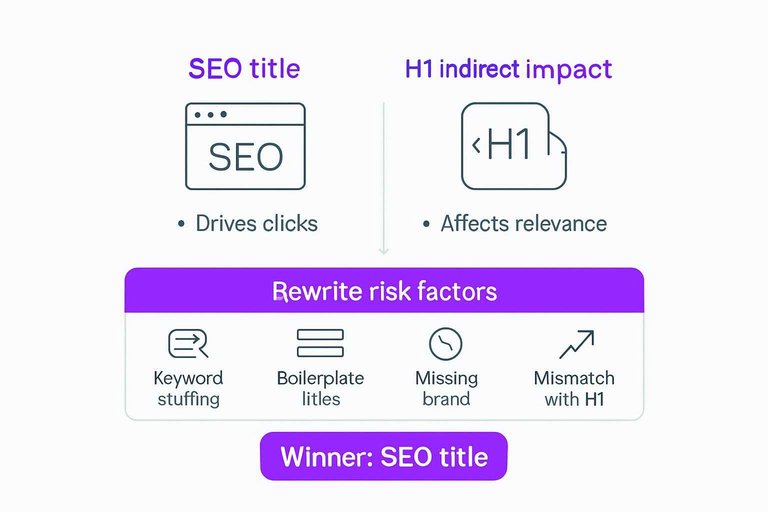
Your SEO title is the primary lever for SERP clicks because it’s the most visible choice cue. It usually becomes the blue link, and it frames the snippet before anyone visits.
So your CTR swings on the few words people actually see—and that’s why it’s worth treating titles as a repeatable, systemized step in your publishing workflow (not an afterthought). Tools like Skribra that generate SEO-focused titles alongside meta descriptions and formatting can help keep that consistency across daily content without sacrificing relevance.
H1 indirect impact
Your H1 rarely drives the click directly because it usually isn’t shown in the SERP. It can still shape relevance and satisfaction, which can lift rankings, impressions, and then clicks.
Nail the H1 to keep the promise your title makes. If you’re producing content at scale, it helps when your process (or platform) encourages tight title–H1 alignment by design, so the on-page headline consistently matches the intent you’re signaling in SERPs.
Rewrite risk factors
Google rewrites titles when your version looks unhelpful, repetitive, or off-page. These are the common triggers.
Keyword stuffing or awkward repetition
Boilerplate titles across many pages
Missing brand where it matters
Mismatch with H1 or prominent anchors
If you trigger a rewrite, you lose control of the click message. This is also where templated, mass-produced titles can quietly hurt you—so it’s useful to have a workflow that varies phrasing, keeps page-specific intent clear, and bakes in metadata and structure checks as you publish.
Winner: SEO title
For SERP CTR, the SEO title wins because it’s the label users choose from. The exception is when Google rewrites your title and effectively promotes the H1 instead.
If rewrites happen often, fix alignment first, then rewrite titles. In practice, that typically means tightening the relationship between your title, H1, and on-page anchors—and using a consistent content pipeline (for example, Skribra’s SEO-optimized generation and WordPress publishing flow) so those elements don’t drift as you scale.
On-page clicks showdown
Once someone lands, clicks come from confidence and clarity, not rankings. Your H1 usually decides whether they scroll, skim, and tap internal links.
First-second confirmation
Your H1 is the on-page receipt. It tells the visitor, fast, they landed on the page they meant to find.
It anchors the whole above-the-fold story. When the H1 matches their intent, they start scrolling, scanning subheads, and clicking supporting links without hesitation.
If your H1 feels “off,” the best internal linking in the world won’t get used.
Title’s on-page role
Your SEO title still shows up after the click, but mostly at the edges. Think browser tab text, bookmark labels, and link previews in shares.
Those touchpoints matter for return visits and multi-tab comparison. On the page itself, the title rarely guides navigation choices.
Once they’ve landed, the title becomes background noise unless you give them a reason to notice it.