June 14, 2026
·
14 min read
How SEO Titles Work: Advanced CTR and Relevance Signals
A pillar guide to how SEO titles actually influence rankings and clicks—understand the title signal stack, align entities and intent, earn CTR without clickbait, manage rewrites and SERP features, and scale title systems with diagnostics.

Your title tag isn’t just a headline—it’s a bundle of signals that can help or hurt relevance, eligibility, and click behavior. And even when you “win” a click, it doesn’t mean the page satisfied the search.
This guide breaks down how titles are read and rewritten, how to align wording with entities and intent, and how to improve CTR without baiting the wrong audience. You’ll also learn what changes trigger replacements, how SERP features change the rules, and how to design titles that scale safely.
Title Signal Stack
Titles sit at the boundary between ranking systems and human choice. They can help relevance, shape snippets, and set expectations after the click.
First-order vs second-order
Titles can affect ranking in two very different ways. Some effects are direct inputs to relevance scoring, and others are downstream behavior that feeds back later.
First-order effects are about matching the query. Your words, entities, and topical alignment can strengthen relevance signals.
Second-order effects come from what people do after seeing or clicking. That includes clicks, satisfaction, and future query refinement.
So aim for relevance first, then earn behavior; you rarely get to skip step one.
Where titles are read
Titles get interpreted at multiple stages, and not always from the same source. The system may swap between your HTML title, on-page headings, and rewrites.
- Retrieval: query-term match against indexed title text
- Re-ranking: relevance and intent fit signals
- Snippet rendering: HTML title vs system rewrite
- Post-click evaluation: expectation set by shown title
If the shown title differs from your HTML, you’re optimizing the wrong artifact.
Why CTR is messy
CTR looks like a clean vote, but it’s heavily confounded. The same title can win or lose based on context you don’t control.
Position bias dominates. Higher ranks get more attention, even with worse titles.
SERP features steal clicks, and brand recognition changes what “good” looks like. Even query intent shifts the click ceiling.
Treat CTR like noisy telemetry, not a scoreboard; validate with controlled comparisons when you can.
Satisfaction over clicks
Clicks are easy to trigger. Satisfaction is harder to fake, and titles help set the contract.
- Long-click: user doesn’t bounce back quickly
- Pogo-sticking: user returns and chooses another result
- Task completion: no further related searches
- Query refinement: narrower follow-up wording
- Brand avoidance: user skips you next time
Write titles that pre-qualify the click; the best CTR is the one that sticks.
Relevance Alignment Mechanics
Titles can strengthen topical signals without repeating the same keyword. You do it by choosing the right entities, matching intent tightly, and removing ambiguity early.
Entity-first phrasing
Polysemous queries break when your title names the wrong “thing.” Lead with the entity, then add modifiers and attributes that pin it to the right concept.
Example: “Python List Comprehensions (Beginner Guide)” is clearer than “List Comprehensions in Python.” The first anchors the entity, then adds the disambiguator and audience.
For more on building relevance signals across a page, see this practical SEO guide.
Modifier placement tactics
Modifier position changes what the model and the human notice first. Use placement to control recall, then persuasion.
- Front-load disambiguators for polysemy
- Front-load “best/compare” for shopping intent
- Delay benefits for branded, known topics
- Delay urgency modifiers to reduce spam feel
- Trail constraints when they’re optional
If your query has multiple meanings, lead with the clarifier, not the sparkle.
Intent compression
Your title has to express the job, the user, and the constraint in very few tokens. Pack the primary intent tightly, then drop any secondary intent that changes the task.
Imagine a page about configuring SPF for Google Workspace. “SPF Record for Google Workspace: Setup, Syntax, and Common Errors” stays on one job. Adding “and Email Marketing Tips” drags the vector toward a different intent.
Semantic uniqueness checks
Clusters drift into near-duplicates when titles differ only cosmetically. Check uniqueness with intent, not wording.
- List all titles targeting the same core query.
- Write each page’s “job-to-be-done” in one line.
- Flag pairs with the same job and same audience.
- Rewrite titles to encode a different constraint or stage.
- Merge or redirect pages that can’t justify separation.
If you can’t explain the difference in one sentence, Google won’t either.
CTR Without Clickbait
You want more clicks from the right people, not the most people. The title is a contract, and broken contracts create bounces, rewrites, and distrust.
Specificity as filter
Specific titles pre-qualify the reader before they land. That lowers pogo-sticking because expectations match the page.
Concrete scope signals who it’s for and what it covers.
Constraints signal what it won’t do.
Recency signals whether the advice matches today’s tools and SERPs.
Imagine two titles: “SEO Title Tips” versus “SEO Title Formulas for B2B Blogs (2026), With Examples.” One attracts curiosity; the other attracts intent.
Qualified CTR usually comes from saying less, more precisely.
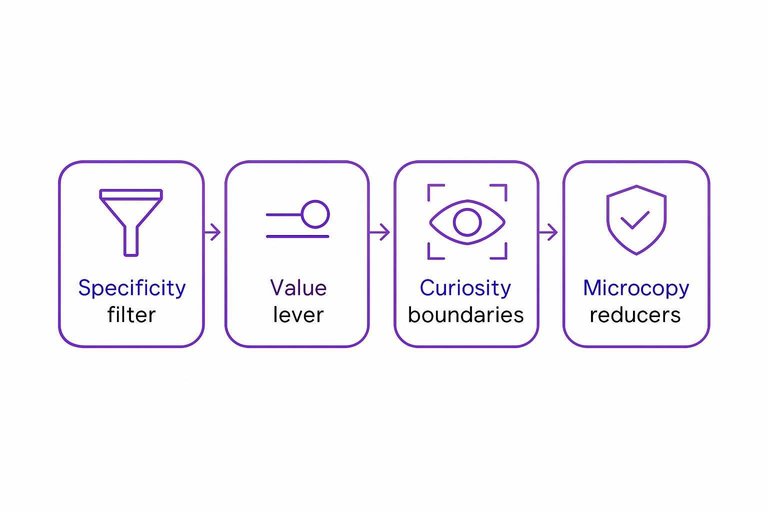
Value proposition levers
Your title can sell value without hype by choosing the right lever for the query. Pick one primary lever, then support it with a qualifier.
- Outcome-focused: “Get X result”
- Time-to-value: “in one pass”
- Difficulty signal: “beginner” or “advanced”
- Comparison framing: “X vs Y”
- Templates angle: “templates” or “swipe file”
- Checklist format: “checklist” or “audit list”
- Troubleshooting: “fix” or “why it fails”
The best lever is the one your page actually delivers, end to end.
Curiosity with boundaries
Curiosity works when you reveal the category and hide the detail. That sets a clear promise while preserving a reason to click.
Safe gaps name the topic and the audience, then withhold the mechanism.
Example: “Why Your Titles Don’t Rank (And the Fix Most Guides Miss).” The reader knows the problem and expects a specific remedy.
Vague hooks like “You won’t believe” inflate clicks, then punish you with bounces and rewrites.
Microcopy risk reducers
Tiny trust cues reduce perceived risk, especially on high-stakes queries. They work when they add information, not when they pad.
- “Examples” when the query needs pattern recognition
- “Step-by-step” when the task has sequence risk
- “Best practices” when norms matter more than hacks
- “For X” when intent varies by audience
- “Avoid” when mistakes are costly
- “Mistakes” when readers want reassurance
When every result uses the same cue, it turns into wallpaper. Then you need sharper specificity, not more microcopy.
Rewrite and Replacement Risks
Google rewrites titles when your tag looks unreliable, unclear, or unhelpful for the query. It is trying to pick the shortest, most specific string that matches the page and the searcher. Treat rewrites as a ranking-and-click risk, not a cosmetic annoyance.
Common rewrite triggers
Google usually rewrites when your title fails a basic “label the page” job for that query.
- Mismatch with H1 wording or intent
- Excessive truncation hides key meaning
- Keyword repetition reads like spam
- Missing entities the page clearly covers
- Boilerplate prefixes crowd out specificity
If you see three or more, you are inviting Google to take the wheel.
Source-of-truth hierarchy
Google picks from multiple text sources, then assembles what best fits the query and device. Your job is to make every candidate “good enough” without cloning the same string everywhere.
The rough competition looks like this:
- Title tag: preferred, but not trusted
- H1: strong fallback label
- Internal anchors: common “what it is” phrasing
- External anchors: reputation-driven descriptors
- On-page context: entities, headings, and nearby text
Align intent and entities across sources, then vary phrasing slightly so replacements still sound on-brand.
Designing for variants
Write titles assuming they will be truncated, remixed, or partially swapped. Build a core that survives, then add a suffix you can afford to lose.
- Lead with the primary entity and qualifier in the first few words.
- Put the differentiator next, before any separators.
- Move brand, location, and legal text into a final suffix.
- Avoid repeated keywords; use one strong synonym instead.
- Make H1 confirm the same promise with different wording.
If Google cuts your title in half, the remaining half should still win the click.
Measuring rewrite impact
You need two views: what Google served, and what Search Console aggregates. Compare them to avoid blaming CTR swings on a title you never actually ran.
Pull GSC by page and query, then spot-check live SERPs for the same combinations. Capture the displayed title, the snippet, and the URL, because rewrites often travel with other snippet changes.
When impressions stay steady but CTR shifts, you are testing messaging. When the served title changes, you are also testing Google’s replacement logic.
SERP Feature Interactions
Your title rarely competes in a clean list of ten blue links anymore. It competes inside a layout with distractions, enhancements, and sometimes an answer that steals the click.
Optimize for the space you actually get. And for the intent that remains after features take their share.
Pixel-width realities
Titles get cut by pixels, not characters, and the cutoff shifts by device and font. People also skim bolded query terms first, so late clarity often disappears.
Write for early disambiguation:
- Put the unique qualifier in the first clause
- Lead with the primary entity, not the category
- Front-load the “for who” or “vs what” distinction
- Use separators sparingly, and only once
If your first 6–8 words are vague, truncation turns your result into a coin flip.
Feature-driven competition
SERP features change what users still need to click for. Your title has to match the intent that survives ads, modules, and instant answers.
- Ads above you reduce “shopping” clicks
- PAA steals early research curiosity
- Video packs capture “watch me” intent
- Featured snippets satisfy quick definitions
- AI answers compress broad comparisons
Aim your promise at the leftover job, not the original query’s full scope.
Rich result eligibility
Structured data and page format can add stars, prices, dates, images, or breadcrumbs. Those embellishments reshape expectations before the click.
Coordinate your title with your markup and on-page facts:
- Don’t imply “review” without review signals
- Don’t imply “in stock” without inventory clarity
- Don’t imply “2026” without visible freshness
- Don’t contradict your breadcrumb category
When your rich result says one thing and your title says another, trust breaks fast. (See Rich result report overview for how eligibility is reported.)
Sitelink title coherence
Sitelinks create a mini-navigation under your main result. If the parent title and sitelink anchors disagree, users hesitate.
- Keep parent title as the umbrella promise
- Make sitelink anchors specific, not clever
- Avoid repeating the exact parent phrase
- Align terminology across parent and child pages
- Prevent two sitelinks targeting one intent
Clean sitelinks turn your result into a menu, not a mystery.
Title Systems at Scale
Large sites don’t “write titles.” They run a title system.
When the system is good, it stays specific, avoids collisions, and still reads human—especially when your publishing pipeline (whether custom or via a platform like Skribra) is producing content continuously and titles have to hold up under volume.
Template variable strategy
At scale, your title variables are your disambiguation engine.
Pick variables that separate one page from its nearest neighbor, not the ones that sound nice.
A practical variable set often looks like:
- Entity: the core noun users search
- Model or variant: the differentiator users compare
- Location: only when geography changes intent
- Use-case: only when it narrows the promise
Order them by “how fast they remove ambiguity.”
Put the entity first, then the strongest differentiator, then optional context like location or use-case.
If your templates repeat a brand-like suffix everywhere, you’re spending characters on sameness—something to watch closely when titles are being generated from standardized SEO fields (keywords/meta) as part of an automated content workflow.
Duplication tripwires
Title duplication hides until rankings flatten and pages start trading impressions.
You can detect it early with a few blunt signals.
- Same high-frequency n-grams across many titles
- Identical suffixes on competing URLs
- Low-entropy prefixes like “Buy” or “Best” everywhere
- Near-identical titles within one category cluster
- Multiple pages matching one query intent
Fix the pages with real demand first.
Prioritize by traffic, then cannibalization risk.
This matters even more if you publish at a steady cadence: the faster new pages go live (for example via WordPress integrations), the faster duplicated patterns can spread unless you’re measuring title entropy and collisions as a default check—using resources to simplify SEO workflows can help standardize those checks.
Controlled generation workflow
Programmatic titles need guardrails, or you ship mistakes at the speed of code.
Use a workflow that treats titles like deployable artifacts.
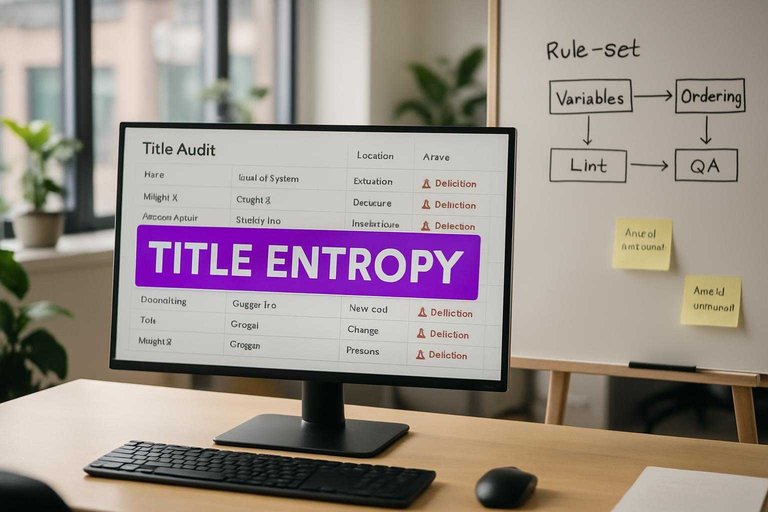
- Define a rule set with allowed variables and ordering.
- Lint generated titles for length, duplicates, and forbidden tokens.
- Sample outputs by template, category, and language.
- Run SERP spot checks for head and long-tail queries.
- Add human QA loops, plus rollback and exception handling.
Rollback is your safety valve.
Exceptions are your truth serum.
If you’re using an AI publishing system like Skribra, treat its title/meta generation as inputs to this same pipeline: validate before publish, sample after template changes, and keep an easy way to pause or revert batches when patterns drift.
Multilingual nuance
International titles break when you assume English-like token boundaries and word order.
Tokenization, inflection, and transliteration can quietly destroy relevance.
Keep entities consistent across languages, especially product names and proper nouns.
Adapt modifiers to local intent, since “best,” “cheap,” or “near me” equivalents behave differently.
Watch for word order shifts that move the key term too far right, or flip meaning.
Transliteration is where duplication hides.
Two spellings can split signals, or collide into one title.
When you’re generating multilingual content at scale, make sure your system can enforce entity consistency (glossaries/locked terms) while still localizing modifiers—otherwise you’ll get “correct” translations that perform poorly or collide across markets.
High-Stakes Edge Cases
YMYL trust signaling
YMYL titles get judged like promises, not marketing. You need clicks, but you also need to be believed.
Signal restraint and scope in the title itself. Use qualifiers like “overview,” “symptoms,” “eligibility,” or “questions to ask.” Add credentials only if the page clearly supports them, like “reviewed by” or a named professional role. Set boundaries early, like “for adults,” “in the U.S.,” or “general information,” when the content cannot cover every case.
Overpromising lifts CTR for a day, then drags trust for months. Google’s guidance on helpful, reliable, people-first content reinforces aligning headings/titles with what the page genuinely delivers.
Volatility and freshness
Freshness modifiers can win the click or create a quiet accuracy problem. Use them when they reduce searcher risk.
- Include a year for fast-changing rules or products
- Use “updated” when content has visible revision notes
- Add “breaking” only for time-bound news coverage
- Avoid dates on evergreen guides and definitions
- Skip versions if you cannot maintain them
If you can’t keep it current, don’t put a clock in the title.
Brand vs keyword tension
Brand placement is a bet on what the searcher trusts more than the keyword. In some queries, brand is the relevance signal.
Lead with brand when the query is navigational, reputation-driven, or safety-sensitive. Suffix the brand when the query is informational and comparison-heavy, where the keyword drives scanning speed. Strong brands often get a CTR lift even when relevance is equal, while weak brands can look like noise and lower clicks.
Treat brand like a ranking factor you can control: position it where it earns trust, not where it takes space.
Reputation query hygiene
Reputation queries invite scrutiny and screenshots. Your title has to match the query without sounding defensive or provocative.
- Mirror the core entity and intent, using neutral wording.
- Use “reviews,” “complaints,” or “ratings” only if the page contains them.
- Avoid absolutes like “scam” unless you can substantiate it clearly.
- Add scope cues like “policy,” “pricing,” or “support experience” when relevant.
- Keep the tone factual, then let the content do the arguing.
The goal is not to win the argument in the title, but to earn the right to be read.
Title Diagnostics Table
Use this table when rankings stall or clicks underperform, because your title is a compound signal. It affects relevance matching, snippet eligibility, and click behavior at once.
| Symptom you see | Likely signal interpretation | Precise fix | Quick validation |
|---|---|---|---|
| High impressions, low CTR | Matches query, weak appeal | Add outcome, remove fluff | Compare CTR by query |
| Low impressions overall | Weak topical alignment | Put primary topic first | Check query coverage |
| Wrong queries triggering | Ambiguous entity intent | Add qualifier term | Inspect triggering queries |
| Title rewrites in SERP | Title conflicts with page | Mirror H1 and intro | Recheck snippet source |
| CTR drops on mobile | Front-load truncated value | Lead with differentiator | Test on phone SERP |
Treat each row as a hypothesis, then validate in Search Console before changing anything else. Otherwise you’ll “improve” copy while the real issue stays untouched.
Put Your Titles on a Short Feedback Loop
- Audit the current SERP: capture the query, visible title, pixel constraints, features present, and whether Google is rewriting you.
- Re-align for relevance first: lead with the primary entity/topic, compress intent, and place modifiers where they clarify—not where they bloat.
- Add CTR levers responsibly: increase specificity, state a concrete value proposition, and use curiosity only when the page clearly resolves it.
- Design for variants and scale: build templates with guarded variables, duplication tripwires, and a controlled generation workflow (especially for multilingual pages).
- Validate with outcomes beyond clicks: check satisfaction signals (pogo-sticking, on-page engagement), compare pre/post rewrite visibility, and iterate using your diagnostics table as the source of truth.
Frequently Asked Questions
- Does your SEO title still matter in 2026 if Google rewrites titles in the SERPs?
- Yes—your SEO title is still the strongest source Google uses, and it also shapes internal linking context and external shares even when a rewrite happens. The goal is to make your on-page title the most accurate, specific label for the page so Google has no better alternative.
- How do I A/B test an SEO title without hurting rankings or confusing Google?
- Test titles by changing only the on-page title tag (not the URL/content) and keeping each variant stable long enough to gather impressions in Google Search Console. Compare query-level CTR and average position for the same pages, and avoid frequent flips that blur signals and trigger rewrites.
- Should every page on my site include the primary keyword in the SEO title?
- Most pages should include the primary keyword or a close variant when it matches the page’s main intent, but forcing it onto every page often creates duplication and misalignment. Use the clearest intent phrase for that page first, then add modifiers (brand, location, audience) only if they improve precision.
- How long should I wait to judge whether an SEO title change improved CTR?
- Wait until the page has enough impressions for the same key queries to smooth out daily volatility, then evaluate trends rather than single-day spikes. Use Search Console’s date comparisons and annotate the change date so you can separate title impact from seasonality or ranking shifts.
- What’s the best workflow to generate unique SEO titles at scale without creating duplicates?
- Use a structured template with “required” intent tokens (topic/entity + action/benefit) and “optional” disambiguators (location, product line, audience), then validate uniqueness with a crawl (e.g., Screaming Frog) before publishing. If you’re producing large volumes of pages, a platform like Skribra can help generate draft title variants aligned to page intent, but you still need QA rules to prevent near-duplicates.
Systemize SEO Titles at Scale
Getting SEO titles right means balancing relevance signals, CTR, and SERP features—then repeating the process reliably across every new page you publish.
Skribra helps you generate and publish SEO-optimized articles with titles, meta descriptions, and formatting built for performance—plus WordPress integration and a backlink network; start with the 3-Day Free Trial.
Written by
Skribra
This article was crafted with AI-powered content generation. Skribra creates SEO-optimized articles that rank.
Share: