July 8, 2026
·
7 min read
What Is International SEO and How Does It Work?
An explainer on how international SEO works so the right page shows in the right country and language—intent signals and SERP routing, locale interpretation cues, URL architecture models (ccTLD/subdomain/subfolder), and hreflang resolution with canonical and x-default considerations.

If your English page keeps ranking in Germany—or your Spanish version shows to U.S. users—you don’t have a “ranking” problem as much as a routing problem. Search engines are deciding which locale version to serve, and they can get it wrong when signals conflict.
This explainer breaks down what international SEO actually is, how Google interprets language and geography, how your URL structure affects targeting, and how hreflang works under the hood so you can diagnose mismatches and prevent them.
The Core Problem
Search engines often see multiple “right” pages for the same topic on international sites. They must pick one country or language version to show, and small signals can swing the decision. When they guess wrong, you get the classic mismatch: the right content shown to the wrong audience.
Two intent signals
International search has two competing intents: what language the user wants and what market they need. They line up sometimes, but they also collide when your versions look interchangeable.
A user in Canada can want French pages. Or English pages with Canadian pricing.
If your US and CA pages share copy, Google may treat them as the same answer.
That’s the line that gets crossed.
SERP routing mechanics
Google routes users to a “best-fit” version using several signals at once.
- Query language and wording
- User location and IP signals
- Device language and browser settings
- Past clicks and account history
- Site signals like hreflang
If three signals disagree, the strongest one wins.
Where it breaks
International setups fail when search engines can’t tell your versions apart. Or when your own signals contradict each other.
A UK page ranks in the US because nothing screams “UK.”
Near-duplicates get filtered, so your preferred version disappears.
Two country pages compete, and neither holds the top spot.
Fix differentiation first. Then fix targeting.
Why SEO changes
Single-market SEO asks one question: “Is this the best page for the query?” International SEO adds more questions before that one even matters.
Search engines must crawl more URLs, then decide which are distinct.
They must canonicalize duplicates without deleting the wrong market page.
They must rank one version while holding back the others.
Your job shifts from just relevance to controlled choice.
International SEO Defined
International SEO is the process of telling search engines which countries and languages your pages serve, so the right version ranks for the right people. For a broader foundation, see this complete SEO guide.
| Concept | What it targets | Common signal | Typical use |
|---|---|---|---|
| Country targeting | Location | ccTLD, GSC | One market focus |
| Language targeting | Language | hreflang | Same language regions |
| Country + language | Both | hreflang + URLs | Localized experiences |
| Default fallback | Everyone else | x-default | Global homepage |
When your signals align, search stops guessing and starts routing users correctly.

How Google Interprets Locale
Google has to guess two things before ranking: language and place. It does that from a bundle of signals, not a single tag, and the bundle can disagree.
Language detection
Google infers a page’s language from the visible text first, then checks reinforcing hints like HTML language markup and surrounding link context. If your navigation is English but your body copy switches to Spanish mid-page, classifiers get conflicting evidence and may hedge.
Common traps include boilerplate in one language, product content in another, and templates that inject mixed snippets across every URL. That’s the line where “bilingual” becomes “unclear,” and unclear pages get shown less confidently.
Geo relevance cues
Google looks for regional intent signals that match the user’s country context. When several cues point to the same place, targeting gets easier.
- Country-code TLD alignment
- Local address and city names
- Currency and pricing formats
- Phone formats and dialing codes
- Local backlinks and mentions
Stack three or more cues consistently, and you stop relying on guesswork.
Host-level targeting
Your host choice sets Google’s default assumption before it reads your page. A ccTLD usually implies a country, while subdomains and subfolders often start neutral unless you add stronger support.
Imagine identical pages at example.fr, fr.example.com, and example.com/fr/. Google can treat the ccTLD as inherently local, but the other two may need clearer reinforcement from hreflang, internal links, and localized cues.
Pick the structure you can keep consistent for years, because migrations rewrite these assumptions.
Personalization layer
Even perfect locale signals can be overridden by the searcher’s location, language settings, and past behavior. You may see your UK page rank in the US on your laptop, then disappear in a clean test.
That’s why manual checks in a normal browser feel chaotic, especially for multilingual brands with travelers and remote teams. Use controlled testing setups, or you’ll debug “problems” that are really personalization.
URL and Site Architecture
Your URL structure decides how search engines crawl your regions, cluster your pages, and pass authority between markets. Pick the model that matches your org and your ranking constraints, then commit to it.
ccTLD model
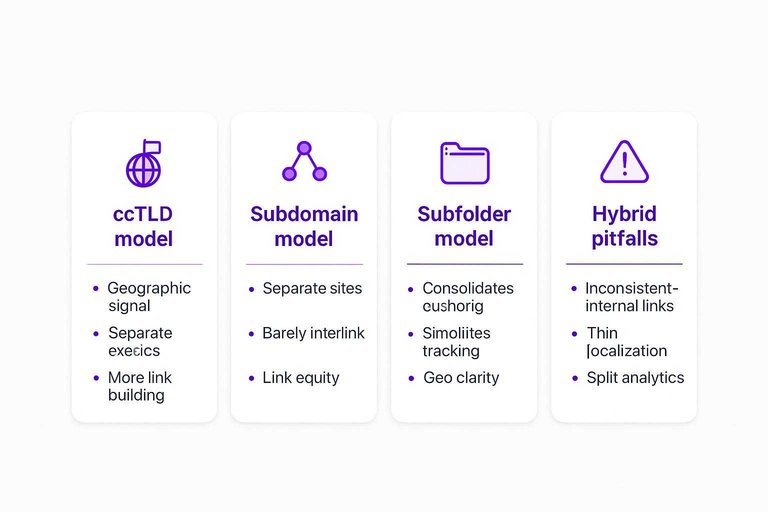
A ccTLD puts each market on its own country domain, like example.fr or example.de. It sends a loud geographic signal, but it also splits your site into separate entities.
You earn authority per domain, not as a shared pool. That often means more link building, more technical upkeep, and more chances for uneven performance between countries.
Use ccTLDs when local trust and regulation beat consolidation.
(For Google’s guidance on setup tradeoffs, see managing multi-regional sites.)
Subdomain model
Subdomains look neat on paper, like fr.example.com and de.example.com. In practice, Google can treat them more like separate sites, depending on linking, content overlap, and how independent they feel.
If your subdomains barely interlink, they can behave like islands. Link equity may not flow as smoothly as you expect, especially if navigation and internal links favor one market.
Subdomains work best when you want separation without full ccTLD cost.
Subfolder model
Subfolders keep everything under one roof, like example.com/fr/ and example.com/de/. That usually consolidates authority, simplifies tracking, and reduces duplicated technical work.
The tradeoff is geo clarity. Without strong signals like hreflang, localized content, and clear internal linking, the folder alone may not be enough for competitive local queries.
If you want shared strength, subfolders are the default choice—and pairing this model with a checklist for streamlining SEO content can help keep localization and internal linking consistent across markets.
Hybrid pitfalls
Mixing models seems flexible, but it creates messy signals fast.
- Inconsistent internal links across regions
- Duplicate templates with thin localization
- Competing pages for same intent
- Split analytics and reporting views
- Unclear ownership of keywords
If your structure is inconsistent, Google’s clustering becomes guesswork.
Hreflang Internals
What hreflang is
Hreflang is a mapping layer that tells Google which URLs are equivalents for language or region. It helps Google show the right version, not rank any version higher.
Think of it like a bidirectional “same content, different audience” annotation across your localized URLs. If the mapping is wrong or one-sided, Google may ignore it.
Resolution process
Google treats hreflang like a clustering and validation problem. It tries to build a clean set of alternates, then pick a display URL per user context.
- Crawl the page and extract hreflang annotations.
- Group referenced URLs into an alternate cluster.
- Check reciprocity across alternates and drop mismatches.
- Evaluate indexability signals, then choose a locale-fit URL.
- Show that URL in results for matching users.
If reciprocity or indexability fails, the cluster collapses into “best guess” behavior.
Canonical interaction
Canonical tags can override hreflang when they collapse multiple localized pages into one preferred URL. If your French page canonicals to English, you told Google the French URL is not the one to index.
Most of the time, each localized page should be self-canonical. Then hreflang can do its job without fighting a “please ignore this URL” signal.
Common breakpoints
Hreflang fails for boring, mechanical reasons. Fix the plumbing first.
- Missing return tags on alternates
- Wrong language or region codes
- Inconsistent URLs across annotations
- Pages set to noindex
- Redirects that change target URLs
- Crawling blocked by robots
When these show up, Google stops trusting the map.
x-default role
Use x-default when you have a global “chooser” page, like a language selector or an international homepage. It gives Google a safe fallback for users with ambiguous locale signals.
You are not targeting a language with x-default. You are preventing misrouting when no specific hreflang match is clearly right.
Make Your Locale Signals Unambiguous
International SEO works best when every page answers one clear question: “Who is this for, and where should it appear?” Choose a URL model you can maintain, then reinforce it with consistent on-page language, geo cues, and clean internal linking. Use hreflang to connect equivalent pages across locales, keep canonicals aligned with the intended version, and reserve x-default for true catch-all experiences. When your signals agree, Google’s routing becomes predictable—and so do your international SERPs.
Frequently Asked Questions
- What’s the difference between international SEO (int seo) and local SEO?
- International SEO targets the right country and/or language versions of your site across multiple markets, while local SEO focuses on ranking a single business in a specific city or service area (often tied to Google Business Profile). They can overlap, but the targeting signals and page strategy are different.
- Do I need separate content for each country, or can I reuse the same English page across the US, UK, and Australia for int seo?
- You can reuse content when the intent and wording match, but you’ll usually perform better with localized spelling, currency, units, shipping/returns, and references that align to each market. If you keep one page, avoid creating multiple near-duplicates that compete with each other.
- How do I track international SEO performance by country and language in Google Search Console?
- Use Search Console’s Performance report and add filters for Country, Query, and Page to see which URLs win in each market. For language breakdowns, segment by your language-specific URL patterns (folders/subdomains) and compare impressions, clicks, and average position.
- Does translating pages automatically hurt int seo, and should I use machine translation at all?
- Machine translation can work if you review and edit it to read naturally and match local intent, especially for product and support pages. Publishing unedited, unnatural translations often leads to poor engagement signals and lower relevance for local queries.
- How often should I update international pages, and do all regions need the same publishing cadence?
- Update pages when the local offer changes (pricing, inventory, legal terms, shipping) and refresh key landing pages when search demand shifts in that market. Most sites benefit from prioritizing updates by revenue potential and search volume rather than keeping every region perfectly synchronized.
Operationalize International SEO Content
Getting international SEO right means consistently publishing locale-specific pages that match your architecture and hreflang strategy—without turning your workflow into a bottleneck.
Skribra helps you produce SEO-optimized, country- and language-targeted articles with the metadata and formatting you need, then publish to WordPress—try the 3-Day Free Trial.
Written by
Skribra
This article was crafted with AI-powered content generation. Skribra creates SEO-optimized articles that rank.
Share: