July 2, 2026
·
10 min read
7 Affiliate SEO Site Examples Worth Knowing in 2026
A case-study-style tour of affiliate SEO sites that still win in 2026—evaluate selection criteria, learn modern content models and quality guardrails, avoid indexing and trust pitfalls, and apply practical takeaways across reviews, directories, niche authorities, deals, and editorial labs.

If your affiliate site still looks like “best X” lists stitched together for keywords, 2026 is going to feel unforgiving. Search systems are better at spotting thin value, users are quicker to bounce, and platforms can change monetization rules overnight.
This case study breaks down five affiliate SEO archetypes that consistently earn visibility and revenue—what their content and operations actually look like, where they fail, and how to read each example so you can borrow the strategy without copying the fragility.
Why These Examples
You don’t need more “best affiliate sites” screenshots. You need criteria that still works in 2026.
These examples are picked to teach specific survival skills: how to earn clicks, trust, and revenue in today’s SERPs.
2026 realities
Affiliate SEO in 2026 is less about ranking a page. It’s about winning a slot inside a crowded results page.
SERP features steal attention, UGC competes on authenticity, and AI overviews compress research into a preview. Trust expectations are stricter, and thin “review” pages get filtered fast.
If your site can’t prove real usefulness, you’re building on sand.
Selection criteria
Use these criteria to decide if an example is a model or a museum piece.
- Matches a clear search intent
- Has defensible content advantages
- Fits a realistic monetization path
- Shows a repeatable refresh cadence
- Carries a defined risk profile
Judge the pattern, not the paint color.
How to read them
Each example is a lens, not a template. Your niche, budget, and tolerance for risk change what “good” looks like.
Map what they do to what you can sustain: content volume, expertise depth, and update frequency. Steal the mechanism, not the layout.
Copying pages is easy. Copying the operating system is the work.
Example 1: Review Hub
A review hub is the classic affiliate SEO shape: category pages funnel users into reviews and “best” money pages. It still works when your internal linking and credibility are real, not cosmetic.
Content model
You’re building a small library, not a pile of pages. The point is to create predictable paths from broad intent to purchase intent.
Category hubs → subcategory hubs → individual reviews → comparisons → “best” lists
- Hubs link down with “choose your path” modules
- Reviews link laterally to alternatives and upgrades
- Comparisons link to the two reviews and a category hub
- “Best” lists link out, then back to top reviews
Internal links become your ranking lever when every page earns a clear job (see this affiliate SEO guide for the basics).
What worked
Trust builders are the only real moat in a review hub. You need signals that a careful human was there.
- Hands-on notes that reveal constraints
- Buyer caveats that prevent wrong purchases
- Alternative picks for different priorities
- Transparent update notes with what changed
- Clear “who it’s for” framing
If your pages help someone avoid a bad buy, Google usually notices.
What failed
Review hubs die when every page looks algorithmically assembled. Users bounce fast, and rankings follow.
- Thin templated reviews with swapped product names
- Generic pros and cons anyone could write
- Over-optimized “best” pages stuffed with variants
- Category pages that repeat the same intro
- Comparisons with no real tradeoffs
If it reads like it could be auto-generated, it will be treated that way.
2026 takeaway
This model is viable when you can own a narrow category and keep it current. Imagine “cordless ratchets” instead of “tools,” where you can test, re-test, and actually change recommendations.
If you can’t refresh and differentiate, you don’t have a review hub. You have a commodity site.
Example 2: Programmatic Directory
A programmatic directory is the classic “scale play” for affiliate SEO. It wins when your pages mirror reality, not a template fantasy. It collapses when the data is thin, stale, or duplicative, and Google treats it like generated noise — which is why the tooling you use for templated copy and SEO markup needs strong quality controls rather than just “more output.”
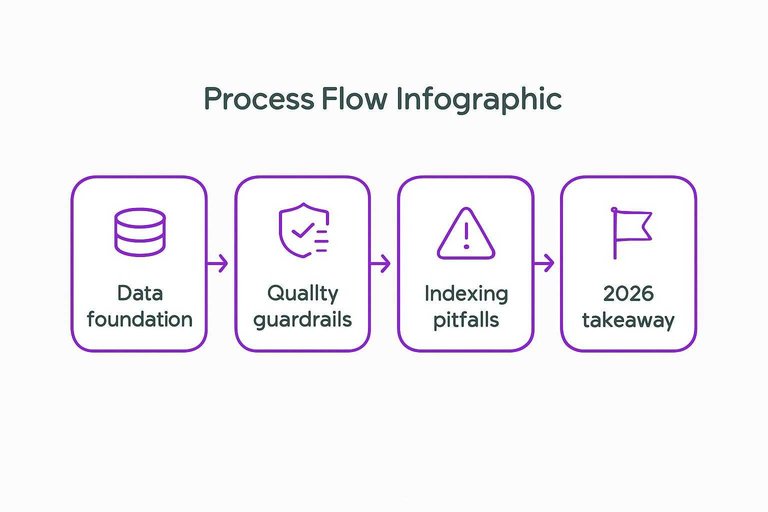
Data foundation
Your directory is only as strong as the data layer behind it. In 2026, search rewards pages that resolve real user uncertainty fast.
Source data that stays stable under scrutiny: specs, feature flags, pricing ranges, availability, and location constraints. Validate it with checks like normalization, freshness rules, and conflict resolution across sources, especially when feeds disagree.
Once the data is sound, systems like Skribra can help you keep category-level content and on-page SEO elements (like keyword targeting and meta descriptions) consistent across thousands of URLs—but only if you’re feeding it verified inputs.
If you can’t verify it, don’t publish it at scale.
Quality guardrails
Guardrails keep your templates from becoming a near-duplicate factory.
- Write a unique intro per category, not per item.
- Add editorial overrides for edge cases and top pages.
- Dedupe entities with stable IDs and merge rules.
- Set canonicals for variants, and noindex low-signal pages.
- Block internal search and parameterized URLs from indexing.
If you’re using AI to assist production, treat it like a drafting layer, not an autopilot: require structured fields, enforce formatting rules, and review the pages that matter most. Platforms that generate SEO-structured articles at a steady cadence can be useful here—see real-world automated SEO content examples—but the guardrails are what prevent “automation” from turning into uniformity.
Without guardrails, your “scale” turns into self-inflicted spam.
Indexing pitfalls
Programmatic directories fail when crawl and indexing get messy. Most of the damage is quiet, then sudden.
- Infinite filters create crawl traps.
- Parameters multiply into duplicate URLs.
- Internal search pages leak into the index.
- Orphan pages never earn internal links.
- Faceted navigation dilutes authority across variants.
Fix crawl pathways first, or you’ll optimize pages Google never prioritizes. And if you’re publishing via WordPress, make sure your publishing workflow doesn’t accidentally expose thin tag archives, search pages, or parameterized duplicates—automation and integrations are great, but they need to respect your indexing rules.
2026 takeaway
In 2026, a programmatic directory is viable when you have defensible data and real editorial decisions layered on top. Without both, it becomes an indexation and quality-control liability you’ll keep paying for.
The winners will pair strong data governance with systems that can reliably produce well-formatted, keyword-aware supporting content and keep publishing consistent without sacrificing editorial control. If your best feature is “we can generate thousands of pages,” you’re already behind.
Example 3: Single-Niche Authority
A single-niche authority site wins by knowing one topic better than anyone else. Depth beats volume when your pages connect, answer, and earn trust.
Topical moat
You build a moat by covering the unglamorous edges of a topic. Definitions, edge cases, and troubleshooting pages make your affiliate reviews feel inevitable.
Imagine a site about espresso grinders. It publishes burr geometry explainers, dial-in guides, cleaning routines, and taste-fault diagnostics, then links those pages into every buyer guide.
When your education pages rank, your money pages stop needing hero SEO.
Community signals
Community signals show Google and readers that real people use your advice. Keep it lightweight so it stays maintainable.
- Enable comments on evergreen how-tos
- Add a simple Q&A box
- Curate a tiny forum hub
- Ship a niche newsletter
- Collect expert quotes sparingly
If your pages capture lived experience, competitors can’t copy-paste their way past you.
Monetization mix
A monetization mix keeps one algorithm change from dictating your rent. The goal is stable income from multiple intent types.
- Sell small info products
- Offer sponsorship placements carefully
- Capture leads with freebies
- Add a services waitlist
- Use affiliates selectively
When revenue comes from three directions, you can write for users again.
2026 takeaway
This model fits small teams because it trades page count for credibility. You publish fewer pieces, but each one has a job in the ecosystem.
Anchor the engine in real user problems, then let affiliate pages be the natural “what to buy” endpoint.
In 2026, the niche you understand becomes your distribution channel.
Example 4: Deal Tracker
A deal-tracker affiliate site wins by spotting price drops early and earning clicks fast. It also breaks fast when pricing accuracy slips or the SERP shifts under you.
Ops requirements
You need a pipeline that treats prices like production data, not blog content. One wrong “was/now” can burn trust and trigger merchant complaints.
Start with merchant feeds or APIs, then normalize SKUs, currencies, and variant rules. Add expiry logic, dedupe rules, and a manual QA layer for high-traffic pages.
Run an on-call workflow for broken links, out-of-stock spikes, and sudden price reversals. If you can’t wake it up at 2 a.m., don’t build it.

Trust risks
Deal sites borrow trust from accuracy, so small mistakes look like scams. You’re managing perception as much as SEO.
- Publishing stale prices and expired coupons
- Creating bait-and-switch impressions with variants
- Missing or burying affiliate disclosures
- Violating merchant wording or logo rules
- Ignoring prohibited keywords in ads
If a user thinks you’re “doing a trick,” you’ve already lost the click.
Evergreen support
Deals churn, so you need pages that don’t. Evergreen pages give Google something stable to rank when yesterday’s discounts vanish.
- Build buying guides around use-cases, not discounts.
- Publish brand pages with model lineups and update notes.
- Link every deal page into a relevant guide section.
- Add “price history” context without promising future drops.
- Retire expired deals into an archive with replacements.
When deal pages disappear, your internal links shouldn’t.
2026 takeaway
This model works when you operate like a newsroom with production discipline. It fails when you treat it like a set-and-forget SEO play.
SERP volatility is the tax you pay for chasing freshness. Pay it with ops, or don’t enter the category.
Example 5: Editorial Lab
Editorial Lab is the affiliate site that behaves like a small product-testing newsroom. It earns trust by showing work, not just opinions.
It’s resilient because your proof is hard to copy at scale. It’s expensive because proof takes people, gear, and inventory.
Testing proof
Testing proof is your moat because it turns a review into a verifiable record. Readers, brands, and algorithms can all audit it.
Look for these proof patterns:
- A public methodology page with repeatable protocols
- Raw photos and uncut clips, not just product renders
- Measurement notes: conditions, units, and tool used
- A clear selection rubric: why these products made the cut
If your page can’t show receipts, it’s just another opinion post.
Production workflow
A testing site only scales with a boring, repeatable workflow. Otherwise, quality collapses and updates never ship.
- Intake products, log SKUs, and assign an owner.
- Write test scripts before testing, then lock the protocol.
- Capture raw media during runs, then store it with notes.
- Publish with the rubric, results, and limitations stated.
- Update on a trigger, then dispose, return, or archive items.
Your process is the product, and the content is the exhaust.
Cost constraints
Editorial Lab works until costs stack up faster than pages ship. You need constraints you can live with.
Common pressure points:
- Inventory spend tied up in test units
- Slow time-to-publish from hands-on cycles
- Review backlog that blocks seasonal updates
- Affiliate pressure that threatens editorial independence
If the economics force you to rush, you’ll start faking certainty.
2026 takeaway
In 2026, unique evidence is a defensible asset because it resists rewrite farms and AI clones. Without that evidence, the model becomes a slow content factory.
Build a lab only if you can keep shipping proof on a schedule.
Steal the Pattern, Not the Template
- Pick the closest archetype to your site (review hub, directory, niche authority, deal tracker, or editorial lab) and write down the one outcome you need most: rankings, trust, conversions, or scale.
- Compare your site to the example’s “what worked/what failed” points and circle any gaps in proof (testing, first-hand usage, policies, data freshness, or community signals).
- Choose one 2026 takeaway to implement in the next 30 days—tighten quality guardrails, fix indexing risks, add credible experience signals, or build an evergreen support layer.
- Re-check performance at the page level (not just keywords): which URLs gained, which swapped rankings, and which need consolidation or a stronger value hook.
Build an Affiliate SEO Engine
These affiliate SEO site models work—but only if you can publish consistently, optimize every page, and keep authority growing over time.
Skribra generates daily, SEO-optimized affiliate content and publishes to WordPress automatically, with meta formatting, images, and a backlink exchange network—start with a 3-Day Free Trial.
Written by
Skribra
This article was crafted with AI-powered content generation. Skribra creates SEO-optimized articles that rank.
Share: