August 28, 2026
·
10 min read
7 Autoblogging Limitations Worth Knowing in 2026
A candid collection of autoblogging limitations to factor into your 2026 content plan — originality ceilings, brittle sources, QA blind spots, SEO volatility, trust impacts, legal/policy exposure, and the ongoing ops work most teams underestimate.


Autoblogging sounds like the perfect shortcut: publish more, faster, with fewer hands on the keyboard. Then a feed breaks, a template misfires, or a “good enough” post quietly chips away at rankings and credibility.
This collection walks you through the seven constraints that matter most in 2026, from sameness and source fragility to compliance, QA, and brand trust. You’ll know where autoblogging fits, where it doesn’t, and what guardrails reduce risk before you scale output.
Autoblogging in 2026
Autoblogging in 2026 is a pipeline that collects inputs, generates or formats posts, then publishes on a schedule. You use it to scale coverage, not to build judgment. The real evaluation is viability under platform rules, risk to your brand, and the maintenance you can actually sustain.
Common use cases
Autoblogging usually shows up where volume matters more than voice.
- News aggregation: consolidate sources into one feed
- Product/affiliate updates: refresh listings, prices, and availability
- AI-assisted topic hubs: cover many subtopics fast
If you can’t state the goal in one line, automation will amplify confusion.
What it replaces
Automation can replace repetitive production steps, not responsibility. Imagine a site that pulls new product specs daily and drafts short blurbs, but still needs a human to decide what deserves attention.
Autoblogging can cover collection, templating, formatting, scheduling, and basic internal linking. Humans still need sourcing standards, editing for accuracy, positioning for the audience, and distribution choices.
The handoff point is your risk boundary, not your convenience.
Decision checkpoints
Before you autoblog, pressure-test fit with a few hard questions.
- Content uniqueness: do you add anything non-derivative?
- Audience trust: will readers feel misled or spammed?
- Operating costs: can you maintain fixes and QA?
- Platform dependency: can you survive a rules change?
If any checkpoint is a “maybe,” start with a small sandbox, not your main domain.
Core tradeoffs
Autoblogging buys speed and coverage, but it sells off differentiation and control. More pages means more surface area for errors, thin content signals, and brand damage when something slips.
The win is operational, not editorial, so treat it like infrastructure with ongoing oversight.
1) Originality ceiling
Autoblogging can produce text that passes basic uniqueness checks. It still struggles to produce distinct value because the thinking stays templated.
Imagine ten posts about the same product update. The wording differs, but the angle, examples, and takeaways feel interchangeable.
That’s the ceiling: new sentences, same contribution.
Sameness signals
Auto-generated posts can look different while feeling identical. Watch for these signals before you publish at scale.
- Lead with the same “what happened” angle
- Reuse the same transition phrases
- Open with generic, shallow intros
- Follow identical section ordering
- End with the same safe takeaway
If you can swap headlines and nothing breaks, you’ve got sameness.
When it hurts least
Originality matters less when users want coverage, not perspective. The goal is completeness and clarity, not a fresh thesis.
Commodity updates, catalog-like posts, and narrowly scoped changelogs usually fit. You’re matching intent, not trying to outthink competitors.
Treat these like reference docs, and you’ll stop overinvesting in “unique.”
Mitigation options
You can raise distinctness without abandoning automation. Add human inputs where they change decisions.
- Add an editorial overlay with a clear point of view.
- Insert unique data, examples, or firsthand experience.
- Prune weak pages that can’t defend a unique purpose.
- Merge overlapping posts into one stronger hub.
- Add “why it matters” sections tied to your audience.
Fix the contribution first; the words will follow—and if you need a clearer frame for what humans add beyond passable prose, see AI content vs human writers.
2) Source fragility
Autoblogs run on other people’s pipes. When a feed, API, or access rule changes, your publishing pipeline can fail instantly.
A single paywall flip, token expiration, or throttle can create empty categories and stale homepages. The gap looks like neglect, not “technical debt.” One way teams reduce that blast radius is by not tying their cadence entirely to third-party feeds—e.g., pairing curated sources with a first-party content stream (tools like Skribra are built for this) so core pages don’t go dark when upstream inputs wobble.
Failure modes
Most autoblog breakages are boring, repeatable, and easy to miss until posts stop shipping.
- Feed schema changes
- API rate limits
- Expired access tokens
- Source removal or takedown
- Duplicate feed entries
If two or more hit at once, your editorial calendar becomes a slot machine. The practical mitigation is to make “publishing” less dependent on a single retrieval pipeline—keeping an internal queue of ready-to-publish drafts (or generating net-new posts on a schedule) so the site stays updated even while you fix ingestion.
Compliance exposure
Scaling republication turns small legal gray areas into operational risk. One misread license, missing attribution, or “summary” that’s too close can trigger takedown demands fast.
Fair use is contextual, not a checkbox. Your safest default is permission, clear credits, and defensible transformation. In practice, that often means shifting from republication-heavy workflows toward original, SEO-focused content where you control inputs, claims, and formatting—reducing the number of third-party permissions and attribution edge cases you have to manage.
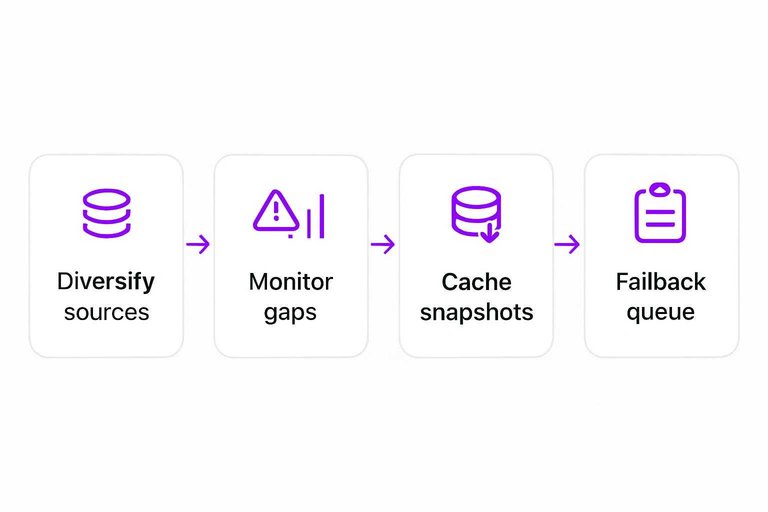
Resilience playbook
You reduce fragility by assuming every upstream source will fail, then designing for recovery.
- Diversify sources per topic, not per site.
- Monitor fetch success, parse errors, and publish gaps.
- Cache raw snapshots for replay and audit.
- Maintain a manual fallback queue for priority pages.
Build for substitution, not perfection, and outages stop being existential. For many teams, that “fallback queue” is easiest when it’s automated—e.g., having scheduled, SEO-structured articles ready to publish via WordPress integration (as with Skribra) while you swap sources and replay caches.
3) Quality control gaps
Automated pipelines miss nuance because they optimize for speed, not scrutiny. That’s how you get factual drift, context loss, and clean-sounding mistakes.
Imagine a post that summarizes an update, then quietly swaps the cause and the effect. It still reads “right.” It’s just wrong.
High-risk topics
Some topics carry real-world consequences, so your review bar must be higher. If you publish fast here, you also need to verify fast.
- Health and medical guidance
- Personal finance and investing
- Legal interpretation and compliance
- Safety and emergency procedures
- Breaking news and live events
Treat these as “human-first” categories, not “automation-first” categories.
Human review scope
Humans should verify the parts readers will repeat, rely on, or act on. You’re checking not just accuracy, but the article’s implied advice.
Verify:
- Key claims and what they depend on
- Dates, timelines, and “as of” language
- Names, titles, and organizations
- Quotes, paraphrases, and source intent
- The implied recommendation and who it fits
You’re not editing for perfection. You’re blocking confident nonsense from shipping.
Minimum QA checklist
Use a lightweight pass that catches the common failure modes fast.
- Claim-check the main assertions against primary sources.
- Validate every link loads, matches the anchor, and supports the claim.
- Confirm attribution for quotes, data, and non-obvious ideas.
- Scan tone for certainty, overpromises, and missing caveats.
- Do a final clarity edit for structure, labels, and reader actions.
If step one fails, stop. Fix the source, not the wording.
4) SEO volatility
Autoblogs amplify patterns. Algorithms notice patterns faster than humans do.
When your content is generated at scale, quality signals become site-wide. One weak template can drag hundreds of pages with it.
Thin content triggers
Thin pages rarely fail alone. They fail in clusters, and classifiers love clusters.
- Reuse the same angle across many pages
- Publish low-engagement pages with no return visits
- Build doorway clusters targeting tiny keyword variants
- Leave weak internal linking and orphan pages
If you can describe the pattern, an algorithm can learn it.
Indexing reality
Publishing more pages doesn’t guarantee more indexed pages. Search engines ration attention, and your site competes with itself.
Crawl budget is finite, canonicals consolidate signals, and quality thresholds block low-value URLs. If enough pages look similar, discovery slows and indexing stalls.
Your real bottleneck is trust, not throughput.
Stabilization tactics
Volatility drops when your site becomes less repetitive. You’re aiming for fewer, stronger, more distinct URLs.
- Consolidate overlapping topics into one definitive page.
- Add unique sections that require real judgment or experience.
- Prune low-value pages that add no new intent.
- Strengthen topical architecture with hubs and intentional internal links—see this SEO guide for site stability for a broader framework.
Treat every new page like it must justify its existence to the whole domain.
5) Trust and brand
Autoblogging can publish at scale, but readers judge it at a glance. When it feels automated, you lose the easy wins: credibility, conversions, links, and repeat visits.
Trust breakers
Readers don’t bounce because you used automation. They bounce because the page feels like it wasn’t made for them.
- Give generic advice with no specific constraints
- Hide authorship or use a faceless byline
- Cite vague sources or skip citations entirely
- Leave outdated details and broken references
- Miss intent: answer adjacent questions
Once trust drops, every CTA looks riskier and every share feels embarrassing.
Transparency choices
Disclosure is a positioning decision, not just a legal one. You’re trading short-term clicks against long-term trust.
Clear labeling sets expectations and reduces “I’ve been tricked” reactions. Hybrid bylines can work, but only if human responsibility is obvious.
Sourcing notes signal rigor, yet they expose thin research fast. Choose the approach you can defend when a reader challenges it. For a benchmark, Google’s guidance on helpful, reliable, people-first content outlines the kinds of trust signals evaluators look for.
Brand-safe guardrails
You can automate without gambling your reputation. Put hard edges around what the system can publish.
- Define topic boundaries and exclude high-risk categories.
- Add escalation rules for claims, advice, and sensitive subjects.
- Publish a corrections policy and actually use it.
- Limit automation to safe formats like roundups and definitions.
Guardrails turn autoblogging from a content faucet into a controlled product.

6) Legal and policy
Autoblogging fails fastest when it crosses rights or platform lines. You can publish “clean” content and still break rules through how you collected it.
Common violations
Most autoblogging trouble comes from inputs, not writing quality. A few repeat offenders show up across copyright, scraping, and monetization.
- Republishing substantial chunks of source text
- Using images without a clear license
- Scraping pages that forbid automation
- Copying databases with protected structure
- Adding affiliate links without disclosure
If you can’t explain your rights in one sentence, you don’t have them.
Risk-reduction setup
Treat this like an ops checklist, not a one-time promise. You want artifacts you can show during a complaint.
- Document permissions for each source and feed.
- Use attribution templates for quotes, images, and snippets.
- Define a DMCA and takedown workflow with owners.
- Keep content logs of inputs, dates, and transformations.
- Review every partner program’s disclosure and placement rules.
Your goal is defensibility, not perfection.
When to get counsel
Get a professional review when the cost of being wrong is high. That usually happens when you publish at scale, rely on the site commercially, operate in regulated niches, or distribute across borders.
A short consult before launch is cheaper than redesigning your whole pipeline after a takedown.
7) Ops and upkeep
Autoblogging only looks “set-and-forget” from the outside. In production, entropy wins: plugins age, models drift, prompts rot, and links break.
Imagine a site that runs fine for months, then a feed format changes overnight. Your pipeline keeps publishing anyway. Quietly wrong content is still content.
Hidden work
Autoblogging creates a stream. Streams need supervision.
- Monitor feeds and fetch failures
- Fix parsers when formats change
- Update prompts as intent shifts
- Refresh pages when links die
- Moderate comments, spam, abuse
If nobody owns this checklist, your “automation” becomes a liability.
Cost creep drivers
Costs rise when volume grows and edge cases multiply. The expensive part is rarely generation. It’s everything around it.
API usage climbs with retries, re-runs, and longer contexts. Storage, caching, and logging expand as you keep more artifacts. Human QA and incident response time appear the moment something public breaks.
Your unit cost stays low until one bad day makes it obvious what you forgot to budget.
Sustainable workflow
You need operations that assume failure, not perfection.
- Set schedules for checks, refreshes, and re-crawls.
- Add alerts for feed changes, error spikes, and publishing anomalies.
- Run staging tests before plugin, prompt, or model updates.
- Keep rollback plans for templates, prompts, and deployments.
- Audit content periodically for accuracy, links, and intent.
Boring is good. Boring ships. Boring ranks.
Decide Where Autoblogging Belongs—and Put Guardrails in Place
- Pick the right lanes: reserve autoblogging for low-stakes, repeatable formats (updates, catalogs, summaries), not high-trust or high-risk topics.
- Build resilience: diversify sources, log failures, and add fallback content rules so one broken feed doesn’t break your site.
- Enforce minimum quality: require citations, factual checks, internal links, and a human review threshold before anything ships.
- Protect search and brand: watch indexing and thin-content patterns, be transparent where appropriate, and set clear legal/policy checks as part of ongoing ops.
Upgrade Beyond Basic Autoblogging
These 2026 autoblogging limitations add up fast—originality, quality checks, SEO swings, and ongoing upkeep all take more effort than most teams expect.
Skribra helps you publish daily, SEO-optimized articles with stronger controls, WordPress automation, and built-in backlink opportunities—start with the 3-Day Free Trial.
Written by
Skribra
This article was crafted with AI-powered content generation. Skribra creates SEO-optimized articles that rank.
Share: